Twilight Dance: Venus, Mars, the Snow Moon, and Winter's Guardians – Star Trails: A Weekly Astronomy Podcast
EP3
This episode of “Star Trails” takes listeners on an astronomical tour of the night sky for the week starting February 18, 2024.
Host Drew guides you through a celestial showcase beginning with Venus and Mars in the pre-dawn sky. As the night unfolds, the rising of Leo, heralds the approach of spring. The Snow Moon arrives at week’s end.
Transcript
Welcome back to Star Trails, your celestial compass guiding you through the universe’s wonders. My name is Drew, and as we gather under the expansive night sky this week, we’re poised to unveil the marvels that await us in the winter skies above North America. So, let us begin our nightly voyage to discover the stories and spectacles embroidered in the cosmic tapestry overhead.
The stage of the late winter sky is rich with astronomical treasures, each narrating its own cosmic saga. As the twilight recedes, surrendering to the enveloping darkness, the heavens above us light up, revealing a grand arena for our imaginations to roam freely.
One of the week’s most anticipated events is the close approach of Venus and Mars in the pre-dawn sky on February 22. This celestial pair will be visible low on the southeastern horizon, offering a breathtaking view less than an hour before sunrise. With Venus shining brightly at a magnitude of -3.9 and Mars at a more subdued 1.3, this conjunction is a perfect opportunity for photography and naked-eye viewing.
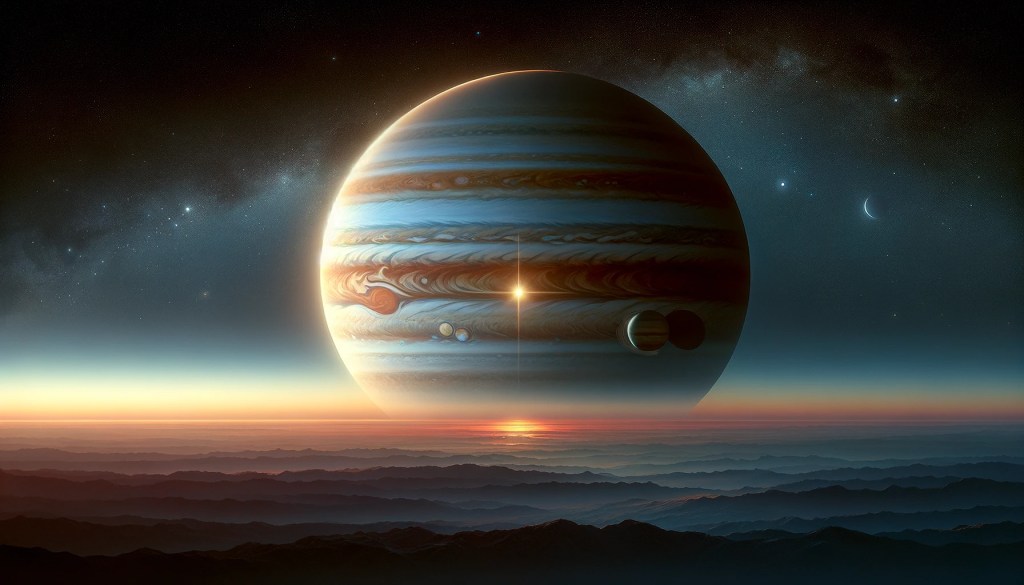
Jupiter continues to command attention in the evening sky, with its moons performing their captivating dance. Galilean moons — Io, Europa, Ganymede, and Callisto — will be visible through small telescopes, engaging in transits and occultations that are a delight to observe.
Our week begins under the watchful gaze of a waxing gibbous Moon, building up to the mesmerizing Full Moon on February 24.
The constellations of Auriga, the Charioteer, and Gemini, the Twins, are prominently displayed in the February sky. Auriga, with its bright star Capella, and Gemini, home to the twin stars Castor and Pollux, offer a wealth of stars and clusters to explore. Canis Major, with the brilliant Sirius, the brightest star in our night sky, also makes a grand appearance, adding to the spectacle.
Among these winter constellations, Orion, the Hunter, still stands out in the southern sky. Known for its distinctive belt, Orion is a gateway to exploring deeper celestial wonders, such as the Orion Nebula. Below Orion’s Belt, this nebula is a cloud where new stars are taking shape, visible to the naked eye and a breathtaking view through binoculars or a telescope.
As the night progresses and transitions into the late hours, the constellation Leo, the Lion, begins to make its ascent in the eastern sky. Recognizable by the bright star Regulus, Leo signifies the impending arrival of spring. Its distinctive sickle shape makes it a landmark for those gazing into the springtime sky.
Now, let’s discover some of the deep sky objects that are visible this week.
The Pleiades – Known as the Seven Sisters, is an open cluster in Taurus. To the naked eye, it appears as a tiny dipper of bright stars, but through binoculars or a telescope, it’s a stunning sight, with dozens of stars cradled in a blue mist. It’s a snapshot of stellar siblings that have recently formed from the same cosmic cloud.
Further out, M31, the Andromeda Galaxy, offers a glimpse into another world. On dark, moonless nights, it’s visible as a faint smudge of light to the naked eye, but telescopes reveal its true glory: a vast spiral galaxy much like our Milky Way, complete with a bright nucleus and spiral arms. It’s a mesmerizing sight that puts our place in the cosmos into perspective.
In the heart of Cancer lies the Beehive Cluster, M44. It’s a smattering of stars that, through binoculars or a telescope, come alive like a swarm of bees. This cluster is a fantastic example of stars living in a loose community, bound together by gravity.
The constellation of Taurus offers up the Crab Nebula, M1. The remnants of a supernova witnessed by Earth’s astronomers in 1054, this nebula is a testament to the violent end of a star’s life. Through a telescope, its intricate filaments and glowing gas offer a glimpse into the forces at play in the aftermath of a stellar explosion.
As our exploration this week comes to a close, we hope the wonders above inspire you to look up and dream. The night sky, with its endless mysteries, invites us all to ponder our place within this vast universe. Until we meet again, remember to keep your gaze upward, for the stars beckon with stories untold. Clear skies!
Before you go, if you find this podcast useful, please re-share it or tell a friend. You can find all our episodes, check out night sky maps and resources, and learn more about the podcast at our website, startrails.show. Thanks for listening!
 Star Trails: A Weekly Astronomy Podcast
Leave a comment