

A Pink Moon Rises; Plus, Making Sense of RA and Declination – Star Trails: A Weekly Astronomy Podcast
EP12
Join us as we delve into the celestial events for the week of April 21th. With the full Moon drowning out dimmer objects and the planets low on the horizon this week, we turn our attention to the Lyrid Meteor Shower.
Also, we demystify the system of Right Ascension and Declination — the cosmic coordinate system used to find any object in the night sky.
Transcript
Hello, everyone! Welcome back to another episode of Star Trails, your nightly companion in unraveling the mysteries of the cosmos. I’m Drew, ready to guide you through the celestial events from April 21st to the 27th, and later in the episode, we’ll delve into the astronomical coordinate system that enables us to easily locate objects in the sky. So let’s dive in and see what the universe has lined up for us this week.
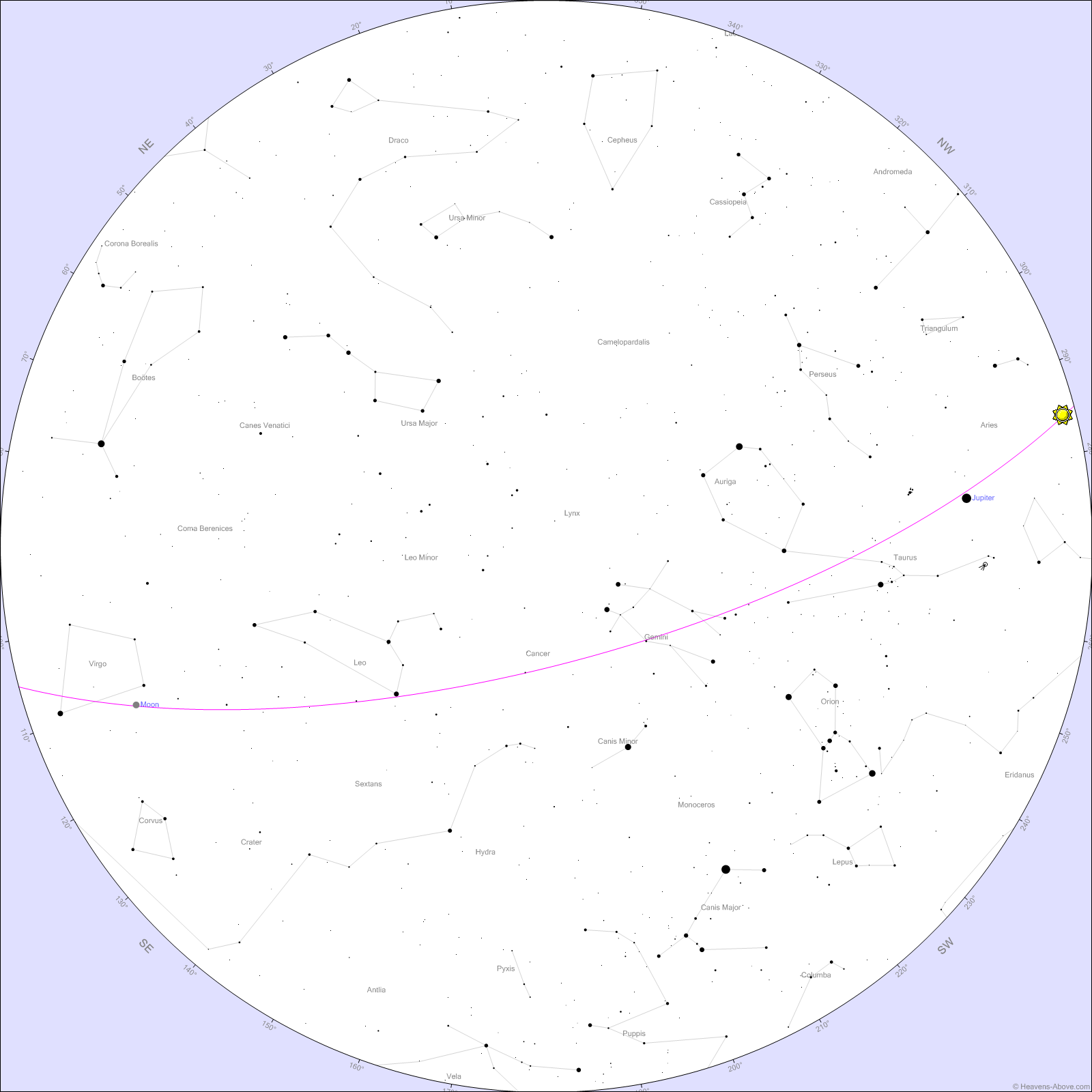
The week begins with the Moon in a Waxing Gibbous phase, with 95% of its disk illuminated on April 21st. As the week progresses, the Moon reaches full illumination on April 23rd. This Full Moon, known as the Pink Moon, doesn’t actually appear pink but is named after the pink flowers that bloom in spring. By the end of the week, on April 27th, the Moon will start to wane but still be a bright Waning Gibbous with 88% visibility.
Planetary observation is challenging this week owing to the full moon and the locations of the planets. Venus is too near the sun for easy observation. Mars and Saturn are both morning planets, visible in the east just before dawn. Jupiter sets in the west just after sunset, so you may get an hour or two of observation time if you have a clear view of the western sky.
You can still catch some spring constellations. Look for Leo, the lion, high in the southwestern sky after sunset, easily identifiable by its distinctive hook shape resembling a backwards question mark. Virgo is also visible, with its bright star Spica.
With a nearly full to waning moon this week, the brightness might make it a bit challenging to see the fainter stars and objects, so try to make your observations before the moon rises in the early evening if possible.
For those of you with telescopes, this week offers some classic deep sky targets. The Whirlpool Galaxy, M51, in Canes Venatici, and the Pinwheel Galaxy, M101, in Ursa Major, are both well placed for observation. These galaxies show stunning spiral structures and can be a treat to observe under clear skies. Another notable object is the Hercules Cluster, M13, a globular cluster of stars in Hercules, which is one of the brightest and best known in the northern hemisphere.
The highlight of this week is the peak of the Lyrid meteor shower on the night of April 22nd into the morning of April 23rd. Although the full moon will brighten the sky considerably, you might still catch a few of the brighter meteors streaking across the sky.
Since observation may be difficult this week, let’s take a moment to review an important concept related to navigating the night sky, particularly with a telescope. While computerized “go-to” mounts are increasingly popular among amateur astronomers, it’s still helpful to understand the concepts of Right Ascension and Declination — the celestial coordinates that allow us to pinpoint the exact location of stars, planets, and other celestial objects in the night sky.
Before computerized mounts were the norm, Right Ascension and Declination coordinates were the method used to orient telescopes at objects in the sky. In fact, if you’re participating in many of the Astronomical League’s observation programs, such as the Messier program, computerized object finding is discouraged. So learning to navigate the night sky with coordinates is still a useful skill. Here’s how it works:
Imagine for a moment that the Earth is enveloped in an invisible sphere, extending far into space. This sphere is what astronomers call the celestial sphere. To find our way among the stars, we’ve projected our geographical coordinate system onto this celestial sphere, giving us Right Ascension and Declination.
Let’s start with Declination. Similar to latitude on Earth, Declination measures the angular distance of an object north or south of the celestial equator. It’s expressed in degrees, with the celestial equator itself at 0 degrees, the North Celestial Pole at +90 degrees, and the South Celestial Pole at -90 degrees.
Now, onto Right Ascension, or RA for short. This one’s a bit trickier. It measures the object’s eastward distance along the celestial equator from the vernal equinox. Think of it as the celestial equivalent of longitude. Right Ascension is measured not in degrees, but in hours, minutes, and seconds, reflecting the Earth’s rotation rate. There are 24 hours in a full circle, mirroring the 24 hours in our day.
So, how do we use these coordinates to locate something in the night sky? Let’s say you want to find the Andromeda Galaxy. You’d start with its coordinates: a Right Ascension of about 1 hour and a Declination of about +40 degrees. Using a star chart or an app, you’d first find the celestial equator, then measure 40 degrees north for the Declination. From there, you’d move right along the celestial equator to the 1-hour mark in Right Ascension. And voilà, you should be in the neighborhood of the Andromeda Galaxy.
This system particularly becomes useful for polar-aligned telescopic mounts that feature setting circles. You’ll also need to know the Sidereal time at your location. More on that in a moment.
Setting circles are akin to the dials on a safe. On one axis, you have the Declination circle, allowing you to dial in the north-south position of your object, much like you would adjust the telescope’s angle to match the latitude of a location on Earth.
The other axis features the Right Ascension circle. This one requires a bit more preparation. Since the Earth is in constant rotation, you’ll need to align your telescope to celestial north and set the RA circle to match the current sidereal time — a timekeeping system that reflects the Earth’s rotation relative to the stars, not the sun. Once set, you can rotate your telescope to the RA of your cosmic point of interest.
Sidereal time is a timekeeping system used by astronomers to track the Earth’s rotation relative to the stars, rather than the Sun. It measures the Earth’s rotation through the apparent movement of the stars across the sky, providing a way to predict when specific stars and constellations will be visible at a given location. Essentially, it’s the time it takes for the Earth to rotate once relative to the vernal equinox point, which is slightly shorter than a solar day.
The best way to obtain the current sidereal time for your location is to use an online calculator or website that provides local sidereal time based on your longitude. One such resource is localsiderealtime.com, where you can input your location’s longitude to calculate the local sidereal time.
With both Declination and Right Ascension dialed in, your telescope is pointed precisely at the spot in the sky where your target resides. Whether it’s a distant galaxy, a nebulous star nursery, or a planet in our own solar system, setting circles and celestial coordinates bridge the gap between a point on a map and a point in the vast universe.
With Right Ascension and Declination in your astronomer’s toolkit, the sky is no longer a mystery but a map waiting to be explored. So grab your charts, and let’s set sail across the starlit sea. Until next time, keep your eyes on the skies and your heart in the stars. Clear skies, everyone!
 Star Trails: A Weekly Astronomy Podcast
Leave a comment