
Saturn’s Disappearing Rings, Night Sky Lore, Plus, Telescope Talk – Star Trails: A Weekly Astronomy Podcast
EP16
Step into the stars with Drew as we journey through the night skies from May 12-18, 2024. From dynamic lunar phases to the intriguing disappearance of Saturn’s rings, there’s no shortage of cosmic phenomena to behold in the spring skies over North America.
With last week’s geomagnetic storms, observers across the world are reporting seeing auroras much farther south than expected. Go out and see them if you can!
In addition to celestial sightings, Drew delves into the rich tapestry of celestial lore, connecting ancient myths to the constellations that grace our skies. Plus, in our Astronomy 101 segment, we shed light on the three main types of telescopes and their suitability for various celestial pursuits.
Transcript
Saturn’s Disappearing Rings, Night Sky Lore, Plus, Telescope Talk
Welcome to another episode of “Star Trails.” I’m Drew, and tonight we’re diving into the celestial sights visible from May 12th to May 18th, 2024. We’ll also explore Saturn’s disappearing rings, celestial lore, and zoom out for an overview of the primary tool of a stargazer — the telescope.
Whether you’re a seasoned astronomer or just starting out, there’s something for everyone in the night sky this week.
Our lunar companion offers a beautiful display of phases. Starting on May 12th, the Moon will be in its waxing crescent phase, with about 23% of its surface illuminated. As the week progresses, the Moon continues to wax, reaching the first quarter phase on May 15th, when it will be exactly 50% illuminated. By May 18th, the Moon will be in a waxing gibbous phase, showing around 78% illumination.
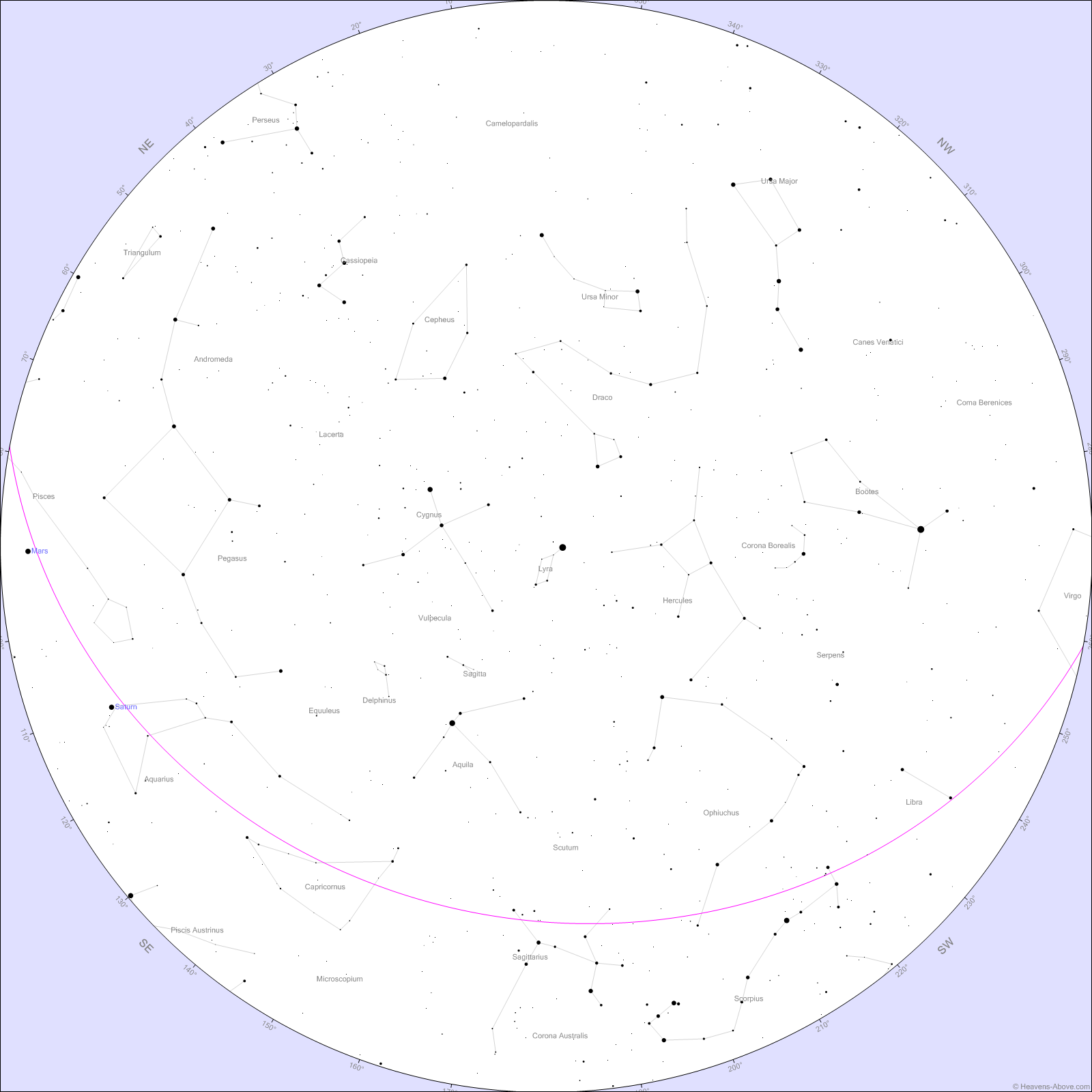
The Moon isn’t the only show in the sky, but you’ll need to be an early riser to catch the planets this week. Saturn rises from the eastern horizon in the pre-dawn hours, chased by Mars and Mercury just before sunrise. Golden and subtly bright, Saturn offers a striking contrast to Mars, its rusty hue unmistakable.
If you have a telescope, be sure to take a look at Saturn’s signature rings — although they may be challenging to see right now because they are approaching an edge-on orientation relative to Earth. This phenomenon occurs approximately every 14-15 years, making the rings appear thinner and, at times, nearly invisible.
During this period, known as a “ring plane crossing,” the rings’ tilt toward Earth decreases, leading to their diminished visibility through telescopes. This alignment also coincides with Saturn’s equinox, when the Sun shines directly over the planet’s equator and the rings. This alignment can provide a unique opportunity for astronomers to study the ring structure and look for smaller moons that might normally be obscured by the brightness of the fully exposed rings.
These early-morning planets will climb higher in the sky each morning, with Saturn making a close approach to the Moon towards the end of the month.
Our spring constellations are still keeping us company on dark nights. Boötes, the Herdsman, continues his watch over the Big and Little Bears — Ursa Major and Ursa Minor. As one of the larger constellations, Boötes is prominent in the evening sky. Look for its brightest star, Arcturus, a red giant that is among the brightest stars in the night sky.
Virgo is also visible, with its brightest star Spica. Virgo is linked to tales of fertility and agriculture, reflecting its prominence in the spring sky, but there’s also a connection to Astraea, the goddess of innocence and purity. According to legend, Astraea was the last of the celestial beings to leave Earth for the heavens, disgusted by the wickedness of humanity. She ascended to the sky to become the constellation Virgo, and the scales she carried became Libra.
Virgo is significant not only for its mythology but also for its numerous galaxies, as it contains the Virgo Cluster, the closest large galaxy cluster to the Milky Way. More than a thousand known galaxies are here, making it a focal point for studies on galaxy clusters and cosmology, and a hotspot for amateur and professional astronomers.
Speaking of galaxies and deep sky objects, this week offers some old favorites: The Whirlpool Galaxy (M51) in Canes Venatici is a stunning face-on spiral galaxy, perfect for astrophotography. The Hercules Globular Cluster (M13) is another gem, easily found in the constellation Hercules. This tight cluster of several hundred thousand stars is a breathtaking sight.
In today’s Astronomy 101 segment, we’re taking a very general look at telescopes, as there are many to choose from, each suited for different celestial appetites. So if you’re in the market for your first scope, let’s delve deeper into the three main types, and discover which might be the best for your stargazing adventures.
First up, refractor telescopes. These are the oldest types of optical telescopes. They use a glass lens at the front to collect and focus light. The design is simple and robust, making refractors an excellent choice for viewing the Moon and planets. The images provided are sharp and have good contrast. However, refractors tend to be more expensive per inch of aperture and can be quite heavy in larger sizes.
In the context of telescopes, “aperture” refers to the diameter of the primary lens or mirror that collects light. It’s essentially the opening through which light enters the telescope. The size of the aperture is critical because it determines the amount of light the telescope can gather. A larger aperture allows more light to enter, which enhances the telescope’s ability to see fainter objects and provides more detail in the images. Thus, the aperture is a key factor in determining a telescope’s light-gathering capability and resolution.
Many astronomers choose Reflector telescopes for this reason.
Reflectors, which include the famous Newtonian design, use a mirror to gather light. They are generally less expensive than refractors and offer larger apertures for the same price. This makes them ideal for viewing faint objects like distant galaxies and nebulae. However, their optical alignment — known as collimation — can be challenging for beginners and needs regular adjustment.
Catadioptric telescopes, or compound telescopes, combine lenses and mirrors to offer a versatile experience. They are compact and easy to transport. These telescopes are great for both planetary and deep-sky viewing. Models like the Schmidt-Cassegrain and Maksutov-Cassegrain are common, with the latter providing extremely high-contrast views due to its thick meniscus lens.
The final component in a telescope’s light path is the eyepiece, which magnifies the image formed by the telescope’s optics. The eyepiece is responsible for presenting the observer with a focused image, defining the field of view, and affecting how bright the final image appears.
The field of view, often described as wide or narrow, determines how much of the sky you can see at one time. A wider field of view is excellent for stargazing and getting a broader perspective of the sky. Shorter focal lengths provide higher magnification, bringing distant objects like planets into clearer view. However, higher magnification reduces the brightness and the field of view, making it challenging to observe dimmer or larger objects like nebulae or galaxies.
For those starting, it’s practical to have a range of eyepiece focal lengths to suit different observing conditions. A good setup might include a low-power eyepiece for large deep-sky objects and general scanning, a medium-power eyepiece for smaller galaxies and nebulae, and a high-power eyepiece for planetary details.
Telescopic Mounts are just as important as the telescope itself. Alt-azimuth mounts are straightforward—up, down, left, right. They’re great for beginners due to their simplicity. However, they don’t track the sky’s motion automatically, which can be limiting for long exposures in astrophotography.
Dobsonian telescopes deserve a special mention here. These are reflector telescopes known for their large apertures and a very simple alt-azimuth mounting system, which makes them both cost-effective and user-friendly. “Dobs,” as they are often referred to, are excellent for deep-sky observation, providing bright views of nebulae, galaxies, and star clusters. Their ease of use and affordability make them particularly popular among beginners.
Equatorial mounts are designed to follow the celestial sphere’s motion, making them ideal for astrophotography and serious star tracking. They require some setup to align with Polaris, the North Star, but once dialed in, are invaluable for their tracking capabilities.
And then, there are Go-To mounts. These are either alt-azimuth or equatorial mounts equipped with motors and computers to automatically point the telescope at celestial objects. They can be a fantastic aid for beginners, removing the steep learning curve of star navigation and allowing immediate enjoyment of major celestial sights.
Which type of telescope is best for you? Dobsonian reflectors are beginner-friendly and offer a lot of bang for your buck, though some may be frustrated by the mount and routine collimation. For those interested in both usability and growing into a more serious hobby, a catadioptric telescope on a go-to mount might be the ideal choice, offering both versatility and ease of use. Of course, we didn’t talk about scopes for astrophotography — that’s a discussion for another episode altogether.
In the end, the best telescope is one that you will use regularly and suits your viewing interests.
That’s it for this week’s episode of “Star Trails.” We hope you feel inspired to embark on your own astronomical journey. Join us next time as we continue to explore the wonders of the cosmos. Until then, keep your eyes on the stars and your mind open to the mysteries of the universe. Clear skies and happy stargazing!
 Star Trails: A Weekly Astronomy Podcast
Leave a comment