
Planets on Parade, a New Moon, and How to Read a Star Chart – Star Trails: A Weekly Astronomy Podcast
EPISODE 19
Join us as we journey through the cosmos and uncover the celestial highlights for the week of June 2, 2024. A spectacular six-planet parade visible on the morning of June 3rd is the highlight for this week. Learn the best times and locations for viewing this rare planetary spectacle, as well as tips for spotting deep-sky objects like the Dumbbell Nebula and the Butterfly Cluster.
In our Astronomy 101 segment, discover how to use a traditional star chart and save your night vision.
Transcript
Hello, stargazers! Welcome back to another episode of Star Trails, where we explore the night sky and all its wonders. I’m Drew, your guide through this week’s celestial events. There’s a lot happening in the sky this week, and in our Astronomy 101 segment we’ll discuss how to use a classic star chart, so let’s get started!
This week, we’re transitioning from a waning crescent to a new moon. And that means darker skies for astronomy. Before we discuss deep sky objects, I want to tell you about the upcoming planetary spectacle I teased in the previous episode.
Be sure to mark your calendars for the early morning of June 3rd because we’re in for a celestial treat, particularly for those in the northeast portion of the United States. On that date, six planets will line up in the sky for a planetary parade. The best viewing window will be about a half hour before sunrise.
If conditions are good, you’ll be able to spot Jupiter, Mercury, Mars, and Saturn with the naked eye. With high-powered binoculars or a telescope, you might also catch a glimpse of Uranus near Mercury and Neptune near Saturn. Venus will be present, but impossible to see as it’s right next to the sun.
It’s a short observation window, so if you’re planning to set up a telescope, be quick!
Across the eastern seaboard, different regions will have varying views. In Florida, you can see Saturn, Mars, Mercury, and Jupiter just before sunrise at around 6 a.m. In Ohio, look for the same quartet at around 5:40 a.m. If you’re elsewhere, you may still see a couple of planets. Your best bet will be to use a night sky app, such as Stallarium, to learn how to view these planets in your time zone and location.
The six-planet parade will be visible every morning for about a week. After that, Mercury will be too close to the sun, and the faint planets will move out of view. Jupiter, Mars, and Saturn will remain visible in the early morning sky for several weeks.
A planetary parade, while not an official astronomy term, perfectly describes this visual phenomenon. Unlike the rare orbital alignment, this type of alignment simply means the planets appear lined up in the sky along the ecliptic plane from our viewpoint on Earth.
Looking ahead, smaller planetary parades occur frequently, but the rare ones with five or more planets are special. Mark your calendars for upcoming events in August 2024, and January, February and August of 2025. On February 28, next year, the parade will feature all seven planets, though some will require a telescope.
As we move into June, let’s explore three fascinating constellations visible as we make our way towards the summer: Cygnus, Aquarius, and Draco.
Cygnus, also known as the Northern Cross, is a prominent constellation in the summer sky. Its brightest star, Deneb, forms part of the Summer Triangle along with Vega and Altair. Deneb is one of the most distant stars you can see with the naked eye, located around 2,600 light-years away.
In mythology, Cygnus represents a swan and is associated with several stories. One popular tale involves Orpheus, the legendary musician. After his tragic death, Zeus transformed his lyre into the constellation Lyra and Orpheus into the swan constellation, Cygnus, placing them together in the sky. Cygnus is rich in deep-sky objects, including the North America Nebula (NGC 7000) and the Veil Nebula, a supernova remnant.
Moving on to Aquarius, this constellation is often depicted as a water-bearer pouring water into the sky. Its brightest star, Sadalsuud, is a yellow supergiant located approximately 540 light-years from Earth. Another notable star in Aquarius is Sadalmelik, a supergiant situated about 800 light-years away. Aquarius is home to several interesting deep-sky objects, such as the Saturn Nebula (NGC 7009), which resembles the planet Saturn, and the Helix Nebula (NGC 7293), one of the closest planetary nebulae to Earth. In Greek mythology, Aquarius is associated with Ganymede, a beautiful youth whom Zeus brought to Olympus to serve as the cupbearer to the gods.
Finally, Draco the Dragon winds its way between the Big and Little Dippers. Its most famous star is Thuban, which served as the North Star around 4,000 years ago. Draco’s brightest star, Eltanin, is a giant star located approximately 148 light-years from Earth. The constellation is steeped in mythology, representing Ladon, the dragon that guarded the golden apples in the Garden of the Hesperides. According to the myth, Hercules was tasked with retrieving these apples as one of his twelve labors, and he slew Ladon to accomplish this. Draco is also home to several intriguing deep-sky objects, including the Cat’s Eye Nebula (NGC 6543) and the Spindle Galaxy (NGC 5866).
The usual spring constellations still invite a look. These include Ursa Major, Leo, Virgo, and Bootes and Hercules. We’ve mentioned them all in recent episodes. Remember, you can always find transcripts of previous episodes at our website, startrails.show.
As the moon wanes away, we’re able to see fainter deep sky objects with more clarity, and June offers some spectacular targets. In addition to the ones we mentioned earlier, check out the Dumbbell Nebula (M27), found in the constellation Vulpecula. It’s one of the brightest planetary nebulae in the sky, appearing like a small, glowing dumbbell.
Another highlight is the Butterfly Cluster (M6) in Scorpius, which looks like a butterfly’s wings spread out in the night sky. It’s composed of young, hot stars.
The Lagoon Nebula (M8) rises in Sagittarius late at night. This nebula is visible to the naked eye under dark skies and offers stunning views through binoculars or a small telescope.
There’s a lot to see this week, and with the new Moon, now is a perfect time to get out and explore the stars. After the break, we’ll talk about how to use a star chart to do just that. Stay with us!
Welcome back! In our Astronomy 101 segment, we’re going to dive into a fundamental tool for any night sky enthusiast: the star chart. Even though many of us rely on phone or tablet apps for stargazing these days, there’s still something uniquely satisfying and educational about using an old-fashioned star chart. Let’s explore why you might want to use one, what are the best charts available, and how to make the most of them.
So why bother with a traditional star chart? Here are a few compelling reasons:
- Educational Value: Using a star chart helps you learn the sky more intimately. It encourages you to understand the relationships between different stars and constellations, rather than relying on an app to guide you.
- No Batteries are Required: Unlike your smartphone or tablet, a star chart never runs out of battery. It’s always ready to use, making it a reliable tool during long stargazing sessions or camping trips where charging options are limited.
- Enhanced Night Vision: Staring at a screen can wreck your night vision, and some estimate that it takes up to half an hour to recover from light exposure. Star charts, especially when used with a red flashlight, are much gentler on your eyes, allowing you to keep your night vision intact and enjoy the stars more clearly.
- Connection to Tradition: There’s a timeless joy in using the same tool astronomers have used for centuries. It’s a way to connect with the history of stargazing and appreciate the art of navigation by the stars.
There are many excellent star charts out there, but here are a few that stand out:
- The Sky & Telescope Pocket Sky Atlas: This compact and comprehensive atlas is perfect for both beginners and seasoned stargazers. It includes detailed charts and is very portable.
- The Cambridge Star Atlas: Known for its clear and detailed maps, this atlas is great for those who want a more in-depth guide to the night sky.
- Philip’s Planisphere: This rotating star chart is adjustable for any date and time, making it a versatile tool for stargazing throughout the year.
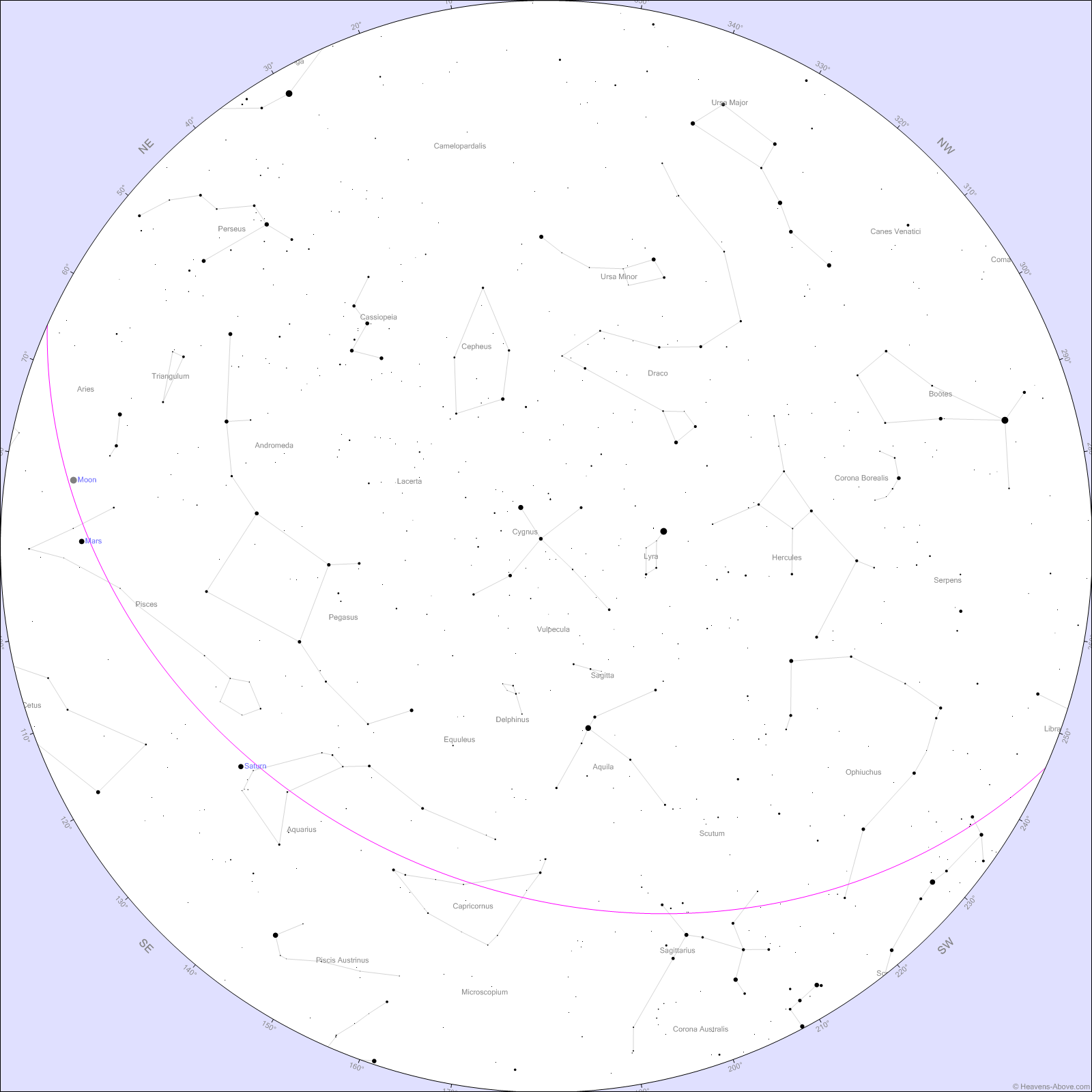
If you need a chart, keep in mind we publish a weekly chart specifically for North America each week on our podcast website, startrails.show. Print it out and you’re ready to start learning how it works.
Using a star chart effectively involves a few key steps:
When you look at a star chart, you’ll notice it’s typically circular, representing the dome of the sky above you. The center of the chart corresponds to the zenith, the point directly above your head, while the edges correspond to the horizon.
You need to orient the chart correctly based on the direction you’re facing. Most star charts have labels for the cardinal directions—north, south, east, and west—around the edges. Hold the chart up and turn it so that the direction you are facing is at the bottom. For example, if you are facing south, make sure ‘South’ is at the bottom of the chart.
Star charts are often designed for a specific time and date. Some charts come with a rotating overlay that lets you adjust for the date and time you are observing. If your chart doesn’t have this, you can use a mobile app or an online planetarium software to match the sky’s appearance to the current time and date.
Start with the most prominent constellations as reference points. For example, in the summer sky, you might begin with the Summer Triangle, formed by the bright stars Vega, Deneb, and Altair. Once you locate these stars, use them to find nearby constellations on your star chart.
Star hopping is a technique used to find fainter objects by using brighter stars as waypoints. For instance, if you’re looking to find the Andromeda Galaxy, start with the constellation Andromeda. Find the star Alpheratz, which is part of both Andromeda and Pegasus, and hop from star to star until you reach the galaxy’s location.
Be sure to use a red flashlight to read your star chart to preserve your night vision. As always, practice makes perfect, so spend time regularly observing the sky. Familiarity with the constellations and their positions will make using a star chart much easier.
That’s a wrap for this week. In case you haven’t seen it, check out our weekly email newsletter on Substack, where you can receive night sky reports and astronomy news that we don’t always mention on the podcast. It’s completely free, and a great supplement to the podcast. Last week I posted an article about the mysteries of the icy gas giants, Uranus and Neptune, the enigmatic outliers of our solar system.
Follow us on Mastodon @star_trails. I’ll include links to both services in the show notes. Also, remember our website, startrails.show, where you can find all our episodes, along with the fantastic episode art we generate each week.
Keep looking up, and I’ll see you next time on Star Trails! Clear skies!
 Star Trails: A Weekly Astronomy Podcast
Leave a comment