
Exploring Nebulae: Cosmic Clouds and Stellar Nurseries – Star Trails: A Weekly Astronomy Podcast
Episode 28
Join us for another journey through the cosmos for the week starting August 4th. In this episode we’re taking a look at nebulae — those vast, colorful clouds of gas and dust that play a crucial role in the life cycle of stars. Discover the different types of nebulae, from the bright emission nebulae like the Orion Nebula to the mysterious dark nebulae like the Horsehead Nebula. Plus, find out which nebulae are best for amateur astronomers to observe, especially with the darker skies brought by the New Moon this week.
There are some interesting stargazing events this week, including the close encounter of the crescent Moon and Venus, Mars and Jupiter in Taurus, and the highlight of the month — the Perseids Meteor Shower, which peaks next week.
Transcript
Welcome back, stargazers, to another episode of Star Trails! I’m your host, Drew, here to take you on a journey through the cosmos for the week starting August 4th.
Here at the top of the show, I’d just like to thank all our listeners who have helped grow the podcast since we launched in February. If you know of a friend who might enjoy the show, please send them to our website, startrails.show. Or, just stop by and say hello. I really appreciate it!
Today, we’re going to focus on some of the most captivating and enigmatic structures in the universe—nebulae. We’ll explore their different types, and highlight some of the most interesting nebulae for amateur astronomers. Plus, a New Moon brings darker skies for observations of these faint objects. So grab your binoculars or set up your scope and let’s get started!
Nebulae are vast clouds of gas and dust in space, and they come in a variety of shapes and sizes. These celestial objects are crucial to the life cycle of stars, acting both as stellar nurseries where new stars are born and as remnants of dead or dying stars. Nebulae can be incredibly beautiful, often glowing in vivid colors owing to the ionization of gasses like hydrogen and oxygen.
The word “nebula” comes from the Latin word for “cloud” or “fog.” Early astronomers used it to describe any diffuse astronomical object, including galaxies. However, modern astronomy has refined the definition to focus specifically on these gaseous structures within our own galaxy and beyond.
Nebulae are not just pretty to look at; they are also important for understanding the processes that shape our universe. By studying nebulae, astronomers can learn about the formation of stars and planets, the dynamics of interstellar gas and dust, and the ultimate fate of stellar material.
There are several types of nebulae, each with unique characteristics and roles in the cosmos. Let’s look at the main categories:
Emission nebulae are clouds of ionized gas that emit light at various wavelengths. These nebulae are often found in regions of active star formation, where young, hot stars emit large amounts of ultraviolet radiation. This radiation ionizes the surrounding gas, causing it to glow.
A prime example is the Orion Nebula (M42), located in the constellation Orion. It’s one of the brightest nebulae in the sky and a stellar nursery where new stars are being born. The Orion Nebula’s vivid reds and blues come from ionized hydrogen and oxygen, making it a stunning sight through a telescope.
When ultraviolet photons from young stars strike the hydrogen atoms in the nebula, they strip away electrons, ionizing the gas. When the electrons recombine with the hydrogen nuclei, they emit light at specific wavelengths, creating the characteristic red glow of hydrogen-alpha emission. This process also occurs with other elements, like oxygen and sulfur, adding to the nebula’s colorful palette.
Reflection nebulae don’t emit their own light. Instead, they reflect the light of nearby stars. These nebulae often appear blue because blue light is scattered more effectively by the small dust particles within the nebula than red light.
The Pleiades star cluster, also known as the Seven Sisters, features a beautiful reflection nebula. This open star cluster is enveloped in a faint blue haze, which is the reflection of light from the hot, young stars within the cluster.
The blue color of reflection nebulae is due to the same scattering process that makes our sky blue. Tiny dust particles within the nebula scatter shorter wavelengths of light, like blue and violet, more efficiently than longer wavelengths, such as red. This scattered light illuminates the nebula, giving it a soft, ethereal glow.
Dark nebulae are dense clouds of gas and dust that block the light from stars and other nebulae behind them. These nebulae appear as dark patches or silhouettes against the brighter background of the Milky Way or other bright nebulae.
One of the most famous dark nebulae is the Horsehead Nebula in the constellation Orion. Its distinctive shape, resembling a horse’s head, stands out against the bright emission nebula surrounding it.
Dark nebulae represent the raw potential of star formation. Within these dense clouds, regions can collapse under their own gravity, leading to the formation of protostars. Over time, these protostars may gather enough mass to ignite nuclear fusion, becoming fully-fledged stars. The process is hidden from view by the thick dust, but infrared telescopes can peer through the dust to reveal these nascent stars.
Despite their name, planetary nebulae have nothing to do with planets. These nebulae form when a dying star, typically a red giant, sheds its outer layers, leaving behind a hot core. The intense radiation from the core ionizes the ejected gas, causing it to glow.
A well-known planetary nebula is the Ring Nebula (M57) in the constellation Lyra. Through a telescope, it appears as a small, colorful ring of gas, the remnant of a star similar to our Sun.
The name “planetary nebula” comes from early astronomers who, through small telescopes, saw these objects as round, planet-like disks. The core left behind is a white dwarf, which will gradually cool and fade over billions of years. Planetary nebulae provide a glimpse into the future of our own Sun, which will one day go through a similar process.
Now, let’s talk about some nebulae that are particularly interesting for amateur astronomers. These nebulae are not only beautiful but also relatively easy to observe with modest equipment.
We’ve already mentioned it, but the Orion Nebula is a must-see for any stargazer. Located in the sword of Orion, it’s visible to the naked eye as a faint smudge but reveals incredible detail through binoculars or a telescope. When observing, look for the Trapezium Cluster at its heart. This tight group of young stars illuminates the surrounding gas and dust, creating a complex and dynamic scene.
Although Orion is visible now low on the eastern horizon just before dawn, the Orion Nebula is best seen in the winter months. Here are a few others that are popular in the summer.
The Eagle Nebula, located in the constellation Serpens, is famous for the iconic “Pillars of Creation” image taken by the Hubble Space Telescope. This emission nebula is another stellar nursery, and the pillars are regions of intense star formation. While the nebula itself is best seen through a telescope, the surrounding star cluster is visible with binoculars.
The “Pillars of Creation” are towering columns of gas and dust, sculpted by the intense radiation and stellar winds from nearby young stars. Observing the Eagle Nebula offers a window into the processes that shape star-forming regions, with dense clumps of gas collapsing to form new stars amidst the chaos.
The Lagoon Nebula in the constellation Sagittarius is a large and bright emission nebula that can be seen with the naked eye from dark locations. Through a telescope, you can see intricate structures of gas and dust, as well as a bright open cluster of stars known as NGC 6530.
The Lagoon Nebula spans about 110 light-years and contains a wealth of detail. Look for the dark lanes of dust that divide the nebula, as well as the bright region known as the “Hourglass Nebula,” where intense star formation is taking place. Also, the Lagoon Nebula’s rich colors and complex structures make it a favorite among astrophotographers.
The Dumbbell Nebula in the constellation Vulpecula is one of the largest and brightest planetary nebulae in the sky. Its distinctive shape resembles a dumbbell, and it’s a great object to observe through a telescope. The nebula’s greenish hue, due to ionized oxygen, makes it stand out even in light-polluted skies.
The Dumbbell Nebula was the first planetary nebula to be discovered, by Charles Messier in 1764. Observing this nebula provides insight into the late stages of stellar evolution, as the central star sheds its outer layers, revealing intricate shells of gas.
Now, let’s take a look at what’s happening closer to home.
The week begins with a New Moon, bringing darker skies for those observing nebulae, galaxies and other faint objects. It will be a razor thin crescent early in the week, cozying up very close to Venus on the evening of August 5. If you have a clear view to the west, look low on the horizon around 9 p.m. to Venus just a few degrees below the 1%-illuminated crescent. It will be difficult to see the pair in the twilight.
Mercury is entering retrograde this week and you probably won’t be able to catch it owing to the sun’s glare.
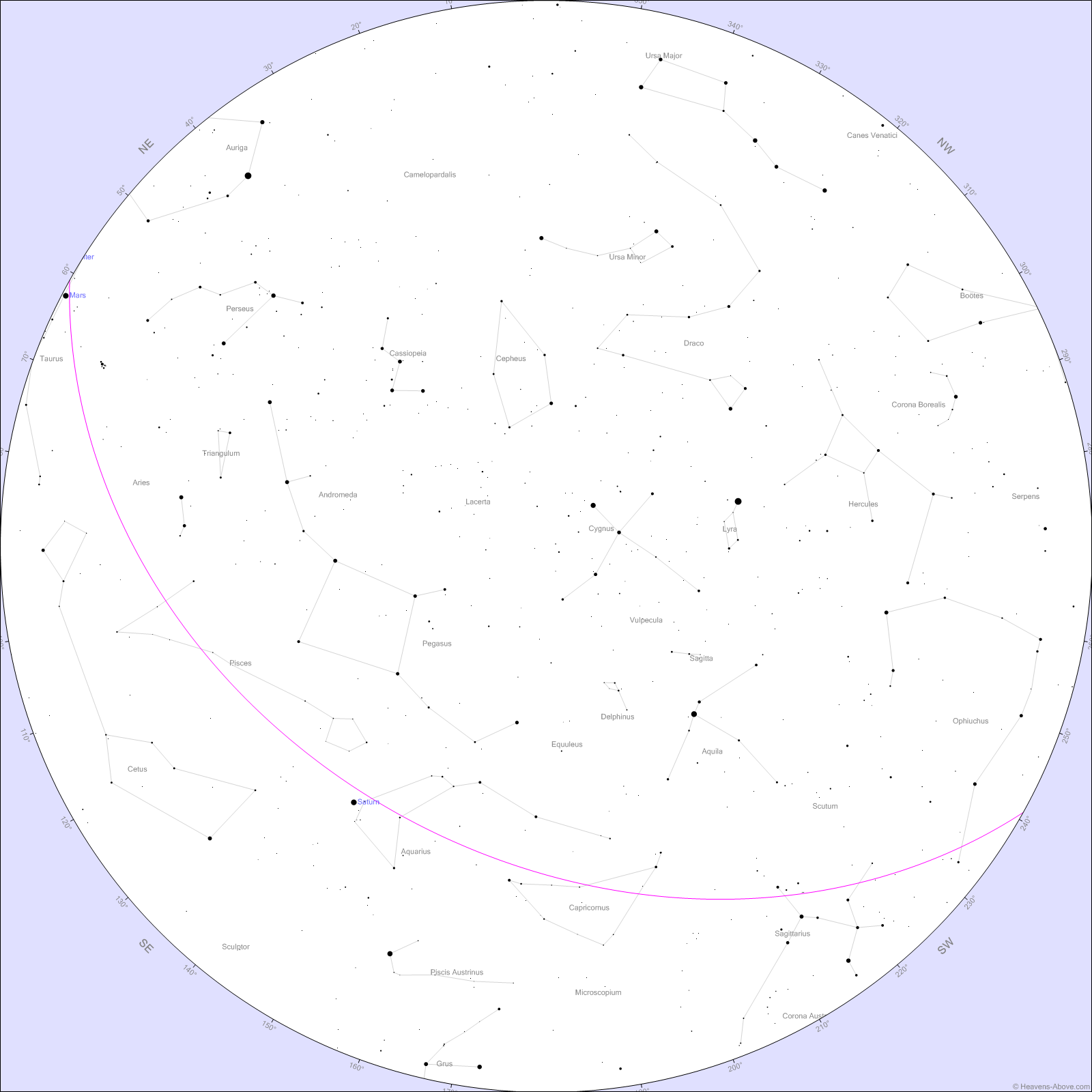
Mars and Jupiter continue lighting up Taurus. Look for the pair after 2 a.m. Jupiter will be bright at more than magnitude -2. Mars, at a magnitude around 1, is less than 5 degrees above and to the right of Jupiter. These two planets form a nice triangle with Aldebaran, the red eye of Taurus.
Look above Taurus for the tranquil Pleiades cluster. Those with good binoculars or a telescope can hunt for Uranus, about 5 degrees to the right of the Pleiades.
Neptune, our most distant planet, rises before midnight near Pisces, making a challenging target for telescope users.
Around 11 p.m. local time this week, look straight up to see Vega, the brightest star of the Summer Triangle. Vega, a stunning bluish-white star just 25 light-years away, is part of the constellation Lyra, the Lyre.
Vega forms a small triangle with two fainter stars, one of which is Epsilon Lyrae. Though it appears as a single star to the naked eye, those with sharp vision might see it as a double star. Binoculars reveal two stars, and a three-inch telescope shows that each of these is also a double, earning Epsilon Lyrae the nickname “Double-double.”
Just a quick note, the locations of celestial objects mentioned on the show are based on what a viewer might see around 35 degrees north of the equator. Consult with an app like Stellarium for the utmost accuracy. Times provided are accurate to your local time, no matter where you’re located.
Don’t forget, August 11 and 12 are considered the peak nights for the Perseids Meteor Shower this year. The viewing window for this shower has been open for a few weeks, and you’ll start seeing more meteors as we close in on the peak days. The Perseids are considered one of the more active showers, and you could potentially see up to 100 meteors an hour during peak times.
That’s it for today’s episode of Star Trails. Before you go, I invite you to check out our weekly e-mail newsletter on Substack, where you can receive night sky reports and astronomy news that we don’t always mention on the podcast. It’s completely free, and a great supplement to the podcast.
We’re also on Mastodon @star_trails and we’d love to hear from you. I’ll include links to both services in the show notes.
Also, remember our website, startrails.show, where you can find all our episodes, including transcripts.
Until next time, keep looking up and exploring the night sky. Clear skies, everyone!
Support the Show
Join us on Substack to get the weekly night sky report as a newsletter, and additional astronomy news. Also, connect with us on Mastodon @star_trails.
If you’re enjoying the show, consider sharing it with a friend! Want to help? Buy us a coffee!
Podcasting is better with RSS.com! If you’re planning to start your own podcast, use our RSS.com affiliate link for a discount, and to help support Star Trails.
 Star Trails: A Weekly Astronomy Podcast
Leave a comment