
The Sturgeon Blue Supermoon and Cosmic Ripples – Star Trails: A Weekly Astronomy Podcast
Episode 30
Join us for another journey through the cosmos for the week starting August 18th. We start with the breathtaking Full Sturgeon Moon, a blue supermoon that will dazzle the night with its brilliance. We’ll also discuss what makes a moon “super” and “blue.”
As the Moon cozies up to Saturn, we share tips for observing this close encounter, along with updates on other planetary highlights this week, including Jupiter, Mars, and Venus. For the early risers, we explore the elusive Zodiacal Light and its mystical glow in the pre-dawn hours.
We’ll also venture deep into the cosmos and take a look at the emerging science of gravitational waves. Discover how these ripples in space-time, predicted over a century ago, are opening a new window into the universe and reshaping our understanding of cosmic events.
Links
Transcript
Howdy stargazers, and welcome to this episode of Star Trails. My name is Drew and I’ll be your guide to the night sky for the week starting August 18 to the 24th.
The Moon and Saturn are both putting on a show this week, and later in the episode, we’ll venture deep into the cosmos to explore the emerging science of gravitational waves, a phenomenon predicted more than 100 years ago. So grab your binoculars or telescope and a comfortable chair, and let’s get started.
August 19 brings us a celestial event that will light up the night sky – the Full Sturgeon Moon, and this time, it’s also a blue supermoon. More on that in a moment.
First, the Sturgeon Moon. The names of the full moons have a history often rooted in the practices and observations of Native American tribes, European settlers, and other cultures around the world. The Sturgeon Moon gets its name from the large sturgeon fish that were easily caught this time of year in the Great Lakes and other major bodies of water. These fish were a crucial food source, and their abundance in late summer made this moon particularly significant for many communities.
But what makes this Full Sturgeon Moon extra special is that it’s also a Supermoon. The media has become obsessed with supermoons in recent years. The term refers to a full moon that occurs when the Moon is at or near its closest point to Earth in its elliptical orbit, a point known as perigee. Because the Moon is closer to us, it appears slightly larger and brighter in the sky – up to 14% larger and 30% brighter than when it’s at its farthest point, or apogee.
The best time to observe the supermoon is just after moonrise when it’s still low on the eastern horizon. At this point, the so-called ‘moon illusion’ comes into play, making the moon appear even larger than it actually is, often with a warm, golden hue.
This event is also an excellent opportunity to observe lunar features like craters, mountains, and the plains known as lunar maria. With the moon closer to Earth, these features will be more visible, even with the naked eye or with a pair of binoculars.
The August Supermoon is the first of four consecutive Supermoons in 2024. Each of these moons will be slightly different, with the one in September being the closest and brightest of them all.
But wait. There’s more. Tomorrow’s full moon is also a “blue moon.” There are two types of blue moons, and for the record, neither are actually blue. This month’s is a seasonal blue moon, meaning that it’s the fourth full moon this season. Monthly, or calendrical, blue moons occur when there are two full moons in a single month.
So if you have clear skies, be sure to check out the Full Sturgeon Blue Supermoon. It will shine a little bit brighter, and perhaps with a little more magic.
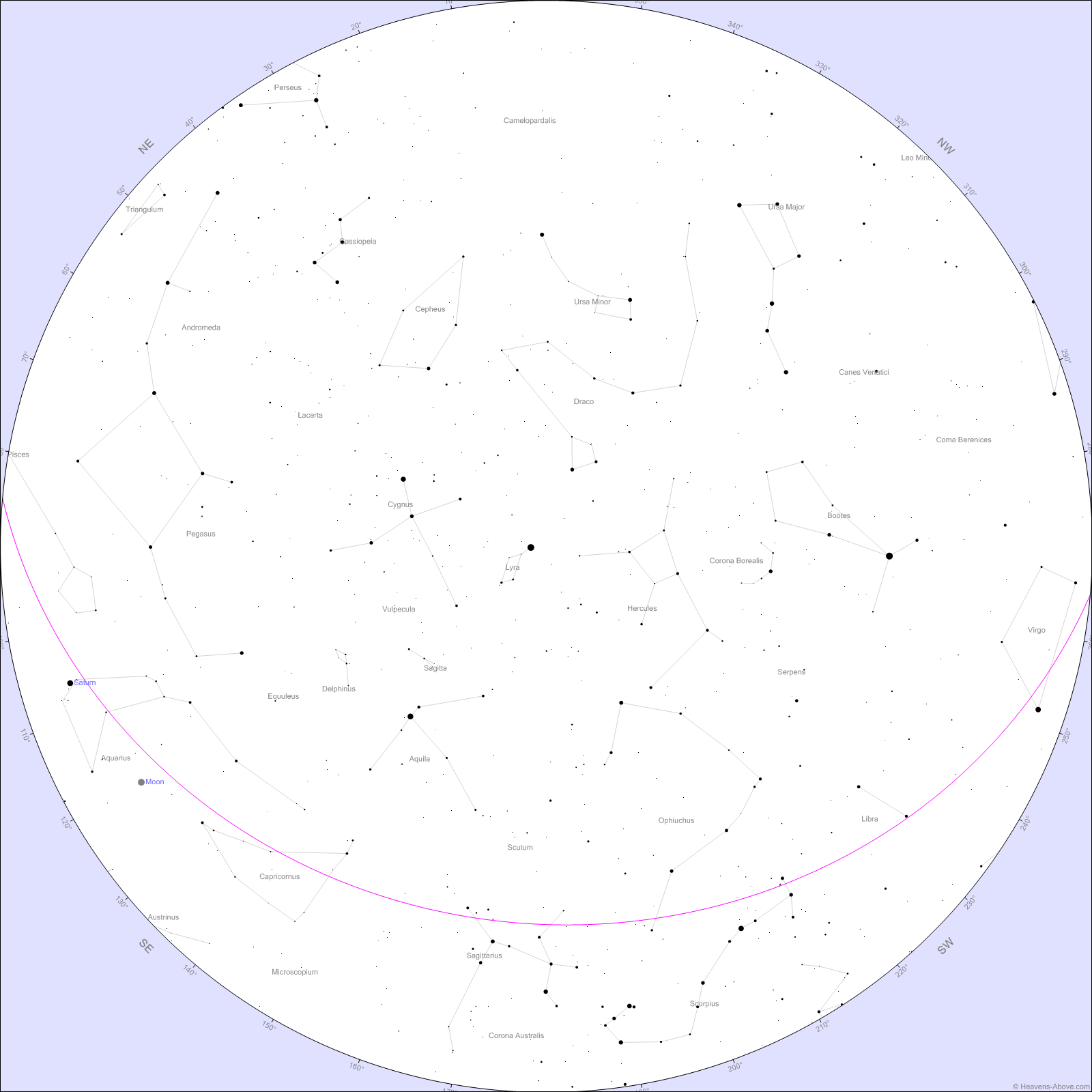
The Moon has another trick up its sleeve this week, as it cozies up within a degree of Saturn on August 20th. Look for the pair to rise around 9 p.m. in the eastern sky, just off the knee of Aquarius. Saturn will continue rising in the sky throughout the night, although it will distance itself from the Moon as the pair march on towards dawn.
For any listeners in Europe and the northern portions of South America and Africa, the moon will occult, or pass in front of, the ringed planet. Be sure to check with an astronomy app, like Stellarium for the most precise positions in your area.
Jupiter and Mars are still fairly close to one another in Taurus. The pair don’t rise until after 2 a.m. Jupiter will clock in at a very bright magnitude of -2. Look for Mars and its signature red hue just below and to the left of Jupiter.
Venus is visible at dusk in the west, just after sunset. If you can catch it, you’ll appreciate its brilliance, as it’s currently at a magnitude of -2.8. Through a telescope, it will be a nearly full disc. Mercury is at inferior conjunction this week, meaning it’s currently between the sun and the Earth. We won’t be able to see it, as it sets before the sun.
As we move deeper into August early risers may have a chance to see the elusive Zodiacal Light – a faint, triangular glow that stretches upward from where the sun is about to rise.
This glow is caused by sunlight scattering off interplanetary dust particles that fill the plane of our solar system. These particles come from comets, asteroid collisions, and other sources, creating a thin cloud of debris along the ecliptic plane – the path that the Sun, Moon, and planets travel across the sky.
Catching a glimpse of the Zodiacal Light requires a bit of planning. It’s most visible during the pre-dawn hours, about 90 minutes to two hours before sunrise. You’ll need a clear view of the eastern horizon, and ideally, you should be far away from city lights or any other sources of light pollution. Think of it as the ‘false dawn’ signaling the approach of morning. This light is often easiest to see during late summer and early autumn in the Northern Hemisphere, so the next few weeks are prime time for catching this subtle effect.
Now, let’s turn our gaze a little higher in the sky and explore the story of Aquila, a constellation that has significance across cultures.
Aquila is Latin for ‘eagle,’ and in Greek mythology, Aquila was the mighty eagle of Zeus, the king of the gods. According to the tales, Aquila carried Zeus’s thunderbolts – his weapons of choice – which he used to maintain order and enforce his will across the heavens. But Aquila’s duties didn’t stop there. He was also said to have abducted Ganymede, bringing him to Olympus to serve as the cupbearer to the gods. Zeus, taken by Ganymede’s beauty, granted him eternal youth and placed him in the stars as the constellation Aquarius, with Aquila by his side.
In other cultures, Aquila has been associated with powerful birds of prey. In Roman mythology, Aquila was the sacred eagle of Jupiter, the Roman equivalent of Zeus. In Hindu astrology, the star Altair, which marks the heart of Aquila, is associated with the eagle Garuda, a divine bird-like creature and the mount of the god Vishnu.
One of the brightest stars in the night sky, Altair is also part of the Summer Triangle, along with Deneb in Cygnus and Vega in Lyra. The Summer Triangle is an asterism – a recognizable pattern of stars that’s easy to spot in the summer months.
And here’s another twist – in Chinese mythology, Altair is known as the star of the Cowherd, who is separated from his lover, the Weaver Girl, represented by the star Vega. The Milky Way, which runs through the Summer Triangle, represents the river that keeps them apart, with only one night a year when they can be reunited.
Look for Aquila soaring high in the summer sky. Observing it is a reminder of how the stars have shaped some of the oldest myths and cultures, while continuing to shape ours.
In our last episode I discussed how radio telescopes have been key in learning more about one of the new frontiers of modern astronomy – gravitational waves. The study of these ripples in space-time are not just a theoretical curiosity; they’re a profound new way of understanding our universe, allowing us to observe cosmic events that were once completely invisible to us.
Imagine space-time – the four-dimensional fabric that makes up our universe – as a vast, stretchy sheet. When massive objects like stars and planets move through this sheet, they create indentations, much like how a heavy ball would cause a dip on a trampoline. The more massive the object, the deeper the indentation.
Now, when these massive objects accelerate, especially when they do so violently – like when two black holes spiral towards each other and merge – they create ripples in space-time. These gravitational waves propagate outwards from the source, traveling across the universe at the speed of light, distorting space-time as they go. But here’s the catch – by the time these waves reach Earth, the distortions they cause are incredibly tiny, shrinking distances by less than the width of a proton!
To detect such small ripples, scientists use incredibly sensitive instruments called interferometers. The most famous of these are the LIGO observatories, located in Washington and Louisiana in the United States.
LIGO, which stands for Laser Interferometer Gravitational-Wave Observatory, works by shooting lasers down two long, perpendicular arms. These arms are several kilometers long, and they are isolated from almost all external vibrations. When a gravitational wave passes through, it slightly changes the length of one or both of these arms, creating a tiny difference in the time it takes for the lasers to travel the length of each arm. By measuring this time difference with extreme precision, LIGO can detect the passing of a gravitational wave.
This is a very new field of study – the first direct detection of gravitational waves was made in September 2015. The event that produced these waves was the merger of two black holes, each about 30 times the mass of the Sun, located more than a billion light-years away. As they spiraled closer together, it’s thought their immense gravity distorted spacetime, releasing a massive burst of energy in the form of gravitational waves.
This detection was monumental for several reasons. First, it confirmed a major prediction of Einstein’s general theory of relativity, made a century earlier. Einstein himself had doubted that gravitational waves would ever be detected because he thought the distortions would be too small. More importantly, it opened a new window into the universe. For the first time, we could ‘listen’ to cosmic events that don’t emit light, like black hole mergers, which are otherwise invisible to telescopes.
Since that first detection, LIGO, along with its European counterpart, Virgo, has observed dozens of gravitational wave events, including the merger of neutron stars. This particular event, detected in 2017, was the first time that both gravitational waves and light were observed from the same cosmic event. The collision of these neutron stars produced a kilonova – an explosion so powerful it forged heavy elements like gold and platinum, spreading them throughout the cosmos.
Gravitational waves could hold the potential to revolutionize our understanding of the universe. For instance, by studying these waves, we might learn more about the fundamental nature of gravity, a force that remains one of the least understood aspects of physics. We might even detect waves from the early universe, providing insights into what happened just fractions of a second after the Big Bang.
The science is still in its infancy, but the discoveries we’ve made so far are just the beginning. As detectors become more sensitive and as new observatories come online, we can expect even more revelations. The universe isn’t just a silent expanse of stars and galaxies. It’s alive with the hum of gravitational waves, carrying the echoes of cataclysmic events across the cosmos.
That’s it for today’s episode of Star Trails. Before you go, I invite you to check out our weekly e-mail newsletter on Substack. It’s completely free, and a great supplement to the podcast.
We’re also on Mastodon @star_trails. If you get a chance, stop by and say hello. I’ll include links to both services in the show notes.
Also, remember our website, startrails.show, where you can find all our episodes, including transcripts and night sky maps.
Until next time, keep looking up and exploring the night sky. Clear skies, everyone!
Support the Show
Connect with us on Mastodon @star_trails.
If you’re enjoying the show, consider sharing it with a friend! Want to help? Buy us a coffee!
Podcasting is better with RSS.com! If you’re planning to start your own podcast, use our RSS.com affiliate link for a discount, and to help support Star Trails.
 Star Trails: A Weekly Astronomy Podcast
Leave a comment