Celestial Triangles and Cosmic Clocks – Star Trails: A Weekly Astronomy Podcast
Episode 31
Join us on this week’s episode as we explore the night sky from August 25 to 31. This week, Mars, the Moon, and Jupiter come together in a stunning celestial triangle visible in the early morning hours. We’ll also take a deep dive into the lore of the constellation Andromeda, home to the nearest spiral galaxy to our own Milky Way.
Plus, discover the fascinating world of pulsars—nature’s most precise cosmic clocks. We’ll also learn how it went for Drew when he attempted to photograph last week’s supermoon!
Links
Transcript
Howdy stargazers, and welcome to this episode of Star Trails. My name is Drew and I’ll be your guide to the night sky for the week starting August 25 to the 31st. This week, Mars, the Moon and Jupiter join in a celestial dance; we’ll take a close look at the constellation Andromeda, and later in the show, we’ll explore the clocks of the universe – pulsars.
So grab a comfortable chair, some binoculars or a telescope, and let’s get started.
First off, some error correction – in our last episode I incorrectly stated our most recent blue full moon was the fourth full moon of the season. That’s not correct; it was the third. The third full moon in a season constitutes a blue moon. I apologize for that oversight. However, it was the first of four full supermoons in a row.
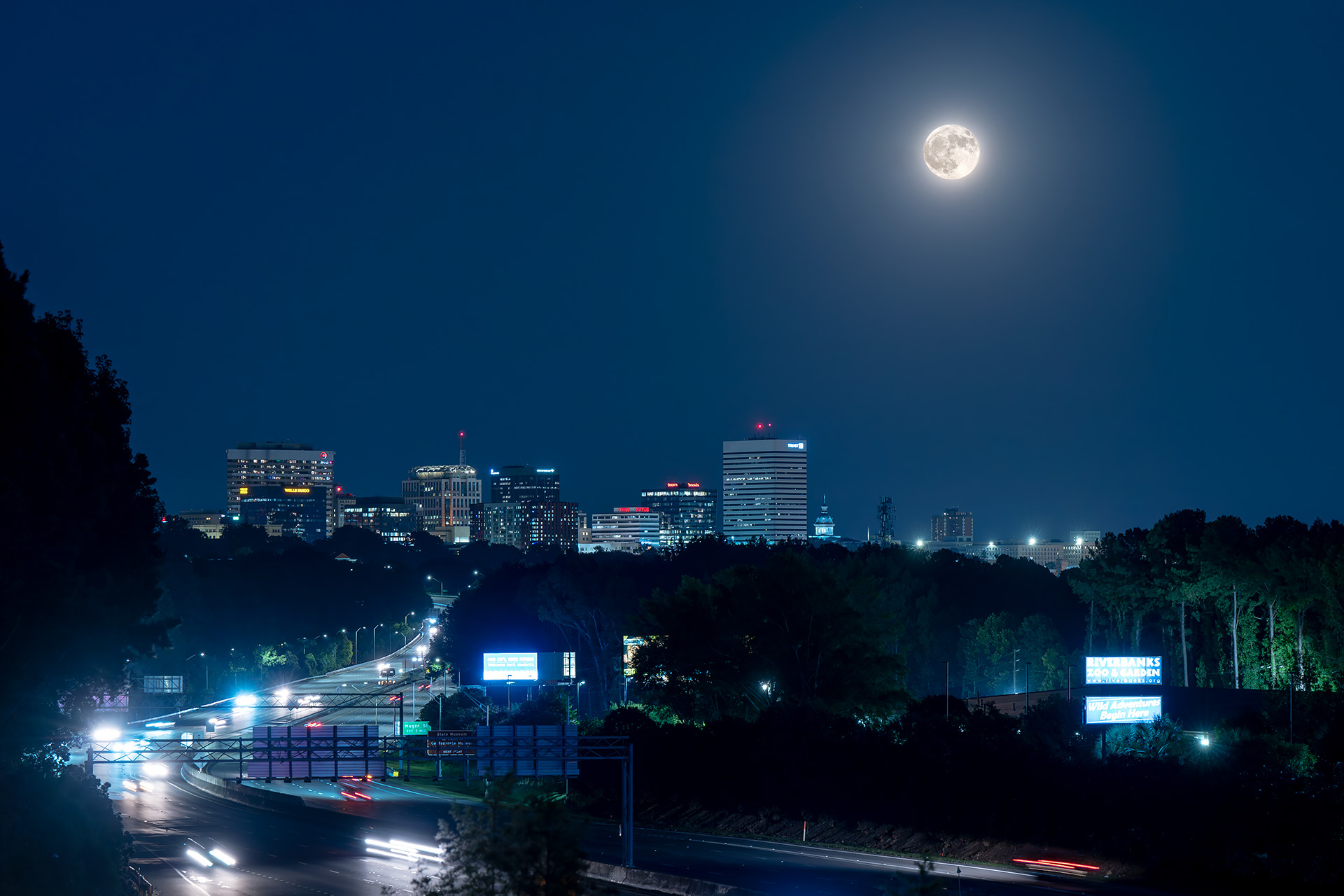
Hopefully you had clear skies and were able to experience last week’s full moon. I decided to go out and try and take a photo of it ascending over the skyline of my home town. I wasn’t entirely successful in that endeavor because the moon was so bright that it made obtaining a good exposure tricky. Normally I like to have some light in the sky for a shot like this to reduce the contrast between the brightness of the Moon and the sky’s darkness.
That didn’t happen last week, but I was glad to finally see a cloudless night, and the Moon itself was larger and more luminous than I’ve ever seen it. I even saw a meteor or two.
But more importantly, I ran into another local astronomer who was out at the same location shooting the moon. If nothing else, I was able to have a nice chat with a fellow stargazer and talk about technique and photography gear.
I ended up creating my Moon photo from a series of images at different exposures and then blending those exposures in Photoshop. The end result was OK, but admittedly could have been a lot better. If you’d like to see this image, visit startrails.show and check out the notes for this episode.
September’s supermoon is predicted to be even more spectacular, and if you somehow miss that one, there are two more right behind it.
With the full Moon behind us, we start this week with Earth’s companion waning, nearly in its last quarter. This means it will be a slender crescent by the end of the week, making for easier observation of those fainter objects in the night sky. For striking views of craters and mountains on the moon, be sure to observe the terminator – the dividing line between day and night on the moon. The contrast between light and shadow along the terminator reveals the Moon’s features in deep 3D relief.
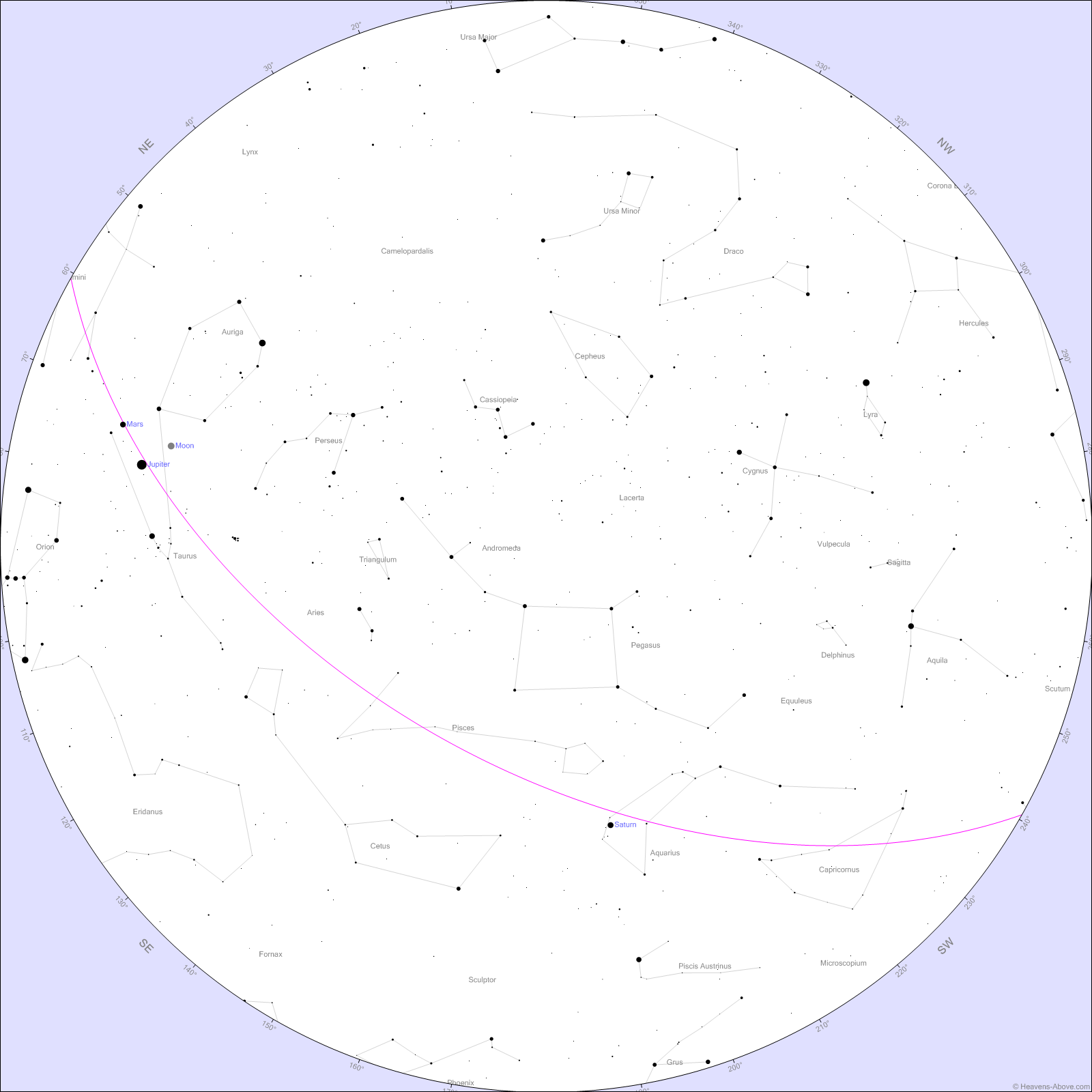
If you can stay up after 2 a.m. on the morning of August 27, you’ll be able to catch a beautiful triangle formed by the crescent moon, Jupiter and Mars. Look eastward in the constellation Taurus to catch the Moon rising first around 12:45 a.m. Jupiter follows just after 1 a.m., clocking in at a bright magnitude of -2.1. The red planet, Mars, joins the party around 1:30 a.m., completing the triangle. The trio will dance in this tight configuration until dawn.
While you’re looking in that part of the sky, look upwards above Aldebaran, the red “eye” of Taurus and catch the Pleiades. Even in binoculars, this blue-hued open cluster is a stunner. Uranus is close by – look to the right of the Pleiades, and as always, you’ll need good binoculars or a scope to see it.
Saturn is still putting on a show earlier in the evening. It rises in the east in Aquarius around 9 p.m. and it’s high in the southern sky by dawn. Neptune isn’t far away, just below and about 10 degrees to the left of Saturn. You’ll need a telescope to see it. You may be able to catch Venus at dusk. It will be visible for about an hour after sunset, but very low on the western horizon. Mercury sets before the sun, and won’t be visible.
Tonight, we’re focusing on a constellation that not only tells a fascinating story from mythology but also houses a galaxy that’s closer to us than any other major galaxy in the universe. The constellation is, of course, Andromeda—the Chained Princess.
According to ancient Greek mythology, Andromeda was a princess, the daughter of King Cepheus and Queen Cassiopeia. Cassiopeia boasted her daughter was more beautiful than the Nereids, the sea nymphs. This angered Poseidon, god of the sea, who sent a sea monster, Cetus, to ravage their kingdom. To appease Poseidon and save their land, Cepheus and Cassiopeia chained Andromeda to a rock as a sacrifice to the monster. But just in time, the hero Perseus swooped in on his winged horse Pegasus, defeated the monster, and saved Andromeda, who became his wife.
Andromeda’s story is immortalized in the night sky, with her constellation lying near those of her parents, Cepheus and Cassiopeia, as well as her savior, Perseus, and the sea monster, Cetus.
The constellation is best viewed in the late summer and autumn months, rising in the eastern sky. The easiest way to locate Andromeda is by first finding the Great Square of Pegasus, which is a prominent asterism nearby. Once you’ve found the Great Square, look for a chain of stars extending to the northeast—these stars form Andromeda’s body.
The constellation itself isn’t particularly bright, but it’s home to one of the most exciting objects you can see with the naked eye: the Andromeda Galaxy, also known as M31 – One of my favorite deep space objects.
M31 is the closest spiral galaxy to our own Milky Way and is one of the few galaxies visible to the naked eye from Earth. On a clear, dark night, far from city lights, it appears as a faint, fuzzy patch in the sky. But don’t let its modest appearance fool you—this galaxy is massive, about 220,000 light-years in diameter, more than twice the size of our Milky Way, and it’s thought to contain more than a trillion stars. It spans an area in the night sky about as wide as six full Moons!
The Andromeda Galaxy is located about 2.5 million light-years from Earth, making it the most distant object you can see without a telescope. What’s even more fascinating is that Andromeda and the Milky Way are on a collision course. In about 4.5 billion years, the two galaxies are expected to merge in a grand cosmic event, forming a new galaxy that astronomers have nicknamed ‘Milkdromeda.’
For now, the Andromeda Galaxy is a spectacular sight for amateur astronomers. Even with a small pair of binoculars or a modest telescope, you can start to see more details, including its bright core and the disk of stars and dust surrounding it. With larger telescopes, you might even spot some of its companion galaxies, M32 and M110, orbiting nearby.
By studying Andromeda, scientists can learn more about how galaxies form, evolve, and interact over billions of years. And because it’s so close, Andromeda provides a detailed look at the kinds of processes that likely occur in countless other galaxies across the universe.
Today, we’re going to talk about one of the most remarkable celestial objects out there—pulsars. You might recall we mentioned pulsars in our recent episode about radio telescopes. In this episode we’re going to take a deeper dive into these unusual entities that are often referred to as the ‘cosmic clocks’ of the universe. Not only do they challenge our understanding of physics, but they also provide us with some of the most precise timekeeping tools in existence.
(maybe some sort of ticking clock effect that reverbs out?)
Pulsars are a type of neutron star, which are the incredibly dense remnants of massive stars that have exploded in supernovae. To give you an idea of just how dense these stars are, imagine compressing the mass of the Sun into a sphere just about 12 miles in diameter. That’s a neutron star.
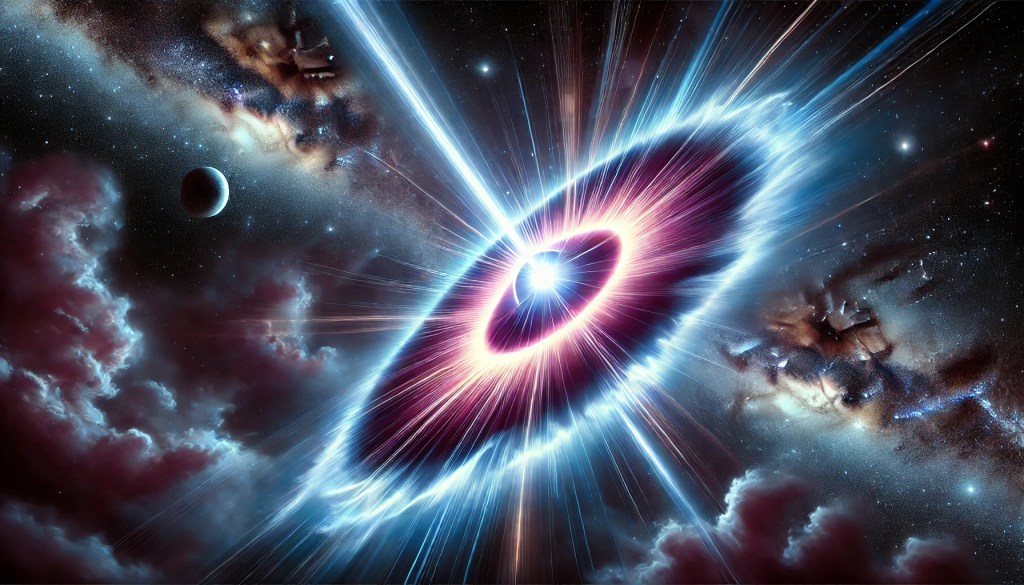
Now, a pulsar is a special kind of neutron star that emits beams of electromagnetic radiation from its magnetic poles. As the star rotates, these beams sweep across space, and if one of those beams happens to point toward Earth, we detect a ‘pulse’ of radiation—hence the name ‘pulsar.’
They rotate incredibly fast, with some spinning several hundred times per second. Think of each rotation’s pulse like a tick. This precise and consistent ticking has earned pulsars the nickname ‘cosmic clocks.’
Pulsars were first discovered in 1967 by Jocelyn Bell Burnell, a graduate student at the University of Cambridge, and her advisor Antony Hewish. While studying radio signals from the sky, Bell Burnell noticed a strange, regular signal that pulsed every 1.3 seconds. Initially, this signal was so regular that the researchers jokingly considered the possibility that it was a signal from an extraterrestrial civilization, dubbing it ‘LGM-1’ for ‘Little Green Men.’ However, it soon became clear this signal was coming from a natural source—a rapidly spinning neutron star.
Since then, astronomers have discovered thousands of pulsars across the universe, each with its own unique characteristics.
Pulsars are considered clocks because of their rotational stability. Some rotate with such precise regularity that they keep time more accurately than the best atomic clocks on Earth. This stability is due to their immense mass and the conservation of angular momentum from the original star’s collapse. Even though these stars are in the process of slowing down—very, very gradually—their regularity remains impressive over long periods.
This precision allows astronomers to use pulsars to study a range of astrophysical phenomena. For example, by monitoring the timing of pulses, astronomers can detect the presence of planets orbiting the pulsar. The gravitational pull of the planet causes tiny variations in the timing of the pulses, revealing the planet’s existence and characteristics.
Also, pulsars have been used to test the predictions of general relativity. A binary pulsar, discovered in 1974, provided the first indirect evidence of gravitational waves. Studies of this binary system revealed that two neutron stars are slowly spiraling toward each other, losing energy in the form of gravitational waves—exactly as predicted by Einstein’s theory.
Among the family of pulsars, there’s a special class known as millisecond pulsars. These spin at rates of hundreds of times per second, often as fast as 700 rotations per second! These incredibly fast rotations are thought to be caused by the transfer of material from a companion star in a binary system, which ‘spins up’ the pulsar to its extreme rotational speed.
Millisecond pulsars are the most precise natural clocks known. They are so regular that their pulses can be used to detect extremely subtle changes in the space around them. For instance, astronomers are currently using a network of millisecond pulsars as a kind of cosmic gravitational wave detector. By monitoring the timing of these pulsars, they hope to detect the tiny distortions in space-time caused by passing gravitational waves—ripples in the fabric of the universe caused by events like the collision of supermassive black holes.
To learn more about gravitational waves, go back and check out last week’s episode.
Beyond their fascinating nature and the insights they provide into the physics of stars, pulsars also remind us of the incredible precision and order of the universe. Even in the aftermath of a catastrophic supernova, we find these spinning remnants of regularity and stability.
That’s it for today’s episode of Star Trails. Before you go, I invite you to check out our weekly e-mail newsletter on Substack. It’s completely free, and a great supplement to the podcast.
We’re also on Mastodon @star_trails. If you get a chance, stop by and say hello. I’ll include links to both services in the show notes.
Also, remember our website, startrails.show, where you can find all our episodes, including transcripts and night sky maps.
Until next time, keep looking up and exploring the night sky. Clear skies, everyone!
Support the Show
Connect with us on Mastodon @star_trails.
If you’re enjoying the show, consider sharing it with a friend! Want to help? Buy us a coffee!
Podcasting is better with RSS.com! If you’re planning to start your own podcast, use our RSS.com affiliate link for a discount, and to help support Star Trails.
 Star Trails: A Weekly Astronomy Podcast
Leave a comment