
Space Oddity: The Harmony of Isolation – Star Trails: A Weekly Astronomy Podcast
Episode 32
Join us on this week’s episode as we explore the night sky from September 1 to 7. With the New Moon providing darker skies, it’s a perfect time to observe deep sky objects, plus, spot the dazzling Venus at dusk.
We also unravel the lore behind the constellation Pegasus and explains how the Moon’s subtle wobble, known as lunar libration, lets us glimpse more of its surface than you might expect.
Transcript
Howdy stargazers, and welcome to this episode of Star Trails. My name is Drew and I’ll be your guide to the night sky for the week starting September 1 to the 7th. This week we’re afforded darker skies for observations of deep sky objects owing to the New Moon, plus, Venus makes her presence known at dusk, and later in the episode, we’ll talk about how our Moon’s wobble lets us see more of the lunar surface than we think.
So grab a comfortable chair, some binoculars or a telescope, and let’s get started.
This week the Moon will transition from the New Moon to the Waxing Crescent phase. Starting off with the New Moon on September 2, the sky will be mostly dark, with the Moon virtually invisible. As the week progresses, a sliver of the Moon will begin to appear in the evening sky. By week’s end, the Waxing Crescent phase will be in full effect, with about 17% of the Moon illuminated and visible after sunset. This marks the start of the Moon’s gradual journey toward becoming a First Quarter Moon next week.
On the evening of September 5, a slender crescent Moon cozies up to Venus, shining brightly at a magnitude of -3.8. Look for both in the western sky, just after Sunset. You’ll have a viewing window of just under an hour before the pair dip below the horizon.
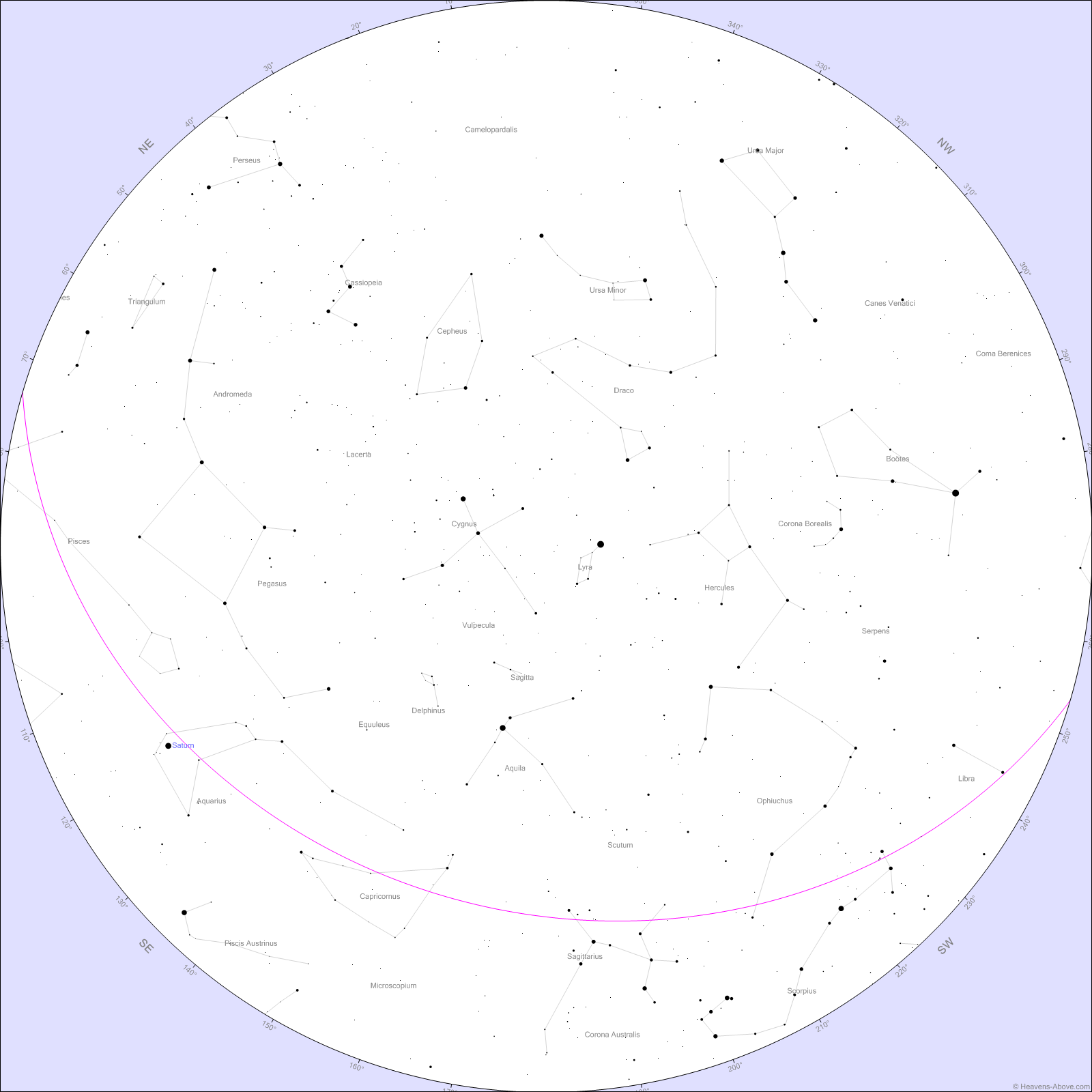
Saturn is still a best bet, as it’s visible all night near Aquarius. Its rings are still at a nearly edge-on orientation to Earth, and Saturn is nearing opposition, so this is an excellent time to catch a glimpse, even with a modest telescope.
Jupiter and Mars are still lingering near Taurus, and visible in the early morning hours. Look east around 3 a.m. to observe these two planets forming a line with the red giant Aldebaran, the star that forms the “eye” of Taurus. Jupiter, clocking in at a bright magnitude of -2, will be seeing red, as he’s flanked by Aldebaran up and to the right, and Mars, down and to the left.
Look above this trio and to the right of the Pleiades to locate Uranus. Neptune remains in Pisces, above and left of Saturn. As always, a telescope is your best bet to view both Neptune and Uranus.
A great constellation to observe during the first week of September is Pegasus, the Winged Horse. This prominent constellation becomes increasingly visible in the evening sky as summer transitions to autumn in the Northern Hemisphere.
Pegasus is known for its distinctive asterism, the “Great Square of Pegasus,” which forms the body of the horse and serves as an easy landmark for stargazers. The four stars that make up the square are bright and easily identifiable even in areas with moderate light pollution. Observing Pegasus can also lead to finding other nearby constellations like Andromeda and Pisces.
Pegasus is one of the most famous constellations in Greek mythology. According to legend, Pegasus sprang forth from the blood of the Gorgon Medusa after she was slain by the hero Perseus. This horse was gifted with the ability to fly and played a significant role in several myths. One of the most well-known stories involves Pegasus aiding the hero Bellerophon in his quest to defeat the fire-breathing Chimera. With the help of Pegasus, Bellerophon was able to soar through the skies and vanquish the beast from above.
After many adventures, Pegasus eventually ascended to Mount Olympus, where he served Zeus, the king of the gods, by carrying his thunderbolts. As a reward for his service, Zeus immortalized Pegasus in the night sky as a constellation. The constellation has since been a symbol of inspiration and creativity, often associated with the muses and artistic endeavors in ancient mythology.
This time of year Pegasus is high in the sky in the evening, making it easier to spot and enjoy without needing to stay up late. Within Pegasus, you can locate the globular cluster M15, a dense collection of stars that is a rewarding target for those with a telescope or binoculars.
Today, we’re turning our attention to our closest celestial neighbor: the Moon. But we’re not just talking about the phases of the Moon or its craters; we’re exploring something a bit more subtle, a bit more mysterious – something called lunar libration. By the end of this episode, you’ll be looking at the Moon in a whole new way – literally.
Let’s start with the basics: what exactly is lunar libration? Most of us know that the Moon always shows us the same face – the familiar near side with its dark maria, or “seas,” and bright highlands. But it’s not entirely true that we only see half the Moon. Thanks to a phenomenon known as lunar libration, we actually get to peek around the edges, just a bit, over time. This means we can see up to about 59% of the Moon’s surface from Earth, rather than just 50%.
Lunar libration is the apparent wobbling of the Moon as seen from Earth. These slight shifts in perspective happen because of a combination of factors, and they allow us to see a bit more of the Moon’s surface than we might expect.
But what causes this wobble? There are three main types of lunar libration: libration in longitude and latitude, and diurnal libration.
Libration in longitude happens because the Moon’s orbit around Earth is elliptical, not a perfect circle. This means the Moon’s speed varies as it moves along its orbit – it’s faster when it’s closer to Earth – at perigee – and slower when it’s farther away – at apogee. However, the Moon’s rotation on its axis happens at a constant rate. So, as the Moon speeds up and slows down along its orbit, we get to see a bit around the eastern and western edges – a back-and-forth motion.
Libration in latitude occurs because the Moon’s axis is slightly tilted relative to its orbit around Earth, by about 6.7 degrees. This tilt allows us to see slightly over the north and south poles of the Moon as it orbits. So, from month to month, we can catch glimpses of the polar regions that are otherwise hidden from direct view.
Lastly, there’s diurnal libration, which is caused by the fact that we’re observing the Moon from a rotating Earth. As Earth turns, our viewpoint changes slightly from moonrise to moonset, allowing us to see a bit more around the Moon’s edges.
So, how can you can observe it? The good news is that you don’t need a fancy telescope or advanced equipment – just a bit of patience and a keen eye.
Start by finding the moon on a clear night. Take note of some of the prominent features near the lunar limb – that’s the edge of the Moon – such as craters, maria, or mountain ranges. Over the course of a month, or even just a few days, observe the Moon again and compare what you see to your previous observations. You’ll notice some features that were near the edge of the Moon have moved slightly, allowing you to see a bit more of what lies beyond.
For those with telescopes, tracking libration can be even more rewarding. You can use detailed lunar maps or apps that show the current libration, allowing you to focus on the areas that are best revealed at that moment. Observing the libration in latitude, for example, can offer views of the Moon’s poles, which are usually out of sight.
Before spacecraft missions provided detailed maps of the Moon’s far side, libration was the only way to catch glimpses of the regions near the Moon’s edges.
In the 17th and 18th centuries, astronomers like Giovanni Battista Riccioli and Johann Tobias Mayer made detailed maps of the Moon, noting the effects of libration. These early maps were the best representations of the Moon’s surface available until the space age.
Even today, libration plays a role in lunar studies. For example, some craters and features near the lunar edges are only visible or best observed during certain libration periods. This makes libration a valuable tool for both amateur astronomers and professionals alike.
The Moon’s far side – the side we never see due to its synchronous rotation with Earth – was first glimpsed directly by humans only in 1959, when the Soviet Luna 3 spacecraft took the first photos? But before that, everything we knew about the Moon’s far side came from careful observations of lunar libration.
And here’s a cool tidbit: some of the Moon’s most famous features, like the craters Grimaldi and Schickard, can only be fully appreciated thanks to libration. Without it, these craters would be partially hidden from view.
The phenomenon of libration reminds us that even the objects we think we know well, like the Moon, can still surprise us with their complexity. And who knows? Maybe your next lunar observation will reveal something new to you.
That’s it for today’s episode of Star Trails. Before you go, I invite you to check out our weekly e-mail newsletter on Substack. It’s completely free, and a great supplement to the podcast.
We’re also on Mastodon @star_trails. If you get a chance, stop by and say hello. I’ll include links to both services in the show notes.
Also, remember our website, startrails.show, where you can find all our episodes, including transcripts and night sky maps.
Until next time, keep looking up and exploring the night sky. Clear skies, everyone!
Support the Show
Connect with us on Mastodon @star_trails.
If you’re enjoying the show, consider sharing it with a friend! Want to help? Buy us a coffee!
Podcasting is better with RSS.com! If you’re planning to start your own podcast, use our RSS.com affiliate link for a discount, and to help support Star Trails.
 Star Trails: A Weekly Astronomy Podcast
Leave a comment