A Comet, a Crescent Moon and the Myth of the Great Bear – Star Trails: A Weekly Astronomy Podcast
Episode 36
In this episode we journey through the night sky from September 29th to October 5th, 2024. As the week begins with a Waning Crescent Moon and leads into a New Moon on October 2nd, it’s the perfect time for deep-sky observation. Also, comet C/2023 A3 (Tsuchinshan-ATLAS), is making a rare appearance on the morning horizon.
Later, we look at two lesser-known constellations, Lacerta and Equuleus, both of which present a rewarding challenge for stargazers seeking to broaden their knowledge.
Finally, we dive deep into the lore surrounding Ursa Major, the Great Bear. Discover why cultures from Ancient Greece to Native America and even prehistoric peoples saw a bear in these stars and how the myth has endured across time and geography.
Transcript
Howdy stargazers, and welcome to this episode of Star Trails. I’m Drew, and I’ll be your guide to the night sky for the week starting September 29th to October 5th.
This week a New Moon brings darker skies, a comet looms on the morning horizon, and later in the episode, I’ll examine the lore of the Big Dipper, and why cultures across the globe have seen this asterism as a big bear in the night sky for millenia.
So grab a comfortable chair under the night sky, and let’s get started!
For the week of September 29 to October 5, 2024, the moon will begin in its Waning Crescent phase, gradually shrinking to a thin sliver visible in the early morning sky. On October 2, we’ll experience a New Moon, leaving the night sky free from moonlight and providing ideal conditions for deep-sky observation. After that, the moon transitions to a Waxing Crescent, starting to grow again from just 1% illuminated on October 3 to about 7% by October 5, when you can spot its delicate crescent just after sunset.
Jupiter is putting on a brilliant show this week. Rising in the east just before midnight, you’ll find it in the constellation Aries, where it shines brightly all night long. If you have a small telescope, you’ll be able to spot Jupiter’s cloud bands and its four largest moons—Io, Europa, Ganymede, and Callisto.
Meanwhile, Saturn is also visible in the early evening, located in Aquarius. Its iconic rings are still on full display, and with a telescope, you can even catch a glimpse of Saturn’s largest moon, Titan.
Venus, the “Evening Star,” will be bright and beautiful near the western horizon after sunset. Though it sets quickly, its dazzling appearance is unmistakable.
Mercury will be in superior conjunction with the Sun on September 30, so you won’t be able to see it for most of the week.
Comet hunters will want to get up early this week. Comet C/2023 A3 (Tsuchinshan-ATLAS) will be visible in the hour before sunrise on four successive mornings this week. Further windows of naked-eye visibility in the evening sky could follow in mid-October.
Just a few days ago C/2023 A3 reached perihelion, its closest point to the sun on its estimated 80,000-year-long orbit. Skywatchers in the Northern Hemisphere may be able to glimpse the comet a few degrees above the east-southeast horizon about 30 minutes before sunrise until Wednesday, Oct. 2.
Monday morning could be a perfect time for spotting C/2023 A3, while it’s joined by a delicate waning crescent moon. As always, comets are unpredictable, so we’ll see what happens with this one.
In this episode I want to highlight a couple of lesser-known star patterns that you might not have heard of, but which are visible at this time of year. These constellations may not be as famous as Orion or Pegasus, but they offer a rewarding challenge for those looking to expand their knowledge of the night sky.
First up is Lacerta, also known as The Lizard. It’s a faint constellation located between the more prominent constellations of Cygnus and Andromeda in the northern sky. Lacerta is shaped roughly like a zigzag or a lightning bolt, with no particularly bright stars to help guide you, making it a bit of a challenge to spot. But that’s part of the fun! One feature you can look for within Lacerta is the open star cluster NGC 7243. It’s visible through binoculars or a small telescope and adds an extra bit of charm to this underappreciated constellation.
The second constellation to explore is Equuleus, or The Little Horse. It’s the second smallest constellation in the sky, located near Aquarius, Delphinus, and Pegasus. Equuleus is made up of a small, somewhat squashed rectangle of stars and looks a bit like a faint version of Delphinus. While it doesn’t boast any major deep-sky objects, it’s a delight for anyone who enjoys star-hopping. Because of its size, it’s a great target for those who want to push their observational skills a little further.
Both of these constellations, Lacerta and Equuleus, might not grab your attention at first glance, but they offer a wonderful way to deepen your stargazing experience. Be sure to look for them next time you’re out under the autumn sky!
As we continue exploring the night sky this week, let’s talk about some deep sky objects that are well-positioned for observation. These are some of the most beautiful and intriguing sights that can be seen with binoculars or a small telescope. Even if you’re a beginner, they’re not too difficult to find, and they offer a great reward once you’ve located them.
First up is the Dumbbell Nebula (M27) in the constellation Vulpecula. This planetary nebula is one of the brightest of its kind, and it has an easily recognizable shape that looks like a glowing dumbbell or hourglass. Through a telescope, you’ll be able to see the shell of gas ejected by a dying star.
Next, we have the Ring Nebula (M57) in Lyra. This is another planetary nebula, but instead of an hourglass shape, it appears as a small but strikingly clear ring of gas. Through a medium-sized scope, the glowing ring really pops out against the dark backdrop of space, making it a favorite target for amateur astronomers.
Don’t forget about the Hercules Cluster (M13), one of the brightest globular clusters in the northern sky. Located in the constellation Hercules, this dense cluster contains hundreds of thousands of stars packed tightly together. A telescope will reveal its granular structure, making it a fascinating object to study. Also, it’s one of the best globular clusters to observe in the fall.
For galaxy hunters, try locating the Triangulum Galaxy (M33) in the constellation Triangulum. It’s a face-on spiral galaxy and the third-largest member of our Local Group of galaxies, after the Milky Way and the Andromeda Galaxy. Under very dark skies, it’s even possible to see M33 with the naked eye, though binoculars or a small telescope will really bring out its faint spiral structure.
All of these deep sky objects make excellent targets for your stargazing adventures this week. They’re visible for much of the night, so take your time to explore the wonders hidden in the cosmos!
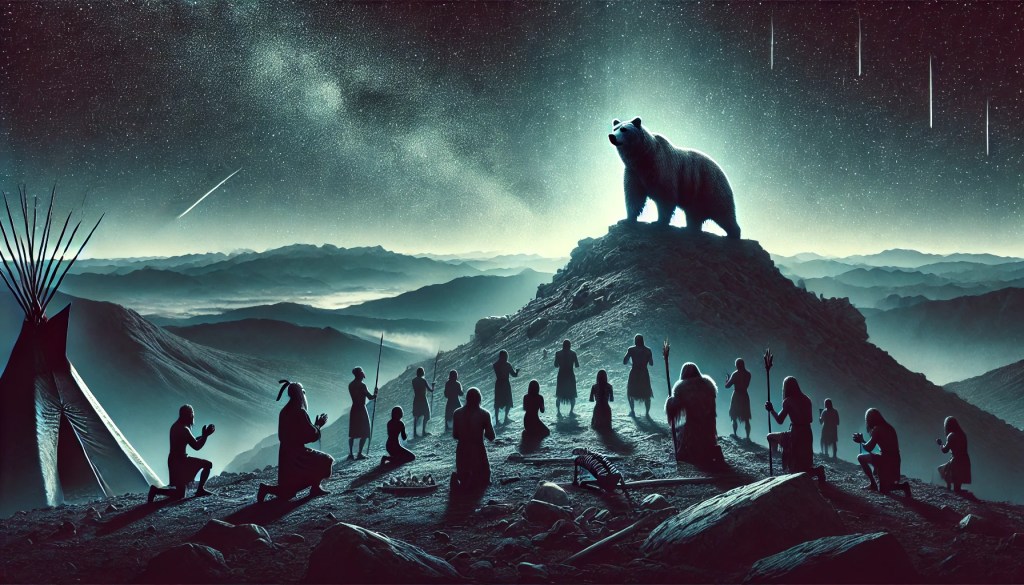
Tonight, we’re taking a deep dive into one of the most iconic constellations—Ursa Major, the Great Bear. But as we’ll discover, this isn’t just any constellation. It’s a star pattern that has captured the imagination of people around the world for thousands of years. And interestingly, many of those people saw a bear in the stars. But why a bear? The answer takes us back to ancient human history, spanning continents and cultures—and maybe even into the mysterious world of prehistoric bear worship.
Let’s start with the constellation itself. Ursa Major, or the Great Bear, is visible all year round in much of the Northern Hemisphere, making it a trusty guide for stargazers. The part you’re probably most familiar with is the Big Dipper, an asterism formed by seven bright stars within Ursa Major.
The handle of the dipper is often meant to be the long tail of the bear, which is odd, because bears have short tails. The cup of the dipper is significant because two of its stars—Dubhe and Merak—serve as pointer stars to the North Star, Polaris.
This was no small matter to ancient civilizations. Before modern navigation systems, people relied on the stars to find their way. And the Big Dipper was like a celestial compass, always pointing north. Mariners, travelers, and even nomadic tribes would have looked to this asterism to guide their paths. But as useful as it was for navigation, it was also the subject of deep mythology and symbolism—and that’s where the bear comes in.
It seems like an odd choice. The stars of Ursa Major are spread out, and it takes some imagination to turn that shape into a bear. Yet, incredibly, people all over the world—separated by time, geography, and culture—came to the same conclusion. From the Ancient Greeks to Native American tribes and Siberian peoples.
In Greek mythology, the bear is connected to the story of Callisto, a nymph who was transformed into a bear by the jealous goddess Hera. Later, Callisto was placed in the sky by Zeus, immortalized as the constellation we know today. The Romans inherited this myth, and the story continued to thrive throughout Europe.
But here’s where things get even more fascinating. On the other side of the world, Native American tribes like the Iroquois and Algonquin also saw a bear in these stars. The Iroquois told stories of hunters chasing a great bear across the sky, with the bear’s death in the fall explaining the changing colors of the autumn leaves. And in some versions of the story, the bear isn’t just being pursued—it’s wounded, with its blood staining the trees.
These parallel myths suggest something deeper, something more ancient, and it might be linked to the migrations of early humans across continents. Anthropologists have suggested that early hunter-gatherers, crossing the Bering Land Bridge from Siberia into North America, carried with them stories of the celestial bear. As they spread across the continent, so did the legend. This bear in the sky became a universal symbol for survival, strength, and perhaps even the changing of the seasons.
To possibly understand why the bear became such a powerful symbol, we need to go even further back in time—tens of thousands of years, to the age of the Ice Age hunter-gatherers. Evidence suggests that humans in Europe once revered and possibly even worshiped the cave bear, a species that roamed the earth during the Pleistocene epoch and went extinct around 24,000 years ago.
Archaeologists have uncovered bear remains in ancient caves across Europe that suggest ritualistic treatment. In some sites in Switzerland and France, skulls of cave bears were found carefully placed in stone niches, almost as if they had been intentionally arranged. Other remains show evidence that humans might have revered these massive animals, which could stand up to 10 feet tall on their hind legs. These cave sites are thought to have been places of bear worship, possibly linked to the awe these prehistoric humans felt towards the bear’s physical power and its ability to seemingly “die” in hibernation and return with the spring thaw.
This seasonal rhythm mirrored the cycles of the natural world that were essential for survival, especially to those dependent on hunting and gathering. It’s not a stretch to imagine that the stories of the cave bear survived in oral traditions, eventually evolving into the myths and stories about a celestial bear we find in cultures from Siberia to North America.
The stars of Ursa Major became the eternal bear—standing watch over the night, year after year, season after season.
However, not every culture saw a bear in Ursa Major. In medieval Europe the Big Dipper was often seen as a plough, a fitting image for agrarian societies. The Romans sometimes called it the Seven Oxen, referring to the seven stars as oxen pulling a cart. In England, the stars were imagined as Charles’s Wagon, named after Charlemagne, the great medieval emperor.
In China, the Big Dipper had a very different cultural significance. It was known as part of the Northern Dipper, which was closely tied to the emperor’s role as the “Son of Heaven.” The movement of these stars was thought to reflect the stability and harmony of the empire itself.
Despite these variations, the bear myth is the most widespread and enduring. It’s amazing to think that people separated by vast distances and thousands of years could look up at the same stars and tell similar stories. Perhaps there’s something primal about the bear that spoke to early humans—an animal that, like them, was powerful, resourceful, and connected to the cycles of nature. As a top predator, the bear represented power and resilience. But the bear was also mysterious—capable of both incredible ferocity and long periods of dormancy during hibernation. In many ways, the bear walked a fine line between life and death, a creature that seemed to conquer the changing seasons in a way humans wished they could.
By identifying a bear in the sky, ancient people could project their hopes, fears, and understanding of the natural world onto the stars. Perhaps when they looked at Ursa Major, they weren’t just seeing stars; they were seeing the cycle of life itself, played out on a cosmic stage.
So, when you look up at the Big Dipper, take a moment to reflect on the idea that you’re connected to a tradition that stretches back thousands of years, one that speaks to the deep relationship between humanity and the natural world. And just like them, you can rely on the Great Bear to guide you through the night sky.
That’s it for today’s episode of Star Trails. If you enjoyed this episode, please share it with a friend. The easiest way to do that is by visiting our website, startrails.show, where you can find all our episodes, including transcripts, night sky maps and more.
Until next time, keep looking up and exploring the night sky. Clear skies, everyone!
Support the Show
Connect with us on Mastodon @star_trails.
If you’re enjoying the show, consider sharing it with a friend! Want to help? Buy us a coffee!
Podcasting is better with RSS.com! If you’re planning to start your own podcast, use our RSS.com affiliate link for a discount, and to help support Star Trails.
 Star Trails: A Weekly Astronomy Podcast

Leave a comment