Autumn Stargazing: From the Draconids to Dazzling Planets – Star Trails: A Weekly Astronomy Podcast
Episode 37
In this episode we take a journey through the night sky for the week of October 6th to the 12th. Venus, Jupiter, and Saturn are dazzling planets to observe this week, with special highlights like Io and Europa’s shadow transits across the Jovian surface. We also explore deep sky objects like the Owl Cluster, the Pleiades, and the striking Blue Snowball Nebula.
We’ll investigate the lore of Perseus, the Greek hero turned constellation, and don’t miss the Draconid Meteor Shower, peaking on October 8th. As the Moon transitions from a Waxing Crescent to a Waxing Gibbous, it’s the perfect time for lunar observations, with plenty of craters and shadows to explore.
Plus, we look at top picks for stargazing apps, like SkySafari and Stellarium, to help you navigate the night sky like a pro.
Links
Transcript
Howdy stargazers, and welcome to this episode of Star Trails. I’m Drew, and I’ll be your guide to the night sky for the week starting October 6th to the 12th.
This week, we’ll check out some familiar and some not-so familiar deep sky objects. Venus, Jupiter and Saturn are all putting on a show, and a meteor shower is also in the forecast. And by the way, did you hear Earth has gained a second Moon?
We’ll check out the lore and features of the constellation Perseus, the Greek hero of myth who has been a key player in some of our recent episodes. And later, I’ll recommend some great apps to kickstart your observations as we make our way into the longer nights of autumn.
So grab your observational instrument of choice, a comfortable chair under the night sky, and let’s get started!
This week the Moon will transition from a Waxing Crescent phase to a Waxing Gibbous phase. By October 10, it will reach the First Quarter phase, marking the halfway point to the Full Moon. As the week progresses, the Moon will continue to grow in brightness, reaching the Waxing Gibbous phase by the week’s end.
This period is excellent for lunar observation, especially with the First Quarter phase providing clear views of the Moon’s craters and shadows, while the Waxing Gibbous phase offers brighter, more expansive views.
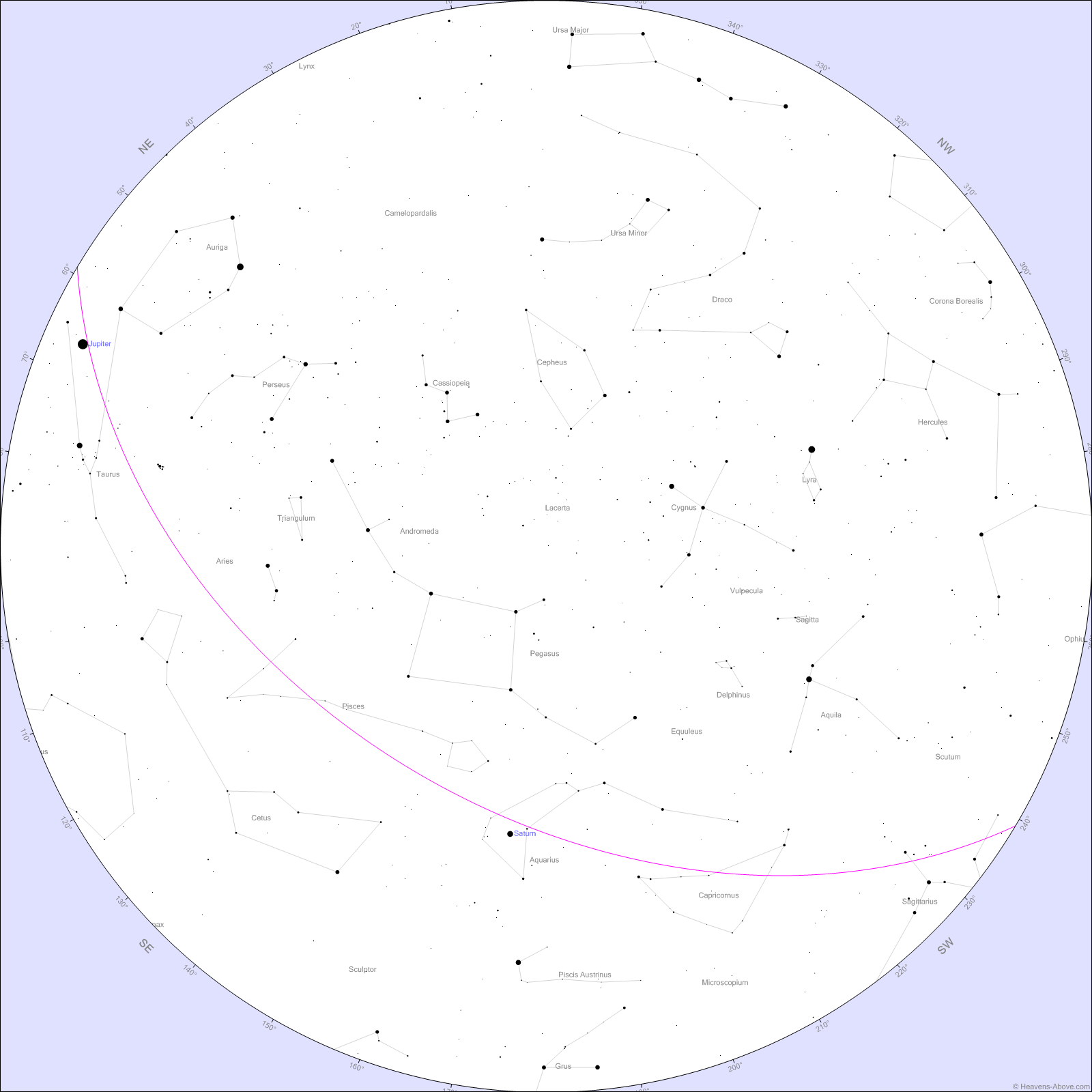
Elsewhere in the solar system, Jupiter continues putting on a show. It rises shortly after sunset and is visible for most of the night in the constellation Aries. It’s near opposition, meaning it’s bright and easy to spot. With a telescope, you can observe the planet’s cloud bands and its four Galilean moons—Io, Europa, Ganymede, and Callisto.
Depending on the resolution of your telescope, you may be able to catch a unique phenomenon on Jupiter’s face. Io’s shadow will transit Jupiter beginning around 8 p.m. on October 9. If you can stay up later, at 2 a.m. on the morning of October 10, you’ll see Europa’s shadow transit Jupiter.
These happen frequently, and Sky & Telescope has a nice online tool for calculating when they appear. I’ll include a link in the show notes. (https://skyandtelescope.org/wp-content/plugins/observing-tools/jupiter_moons/jupiter.html)
Look towards the southeast after sunset to spot Saturn in the constellation Aquarius. Saturn will be visible through most of the night, and with a small telescope, you can catch its stunning rings and possibly its largest moon, Titan.
Mars rises around midnight and is visible in the early morning hours in the eastern sky. You’ll spot it near the stars Castor and Pollux in Gemini, and its reddish hue makes it easy to identify.
Venus will be shining brightly just after sunset, low on the western horizon. I’ve managed to catch it during my evening walks the past few nights.
Uranus can be seen near the Pleiades star cluster in Taurus, while Neptune is best viewed earlier in the evening in Aquarius. As always you’ll need a good telescope to locate these outer gas giants.
Even farther out, some familiar deep sky objects are rising higher in the autumn sky. The Owl Cluster (NGC 457) is a star cluster in Cassiopeia. Also known as the “ET Cluster,” its bright stars form a shape that looks like an owl or the famous movie alien. This cluster is easy to spot and it’s a perfect target for binoculars.
The Pleiades (M45), also known as the “Seven Sisters,” is a beautiful open star cluster located in the constellation Taurus. This cluster becomes increasingly prominent as autumn progresses. It is a fantastic target for binoculars, which reveal more stars than are visible to the naked eye.
For a challenge, telescope users can seek the Blue Snowball Nebula (NGC 7662).
Located in the constellation Andromeda, this striking planetary nebula is known for its bright blue appearance, resembling a small, round snowball. It is relatively easy to spot through small to medium telescopes, and with higher magnification, you may observe its internal structure. The nebula is the result of a dying star shedding its outer layers.
Don’t forget The Draconid Meteor Shower, which peaks overnight between October 8th and 9th. The Draconids are unique because they are best viewed in the evening, not after midnight like many other showers. The meteors will appear to radiate from the constellation Draco, but remember you can see them almost anywhere in the night sky.
Between last week’s annular solar eclipse – which sadly was not visible in North America, seemingly nonstop solar flare blasts, a new comet that could light up the sky next week, and the nova watch on T Coronae Borealis that I’ve mentioned in quite a few episodes, there’s been a lot of astronomy in the news lately. Sometimes these headlines just seem a bit sensational. For instance, there’s been a fair amount of press lately about Earth’s new “second moon.”
On September 29, Earth “captured” a new mini moon called 2024 PT5, which will orbit the Earth for about 57 days. But despite the flashy headlines, if you expect to see this new moon, you’re going to be disappointed. Astronomers estimate this object is only about 10 meters wide – about the size of a school bus. I’ll leave spotting this one to the professionals.
While PT5 might not be much to look at, it does remind us that there’s a whole world of quasi-satellites that whip around the Earth thanks to the influence of our planet’s gravity on these small objects. We’ll talk about some of these in a future episode.
A great constellation to explore in October is Perseus, which is well-positioned in the northeastern sky and offers plenty of interesting stars and deep-sky objects.
In Greek mythology, Perseus is one of the great heroes, known for slaying the Gorgon Medusa and rescuing Andromeda from the sea monster Cetus. After his adventures, Perseus and Andromeda were placed among the stars, along with other characters from his story, such as Cassiopeia. The constellation features some perennial deep sky targets, including the Double Cluster (NGC 869 and NGC 884).
Located on the border between Cassiopeia and Perseus, the Double Cluster is a stunning sight through binoculars. These two open star clusters are packed with young, hot stars, and they shine brightly against the backdrop of the Milky Way.
The California Nebula (NGC 1499) is a faint emission nebula, visible under dark skies, and named for its resemblance to the shape of the state of California. The nebula is located near the bright star Menkar. It’s best viewed with long-exposure astrophotography due to its faintness.
Finally, Algol, the “Demon Star,” is one of the most famous variable stars in the sky. It’s part of an eclipsing binary system, where one star periodically passes in front of the other, causing the star to dim and brighten over a 2.8-day cycle. This dimming and brightening can be observed with the naked eye, making it one of the few stars where you can directly observe variability.
As we head into October, the nights are getting longer and clearer, which means it’s the perfect time to get outside and do some serious stargazing. When I was a kid, that meant I had to pull out an atlas of star maps and try to make sense of the sky while trying to read the charts with a red flashlight. I feel very fortunate nowadays – as my night sky atlas is on my smartphone.
There’s a universe of helpful apps and software out there that can make your stargazing experience even better. So, I wanted to mention a few of these tools that will hopefully help you get more out of your time under the stars.
We’ll start with the apps you can take with you wherever you go: smartphone apps. Most of these night sky apps make it easy to navigate the sky, using some form of augmented reality or motion-based tracking. They are also helpful for tracking celestial objects, and for finding the best times to observe. You’ve probably heard me mention on various episodes that cross-checking with an app is the best way to ensure you can see the phenomenon we discuss in your area.
Here are a couple good ones to try, and don’t worry, there will be links to all of these resources in the show notes:
First up is SkySafari, one of the most comprehensive stargazing apps out there. Available on both iOS and Android, SkySafari lets you point your phone at the sky and instantly identify stars, planets, and constellations. You can even simulate what the sky looked like hundreds or thousands of years ago.
I know many of the folks in my local astronomy club prefer SkySafari. It features a massive database of stars, planets, and deep-sky objects, and you can use it to control compatible telescopes, which is always nice. The basic app sells for about $5, but there are Plus and Pro versions that sell for $20 and $30 respectively.
The Basic version is aimed at beginners or casual stargazers. It includes a database of around 120,000 stars, planets, and other celestial objects.
SkySafari Plus significantly expands the database to more than 2.5 million stars and includes many deep sky objects, comets, and satellites. It also introduces enhanced features like more advanced telescope control, orbit simulation, and detailed observation planning tools.
For the most advanced users, there’s SkySafari Pro. With an unimaginable database of more than 100 million stars and millions of galaxies, Pro is designed for seasoned astronomers and astrophotographers who need detailed observation logs and extensive telescope control options.
Next up is my app of choice, Stellarium Mobile, which is another highly rated app for iOS and Android. Stellarium is known for its clean, intuitive interface that mimics a real-time sky view, Stellarium tends to be more accessible for casual users or those who prefer a more visually immersive experience without the need for advanced customization. It does have some telescope control, and a host of other nice features, but it’s not nearly as full-featured as SkySafari.
Even so, I’ve been a fan of Stellarium since its early days when it was a free, open-source desktop app. The base mobile app is free, and paying $20 gets you some additional tools to help you plan your observations.
You can also use Stellarium on the desktop or in a web browser for free, and we’ll talk about that in a moment.
Here’s one more app to consider, Star Walk 2. Like SkySafari and Stellarium, Star Walk is like having a planetarium in your pocket. Available on iOS and Android, this app uses augmented reality to give you an immersive view of the night sky. Point your phone anywhere, and Star Walk will display the names of stars, constellations, and planets.
Compared to the other apps, Star Walk 2 is even more beginner-focused and leans more into accessibility and ease of use. It lacks some of the in-depth tools but provides a visually appealing, easy-to-understand sky view that works well for quick lookups and educational purposes. There’s an ad-supported free version, but upgrades and add-ons are only around $3.
These three apps are all similar, so you may want to download each one and see which one speaks to you.
I’d like to mention two smartphone apps, and these both deal with astrophotography.
PhotoPills is an app that lets you plan your shots by predicting where the Milky Way, moon, or specific stars will be at any given time. It includes a calculator for finding the best times and angles for photography, and a set of tools for figuring exposure times. Even if you’re not an astrophotographer, the sky planning features can really help you understand celestial movements better.
If you want to dip your toe into the world of astrophotography and you don’t have a photography rig, you might enjoy playing with NightCap Camera. This app is limited to iOS, but many phones now have a night or astronomy mode built-in, so you may not even need the app.
And before you scoff at using a phone for astrophotography, you should try it and see what happens. Using a Google Pixel phone I caught Andromeda one evening. I’ve shot aurora with my iPhone.
NightCap Camera offers up some features for capturing starfields, meteors, and even the International Space Station. Don’t forget a tripod.
Now, for those of you who like to do a little research and planning before you head outside, there are a couple of great desktop programs worth mentioning.
First up is the desktop version of Stellarium, which is free and open-source. Like the phone app, you can simulate the night sky from any location on Earth and see what it will look like at any time of the day or night.
Another great option for the desktop is Starry Night. This one is a bit more polished than Stellarium, with a highly accurate star map and some extra telescope connectivity.
And finally, before we wrap up, there are a couple of websites I recommend you check out if you want to stay up-to-date with celestial events or track satellites and other sky phenomena.”
Heavens-Above.com is my go-to for tracking satellites like the ISS, Iridium Flares, and more. We use this site to generate the sky maps featured on the Star Trails website each week. This site is also popular for amateur radio operators who are trying to bounce a signal off one of the numerous ham sats floating around up there.
And finally, with all the solar flare activity we’ve been having lately, I’ve been checking in frequently over at SpaceWeather.com. This site keeps you updated on solar activity, auroras, meteor showers, and other sky events. It’s a great resource if you’re looking to catch something like a solar storm or the Northern Lights.
There are a lot more applications and sites that are useful for astronomy, and we’ll probably cover more in future episodes. Hopefully, these help kick your stargazing into high gear as clear evenings and longer nights await us.
That’s it for today’s episode of Star Trails. If you found this episode useful, please share it with a friend. The easiest way to do that is by visiting our website, startrails.show, where you can find all our episodes, including transcripts, night sky maps and more.
Until next time, keep looking up and exploring the night sky. Clear skies, everyone!
Support the Show
Connect with us on Mastodon @star_trails.
If you’re enjoying the show, consider sharing it with a friend! Want to help? Buy us a coffee!
Podcasting is better with RSS.com! If you’re planning to start your own podcast, use our RSS.com affiliate link for a discount, and to help support Star Trails.
 Star Trails: A Weekly Astronomy Podcast
Leave a comment