The Hunter's Moon and Celestial Resonances – Star Trails: A Weekly Astronomy Podcast
Episode 38
The week of October 13-19 brings a cosmic lineup you won’t want to miss. We’ll explore the Full Hunter’s Moon, a supermoon that’s set to be the biggest and brightest of 2024. Saturn and Jupiter, which will be sharing the sky with the moon this week, creating stunning pairings you can spot just after sunset.
Plus, we’ll explore the fascinating world of orbital resonances, where the gravitational dance between celestial bodies creates predictable patterns. From the three-body resonance of Jupiter’s moons to the distant influence of Neptune on the Kuiper Belt, these cosmic interactions are key to understanding the delicate balance that keeps our solar system running like clockwork.
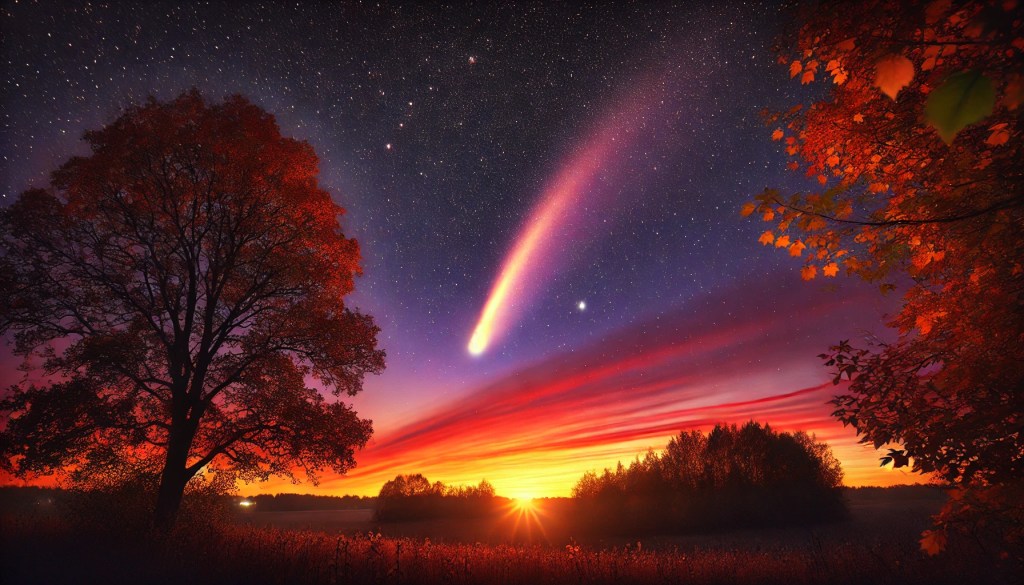
Don’t forget Comet C/2023 A3 (Tsuchinshan-ATLAS), which could put on a show from October 14th onward. This ancient comet, possibly last seen 80,000 years ago, will be visible near the western horizon after sunset. Grab your binoculars and catch a glimpse of this icy visitor before it’s gone!
Links
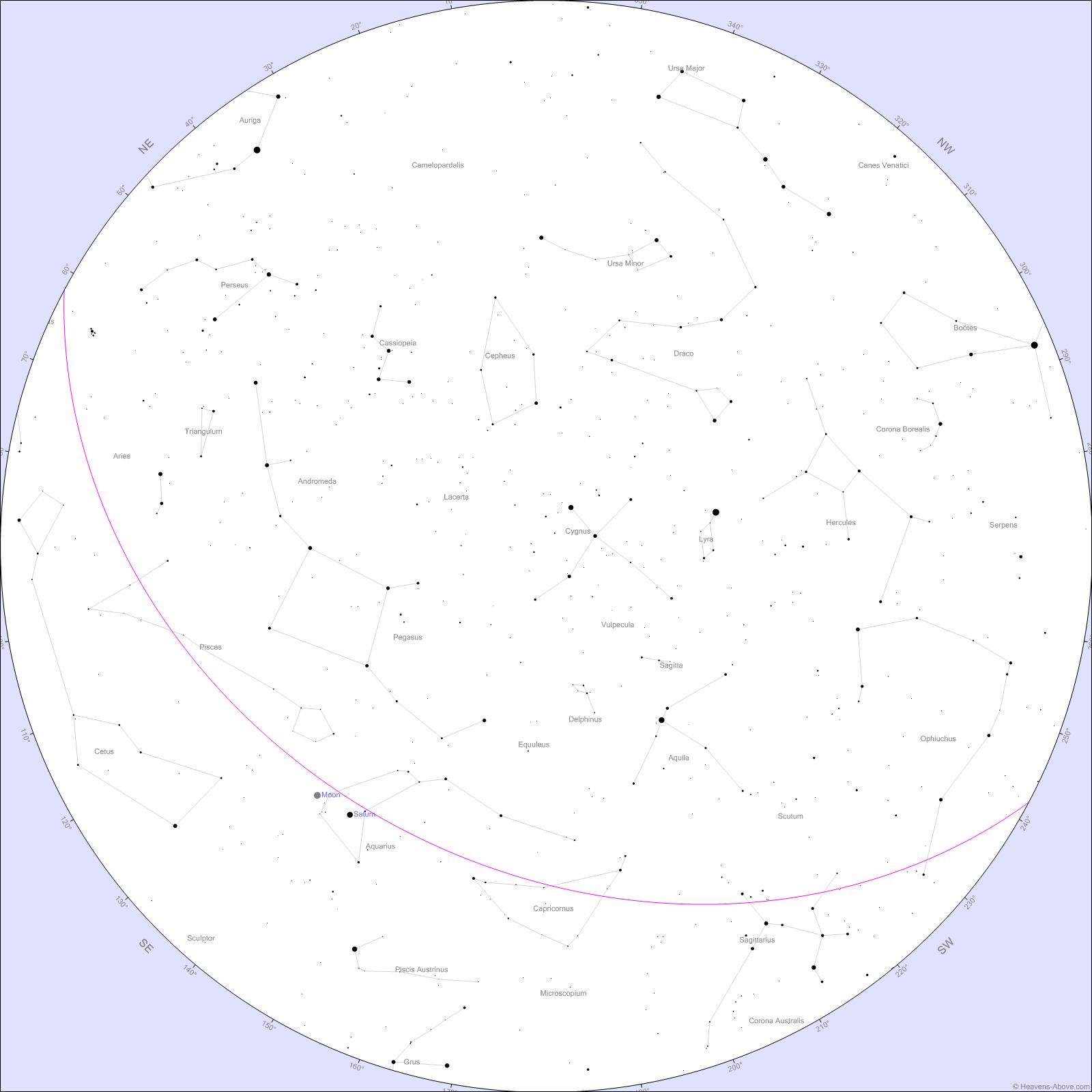
- Sky map for week starting October 13, 2024
- Episode 38 on YouTube
Transcript
Howdy stargazers, and welcome to this episode of Star Trails. I’m Drew, and I’ll be your guide to the night sky for the week starting October 13th to the 19th.
This week brings a full moon and the possibility of a shimmering comet. We’ll take a look at a minor constellation with a “lonely star,” and later in the episode, we’ll explore the orbital patterns that shape our planetary system – the gravitational interactions that create predictable patterns known as “resonances.”
So grab a comfortable spot under the night sky, and let’s get started.
First off, I hope many of you were able to catch the Northern Lights in some of the lower 48 states this week. Following a massive geomagnetic storm in the wake of a coronal mass ejection, the skies lit up with aurora as far south as Mexico on October 11th. I know folks around my area saw and managed to photograph the aurora, but I wasn’t so lucky.
I thought I could spot some high altitude red or pink bands earlier in the evening from a photo taken in my backyard, so I ventured out into the countryside around 9 p.m. and found a vast north-facing field. In the near total darkness, I saw absolutely nothing. So I suspect whatever folks saw in my area dissipated quickly.
Since May, many states in lower latitudes have been fortunate to see the Northern Lights thanks to a very active solar cycle. While a solar storm can kill radio communications on some bands, overall, this solar cycle has been a boon for ham radio operators for the past year or more. A few years ago, solar activity, which plays a role in the propagation of radio signals, was at an all-time minimum, so operations in certain bands, like 10 meters, were very hit or miss.
Anyway, space weather and amateur radio are topics for a future show, so let’s get on with this week’s exploration of the night sky!
October 17 marks the Full Hunter’s Moon, which will also be the biggest and brightest Supermoon of 2024. This Supermoon will appear larger than usual due to the Moon being at its closest point to Earth. You can start observing it on the evening of October 16, and it will shine in the constellation Pisces.
The Hunter’s Moon has a rich lore rooted in the rhythms of rural life. The name originated from Native American and European traditions. After farmers completed their harvest under the bright Harvest Moon, which is the full moon nearest the autumnal equinox, the Hunter’s Moon provided additional light for hunting game, which was then stored for winter. The bright moonlight allowed hunters to track animals at night, especially deer and other creatures.
The Hunter’s Moon is known for rising just after sunset, with the moonlight lasting throughout the night. This is because of the Moon’s shallow angle relative to the horizon during this time of year, which causes it to rise sooner than at other times. This creates an effect where the moonlight appears brighter and lasts longer in the sky, adding to its importance in ancient times.
In modern times, the Hunter’s Moon is also celebrated for its beauty, often appearing larger and more orange as it rises, due to the atmospheric conditions when it is closer to the horizon.
Elsewhere in the solar system, Saturn will be visible in the southeastern sky just after sunset and remain up for most of the night. On October 14, it will be near the waxing gibbous Moon, creating a striking conjunction.
Jupiter will rise after 10 p.m., and by the early morning of October 19, it will appear near the nearly full Moon in the constellation Taurus. Look for Jupiter’s bright presence in the eastern sky, especially after midnight.
Mars rises near midnight. Its reddish hue will be noticeable in the pre-dawn hours as it climbs higher in the sky. Venus will be visible low in the west just after sunset. Although it sets soon after, you can catch it shining brightly early in the evening right now.
And I’ve saved the best for last. From October 14 until the end of the month, Comet C/2023 A3 (Tsuchinshan-ATLAS) should make a stunning appearance low on the western horizon after sunset. The best viewing window for this comet is from October 14-24 and is predicted to have a magnitude around 0 – that means it’s about the same brightness as Mars, and will be easily visible to the naked eye.
This comet has a long, curved tail, and images already captured of it have been stunning. Hopefully you get a chance to see this icy visitor. The last time it visited Earth may have been around 80,000 years ago, in the era of the Neanderthals!
For those of you looking to spot something a little off the beaten path this October, take a look at Piscis Austrinus, the Southern Fish. It’s a lesser-known but still-interesting constellation that rises in the southern sky during the fall.
While it may not be as famous as some of its neighboring constellations, such as Aquarius, Piscis Austrinus holds a special place in the sky. In fact, it’s home to one of the brightest stars you can see this time of year—Fomalhaut. Fomalhaut shines at magnitude 1.16, making it one of the brightest stars in the night sky, and the brightest star in its immediate region. It’s often called the ‘Lonely Star’ because it stands alone in a relatively empty patch of sky, away from other bright stars. You’ll notice its clear, solitary presence in the southern sky, especially on dark autumn nights.
Fomalhaut also has some modern significance—astronomers have discovered an exoplanet orbiting this star, known as Fomalhaut b. This makes Piscis Austrinus an exciting target for those interested in the ongoing search for planets beyond our solar system.
In ancient Greek stories, Piscis Austrinus represents the Great Fish that swallowed water from the flood sent by Zeus. Some myths also associate it with the fish that saved Aphrodite and her son Eros when they transformed to escape the monstrous Typhon. This tale is also tied to the neighboring constellation Pisces, representing two fish swimming together.
Today, we’re going to explore one of the more fascinating aspects of orbital dynamics in our solar system: resonances. These are relationships between orbiting bodies where their gravitational interactions cause them to establish predictable, repeating patterns.
In simple terms, a resonance occurs when two or more orbiting objects exert a regular, periodic gravitational influence on each other, usually because their orbital periods are in a simple ratio. For example, if one planet takes exactly twice as long to orbit the Sun as another, we call that a 2:1 resonance. Resonances can occur between planets, moons, or even small objects like asteroids, and these orbital relationships play a key role in the stability of the solar system.
Our understanding of orbital resonances goes back centuries, to the early days of celestial mechanics. One of the key figures in this field was the French mathematician and physicist Pierre-Simon Laplace. In the late 18th century, Laplace developed a mathematical framework for understanding how gravitational forces shape the motion of celestial bodies. His work extended and built upon the laws of motion first formulated by Isaac Newton, and he laid the foundation for modern orbital mechanics.
Laplace was the first to describe the Laplace resonance, a three-body orbital resonance that we observe today among the moons of Jupiter—Io, Europa, and Ganymede. These moons follow a 1:2:4 resonance, meaning for every four orbits Io makes around Jupiter, Europa makes two, and Ganymede makes one. This resonance affects the physical conditions of these moons, particularly Io. The constant gravitational tug from the other moons causes significant tidal forces, which heat Io’s interior, leading to the extreme volcanic activity we observe.
In the centuries following Laplace, astronomers began to realize that these resonant patterns weren’t just an abstract mathematical curiosity—they were a key to unlocking new discoveries.
For instance, the discovery of Neptune was the result of the study of resonances. In the early 19th century, astronomers noticed that Uranus wasn’t moving as expected. Its orbit showed small deviations, suggesting that another planet was influencing it through gravitational interactions—likely a resonance effect.
Using these discrepancies, French mathematician Urbain Le Verrier and British astronomer John Couch Adams independently calculated the position of this unseen planet. In 1846, astronomers pointed their telescopes to the predicted coordinates, and Neptune was found exactly where the calculations had indicated. This marked one of the first times a planet was discovered through mathematical prediction—an extraordinary triumph for celestial mechanics and gravitational theory.
And speaking of Neptune, let’s explore the resonance between it and Pluto. Despite the fact that Pluto’s orbit crosses inside Neptune’s, the two will never collide because they are locked in a 3:2 resonance. This means that for every three orbits Neptune completes around the Sun, Pluto completes two. This resonance ensures that they are never at the same point in their orbits at the same time, which stabilizes their otherwise intersecting paths.
Saturn’s moons and rings provide several examples of resonance-driven dynamics. One prominent case involves the moons Mimas and Tethys, which are in a 2:1 resonance. Every time Tethys completes one orbit around Saturn, Mimas completes two. This interaction has played a role in shaping Saturn’s rings, particularly the Cassini Division, a gap in the rings. Mimas exerts gravitational forces on the particles in the rings, preventing material from accumulating in this region.
There’s also a fascinating resonance between Earth and the Moon. This is a 1:1 spin-orbit resonance, more commonly referred to as synchronous rotation. It means that the Moon rotates on its axis in the same amount of time it takes to orbit the Earth—about 27.3 days. As a result, the same side of the Moon is always facing the Earth. This is why we never see the ‘far side’ of the Moon from our vantage point.
This synchronous rotation is the result of tidal forces between the Earth and the Moon. In the early history of our planet the Moon rotated faster. Over millions of years, Earth’s gravitational pull created tidal friction on the Moon, gradually slowing its rotation until it became locked in this resonance. Now, the Moon’s spin is perfectly matched to its orbital period, and it’s been that way for a very long time.
There is a Reciprocal Effect. The Moon of course exerts tidal forces on Earth too, which is why we experience tides in the oceans. Over time, these forces are also slowing Earth’s rotation. Every century, Earth’s day gets a tiny bit longer—about 1.7 milliseconds per century. As Earth’s rotation slows, the Moon is gradually moving farther away from us, by about 3.8 centimeters per year. This means the resonance between Earth and the Moon will continue to evolve over millions of years.
You may recall in our last episode I mentioned that Earth recently captured a new moon, a small asteroid about the size of a school bus. This isn’t the first time this has happened.
Near-Earth asteroid 3753 Cruithne, has in the past been called “Earth’s Second Moon.” Cruithne isn’t a true moon, but shares a 1:1 resonance with Earth. Instead of orbiting Earth directly, Cruithne follows a unique horseshoe-shaped path around the Sun that keeps it in sync with Earth. This resonance prevents Cruithne from ever coming too close to Earth, while keeping it in a gravitational dance with our planet.
Resonances are not limited to just these major moons and planets. There are several other interesting examples throughout our solar system.
Jupiter plays a key role in shaping the asteroid belt through a series of resonances. These are called Kirkwood gaps, named after astronomer Daniel Kirkwood who discovered them in the 19th century. The Kirkwood gaps are regions in the asteroid belt where there are fewer asteroids because their orbital periods would have been in resonance with Jupiter, causing gravitational disturbances that ejected the asteroids from these orbits. For example, there’s a 3:1 resonance gap, where an asteroid would orbit the Sun three times for every one orbit of Jupiter. Over time, these resonances either push asteroids into new orbits or eject them from the belt altogether.
Resonances also occur in the distant Kuiper Belt, where objects like Pluto and its fellow dwarf planets reside. Many Kuiper Belt objects are in resonance with Neptune. For instance, there are KBOs in 2:3 and 1:2 resonances with Neptune, meaning that for every two orbits Neptune makes around the Sun, these objects complete three orbits, or in some cases, two. This stabilizes the orbits of these small bodies despite their proximity to Neptune’s much stronger gravitational influence.
While not part of our solar system, it’s worth noting that resonances are observed in exoplanetary systems as well. Several multi-planet systems discovered by astronomers show planets in tight, resonant orbits, providing evidence that resonance is a common feature in planetary systems across the galaxy.
Resonances are important because they help maintain the stability of our solar system over long timescales. By preventing chaotic interactions between orbiting bodies, resonances help keep their orbits predictable and stable.
In some cases, resonances can also destabilize certain orbits, as we see with asteroids in the Kirkwood gaps. The existence of resonances suggests that the solar system has undergone a delicate process of gravitational balancing that has shaped its current structure.
That’s it for today’s episode of Star Trails. If you found this episode informative or entertaining, please share it with a friend. The easiest way to do that is by visiting our website, startrails.show, where you can find all our episodes, including transcripts, night sky maps and more.
Until next time, keep looking up and exploring the night sky. Clear skies, everyone!
Support the Show
Connect with us on Mastodon @star_trails.
If you’re enjoying the show, consider sharing it with a friend! Want to help? Buy us a coffee!
Podcasting is better with RSS.com! If you’re planning to start your own podcast, use our RSS.com affiliate link for a discount, and to help support Star Trails.
 Star Trails: A Weekly Astronomy Podcast
Leave a comment