Chasing Comets and Conquering Light Pollution – Star Trails: A Weekly Astronomy Podcast
Episode 39
Join us as we explore the night sky from October 20th to the 26th. This week is packed with celestial delights, including the Orionid and Leonis Minorids meteor showers, planetary conjunctions, and the star of the show, Comet C/2023 A3 (Tsuchinshan-ATLAS). Drew will describe his efforts to spot and capture this spectacle, which is a must-see for any backyard astronomer.
We’ll also discuss one of the biggest challenges for stargazers: light pollution. Discover how you can improve your stargazing experience even in brightly lit areas, and learn about the Bortle Scale, which measures night sky darkness. Drew will also discuss practical tips for reducing local light interference and maximizing your night sky enjoyment with filters and other techniques.
Transcript
Howdy stargazers, and welcome to this episode of Star Trails. I’m Drew, and I’ll be your guide to the night sky for the week starting October 20th to the 26th.
This week brings meteor showers, conjunctions, some classic deep sky objects, and of course, a comet that has everyone talking. We’ll complete a celestial family drama that played out in Greek mythology, and later in the episode, we’ll talk about the scourge of stargazers – light pollution – and what we can do about it.
So grab a comfortable spot under the night sky, and let’s get started.
Comet C/2023 A3 (Tsuchinshan-ATLAS) is currently one of the most exciting celestial objects in the sky for October 2024. It reached its closest approach to Earth on October 12 and will remain visible in the evening skies through this month. Look for it around twilight, shortly after the Sun sets, and make sure you have an unobstructed view of the western horizon!
The comet is steadily climbing higher each night, making it easier to observe as the days progress. By October 26, it will be about 38 degrees above the horizon – that’s about the height of four fists held at arm’s length to the sky – setting roughly four and a half hours after sunset.
During this period, the comet’s tail is expected to become more prominent, stretching dramatically as it moves further from the Sun. If you’re in a location with dark skies, far from city lights, you may even spot some detailed features of the tail. While binoculars or a small telescope will enhance your view, it may be visible to the naked eye in optimal conditions.
This period may be the best chance to observe this comet, as it won’t return for tens of thousands of years. The moon will be rising later in the evening this week, which may prove useful for comet spotting.
I went out and photographed Comet A3 a few days ago, and I can confirm it’s a spectacular object, visible even in the light of the full supermoon. With averted vision, I was barely able to make it out, but it jumped out of the sky in my 11×70 binoculars. I was able to photograph it using an iPhone in night shot mode, and it looked great at 200mm when photographed with a full-frame mirrorless camera.
It took me two tries to spot A3. My first effort went horribly awry as I attempted to locate it against the bright backdrop of metropolitan light pollution near my home. I knew it would be a longshot. Since we’ve had consecutive clear nights lately, I decided to try spotting it the next evening. But this time, I drove about an hour into one of the most desolate counties in my state to a location where I’ve had good success shooting the Milky Way in the past.
Conditions still weren’t great. I was fighting against both the brilliance of the full supermoon, and time. The comet was low in the sky – I estimated it was about 10 degrees above the horizon by the time I arrived, so it wasn’t going to hang around long for photos. I put my camera on a tripod and found an old barn to place in the foreground for some wide shots. Then I switched to a 200mm lens for a closer view, and before I left, I placed my iPhone on a tripod to see how those would turn out. I discovered that if you’re in a reasonably dark area, a steadily-held smartphone using a night shot or astronomy mode can easily capture this comet.
Although I managed to eke out a few images, I won’t be entering these into a competition or even sharing them on social media. I plan to make another effort in the coming days, provided we have clear skies, and I encourage anyone listening to go out and see this comet now before it’s too late. The last time I saw a comet this spectacular was Halley’s Comet in 1985 when I was 10 years old. A3 is really that good, so go get your eyes on it if you can.
Not to be Captain Obvious here, but the darker the skies, the better your view will be, and that goes for every object in the night sky. In the second half of the show I’ll tell you how you can find the darkest skies in your neck of the woods, but first, let’s find out what else is happening in the sky this week.
The Last Quarter Moon is on October 24, so you’ll see half of it illuminated, rising late at night and setting in the early afternoon. Before that, on October 20th and 21st, keep an eye out for a nice conjunction of the Moon and Jupiter. As the second brightest planet in the sky, Jupiter will shine brightly next to the Moon all night long.
By the end of the week, on October 26, the Moon will also be hanging out with Regulus, the red heart of the constellation Leo. This early morning pairing will be a great way to start your day, just before dawn.
Jupiter will be visible all night long, hanging out in Taurus. As I mentioned, you’ll see it in conjunction with the Moon on the 20th and 21st, but it’ll be shining brilliantly throughout the week. Saturn is situated in the constellation Aquarius and is a perfect target for telescope viewers, especially with its rings becoming more edge-on as we head into 2025.
You’ll spot Mars rising in Gemini later at night, around midnight by week’s end. On the night of October 23, it will also pass close to the Moon—another conjunction worth checking out! Meanwhile, Venus, our bright evening star, will be glowing low in the southwestern sky, especially around October 24 when it appears near the bright red star Antares in Scorpius.
Don’t forget the Orionid meteor shower, peaking tonight and into the morning. These meteors come from Halley’s Comet and shoot across the sky at 41 miles per second! Be aware the Moon will be quite bright during the peak, which means it may drown out some of the fainter meteors. Try to block the Moon behind a tree or building, and focus on the darker parts of the sky.
Later in the week, the Leonis Minorids meteor shower peaks on October 24, but these are a bit quieter with fewer meteors per hour.
For deep sky enthusiasts, the Perseus Double Cluster will be well-positioned in the northern sky on October 26. This duo of open star clusters, NGC 869 and NGC 884, is about 7,500 light-years away, and you can find them nestled between Perseus and Cassiopeia. Even with just binoculars, you’ll be able to see this rich field of stars sparkling against the darkness of space.
Also well-placed this week is the Andromeda Galaxy—our nearest galactic neighbor. At about 2.5 million light-years away, it’s the largest galaxy visible from Earth and can be spotted with the naked eye if you’re in a dark area. You’ll find it in the constellation Andromeda, rising higher in the sky as the night goes on.
And for telescope users, the Triangulum Galaxy, M33, is another great target. It’s the third-largest member of our local group of galaxies and offers a beautiful, spiral structure for those with larger scopes. You’ll find it in the small constellation Triangulum, which is located roughly between Andromeda and Aries.
Lastly, don’t miss the Pleiades, or Seven Sisters, cluster. This open star cluster in Taurus is always a breathtaking sight, and it’ll be visible in the eastern sky.
A prominent constellation that rises this time of year is Cepheus, the King. If he sounds familiar, it’s because he’s been a big player in some of the night sky lore we’ve discussed recently, particularly in the stories of Andromeda, Cassiopeia, Cetus, Pegasus and Perseus.
Located near the constellations Cassiopeia and Draco, Cepheus is best seen in the northern sky during the fall and early winter months. It’s easily identifiable by its “house” shape—a five-sided figure that somewhat resembles a child’s drawing of a house with a peaked roof.
The constellation contains several notable stars, including Alderamin, the brightest star in Cepheus, and Delta Cephei, which has been critical in the study of variable stars. In fact, Delta Cephei is the prototype of Cepheid variable stars, which astronomers use to measure distances to far-off galaxies.
Another highlight is the Garnet Star (Mu Cephei), a strikingly red supergiant that shines with a deep, ruddy hue. Cepheus also hosts IC 1396, an expansive star-forming region containing the Elephant’s Trunk Nebula, a favorite among astrophotographers.
According to Greek myths, Cepheus was the king of Aethiopia, and he was caught up in some celestial drama after his wife, Cassiopeia, boasted that she was more beautiful than the sea nymphs. This angered the sea god Poseidon, who sent a sea monster, Cetus, to ravage their kingdom. To appease Poseidon, Cepheus and Cassiopeia sacrificed their daughter, Andromeda, by chaining her to a rock. The hero, Perseus, swooped in riding Pegasus to save her just in the nick of time, and she ended up marrying him.
The entire family is immortalized in the night sky as constellations, with Cepheus often depicted as a king on his throne or holding a royal scepter.
If you like fast cars, you’ve at some point probably heard the expression, “there’s no replacement for displacement,” meaning that you can bolt on a turbo or a supercharger, and various go-fast parts that boost an engine’s power, but at the end of the day, the greatest performance will come with more displacement, in other words, a bigger engine. In astronomy, and especially astrophotography, there are tricks to pull dim objects from light polluted skies, such as techniques involving filters, exposure stacking, certain types of cameras and computer processing. But everything gets a lot easier to deal with, and viewing is much more enjoyable if you can relocate to darker skies.
Today, we’ll talk about the Bortle Scale, which measures the brightness of the night sky based on light pollution, and we’ll get into practical ways you can still enjoy the stars even if you live in a brightly lit area.
This light pollution scale was developed by astronomer John E. Bortle in 2001. The scale ranges from 1 to 9, with 1 being the darkest, most pristine sky you could ever imagine, and 9 being a sky flooded with artificial light, like in the middle of a large city. If you’ve looked at any astrophotography online recently, you’ll often see the photographer mentioned the Bortle rating in the area where the photo was taken. Knowing your Bortle rating can give you a great sense of what you’ll be able to see from your location, or capture with your astrophotography rig.
Let’s break down a few key levels of the Bortle Scale:
Bortle 9 is the worst of the worst. Think of downtown in a major city, like New York or Tokyo. Here, you might only be able to see a handful of the brightest stars. Forget about spotting the Milky Way, planets other than Venus or Jupiter, or any deep-sky objects.
Bortle 7 and 8 are suburban skies. You’ll see more stars than in the city, but the Milky Way is still a no-show. You might be able to spot a few planets and the brighter constellations, like Orion in winter or Scorpius in summer. I live in a transitional zone between Bortle 7 and 8, just a few miles outside a metropolitan area. Still, with binoculars I can spot star clusters and some major nebulae, such as the Great Nebula in Orion.
Bortle 4, 5, and 6 are rural skies with varying degrees of light pollution. In Bortle 5 or 6, you can start to see the Milky Way on a clear night, but it’s faint. As you move toward Bortle 4, the Milky Way gets clearer, and you might spot some of the brighter nebulae, like the Orion Nebula or the Andromeda Galaxy. When I went out to photography Comet A3 a few days ago, my location was in a Bortle 4 zone. My local astronomy club’s observation site is located in Bortle 4.
Bortle 2 and 3 zones are considered truly ‘dark skies.’ You can see the Milky Way shining brightly, and if you have a telescope, you can start tracking down faint galaxies.
Bortle 1 is the dream. A truly dark sky where the Milky Way is so bright it casts a shadow! You can see thousands of stars, all the constellations, the Zodiacal Light, and even faint details of nebulae without any equipment. It’s the kind of sky you can find in remote deserts, high mountains, or far out at sea.
I live in a southeastern state where Bortle 4 is common in between small cities and a few metropolitan areas. In my experience, I typically need to drive about 30 miles away from my home location to get truly dark skies. In my state we have a handful of small areas that are Bortle 3 or even 2.
So, how can you determine what zone you’re in, and where some darker areas are? My favorite resource is a web site. Visit lightpollutionmap.info and click anywhere on the map to get detailed information on the sky brightness at that point, and zooming out will give you an idea of where light pollution hot spots are. I’ll include a link in the show notes.
If you’re stuck in a Bortle 7 or 8 zone, there are ways to enhance your stargazing.
First up is reducing local light interference. It sounds simple, but blocking out nearby streetlights or house lights can make a big difference. These nearby light sources wreak havoc on your night vision. Find a spot where they aren’t shining in your eyes. Even moving just a few blocks away from bright streetlights, or heading out to a park or field, can make a difference. If you can, seek out higher ground – hills or rooftops where there’s less light reflecting off nearby surfaces.
Filters are another tool in your kit. Light pollution filters, like UHC (Ultra High Contrast) or CLS (City Light Suppression) filters, can help cut through some of the artificial light by blocking certain wavelengths, such as those emitted by streetlights. These filters really improve the visibility of faint objects like nebulae, star clusters, and galaxies, even in moderately light-polluted areas.
Astrophotographers who live in areas with a lot of light pollution have devised some smart techniques to deal with pollution. As with visual observation, a broadband light pollution filter can be especially useful. These selectively block the most common types of artificial light, like sodium vapor and LED lights, which are the main culprits in city and suburban lighting. You can also use narrowband filters, which only let through very specific wavelengths of light. These are useful for photographing nebulae, as they enhance the light emitted by ionized gases while filtering out almost all other light.
Another strategy for astrophotography is using a monochrome camera with narrowband filters. Monochrome cameras don’t capture color the way regular DSLR or color astronomy cameras do. Since they essentially shoot black and white images, you have to use red, green and blue filters to create the layers for an RBG image. There are other useful filters for monochrome cameras too. By capturing different wavelengths separately – usually hydrogen-alpha, oxygen-III, and sulfur-II – you can build up a detailed, high-contrast image, even in areas with significant light pollution.
After capturing each filter’s data, you can stack the images in image processing software. This technique is a favorite among astrophotographers who shoot in urban areas because it allows you to essentially exclude the wavelengths you don’t want to capture, such as light pollution.
Regardless of the camera used, image stacking is an essential technique for almost all astrophotography nowadays. By taking multiple long-exposure shots and then using software to combine them, you can increase the signal-to-noise ratio in your final image. This helps to bring out faint celestial objects while minimizing the impact of light pollution. Programs like DeepSkyStacker or PixInsight are popular for this technique, and the results can be stunning, even from a city.
Light pollution doesn’t just affect our ability to see the stars – it’s also impacting wildlife! Artificial lights confuse animals that rely on natural light cues for navigation, migration, and reproduction. Birds, sea turtles, even fireflies can suffer from the excess light that we throw into the sky. So, reducing light pollution isn’t just about us stargazers, it’s about keeping nature in balance too.
Some communities are adopting dark sky initiatives. These efforts work to replace traditional streetlights with shielded, downward-facing lights, reduce unnecessary outdoor lighting, and promote more efficient lighting designs. It’s a win for the environment, energy use, and, of course, for stargazing.
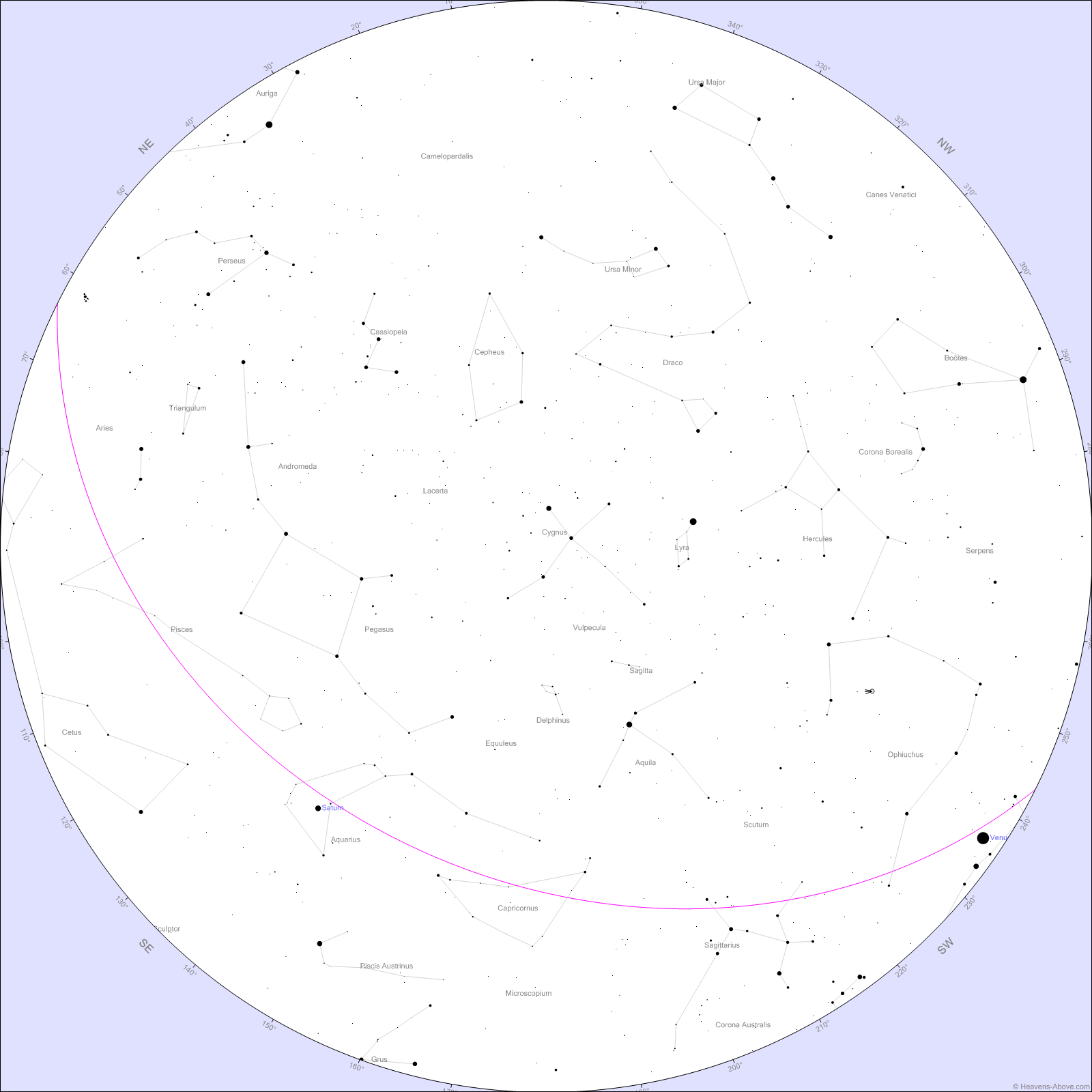
That’s it for today’s episode of Star Trails. If you found this episode informative or entertaining, please share it with a friend. The easiest way to do that is by visiting our website, startrails.show, where you can find all our episodes, including transcripts, night sky maps and more.
Until next time, keep looking up and exploring the night sky. Clear skies, everyone!
Support the Show
Connect with us on Mastodon @star_trails.
If you’re enjoying the show, consider sharing it with a friend! Want to help? Buy us a coffee!
Podcasting is better with RSS.com! If you’re planning to start your own podcast, use our RSS.com affiliate link for a discount, and to help support Star Trails.
 Star Trails: A Weekly Astronomy Podcast
Leave a comment