Spirits in the Sky: Halloween Stargazing – Star Trails: A Weekly Astronomy Podcast
Episode 40
Join us for a haunting Halloween edition of Star Trails as Drew teams up with the enigmatic “Eternal Watcher,” a spectral voice from the cosmic beyond, to reveal the eeriest celestial wonders lurking in the night sky. Take a journey through the ghostly side of the cosmos, from the Witch Head and Ghost Nebulae to the “Eye of God” — a nebula that seems to gaze back at us.
Alongside our celestial sights, we’ll explore myth and mystery with tales of Algol, the Demon Star, and the tragic tale of Orion, the eternal hunter.
Also this week, be on the lookout for the Orionid meteor shower, Jupiter, Saturn’s rings, and more!
Transcript
[Eerie music and ambiance]
THE ETERNAL WATCHER:
Well, well, what have we here? Another curious soul, daring to venture into the dark, starry abyss… How delightful! Welcome to the decrepit observatory of the Eternal Watcher, perched atop this forsaken peak where the winds never cease, and the shadows grow long. Here, I watch the skies… and listen… to the whispers of the cosmos.
Ah, but tonight is no ordinary night, my celestial companions. No, no… for the veil between worlds is thin, and the heavens are brimming with secrets. And look at this… I’m receiving a transmission… Yes, my radio telescope is receiving a voice from the aether… a familiar one. Do you hear it? It’s our friend Drew, drifting through the cosmic microwave background, bringing you his usual… what does he call them? Stargazing tips? How quaint!
[Radio tuning, voice buried in the noise]
Now, don’t get me wrong, Drew is a fine stargazer, even if he’s more likely to trip over his own telescope than discover a new constellation. He’s got that endearing, ‘oh-look-there’s-a-meteor’ enthusiasm that you mortals find so charming. But tonight, let’s see if he can handle the darker side of the cosmos, shall we? After all, not every twinkling light is as friendly as it seems… Heheheheh!
[Radio static gives way to a the narrator’s filtered voice]
DREW:
Howdy, stargazers, and welcome to a special Halloween edition of Star Trails! My name is Drew, and today, we’re diving into the spookier side of the universe, exploring some ghostly nebulae and deep-sky objects that might send a shiver down your spine, and later in the episode, we’ll gather around the campfire for some scary stories of the night sky.
So grab your binoculars and some Halloween candy, and let’s get started.
Now, when you think of Halloween, your mind might wander to haunted houses and eerie graveyards, but did you know the night sky has its own share of ghost stories? Out there, in the depths of space, are nebulae that seem to float like spectral apparitions, stars that flicker like candle flames, and even cosmic clouds that resemble ghostly figures.
I can’t think of a better place to begin, than with the Ghost Nebula, also known as SH2-136. Located about 1,200 light-years away in the constellation Cepheus, this eerie structure of gas and dust appears to have ghostly figures drifting through space. These “figures” are actually knots of interstellar dust and gas, which reflect and scatter the light from nearby stars, giving the nebula its haunting, translucent appearance. If you catch a glimpse of this nebula through a telescope, it’s not hard to imagine a few ghostly apparitions gliding silently across the void.
And then there’s the Witch Head Nebula. With a name like that, it’s no surprise this cosmic cloud makes an appearance in our Halloween special. The Witch Head Nebula, located about 900 light-years away in the constellation Eridanus, is so named because it looks remarkably like a witch’s profile — complete with a pointy nose and chin. But this nebula isn’t conjuring up spells; it’s actually a cloud of gas and dust that’s reflecting the light of the nearby supergiant star, Rigel. This blue star, which is part of the Orion constellation, gives the nebula a ghostly blue hue, perfect for Halloween night.
Of course, we can’t forget about one of the most iconic deep-sky objects in this spooky category: the Helix Nebula, also known as the “Eye of God.” This planetary nebula is what’s left of a star much like our own Sun, which has shed its outer layers at the end of its life. What remains is a glowing ring of gas, with a dense core at the center. Viewed through a telescope, it almost looks like a giant eye staring back at you from across the cosmos. Spooky, right? The Helix Nebula is about 650 light-years away in the constellation Aquarius, and if you’re lucky enough to be in a dark-sky area, you might just be able to spot it on a clear night.
[Transition FX – Creepy]
When you think of Halloween, you probably picture the warm orange glow of a jack-o’-lantern, right? Well, it turns out, the night sky has its own version of this Halloween hue. Tonight, we’re looking at the stars, moons, and other celestial bodies that shine with that same fiery orange glow, creating a pumpkin-like palette across the cosmos.
Let’s start with some of the orange stars you might spot in the night sky. One of the brightest is Betelgeuse, the red supergiant star that marks the shoulder of Orion. Betelgeuse is one of the largest stars visible to the naked eye, and it shines with a deep, reddish-orange color. This hue comes from its cooler temperature compared to other stars like our Sun, giving it that warm, pumpkin-like glow. Betelgeuse has been in the news quite a bit recently because it’s expected to explode as a supernova sometime in the next 100,000 years. Imagine the Halloween show that would put on!
Another orange star worth noting is Aldebaran, the eye of Taurus the Bull. This star has a softer, orange tint, and it’s relatively easy to find in the night sky. Look for it near the famous Pleiades star cluster, which appears like a tiny dipper of blue-white stars. Aldebaran’s color comes from its cooler surface temperature, similar to Betelgeuse, making it another great example of a “pumpkin star.”
But it’s not just stars that take on a Halloween hue. Every autumn, we get to enjoy the sight of the Harvest Moon, a full moon that rises around the time of the autumn equinox. This year’s Harvest Moon might have already passed, but you can still catch the Hunter’s Moon, which will light up the sky just before Halloween. The Moon appears larger and more orange when it’s closer to the horizon, thanks to an effect called Rayleigh scattering. As the Moon’s light passes through more of Earth’s atmosphere at a low angle, shorter blue wavelengths scatter, leaving the longer red and orange wavelengths to reach our eyes. It’s the same reason sunsets look so vibrant.
Finally, there’s Mars, the “Red Planet.” If you’ve been out stargazing recently, you might have noticed Mars shining brightly in the sky. Its reddish-orange color comes from iron oxide, or rust, on its surface. During certain times of the year, Mars is particularly close and bright, making it a striking addition to the night sky. Maybe it’s not quite a jack-o’-lantern, but it definitely adds to the Halloween color scheme.
So, if you’re heading out for some nighttime stargazing this Halloween, keep an eye out for these celestial pumpkins. From stars to planets, the sky is full of warm, glowing oranges, just like the flickering light of a jack-o’-lantern.
[Transition FX – Creepy]
For thousands of years, people have looked up at the stars and told stories about them — some of them beautiful, some of them spooky, and some of them downright chilling. Tonight, we’ll explore a few of these celestial tales that are perfect for a night of cosmic ghost stories.
First up is the story of Algol, also known as the “Demon Star.” Algol is a star in the constellation Perseus, and it’s famous for its strange, flickering behavior. It’s what astronomers call an eclipsing binary — two stars that orbit each other, causing the star’s brightness to dip every few days. But to ancient astronomers, this dimming and brightening was unsettling, almost as if the star were blinking or winking ominously. The name “Algol” comes from the Arabic word for “the demon’s head,” and in Greek mythology, it represents the eye of Medusa, the snake-haired gorgon whose gaze could turn you to stone.
Fortunately, we know now that there’s no magic behind Algol’s eerie flickering — just a case of celestial mechanics at work.
Let’s visit a tale from Egyptian mythology. The ancient Egyptians believed that the star Sirius represented the soul of the god Osiris, a king who was murdered and dismembered by Set, the God of War. Every year, when Sirius reappeared in the dawn sky after months of being hidden by the Sun, it signaled the start of the annual flooding of the Nile, which brought life and fertility to the land.
But for some, the bright, sudden appearance of Sirius was a ghostly sight. Osiris wasn’t merely an icon of fertility, but in his death, he became the god of the underworld and a symbol of resurrection.
Even today, Sirius is sometimes called the “Dog Star,” because of its association with the “dog days” of summer, when its early morning rise signals the hottest days of the year.
Finally, let’s hear a tale about the constellation Orion. In many cultures, Orion is depicted as a mighty hunter, but some legends paint him in a darker light. In Greek mythology, Orion was known for his unparalleled skill. He was so impressive, in fact, that he claimed he could hunt and kill every animal on Earth. This arrogance would ultimately play a role in his downfall, as the gods rarely looked kindly on mortals who were too boastful.
One of the most well-known myths involves Orion’s complicated relationship with Artemis, the goddess of the hunt and the moon. Depending on the version, Orion was either a companion of Artemis or a would-be suitor. In some stories, Orion tried to force himself on Artemis, enraging the goddess, who then struck him down with her arrows. In other versions, Artemis genuinely cared for him, and it was Apollo, her brother, who grew jealous of their friendship.
In this version, Apollo, the god of the Sun, felt that Orion was becoming too close to his sister. One day, when Orion was swimming far out in the sea, Apollo tricked Artemis. He challenged her to hit a tiny, dark speck in the distance with her arrow, without telling her that the target was actually Orion’s head. Being an excellent archer, Artemis hit the mark and killed Orion. When she realized what she had done, she was heartbroken. To honor him, she placed Orion’s image among the stars, where he continues to hunt eternally across the night sky.
Yet another version has Orion killed by a giant scorpion sent by the Earth goddess, Gaia. The two combatants were placed in the sky as constellations, damning them to forever chase each other across the sky. The two constellations are never seen in the sky at the same time. When Orion rises, Scorpius has already set, and vice versa. It’s as if they’re forever destined to avoid one another, yet always remain locked in their celestial dance.
Despite his tragic and sometimes dark end, Orion’s placement among the stars also symbolizes a kind of immortality. Though he was killed, he was honored by being given a place in the sky, where he remains one of the most recognizable constellations, with his distinctive belt of three bright stars. In a way, this makes Orion’s story both a warning against hubris and a symbol of eternal vigilance and strength, albeit haunted by the events that led to his downfall.
[Transition FX – Creepy]
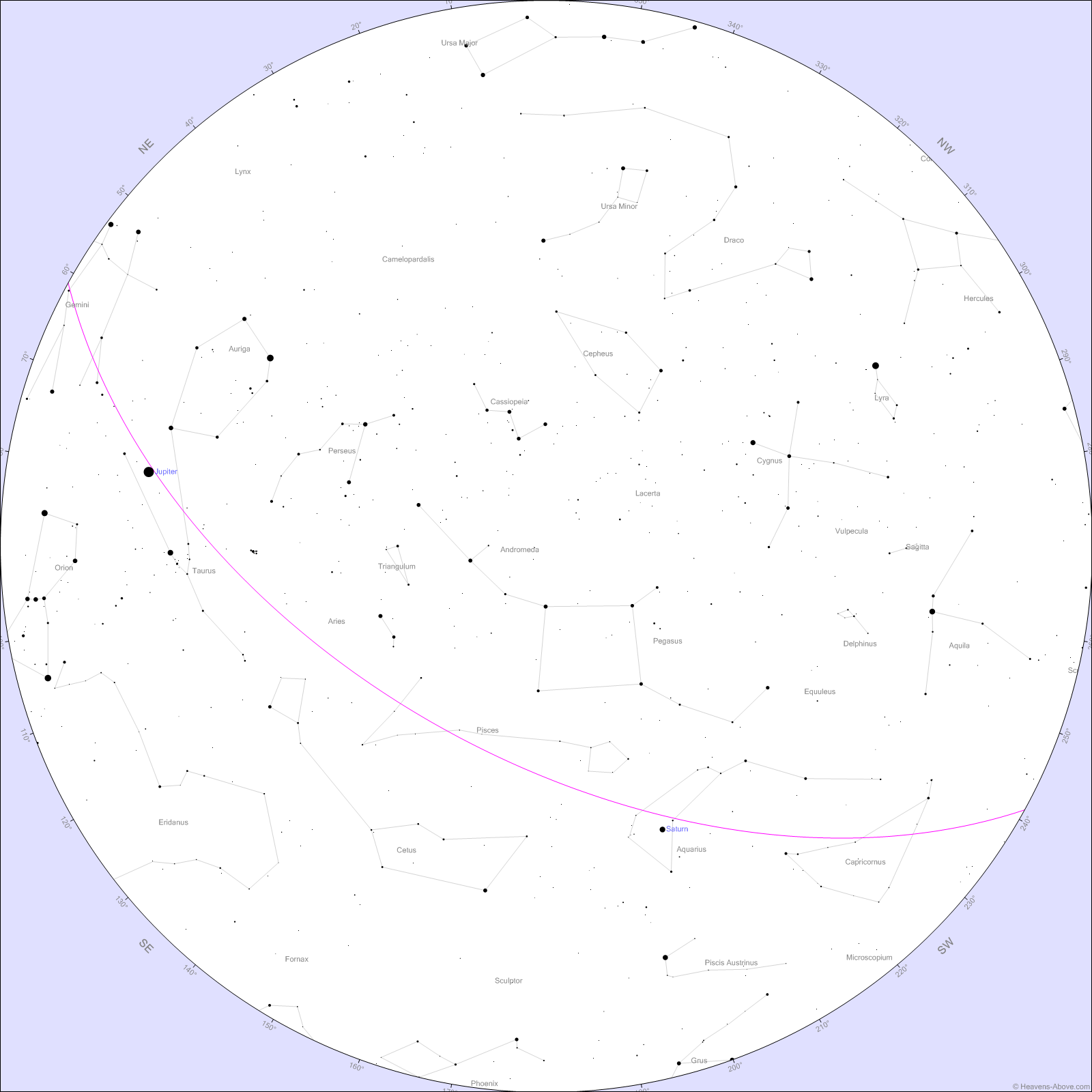
Finally, here’s what’s in the night sky for the week of October 27 to November 2, 2024.
On October 29 the Moon will be in its waning crescent phase, moving closer to a New Moon on November 1. The dwindling Moon is a great time for stargazing as the night sky will be darker, providing better visibility for deep-sky objects.
Jupiter will be bright and easily visible, rising earlier each night and peaking around midnight. It’s positioned in Taurus and reaches a prominent altitude in the sky. Jupiter’s brightness, around magnitude -2.7, and position, make it ideal for observing, especially in the darker hours after the New Moon. Jupiter is also showing great detail, with features like the Great Red Spot visible on certain nights.
Saturn is best observed in the early evening, located in Aquarius. As always, its stunning rings make it a solid target for telescopes. Mars will be rising late in the evening and visible in the pre-dawn hours. It will appear in Gemini, gradually moving toward Cancer, and is brightening as it heads toward opposition in January 2025.
The Orionid meteor shower is still active, though past its peak, which occurred last week. They are still a potential treat for those with clear, dark skies.
Looking out a bit deeper, here are two easy targets to explore this time of year. The Pleiades star cluster (M45) is prominent in the eastern sky. Look for its tiny “dipper-like” shape. The Orion Nebula (M42) is also visible, and easy to locate in the sword of Orion, just under the three distinct stars that form his iconic belt.
The constellations Cassiopeia and Pegasus are well-placed for northern observers, while the Summer Triangle of Vega, Deneb, and Altair will be setting earlier in the evening, marking the end of the summer stargazing season.
That’s it for today’s episode of Star Trails. If you found this episode informative or entertaining, please share it with a friend. The easiest way to do that is by visiting our website, startrails.show, where you can find all our episodes, including transcripts, night sky maps and more.
Until next time, keep looking up and exploring the night sky. Clear skies, everyone!
[Reverbs out to harsh static and radio tuning sounds]
THE ETERNAL WATCHER:
(Mocking) Clear skies everyone… Makes me sick! Well… It seems Drew has managed to make it through another transmission without being completely engulfed by dark matter. Impressive.
My dear stargazers, our time together is coming to an end… but fear not. The night is long, and the sky is vast, filled with countless mysteries that have yet to reveal themselves.
As you leave my haunted observatory, take one last look up at the stars. Perhaps you’ll see a flickering light that wasn’t there before… or a strange, ghostly glow hovering just above the horizon. Or maybe… just maybe… you’ll catch a glimpse of me, peering through the eyepiece of my spectral telescope, watching over the cosmos… and you.
Hahahaha!
Support the Show
Connect with us on Mastodon @star_trails.
If you’re enjoying the show, consider sharing it with a friend! Want to help? Buy us a coffee!
Podcasting is better with RSS.com! If you’re planning to start your own podcast, use our RSS.com affiliate link for a discount, and to help support Star Trails.
 Star Trails: A Weekly Astronomy Podcast
Leave a comment