The Beaver Moon, Planetary Pairings, and the Cosmic Ray Mystery – Star Trails: A Weekly Astronomy Podcast
Episode 42
In this week’s episode, we’re covering the sky highlights for November 10th through 16th. Get ready for the year’s last supermoon, and the bright close-up appearances of Jupiter and Saturn alongside our lunar companion. Plus, the Leonid Meteor Shower is coming. This “king of meteor showers,” is known for its legendary meteor storms!
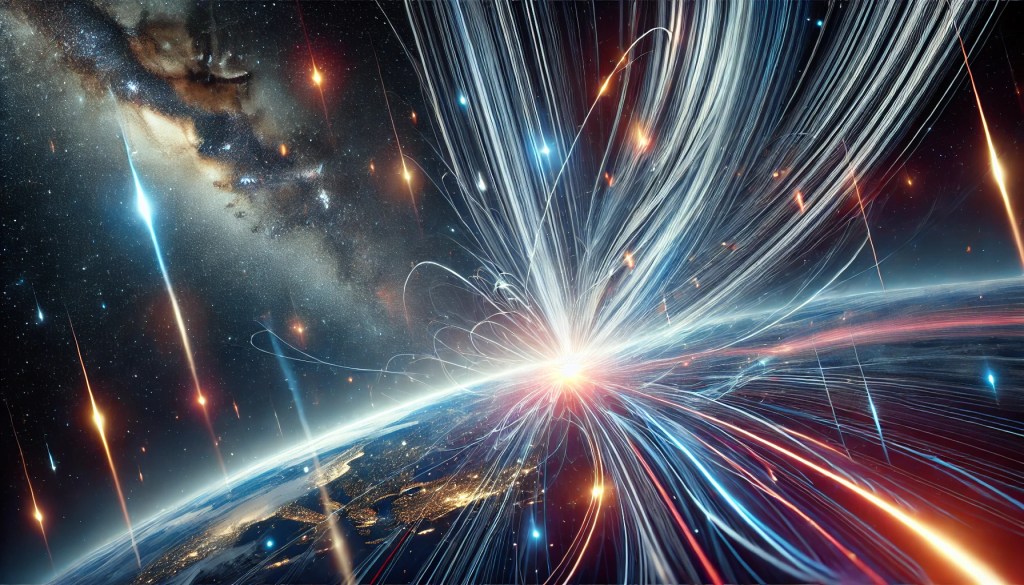
Also, we’ll take a look at cosmic rays—high-speed particles that travel across space, sometimes causing astronauts to “see” light with their eyes closed.
Transcript
Howdy stargazers, and welcome to this episode of Star Trails. I’m Drew, and I’ll be your guide to the night sky for the week starting November 10th to the 16th.
This week we welcome another full supermoon, Mercury makes its presence known, Jupiter and Saturn take turns dancing with the Moon, and we’re on the cusp of the Leonids, the “king of meteor showers.” And later in the show, we’ll take a look at the high speed particles that sometimes cause astronauts to see light with their eyes closed – cosmic rays.
So grab a comfortable spot under the night sky and let’s get started!
We kick things off with the Moon. We’ll be in the First Quarter phase on November 10th. That means the Moon will be over 50% illuminated, making this a great time to view its craters and mountains in sharp relief. Then, on November 15th, we’ll have the Full Moon, known as the Beaver Moon.
This name comes from Native American and early colonial traditions, marking the time when beavers start preparing for winter, safely tucked away in their lodges after gathering food. November’s Full Moon was a sign that it was time to finish up the preparations for the colder months. It’s also sometimes called the Frost Moon or the Snow Moon, as it typically coincides with the first signs of winter.
This Full Moon will peak in the afternoon at 4:29 p.m. Eastern on November 15th, but it will be bright and striking throughout the nights of the 15th and 16th, so be sure to look up and enjoy the sight. The Beaver Moon is the last of four straight supermoons we’ve had this year, so it will be especially large and bright.
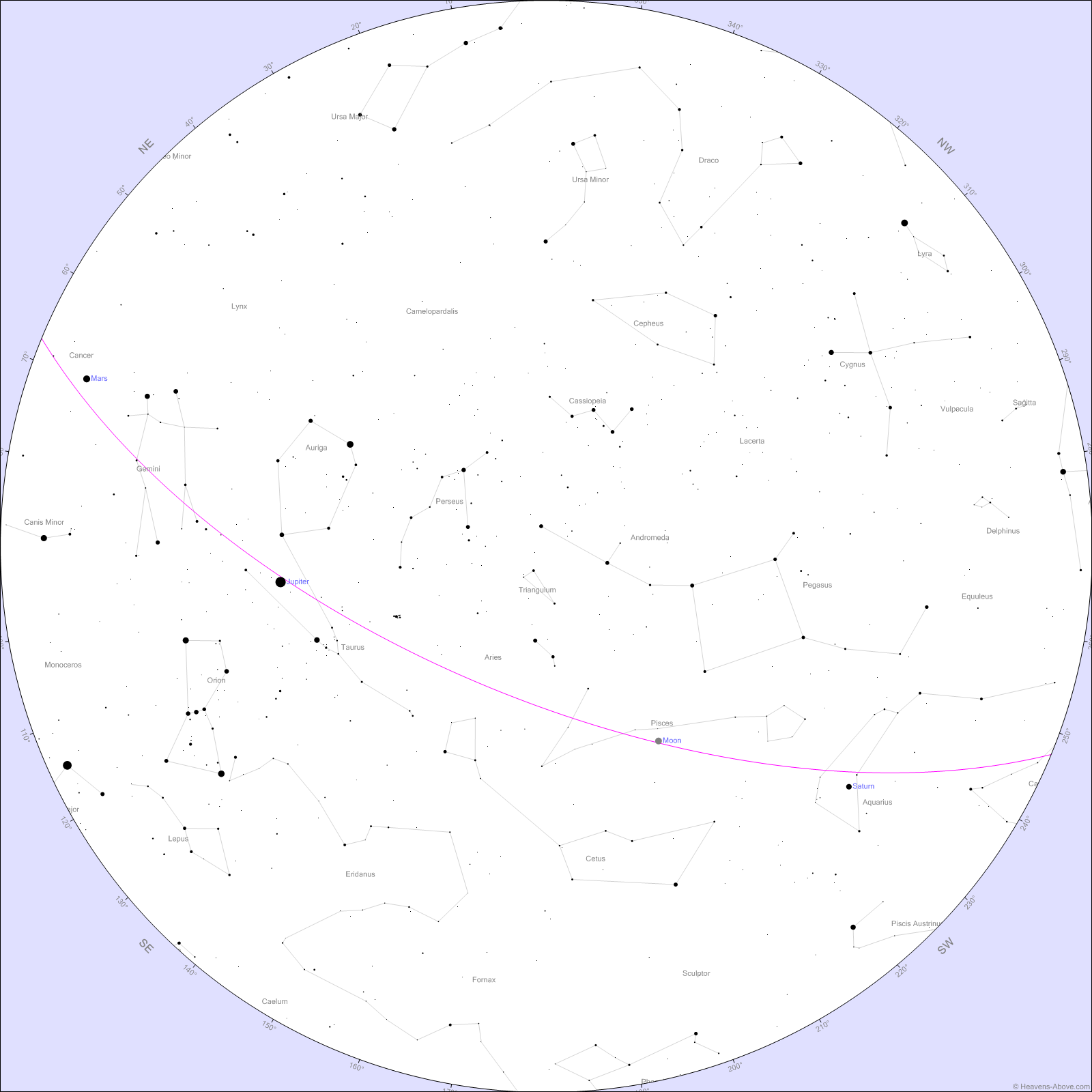
On the evening of November 10th, look for Saturn just a pinky-width away from the Moon in the southeastern sky. This pairing will be quite close, creating a fantastic sight for binoculars or a small telescope. Saturn will stay visible through most of the night in the constellation Aquarius.
Then, on November 16th, Jupiter gets its turn next to the Moon. Jupiter will be rising in the east around 6:30 p.m., and by early evening, you’ll be able to spot it shining bright near the nearly Full Moon. Jupiter will be visible alongside some iconic winter constellations, including Taurus and Orion, making it easy to find.
Mars is also making an appearance, although it rises later at night. You can catch it in the early morning sky before dawn, glowing with its distinctive reddish color. And keep an eye out as Mars continues to brighten over the coming months.
For those with a clear horizon, bright Venus will be low on the western horizon shortly after sunset, though it stays close to the horizon and fades quickly. If you want to see Venus, aim to catch it right as the sky begins to darken.
On November 16th, Mercury will reach its greatest eastern elongation, appearing farthest from the Sun in the evening sky. This marks the best chance to spot Mercury for this month, so look low in the southwest shortly after sunset.
If you’re looking to catch a dazzling show in the night sky, November has something spectacular in store: the Leonid Meteor Shower. Known as the “king of meteor showers,” the Leonids are famous for their speed, brilliance, and, on rare occasions, absolutely jaw-dropping meteor storms.
The Leonids occur each year when Earth crosses the debris trail of Comet Tempel-Tuttle, which orbits the Sun every 33 years. As Earth sweeps through the scattered bits of dust and rock left behind by this comet, these particles hit our atmosphere and burn up, creating those bright streaks of light we call meteors—or, as we often say, “shooting stars.”
The Leonids are known for their incredible speed. These meteors zoom through the atmosphere at up to 71 kilometers per second—that’s more than 150,000 miles per hour! They’re among the fastest of any meteor shower, which makes for a dramatic light show. This speed also helps produce vibrant trails and even occasional fireballs. Some Leonid meteors leave glowing “trains” that linger for several seconds after the meteor streaks by, adding a bit of magic to the experience.
But what really sets the Leonids apart is their history of meteor storms. Every 33 years or so, Comet Tempel-Tuttle’s debris field delivers an especially dense stream of meteors, creating a phenomenon known as a meteor storm. Instead of a few meteors per minute, a meteor storm can bring hundreds or even thousands of meteors per hour! The last Leonid meteor storm was in 2001, with rates reaching hundreds of meteors per minute, which absolutely stunned observers around the world. Even though we’re not expecting a storm this year, the Leonids are always worth a look. In years without a storm, they typically produce a respectable 10 to 15 meteors per hour around the peak.
The Leonids peak this year on the night of November 17 through the early morning of the 18th. To catch the most meteors, head outside around midnight when the radiant point, the spot in the sky where the meteors seem to come from, rises higher. For the Leonids, the radiant is located in the constellation Leo the Lion—hence the name “Leonids.” You don’t need to find Leo to enjoy the show, but knowing where it is can help you orient yourself. You’ll spot the constellation in the eastern part of the sky around midnight, rising higher through the night.
To get the best view of the Leonids, try to find a dark, open spot away from city lights. Lay back, get comfortable, and give yourself time—meteor showers can be unpredictable, and the longer you watch, the better chance you have of catching some truly memorable meteors. If you’re lucky, you might even catch a bright fireball or a meteor with a colorful trail, thanks to the Leonids’ high-speed encounters with our atmosphere.
The Leonids have been inspiring awe for centuries. One of the most famous Leonid storms happened in 1833. Imagine thousands of meteors lighting up the sky all at once! People across North America witnessed it, and some were so astonished, they thought it was the end of the world. The 1833 Leonid storm is one of the events that sparked scientific interest in meteor showers, marking a turning point in how people understood these celestial displays.
So, as November rolls on, take a few minutes—especially around the 17th and 18th—to look up. Whether you see just a handful of meteors or catch a dozen in a few minutes, the Leonids always bring a bit of cosmic wonder to our skies.
Today, we’re exploring one of the most mysterious and energetic phenomena in space: cosmic rays. These high-energy particles travel vast distances to reach us here on Earth, carrying clues about some of the most powerful events in the universe. But what exactly are cosmic rays, where do they come from, and how do they affect us?
Cosmic rays are high-speed particles zipping through space at nearly the speed of light. Despite the name “ray,” they aren’t beams of light or radiation like X-rays or gamma rays. Instead, cosmic rays are primarily made up of atomic nuclei—mostly protons, with some heavier nuclei and electrons. When these fast-moving particles hit Earth’s atmosphere, they interact with atmospheric molecules, creating showers of secondary particles that cascade down toward the surface.
Most cosmic rays are harmless by the time they reach Earth’s surface, thanks to our planet’s atmosphere and magnetic field, which act as shields. But their presence offers scientists valuable insights into high-energy processes happening far beyond our solar system.
Cosmic rays originate from various sources, both inside and outside our galaxy. They’re usually grouped into three categories based on their energy and likely origin:
Solar Cosmic Rays – These are the lowest-energy cosmic rays, generated by our Sun during solar flares or coronal mass ejections. While these are less energetic than other cosmic rays, they pose a concern for astronauts and satellites orbiting Earth, as they can penetrate spacecraft and human tissue.
Galactic Cosmic Rays – These mid-energy cosmic rays come from sources within our Milky Way, such as supernovae—the explosive deaths of massive stars. When a star goes supernova, it releases a tremendous amount of energy, accelerating particles to near-light speeds. Galactic cosmic rays travel vast distances, sometimes thousands of light-years, across the galaxy to reach us.
Extragalactic Cosmic Rays – These are the most energetic and mysterious cosmic rays, originating from outside our galaxy. Some extragalactic cosmic rays have energy levels millions of times higher than those produced by supernovae. Scientists suspect that these particles may come from extremely energetic sources, like active galactic nuclei (supermassive black holes actively consuming matter), gamma-ray bursts, or other still-mysterious cosmic events.
When cosmic rays collide with particles in Earth’s atmosphere, they create secondary particles that “shower” down to the surface. This interaction forms a continuous, low-level stream of cosmic radiation, known as “background radiation,” which we encounter every day. Though it’s undetectable to human senses, cosmic rays play a subtle role in our environment.
Interestingly, some researchers believe that cosmic rays might even influence Earth’s weather patterns, particularly cloud formation, though this connection remains an area of active research and debate. If cosmic rays indeed play a role in cloud formation, they could have a slight but intriguing impact on weather and climate.
Astronauts experience cosmic rays firsthand when they travel outside Earth’s magnetic shield. High-energy cosmic rays can pass through spacecraft and even human tissue, which poses a health risk on long missions. One unusual effect astronauts report is seeing flashes of light when they close their eyes. These “light flashes” are caused by cosmic rays interacting with the retina or optic nerve, producing a brief spark of light that astronauts perceive in their vision. The Apollo astronauts, who ventured beyond the Earth’s magnetic protection, reported this phenomenon, and it’s still experienced by those on the International Space Station.
For astronauts on future missions to Mars or beyond, exposure to cosmic rays will be a significant concern. Space agencies are exploring various shielding techniques—such as using magnetic fields or specialized materials—to reduce this exposure and safeguard astronauts on long-duration missions.
Cosmic rays can even make their presence known in photography and electronics. High-energy cosmic rays can create artifacts on camera sensors, showing up as unexpected bright spots or streaks in photos. This effect is especially noticeable in space-based astrophotography, where long-exposure images capture faint objects. During these exposures, cosmic rays may hit the camera sensor, leaving a visible “trail.” To remove these cosmic ray artifacts, astronomers typically take multiple photos of the same region and use software to identify and filter out any anomalies.
Cosmic rays don’t only affect cameras in space—they can also disrupt sensitive electronics on satellites and even on Earth. On rare occasions, a cosmic ray may interfere with a computer chip, causing a bit to “flip” and leading to minor errors or glitches in data. While this is rare at ground level, it’s more common at high altitudes, such as in airplanes or on satellites, where there’s less atmospheric shielding. This effect, known as a “single-event upset,” has been observed in both spacecraft and sensitive ground-based electronics.
In fact, scientists take advantage of cosmic rays’ interaction with sensors on certain spacecraft, using specialized detectors to study cosmic ray properties directly. Instruments like the Radiation Assessment Detector (RAD) on NASA’s Curiosity rover measure cosmic rays on Mars, helping us understand the radiation levels future astronauts might face on the Red Planet.
Studying cosmic rays provides scientists with valuable insights into some of the universe’s most extreme events. Their high energy levels carry information about powerful cosmic forces. By analyzing the energy, composition, and arrival direction of cosmic rays, scientists trace these particles back to their sources, studying phenomena like supernovae, black holes, and gamma-ray bursts.
In fact, cosmic ray research has led to surprising discoveries. In the 1960s, scientists observed cosmic rays with energy far beyond what was thought possible, challenging our understanding of particle physics. These “ultra-high-energy” cosmic rays have since pushed scientists to rethink the energy limits of cosmic processes and search for possible sources in the distant universe.
Here’s a cosmic twist: cosmic rays may have even contributed to Earth’s chemistry. In a process called cosmic ray spallation, these high-energy particles break apart atomic nuclei when they collide with them, producing lighter elements. It’s believed that cosmic ray spallation helped create some of the lithium and beryllium present on Earth, contributing to our planet’s unique composition.
That’s it for today’s episode of Star Trails. If you found this episode useful, please share it with a friend. The easiest way to do that is by visiting our website, startrails.show, where you can find all our episodes, including transcripts, night sky maps and more.
Until next time, keep looking up and exploring the night sky. Clear skies, everyone!
Support the Show
Connect with us on Mastodon @star_trails.
If you’re enjoying the show, consider sharing it with a friend! Want to help? Buy us a coffee!
Podcasting is better with RSS.com! If you’re planning to start your own podcast, use our RSS.com affiliate link for a discount, and to help support Star Trails.
 Star Trails: A Weekly Astronomy Podcast
Leave a comment