Skies Alive: Planets, Meteors, and Satellites in Motion – Star Trails: A Weekly Astronomy Podcast
Episode 43
This week we start with Jupiter’s dazzling conjunction with the waning Beaver Moon and look for meteors from the Leonid shower, which peaks tonight.
We’ll also explore satellite-spotting with tips for catching sight of the International Space Station, China’s Tiangong space station, and even SpaceX’s Starlink satellites. As a bonus, Drew talks about how space and astronomy connected him to the hobby of amateur radio, and how you can use amateur radio to interact with the ISS.
Links
Transcript
Howdy stargazers, and welcome to this episode of Star Trails. I’m Drew, and I’ll be your guide to the night sky for the week starting November 17th to the 23rd.
This week the night sky will offer some of the usual celestial sights, including prominent planets and deep sky objects. And later in the show, we’ll talk about how to spot, and maybe even listen to, the unnatural objects that float around Earth – space stations and satellites.
So grab a comfortable spot under the night sky and let’s get started!
We just experienced the full Beaver Moon, which was the last of four straight supermoons this year. The moon will begin waning this week, but it’s still plenty bright, making observation of faint objects difficult. By November 20, the Moon will be in a waning gibbous phase.
Jupiter will be a standout all night long this week, rising in the eastern sky and reaching its peak around 1 a.m. On November 17 Jupiter will be near the almost full Moon, making for an eye-catching conjunction. Look for the Pleiades star cluster nearby.
Mars rises late in the evening and is visible before dawn in the eastern sky. By November 20, Mars will be in close proximity to the waning gibbous Moon, appearing about two fingers’ width away at arm’s length.
Saturn remains positioned in Aquarius, visible in the southeastern sky during the evening, and gradually setting before dawn. Its steady, yellowish glow is easy to spot, and a small telescope will help reveal its iconic rings.
Uranus reaches opposition on November 17, meaning it’s directly opposite the Sun from our perspective, making it brighter than usual. Even so, Uranus is a dim object and you’ll need at least a good pair of binoculars to see it. Look for it in Taurus.
The Leonid meteor shower peaks on the night of November 17 into the early hours of November 18. This shower typically produces around 15 meteors per hour under ideal conditions. However, this week’s Moon may wash out all but the brightest meteors this year.
The Pleiades and Hyades star clusters in Taurus are easily visible this month. The Pleiades cluster, known as the “Seven Sisters,” is a beautiful cluster of blue stars, while the V-shaped Hyades cluster includes the bright star Aldebaran. Both clusters can be seen with the naked eye, but binoculars will enhance the view.
Orion and its famed Orion Nebula will also be well-positioned. Located below Orion’s Belt, the nebula appears as a fuzzy patch visible to the naked eye, but it truly shines when viewed with binoculars or a telescope.
While most of our episodes are about the natural wonders of the cosmos, let’s not forget that there are thousands of man-made objects orbiting Earth, including communication satellites, space stations, space telescopes and even portions of spacecraft. Spotting these objects can be a unique challenge – in fact, I know an astronomer who has photographed the James Webb Space telescope from his home observatory!
For the rest of us, we can enjoy plenty of celestial “bird” watching with the unaided eye, or with a simple pair of binoculars. Satellite spotting is one of my favorite ways to enjoy the night sky, and even though these objects aren’t light years away, there’s still something fascinating about catching one gliding overhead. Nowadays, with nearly 6,500 Starlink satellites in orbit, it will be a rare night of stargazing when you don’t see a man-made object overheard.
We’ll focus on some of the bigger stars of the satellite world: the International Space Station and China’s Tiangong space station. We’ll also get into how to locate other satellites zooming across the night sky.
But first, what are we actually seeing when we spot a satellite? After all, they’re pretty far away. The answer is simply, sunlight, reflecting off the solar panels or other shiny surfaces. That means you’ll have a better chance of seeing satellites right after dusk or before dawn, when the sky is dark, but sunlight is still able to highlight them as they cruise overhead.
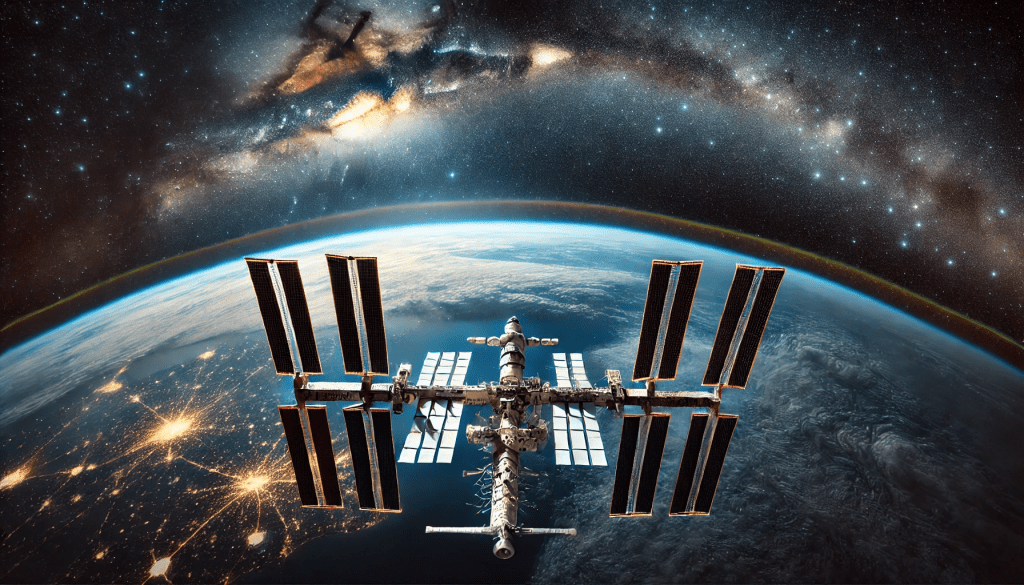
If you’ve never seen it, you owe it to yourself to check out the International Space Station which is really easy to spot. The ISS is a massive science lab – about the size of a football field – that orbits Earth at about 17,500 miles per hour! At this speed, it orbits Earth every 90 minutes, meaning it could pass over your location multiple times in a single evening.
The ISS is special not just because of its size, but also because of its brightness. It’s one of the brightest objects in the night sky – sometimes even brighter than Venus! Just a quick aside – I was inspired to create this episode because a few nights ago I was observing Venus when the ISS drifted by, and passed right below the first quarter Moon. I’ve seen the ISS many times through the years, and it really never fails to inspire.
When it’s overhead, you’ll see it moving steadily from one horizon to the other, almost like a slow, silent airplane without any blinking lights. Eventually you’ll see it fade out as it passes into shadow. Its brightness is caused by sunlight reflecting off its giant solar panels.
It’s also worth checking out the ISS’s “cousin” in orbit. Tiangong, which means “Heavenly Palace,” is China’s own space station and a significant part of their ambitious space program. While it’s not quite as big as the ISS, it’s still easily visible and follows a similar orbit – so, just like the ISS, it’s best viewed around dusk or dawn.
The Tiangong space station may appear a bit dimmer than the ISS, but it’s still a very bright object. In fact, it’s easy to mistake it for the ISS.
Finding the location of the ISS or Tiangong on a given night is quite easy. For the ISS, you can use NASA’s “Spot the Station” service – just sign up, enter your location, and you’ll get alerts for when it’s passing overhead. There are also a number of smartphone apps that will send you an alert when the station is overhead. Just search for them on your device’s app store.
The best way to locate Tiangong is by using a service such as Heavens-Above.com to predict its passes, although various apps, like Stellarium can also do it. A desktop application you might find useful is the open source program, Gpredict, which tracks a massive database of satellites. I used to keep Gpredict open frequently when I was doing a lot of ham radio with satellites. More on that in a moment.
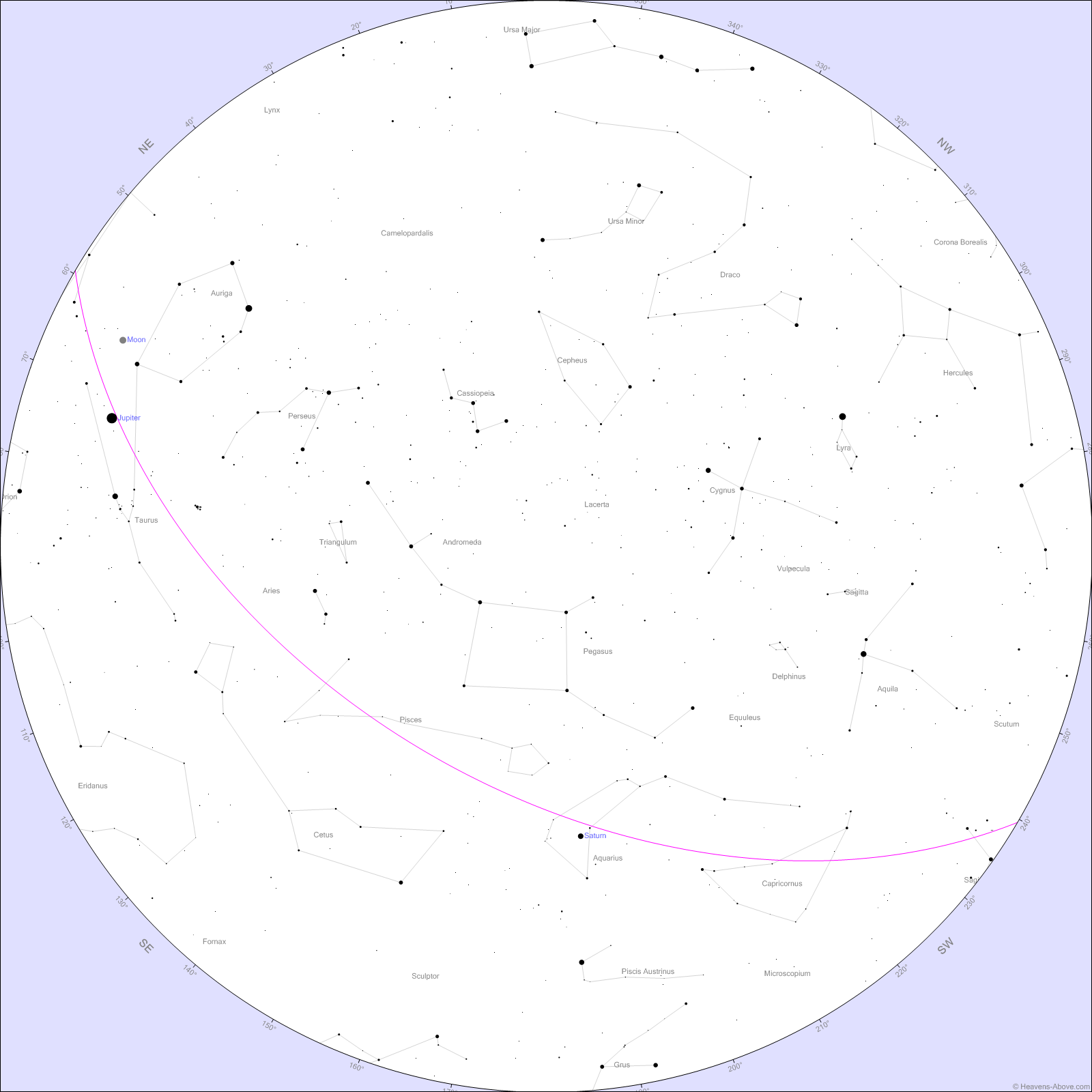
When it’s time to view a station or satellite, make note of its predicted direction of travel and degrees above the horizon. For example, Heavens Above will chart the objects from when and where they appear on the horizon, their highest point in degrees above the horizon, and where the pass ends.
As always make sure you have a clear view of the sky – ideally with as little light pollution as possible – and be ready a few minutes before it’s supposed to appear. But, even in light polluted areas, the space stations will be easily visible.
It’s always a thrill watching these stations glide smoothly and quickly across the night, especially when you realize there are people on board doing science and research right at that moment!
There are literally thousands of other satellites you can see on any given night, so if you’re out stargazing and see something dim gliding across the sky in a straight line, it’s probably a satellite. Some of the most popular sightings recently have been SpaceX’s Starlink satellites, which sometimes appear in “trains” – a series of lights moving one after the other.
From my location near the city, I don’t see these with my naked eye, but glancing at nearly any patch of night sky with binoculars for a minute or two will eventually reveal a Starlink satellite or two or three. They are literally everywhere in the night sky now.
Another type to watch for are Iridium satellites, which create “flares” – sudden bursts of brightness – as sunlight hits their solar panels at just the right angle. These can be incredibly bright, and sudden. The first time I saw an Iridium flare, I thought I was watching a very bright meteor, slowly burning up. You can check Heavens Above to see when one might be spotted in your area.
Some satellites orbit close to the equator, so if you live near the poles, your view might be limited. But with the ISS and Tiangong, their orbits cover quite a bit of Earth, so most of us have a good chance of seeing them.
If just spotting the ISS isn’t enough for you, maybe you can try to talk to astronauts on board. The ISS has a ham radio station as part of its educational program called ARISS, which stands for Amateur Radio on the International Space Station. Through this setup, astronauts sometimes host scheduled events where they chat with schools and ham radio operators here on Earth.
Back in 2011, I went down to Florida to watch the final launch of the Space Shuttle. While I was roaming around the Kennedy Space Center, I noticed a gentleman with a large antenna and a radio transceiver. Turns out, he was an amateur radio operator monitoring radio traffic on the cape in advance of the launch, and that piqued my interest. A week later, I found myself down the ham radio rabbit hole, eventually learning about the ARISS program.
Before the month’s end, I’d studied for and obtained my Technician class license. In the coming months, I’d upgrade to General and finally, the Extra class license. Although you only need the Technician class license to experiment with ham radio via the ISS.
Even with a small 5-watt handheld radio I was able to listen in on ISS communications. One evening, I heard Sunni Williams, then the station commander, chatting with her family hundreds of miles north of my location.
I’ve decoded slow-scan TV signals transmitted by Russian cosmonauts from the ISS, and I even sent data packets up to the station’s digital repeater, which were then re-transmitted across the eastern seaboard and picked up by other ground stations. It’s kind of special seeing your amateur callsign originating from NA1SS, that’s the station’s official callsign. It’s even more fun if you’re watching the station flyover at the same time.
Additionally, there are dedicated amateur radio satellites, and you can exchange contacts with other hams via these objects. It’s tricky, but I’ve used these for both voice and Morse code communications in the past.
So while it’s not astronomy, amateur radio offers some astro-adjacent fun. Space operations are just a small facet of the ham radio hobby, but I know many astronomers who also hold an amateur radio license.
Even if you don’t have a license, you can use a police scanner or other VHF receiver to listen in on the ISS downlink – that’s their transmitting frequency. Tune to 145.800 MHz and see if you can hear anything when the station flies overhead. You might be surprised!
And if you’d like to go the extra mile, you can even try photographing the ISS, Tiangong, or other satellites. Use a tripod, set your exposure time to a few seconds, and aim your camera where the satellite will appear. You’ll get a little streak across your photo as a memory of the station’s pass.
If you want to go deeper into the world of ham radio and ISS, I’ll leave a link to the ARISS program’s web page in the show notes, along with links to Heavens Above and other useful resources for tracking satellites.
That’s it for today’s episode of Star Trails. If you found this episode useful, please share it with a friend. The easiest way to do that is by visiting our website, startrails.show, where you can find all our episodes, including transcripts, night sky maps and more.
Until next time, keep looking up and exploring the night sky. Clear skies, everyone!
Support the Show
Connect with us on Mastodon @star_trails.
If you’re enjoying the show, consider sharing it with a friend! Want to help? Buy us a coffee!
Podcasting is better with RSS.com! If you’re planning to start your own podcast, use our RSS.com affiliate link for a discount, and to help support Star Trails.
 Star Trails: A Weekly Astronomy Podcast
Leave a comment