A Celestial Feast: Thanksgiving Under the Stars – Star Trails: A Weekly Astronomy Podcast
Episode 44
This week we explore the celestial wonders gracing the night sky from November 24th to the 30th. With the Moon transitioning to a waning crescent, the darker skies set the stage for breathtaking views of Venus and Jupiter, Saturn’s iconic rings, and the distant glow of Uranus near the Pleiades—a cluster tied to harvest myths and Thanksgiving themes.
We’ll look at the sprawling constellation Eridanus, Auriga’s glittering star clusters, and the enchanting Monoceros, home to the Rosette Nebula and the Christmas Tree Cluster.
Later, we’ll explore the fascinating “bubble” that encapsulates our solar system—a remnant of an ancient supernova. Learn how this Local Bubble connects us to a vast cosmic network of interstellar tunnels.
Transcript
Howdy stargazers, and welcome to this episode of Star Trails. I’m Drew, and I’ll be your guide to the night sky for the week starting November 24th to the 30th.
It’s Thanksgiving week here in the U.S., a time for gathering with loved ones, reflecting on what we’re grateful for, and maybe even sharing a moment under the stars. In this episode we’ll look at some lesser-known constellations you can see this time of year, and later in the show, we’ll explore the cosmic bubble our solar system resides in, and how our place in the universe might be connected to others like it by a series of tunnels.
The cosmos have a feast in store for us this week, so grab a comfortable spot under the night sky, and let’s enjoy some celestial side dishes for the holiday.
[Transition FX]
First up, the Moon. Early in the week, we’re in the Last Quarter phase, with the Moon slowly slimming down to a Waning Crescent by Thanksgiving and beyond. That means less moonlight washing out the stars, giving us darker skies—perfect for spotting some of the treasures we’ll talk about tonight.
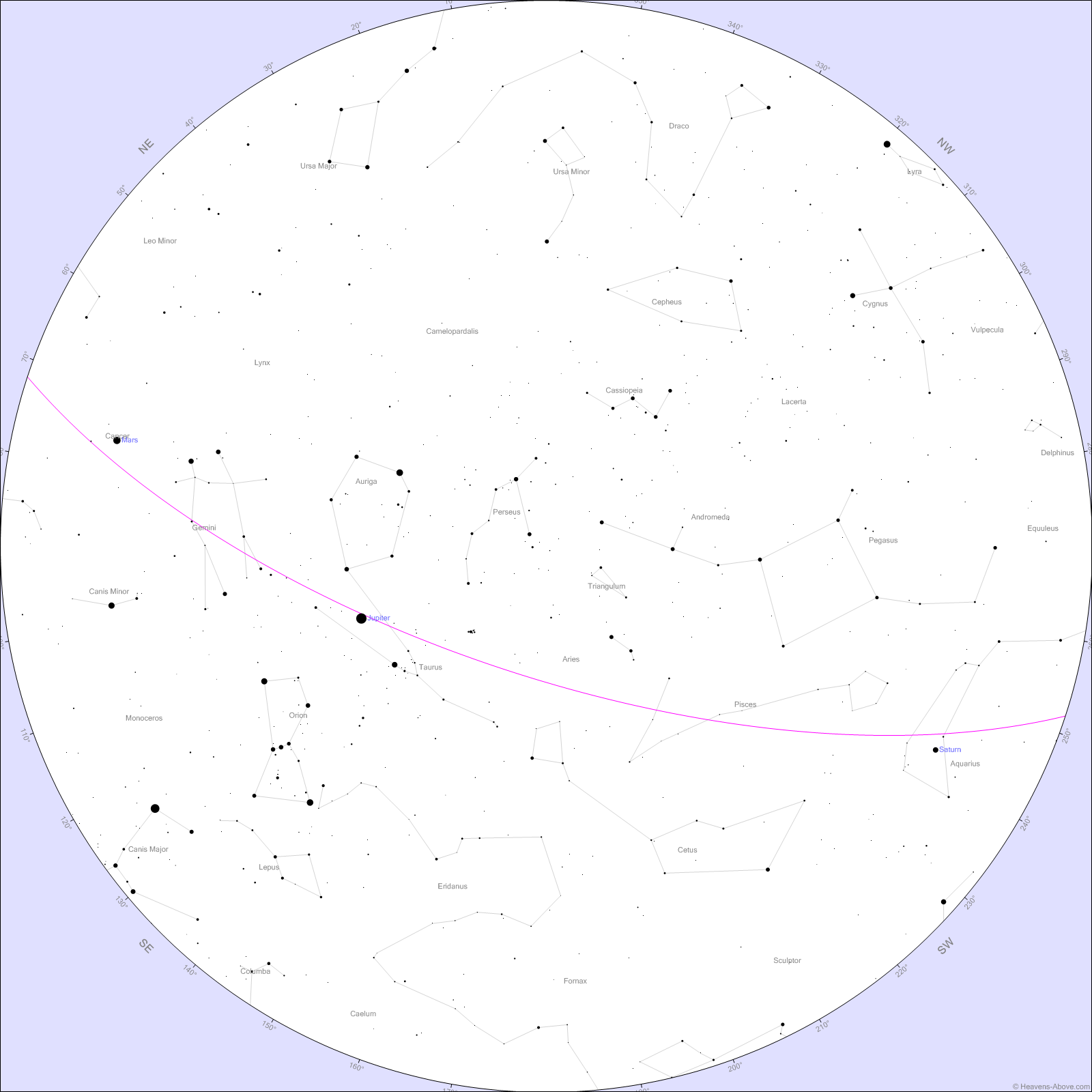
Venus and Jupiter are stealing the show this week. You can catch Venus just after sunset in the western sky, shining at a bright -4 magnitude, making it the brightest object in the night sky after the Moon.
Jupiter is sitting bright and bold in the constellation Taurus. It begins its rise around 6 p.m. and reaches its highest point in the sky by 1 a.m. If you have a telescope, you can glimpse its cloud belts or the dance of its four largest moons—Io, Europa, Ganymede, and Callisto.
Saturn, over in Aquarius, is another highlight. Even a small telescope will reveal its iconic rings, a sight that never fails to amaze. Catch it before it sets around midnight. For early risers, Mars makes a brilliant appearance in Cancer during the predawn hours. Look for it near the Beehive Cluster (M44) for a stunning view.
Lastly, don’t forget Uranus. It’s still near its opposition in Taurus, making it a prime time to spot this distant, icy world. Look for it just off to the right of the Pleiades.
The Pleiades cluster has been celebrated in myths across cultures, often associated with family and the harvest. The Ancient Greeks saw them as the Seven Sisters, while Native American tribes, like the Lakota and Cherokee, linked them to stories of kinship and survival. The Pleiades were also a seasonal marker, guiding farmers to know when to plant and harvest—a perfect connection to Thanksgiving’s roots as a harvest festival.
Resembling a tiny “dipper,” the cluster is visible to the naked eye, but binoculars will reveal even more stars, each sparkling like diamonds on black velvet.
Speaking of harvests, think about Jupiter and Saturn. These two planets represent abundance and stability in mythology—Jupiter as the bringer of bounty and Saturn as the god of the harvest. Seeing them bright in the night sky feels like a cosmic reminder to appreciate the gifts we have and share them with others.
And while the big meteor showers are behind us, a few Leonid meteors may still streak across the sky, especially earlier in the week.
[Transition FX]
As we approach the skies of winter, let’s take a moment to examine a few of the lesser-known constellations that adorn the sky this time of year.
We’ll start with Eridanus, one of the longest constellations in the night sky. Known as the celestial river, Eridanus stretches across the southern sky, beginning near Rigel in Orion and winding its way toward the far reaches of the southern hemisphere.
In Greek mythology, Eridanus represents a river, often associated with the River Po in Italy or the mythical river of the underworld. The constellation’s most famous star, Achernar, marks its endpoint. Achernar is the ninth-brightest star in the sky, but here’s the catch—you can only see it from the Southern Hemisphere or very low latitudes in the Northern Hemisphere. For those of us further north, the visible portion of Eridanus is still impressive, with stars tracing a serpentine path through the sky.
This constellation is also home to the Eridanus Supervoid, a vast region of space with very few galaxies, baffling astronomers to this day. If you have a telescope, you might also spot NGC 1232, the Eye of God Galaxy, a stunning spiral galaxy that lies roughly 60 million light-years away.
Next, let’s explore Auriga, the charioteer. High in the northern sky, this constellation is easy to find thanks to its brightest star, Capella, a golden giant that ranks as the sixth-brightest star in the night sky. Capella is part of a binary star system and represents the charioteer’s “goat.”
Auriga is a treasure trove for stargazers. It contains three stunning open star clusters—M36, M37, and M38. These clusters are perfect examples of young stars born in the same stellar nursery, still bound together by gravity.
In mythology, Auriga is often depicted as a charioteer holding a goat and her kids, a nod to its association with agriculture and herding. For the modern observer, Auriga symbolizes cosmic abundance, with its stars and clusters offering something for everyone—whether you’re peering through binoculars or simply gazing up with the naked eye.
Finally, we come to Monoceros, the Unicorn—a constellation that feels like it belongs in a storybook. Unlike the bright constellations we’ve covered so far, Monoceros is faint and requires dark skies to fully appreciate. It’s nestled near Orion, Canis Major, and Canis Minor, acting as a bridge between these more prominent constellations.
But don’t let its faintness fool you—Monoceros is brimming with treasures. This constellation is home to the Rosette Nebula, a massive cloud of gas and dust shaped like a blooming flower. Close by, you’ll find the Christmas Tree Cluster, a charming group of stars shaped, as its name suggests, like a holiday tree. These objects are accessible with binoculars or a small telescope and are especially beautiful for astrophotographers.
Monoceros was introduced in the 17th century, making it a relatively modern addition to the night sky.
[Transition FX]
Tonight we’re taking a closer look at our Solar System’s cozy spot in the galaxy. Imagine this: we’re not just floating in empty space. We’re actually sitting inside a giant bubble. Not like a soap bubble, but something called the Local Hot Bubble.
It’s invisible to the naked eye, but it’s a cosmic wonder that tells an incredible story about the violent history of our galactic neighborhood. And there’s some brand-new science about this bubble that’s blowing astronomers’ minds, including the discovery of mysterious “tunnels” that may connect our bubble to others.
Around 10 to 20 million years ago, a massive star in our corner of the Milky Way reached the end of its life, exploding in a brilliant supernova. The force of that explosion sent shockwaves rippling outward, carving a massive cavity in the surrounding interstellar gas and dust. But that wasn’t the end of it. Astronomers think that multiple supernovae went off in this same region, one after the other, creating an enormous, interconnected region of hot, sparse gas.
That region is known as the Local Hot Bubble. It’s about 1,000 light-years across, and while the gas inside it is searingly hot—millions of degrees—it’s also incredibly thin, like a faint wisp of a breeze.
Although our Solar System is almost right in the middle of this bubble, the gas is so diffuse that it doesn’t affect us here on Earth.
So, if we can’t see this bubble, how do we even know it’s there? The key is X-rays. The superheated gas emits faint X-rays, and astronomers using space telescopes can detect them. By mapping these X-rays, along with the distribution of interstellar dust, scientists have pieced together the shape and size of the Local Hot Bubble.
Using data from eROSITA, an instrument built by the Max Planck Institute for Extraterrestrial Physics to map cosmos, researchers recently created a detailed 3D map of the bubble. This map revealed some unexpected features, including an interstellar tunnel extending toward the constellation Centaurus. This tunnel may connect the Local Hot Bubble to a neighboring superbubble, such as the Gum Nebula, creating a kind of galactic highway for hot gas to flow.
The Local Hot Bubble isn’t unique. Space is full of these bubbles, formed by similar supernova explosions. For instance, the Loop I Bubble near the Scorpius-Centaurus region overlaps with our bubble. The Orion-Eridanus Bubble, connected to the famous Orion Nebula, also lies nearby.
These bubbles don’t exist in isolation. They’re part of a larger network, connected by tunnels carved through the cooler interstellar medium. Think of it as a cosmic web where hot gas flows freely between these structures.
So, why is all this important? The Local Hot Bubble isn’t just a historical artifact—it actively shapes our Solar System’s environment. The hot gas acts as a kind of buffer, influencing how cosmic rays and other interstellar particles reach us.
It also tells us something about the dynamics of the Milky Way. For example, these bubbles influence star formation. The edges, where hot gas meets cooler material, can compress gas enough to form new stars. The tunnels, like the one toward Centaurus, give us clues about how energy and matter flow through the galaxy.
These recent findings are part of a growing understanding of the galaxy’s structure. The eROSITA data has even revealed temperature differences within the bubble itself, with the southern hemisphere slightly hotter than the northern. This uneven heat distribution reflects the chaotic nature of the multiple supernova explosions that shaped the bubble.
Before we wrap up, here are some other fun facts about our local bubble:
If the Local Hot Bubble were visible, it would look like a faintly glowing sphere surrounding us in the night sky.
Our Solar System entered the Local Interstellar Cloud about 100,000 years ago, and we might leave it in another 20,000 years or so. When that happens, we could encounter a different region of the bubble—or maybe even pass into one of these interstellar tunnels!
Also, the edges of these bubbles, like the Orion Nebula, are some of the most visually stunning and dynamic places in the galaxy.
The Local Hot Bubble and its surprising connections to the rest of the galaxy is yet another reminder that even in the vast emptiness of space, there’s always something happening. Next time you gaze up at the stars, think about the bubble of hot gas cradling our Solar System and the supernovae that helped shape our tiny corner of the galaxy.
[Music]
Thanks for joining me this week on Star Trails! I’m grateful for all of you, my fellow stargazers, and the chance to share the wonders of the cosmos.
If you found this episode useful, please share it with a friend. The easiest way to do that is by visiting our website, startrails.show, where you can find all our episodes, including transcripts, night sky maps and more.
Until next time, keep looking up and exploring the night sky. Clear skies, everyone!
Support the Show
Connect with us on Mastodon @star_trails or on Bluesky @startrails.bsky.social
If you’re enjoying the show, consider sharing it with a friend! Want to help? Buy us a coffee!
Podcasting is better with RSS.com! If you’re planning to start your own podcast, use our RSS.com affiliate link for a discount, and to help support Star Trails.
 Star Trails: A Weekly Astronomy Podcast
Leave a comment