A Beginner’s Winter Sky Tour & the Wonders of Ceres – Star Trails: A Weekly Astronomy Podcast
Episode 46
Join us on a tour through the celestial highlights of January 5th–11th. In this episode, beginners learn how to navigate the sky by finding Polaris, identifying iconic constellations like Orion and Taurus, and spotting Jupiter, Saturn, and Venus through a telescope or binoculars. We also share practical tips on using a telescope, star hopping, and protecting your night vision.
Finally, we journey beyond Mars to the enigmatic Asteroid Belt, where the dwarf planet Ceres takes center stage. Discover how this largest resident of the belt reshapes our understanding of solar system history, water-rich bodies, and the potential for life.
Transcript
[MUSIC]
Howdy stargazers and welcome to this episode of Star Trails. I’m Drew, and I’ll be your guide to the night sky for the week starting January 5th through the 11th.
It seems like it’s been ages since we last met under the stars. We took a little break for the month of December to recharge, travel and spend time with family and friends. I hope everyone had a great holiday break.
If you maybe found a new telescope under the tree, or a pair of binoculars in your mantle stocking, or just stumbled on the show out of a curiosity for astronomy, you’re in luck, because this episode is aimed at new backyard astronomers. In the first part of the episode, we’re going on a guided tour through notable planets, constellations and objects visible in tonight’s sky. I’ll share some tips for using telescopes and binoculars, and later in the show, we’ll cruise out to one of my favorite spots in the solar system, the enigmatic Asteroid Belt, home to the dwarf planet, Ceres.
So, grab a jacket if it’s cold, find a comfortable spot under the night sky, and let’s get started!
[MUSIC FADES]
Before we get oriented, be sure to go ahead and bring your scope or binoculars outside and let them acclimate to the temperature outdoors. Optics can expand and contract with temperature fluctuations, so letting them cool down to the ambient temperature will improve your visibility. Also, take a moment to let your eyes become used to the darkness. Try to avoid bright lights if you can, and don’t ruin your night vision with your smartphone. Put it in dark mode and turn the screen brightness down. A red flashlight will also be useful.
You won’t need anything special for this observation, but in case you’d like a smartphone app to help you locate objects, go back and check out Episode 37, where I shared my top picks for stargazing apps. I prefer the app Stellarium.
When we talk about finding objects in the night sky, it helps to have a reference point. For most of us in the Northern Hemisphere, that point is Polaris, the North Star. If you’re just stepping outside, figure out which direction is North. It’s easy to find west just after sunset, then make a quarter turn right to face north. A compass or compass app can also help.
Typically we’d use the Big Dipper, or Ursa Major, to help us locate Polaris. Currently the Big Dipper is low on the horizon for North American observers just after dusk, but it will rotate into view later in the evening, becoming fully visible by midnight. When it’s up, the two stars at the end of its “bowl” will point you directly to Polaris. When you see Polaris, you’ve found the sky’s version of “home base.” It doesn’t move much through the night, so it’s a good starting point.
If you have a telescope with an equatorial mount, you’ll often hear about “polar alignment.” That means aligning your mount so its axis points toward Polaris. While that’s essential for astrophotography or tracking objects for long periods, don’t let it intimidate you if you’re just starting out. A rough alignment is often enough for casual observing. Check your scope’s manual for the exact procedure, as all mounts are slightly different.
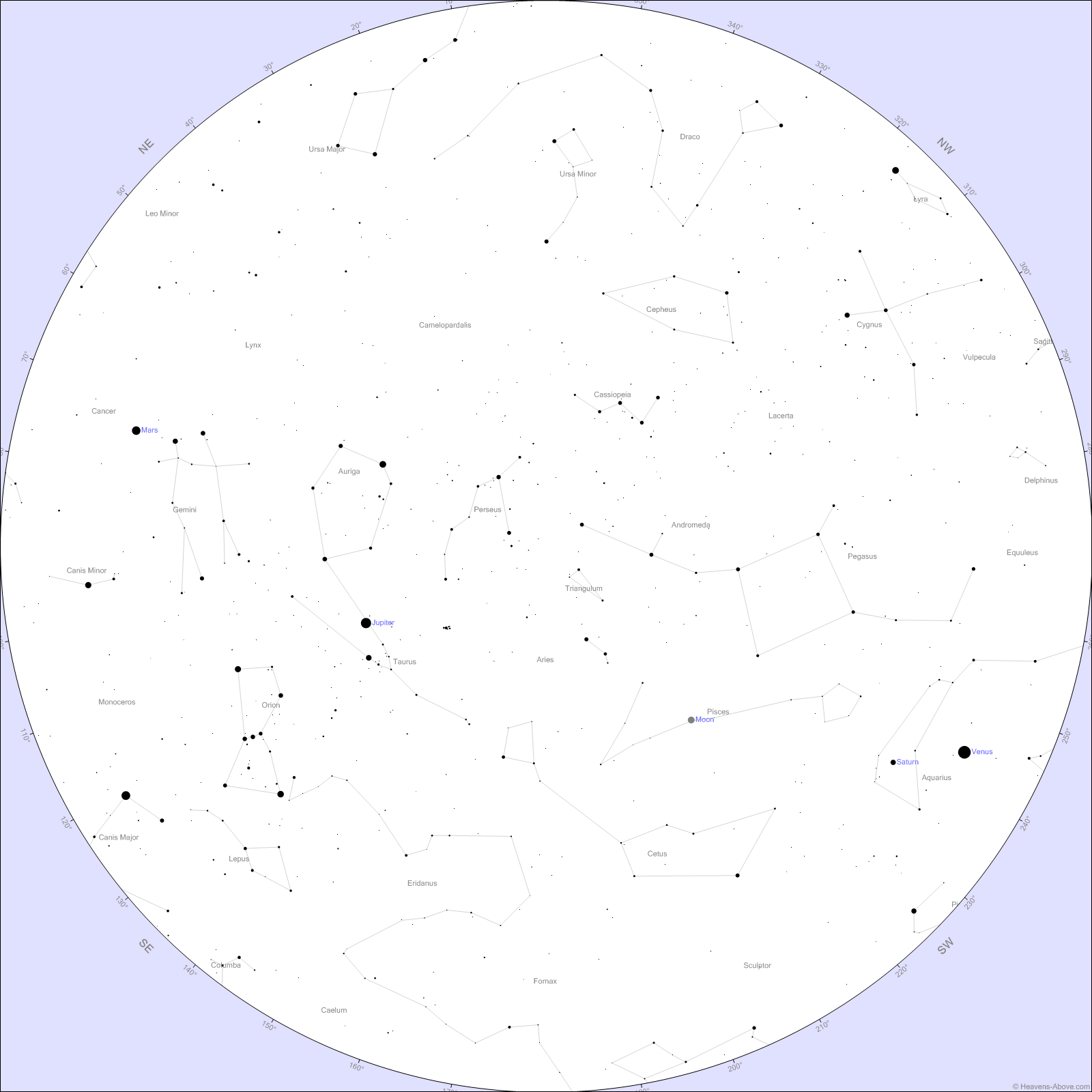
So let’s begin the tour. If you happen to be outside at twilight, look west and up at about a 45 degree angle to spot the brightest star in the sky right now. That’s the planet Venus. It’s not much to gaze at in a telescope, but because it’s between the Earth and Sun, it goes through phases like our moon, so you may see it in a crescent or gibbous phase depending on the time of year. To be honest, its brightness is alluring and I just enjoy looking at it with my naked eye.
Just like the Sun, planets rise in the east and set in the west. Venus, an evening star, will be setting around 8 p.m. so catch it while you can.
Now, let’s turn towards the east and about 45 degrees up, where we find Jupiter rising. It will be the brightest star in that area of the sky. Through a telescope, it kind of resembles a small solar system – you can see its four largest moons—Io, Europa, Ganymede, and Callisto—lined up around the planet. You may even discern cloud bands on Jupiter’s surface, or Jupiter’s raging storm, the Great Red Spot, in a good telescope.
Now, look back towards the west. Gaze about a fists’ width above and slightly to the left of Venus. You should be able to locate another bright star here – Saturn, the ringed planet.
Known for its gorgeous ring system, Saturn usually appears a bit fainter than Jupiter. If you can spot it, aim your telescope and prepare to have your breath taken away! Even at lower magnification, Saturn’s rings are a jaw-dropping sight, and observing them never gets old. Some scopes may even resolve the gap in the rings, called the Cassini Division.
Looking south and higher in the sky, you can spot the Moon around its first quarter this week, waxing towards next week’s full moon. This is a great period for examining the Moon’s terminator, the dividing line between night and day on the lunar surface. In a telescope, you can see 3D-like relief where the light meets shadow. A fun fact: Those dark patches you’re seeing on the surface are “maria” – ancient lava plains. Imagine volcanic eruptions billions of years ago shaping the face of our Moon.
The Moon is an excellent first target for new telescope owners, and a great way to get acquainted with your instrument. When you’re comfortable viewing the Moon, move on to Jupiter and Saturn.
[TRANSITION FX]
Now, let’s check out some key constellations.
Look south to southeast to spot one of the most recognizable constellations in the sky: Orion the Hunter. Orion is easily identified by his famous “belt”—three bright stars almost evenly spaced in a row. If you see those three stars, you’ve got Orion.
Above the belt, you’ll notice a bright, ruddy star called Betelgeuse—a massive red supergiant nearing the end of its life. Below the belt, there’s a bright blue-white star called Rigel, one of the most luminous stars we can see.
Just below Orion’s belt is a small hazy patch—if you look at it with the naked eye, it appears like a fuzzy star. Aim your telescope or binoculars there, and you’ll see the glowing gas and dust of the Orion Nebula, one of the most spectacular deep-sky objects you can see from your backyard. Even a modest telescope at low magnification reveals swirling gray-green or bluish clouds in the nebula.
Just to the northwest of Orion, you’ll find another majestic constellation: Taurus the Bull. The brightest star in Taurus is Aldebaran, a red giant that forms the “fiery eye” of the Bull. You’ll notice that Aldebaran is embedded in a loose cluster of stars known as the Hyades. This V-shaped cluster outlines the face of Taurus.
A little higher in the sky (or a bit to the right if you’re scanning from Orion), look for a tighter, dazzling cluster of stars known as the Pleiades (also called the Seven Sisters, or M45). It’s one of the easiest star clusters to spot with the naked eye. To many, it looks like a tiny dipper.
Through binoculars or a wide-field telescope eyepiece, the Pleiades fill your view with luminous, bluish-white stars. You might catch a hint of the reflection nebula around the brightest members, especially under dark skies. This cluster is young, only about 100 million years old—practically newborns in cosmic terms.
Back to the north and northeast, if you look high above Polaris, you might see a distinct “W” shape in the sky—that’s Cassiopeia. It’s an excellent landmark constellation that stands opposite the Big Dipper, helping frame Polaris between them.
From Cassiopeia, you can star-hop toward the Andromeda Galaxy (M31), the nearest major galaxy to our own Milky Way. Star hopping is a navigational technique in which you start from a bright, easily recognizable star and “hop” from one star to another using a chart or your memory. Think of it like following stepping stones across the sky—each known star helps guide you closer to your target, whether it’s a faint nebula or a distant galaxy.
M31 can be challenging to see with the naked eye. Under very dark skies, it can appear as a faint fuzzy patch to the naked eye, but with binoculars or a small telescope, you’ll see a brighter core surrounded by a delicate halo of light.
If you’ve managed to locate the bright core of Andromeda in your telescope, you might even catch glimpses of its satellite galaxies, M32 and M110, depending on how dark your location is. Don’t be disappointed if you can’t see much detail; galaxies are faint, extended objects, so it helps to let your eyes adapt to the dark and use averted vision – that’s looking slightly away from the target – to capture more detail.
Later in the evening, around 9 p.m., look back to the east to find another planet rising, Mars. Mars may appear as a bright, ruddy point of light. It doesn’t show as many details as Jupiter or Saturn in a small telescope, but the color is unmistakable. Occasionally, you can make out bright polar caps or dark surface markings when Mars is closest to Earth.
[TRANSITION FX]
No matter which of these objects you decide to explore first, here are some tips to make your stargazing experience more enjoyable:
Use low magnification first: Start with your telescope’s lowest-power eyepiece. This gives you a wider field of view, making it easier to find and center objects. Once you’ve acquired your target, you can swap to higher magnifications.
Stabilize your scope: Telescopes can be wobbly, especially cheaper models, and even the slightest touch can knock an object out of your field of view, particularly at high magnifications. Make sure your telescope is on level ground and your mount is properly adjusted and locked down. Even a slight wobble can make focusing difficult. If you have a Dobsonian mount, try placing it on a perfectly flat surface. Be careful of bumping the scope when you look through the eyepiece.
Unless you have a computerized scope that finds targets automatically, you’re going to spend a good bit of time simply placing your target in the field of view. Your first night with a new scope is probably going to be frustrating, but once you get the hang of it, you’ll be sliding around the sky with ease.
Aligning your finder scope (or red-dot finder) in daylight on a distant tree or telephone pole is a huge time-saver at night. This helps you accurately aim at celestial targets when the sky is dark.
Keep a little notebook or use a voice recorder to jot down your observations, sketches, or anything interesting you notice. Over time, this will help you track your progress and build your skills as an observer. Saturn, Jupiter and the Moon are all very dynamic targets that change from night to night, so it pays to revisit them often.
If you live in an urban or suburban area, you might struggle with light pollution. Streetlights, car headlights, and the glow from nearby buildings can wash out fainter stars and deep-sky objects. If you can, plan a trip to a darker location—maybe a local park or a campsite away from city lights. You’ll be amazed at how many more stars you can see.
And one last note: be patient. And, I say this as someone who is very impatient. Telescopes, especially for beginners, require a bit of practice before finding that “wow!” moment. The more you use it, the better you’ll get at finding objects quickly, focusing, and picking out faint details. Astronomy is a lifetime hobby, and the night sky offers endless discoveries. If you can’t find what you want to see tonight, there’s always tomorrow.
As the year progresses, I’ll make note of night sky objects to keep an eye out for. You may even want to go back and check out some of the episodes in the back catalog. The winter is one of the best times for stargazing, owing to longer nights, and clearer skies, so if you’ve just started your journey, you’re coming in at a very good time.
[TRANSITION FX]
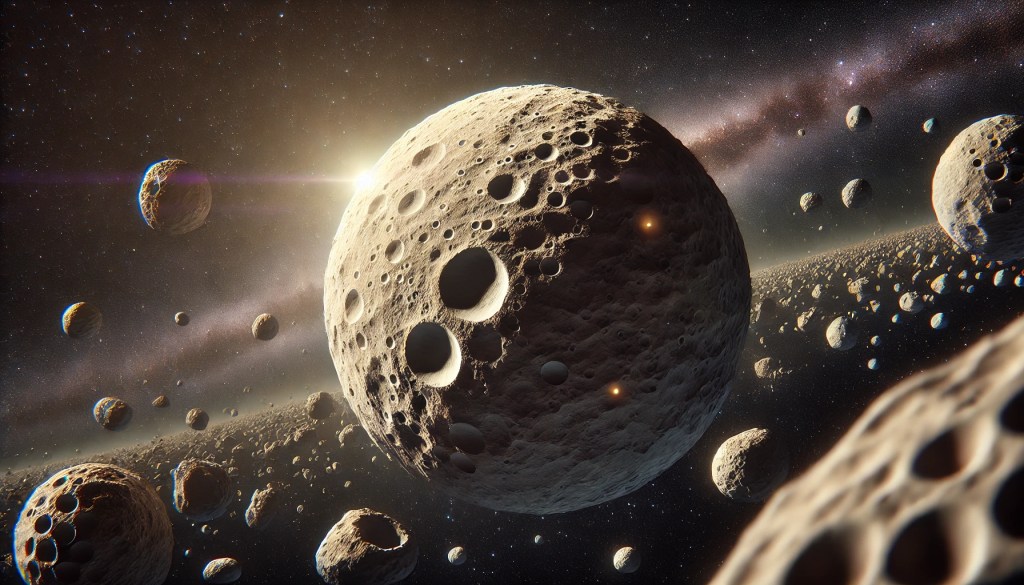
Today, we’re focusing on a fascinating region of the solar system: the asteroid belt. This expanse of rocky bodies has captivated astronomers for centuries, and in it lies the dwarf planet Ceres, a world that’s rewriting what we know about these ancient remnants of planetary formation.
The asteroid belt is a vast region of space located between the orbits of Mars and Jupiter. Unlike the chaotic obstacle courses often depicted in movies – such as the asteroid sequence in Empire Strikes Back – the asteroid belt itself is mostly empty. Although it contains millions of objects, these are spread out across a region spanning more than 140 million miles. The combined mass of the entire belt is only about 3% of the Moon’s mass.
This region is home to objects of all shapes and sizes, from dust grains to large bodies like Ceres, which alone accounts for 40% of the belt’s total mass. These objects date back to the early days of the solar system. They’re often described as ‘failed planets,’ or leftovers that couldn’t form a larger body owing to the disruptive gravitational influence of Jupiter, whose immense gravity is responsible for shaping the asteroid belt.
Jupiter’s influence has created gaps in the belt known as Kirkwood gaps, areas cleared of asteroids by orbital resonances with the gas giant. This dynamic prevents the asteroid belt from becoming a static graveyard of rocks—it’s a constantly evolving part of the solar system.
Ceres is the largest object in the asteroid belt. It was discovered in 1801 by Giuseppe Piazzi, who originally classified it as a planet. As more objects were found in the belt, Ceres was reclassified as an asteroid. Then, in 2006, it was promoted to dwarf planet status alongside Pluto.
Ceres is about 590 miles in diameter, roughly the size of Texas, and it’s made up of rock and water ice. Its density suggests it has a layered structure: a rocky core surrounded by a mantle rich in water. In fact, Ceres is thought to contain more water than all of Earth’s fresh water combined—most of it likely locked beneath its surface as ice or even liquid in a subsurface ocean.
One of its most striking features is Ahuna Mons, a cryovolcano that towers about 4 kilometers high. Unlike the lava-spewing volcanoes on Earth, Ahuna Mons erupts icy slush. This indicates that Ceres has been geologically active in the recent past, possibly within the last few hundred million years.
In 2015, NASA’s Dawn spacecraft became the first mission to orbit a dwarf planet. After visiting the asteroid Vesta, Dawn arrived at Ceres and began sending back data that transformed our understanding of this small world.
One of its most surprising discoveries was the bright spots in Occator Crater. These spots, visible even from a distance, turned out to be deposits of sodium carbonate—a type of salt. Scientists believe these salts were left behind when briny water from Ceres’ interior seeped to the surface and sublimated, leaving the salt behind. This discovery suggests that Ceres has—or had—a subsurface reservoir of liquid water.
The mission also found evidence of organic molecules, primarily in Ernutet Crater. Combined with the presence of water, this raises the tantalizing possibility that Ceres might once have supported prebiotic chemistry—the early steps toward life. While there’s no evidence of life itself, these findings make Ceres a compelling target for future astrobiological studies.
Ceres formed about 4.5 billion years ago, around the same time as the rest of the solar system. So, by studying Ceres, scientists can learn more about the conditions that existed during those early, turbulent days when planets were forming.
Ceres also offers practical opportunities for the future of space exploration. Its water ice could be harvested to provide drinking water for astronauts or converted into hydrogen and oxygen for rocket fuel. If humanity ever ventures into the outer solar system, places like Ceres could become vital refueling stations.
Finally, Ceres challenges us to rethink our assumptions about what an asteroid world looks like. Its geology, chemistry, and even its thin atmosphere—all point to a body that has been far more active and dynamic than we once imagined. It isn’t simply a rock floating in space.
You might be wondering: can you see Ceres from your backyard? The answer is yes, with a keen eye and some planning. Ceres is visible in a good pair of binoculars or a small telescope when it’s at opposition—the point when it’s closest to Earth in its orbit. A stargazing app can help you locate it as it slowly moves through the constellations. While it won’t look like more than a bright dot, knowing you’re observing the largest object in the asteroid belt is an awe-inspiring experience.
[MUSIC]
If you found this episode helpful, let me know, and feel free to send in your questions and observations. The easiest way to do that is by visiting our website, startrails.show. This is also a great way to share the show with friends. Until next time, keep looking up and exploring the night sky. Clear skies, everyone!
Support the Show
Connect with us on Mastodon @star_trails or on Bluesky @startrails.bsky.social
If you’re enjoying the show, consider sharing it with a friend! Want to help? Buy us a coffee!
Podcasting is better with RSS.com! If you’re planning to start your own podcast, use our RSS.com affiliate link for a discount, and to help support Star Trails.
 Star Trails: A Weekly Astronomy Podcast
Leave a comment