The Wolf Moon and Mars: Spooky Occultations & Planetary Oddities – Star Trails: A Weekly Astronomy Podcast
Episode 47
Join us this week for a spectacular cosmic event: On January 13th – the Moon will briefly occult Mars, causing the red planet to vanish from sight for about an hour. Discover the “why” behind this eerie alignment and how it’s all tied to the ecliptic plane — our Solar System’s celestial highway.
We’ll take a moment to learn about a prominent constellation this time of year, Gemini. You’ll want to seek out a telescope this week to enjoy Mars as it reaches opposition. Mercury is a morning star, Jupiter dominates the sky, and Saturn and Venus are in conjunction. We’ll also explore some strange facts about a few of the planets in our solar system.
Transcript
[MUSIC]
Howdy stargazers and welcome to this episode of Star Trails. I’m Drew, and I’ll be your guide to the night sky for the week starting January 12th through the 18th.
I’m really excited this week because a spooky phenomenon awaits us on January 13th – the full Wolf Moon will occult the planet Mars, causing it to disappear for about an hour. We’ll explore why that happens, and why we sometimes see eclipses and parades of planets. It’s all connected.
In the second half of the episode, I’ll share some facts about the solar system that you may not have heard before. For example, did you know Jupiter doesn’t exactly orbit the Sun like the other planets? Stick around and I’ll tell you why.
This week is shaping up to be a fun one for stargazers, so let’s get started.
The Moon will be the main event this week, as it waxes towards being full on January 13. This month’s full moon is traditionally called the Wolf Moon. In January’s depths of winter, wolves were often heard howling outside villages, inspiring this evocative name. This luminous Full Moon will dominate the sky, making it a perfect companion for moonlit strolls.
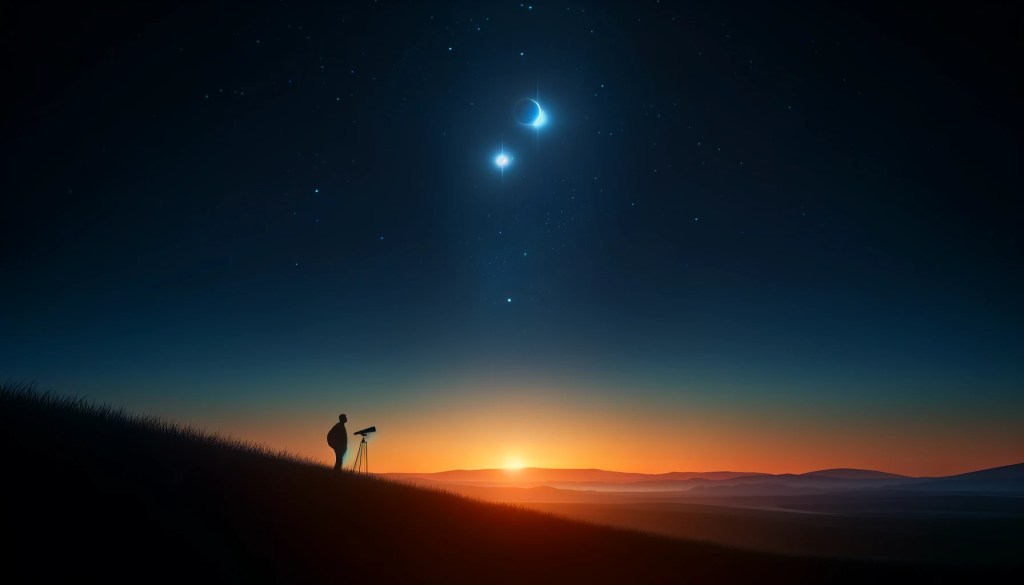
Also on the 13th, a rare lunar occultation of Mars will occur, where the Moon passes in front of Mars, temporarily hiding it from view. Observers on the East Coast can expect to see Mars disappear between 9:00 PM and 9:30 PM EST, reappearing about an hour later. The west coast will see this event around 6 p.m. Be sure to consult with a stargazing app, like Stellarium or Sky Safari to learn the exact time when you can see this phenomenon in your area.
By week’s end, the Moon will have dwindled to nearly a third quarter moon, with a little more than half of the surface illuminated.
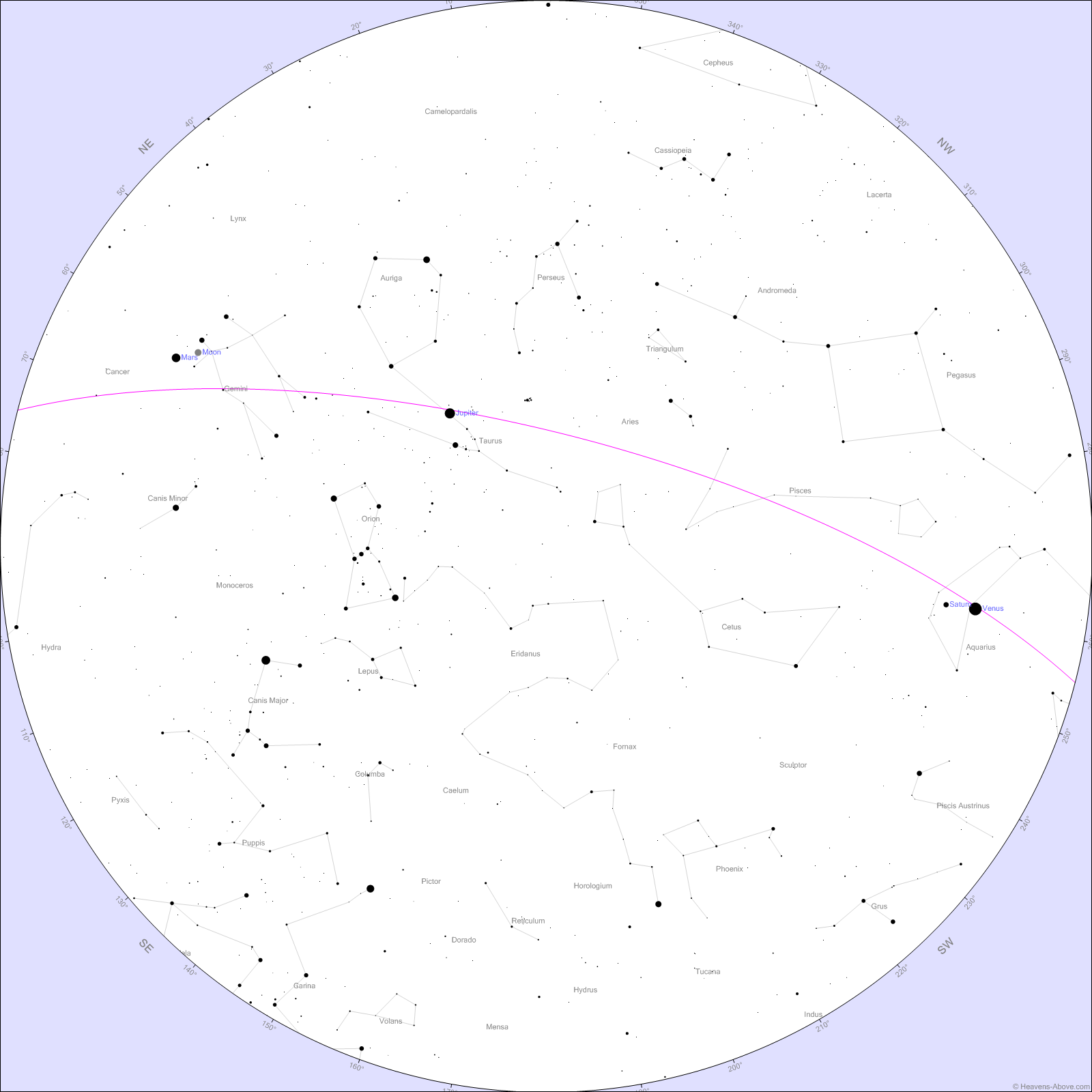
If Mars seems a little brighter this week, it’s because the red planet reaches opposition on January 15, meaning it will be at its brightest and most prominent size for the year. Look for its reddish hue in the east in the constellation Gemini. It’s visible all night as it makes its way west before dawn.
Venus and Saturn will appear exceptionally close to each other on January 17 and 18, a conjunction visible in the southwestern sky shortly after sunset. Venus, the brighter of the two, will guide you to Saturn, just slightly to the left and above Venus.
Jupiter is currently shining brightly in the constellation Taurus. Look for it in the southeast sky between Orion and the Pleiades. It will be the brightest object in that portion of the sky.
Mercury will be a morning star this week, but fairly elusive. Look for it on the eastern horizon just before dawn.
[Transition FX]
In our last episode, I told you how to locate Orion by its three prominent belt stars, and we journeyed through Taurus, home of the bright star Aldebaran, and the Hyades star cluster.
Let’s take a look at another constellation nearby: Gemini. To the northeast of Orion, Gemini’s twin stars, Castor and Pollux, are prominent. The story of these twins is one of loyalty, love and sacrifice.
According to mythology, Castor and Pollux were said to be the sons of Leda, a mortal woman, and either her mortal husband, King Tyndareus of Sparta, or the god Zeus, who seduced Leda in the form of a swan. Pollux was considered immortal because Zeus was his father, while Castor, being the son of Tyndareus, was mortal.
Despite their different parentage, Castor and Pollux were inseparable and renowned for their adventures. Together, they joined Jason and the Argonauts in their quest for the Golden Fleece. They were also known for their strength, bravery, and skill in battle.
Their story takes a sorrowful turn when Castor, the mortal twin, is killed in a fight. Pollux, stricken with grief, begged Zeus to let him share his immortality with his brother. Zeus, moved by Pollux’s devotion, grants his wish by transforming both brothers into stars, placing them together in the sky as the constellation Gemini.
The constellation’s two brightest stars represent the heads of the twins. They sit close together in the sky, with their “bodies” outlined by dimmer stars. Pollux is an orange giant star, slightly brighter than Castor. While Castor, a white star, is actually a complex system of six stars bound by gravity!
Mars will become part of this constellation during the week, adding a bright, reddish -1.4 magnitude guest star to the twins.
[Transition FX]
If you pay attention to the positions of the planets, the Moon and the Sun, you might notice something peculiar. They all follow a similar path across the sky. For example, right now, the Moon, Saturn and Venus are roughly lined up in one part of the sky. If you were to draw a line through them, that line would arc across the sky to the opposite horizon, passing near Jupiter and Mars. The line that the planets follow is the ecliptic plane.
Our solar system is actually a relatively flat disc, with the planets orbiting the sun on a conceptual plane, called the Ecliptic. Earth and the other planets’ orbits are roughly aligned to the ecliptic plane. When we look up at the night sky, the ecliptic appears as a curved line tracing across the celestial sphere, marking the Sun’s apparent path over the course of a year.
The planets formed from a rotating disk of gas and dust billions of years ago. This protoplanetary disk flattened out owing to the conservation of angular momentum, leading to the alignment of planetary orbits. While their orbits aren’t perfectly aligned (each has a slight tilt), they all stay close to the ecliptic.
The Sun’s path across the sky follows the ecliptic, as does the Moon, although its orbit is slightly tilted relative to the ecliptic. When the Moon and Sun’s apparent paths intersect, it creates a point called a “node” – these are points where solar and lunar eclipses can occur.
Because planets and the Moon hover near the ecliptic, their apparent paths often intersect. This is why events like the Venus-Saturn conjunction or the Mars occultation by the Moon occur—they’re all traveling along the same general path in the sky.
The idea of the ecliptic simplifies the study of celestial motions and provides a framework for understanding alignments and events in the sky. For backyard astronomers, it’s a celestial “highway” guiding you to the planets and even the occasional surprise like a comet or asteroid.
[Transition FX]
Now, let’s look at some weird facts related to a few of the planets in our solar system.
Did you know a day on Mercury is longer than its year? Mercury takes about 88 Earth days to complete one orbit around the Sun—that’s its “year.” However, it also spins on its axis very slowly, taking about 59 Earth days to make one full rotation. This rotational period is called a “sidereal day” and it’s a bit different from a “solar” day, which features a sunrise and sunset.
Because of this interplay between orbit and rotation, from the perspective of someone standing on Mercury’s surface, the time from one sunrise to the next is roughly 176 Earth days long. In other words, one solar “day” on Mercury lasts almost twice as long as a Mercurian year!
This odd scheduling is due to something called a spin-orbit resonance. Mercury is in a 3:2 resonance, meaning it rotates exactly three times about its axis for every two orbits around the Sun. Spin-orbit resonances happen because tidal forces from the Sun lock the planet’s rotation rate in a precise ratio to its orbital period. Mercury is close enough to the Sun that it experiences powerful gravitational pulls, ensuring its spin and orbit remain locked in this unusual pattern.
Let’s cruise over to Venus, the hottest planet in the Solar System, and one with another rotational quirk.
Most planets in the solar system rotate on their axes in the same direction they orbit the Sun, which is counterclockwise if viewed from above the Sun’s north pole. Venus, however, spins in the opposite direction. This is called retrograde rotation, and it means that on Venus, the Sun would appear to rise in the west and set in the east—if you could survive long enough under its harsh atmospheric conditions to watch a sunset!
No one is entirely sure why Venus rotates backward, but the leading hypotheses involve ancient collisions with large protoplanetary bodies or gravitational interactions with the Sun and other planets. Whatever caused this backward spin, the slow, retrograde rotation of Venus contributes to its extreme atmospheric dynamics and bizarre day–night cycles. A sidereal day on Venus is 243 Earth days, making it longer than its year, which is around 225 Earth days.
Venus boasts the highest temperatures of any planet in our solar system, with surface temperatures around 860°F. This extreme heat is largely due to a runaway greenhouse effect driven by its dense carbon dioxide atmosphere. The thick cloud layers trap heat very efficiently, allowing sunlight in but preventing infrared radiation from escaping back into space.
Venus’ clouds are filled with sulfuric acid droplets, and the resulting chemical and thermal environment is incredibly hostile. Probes that have landed on Venus, like the Soviet Venera missions, survived only a short time—on the order of minutes to a couple of hours—before succumbing to the crushing pressure and corrosive heat. Yet this very harshness makes Venus a key laboratory for understanding the limits of planetary habitability and the power of greenhouse gases.
Let’s make a jump out to Jupiter, our largest planet, and an outlier for several other reasons.
Jupiter’s Great Red Spot is an enormous storm system big enough to swallow multiple Earths. It’s been observed continuously since at least the 1600s, making it perhaps the longest-lived storm we know. While the Great Red Spot has shrunk somewhat over recent decades, it remains a swirling anticyclone with winds topping hundreds of kilometers per hour.
Scientists still debate exactly why it’s so stable and why it’s red. Possible explanations range from the storm dredging up chemicals from deep in Jupiter’s atmosphere that turn red when exposed to sunlight, to complex interactions of ammonia and other compounds. Juno spacecraft data continues to shed new light on the storm’s depth and structure, but the Great Red Spot remains a powerhouse of planetary meteorology, illustrating how different weather can be on a gas giant compared to Earth.
Here’s a strange-but-true tidbit: Jupiter doesn’t orbit the Sun’s center—it orbits a shared center of mass – the barycenter – that actually lies just outside the Sun’s surface. Despite Jupiter being only a fraction of the Sun’s mass, it’s still so massive compared to the other planets that its gravitational pull is significant enough to yank the Sun ever so slightly off-center.
When two bodies orbit each other—say, Jupiter and the Sun—they both revolve around their combined center of mass, not just one body around the other. Because Jupiter is by far the heaviest planet in the solar system (more than twice as massive as all other planets combined), the Sun-Jupiter barycenter ends up sitting about one to two solar radii above the Sun’s actual center. This might sound small on the scale of the entire solar system, but it’s enormous compared to how the other, lighter planets affect the Sun. So when you visualize Jupiter orbiting the Sun, remember that the Sun is also “wobbling” around a point in space, paying its gravitational dues to the solar system’s most massive planet.
Jupiter’s massive gravity doesn’t just pull the Sun off-center; it also orchestrates a host of other “dance moves” throughout the solar system. For instance, many astronomers refer to Jupiter as the solar system’s “cosmic vacuum cleaner” because it deflects or captures numerous comets and asteroids that might otherwise threaten the inner planets. When a comet from the distant Kuiper Belt or Oort Cloud ventures inward, Jupiter’s strong gravitational field can alter the comet’s trajectory significantly, sometimes flinging it right back out of the solar system or steering it into a collision course with itself (like Comet Shoemaker-Levy 9 in 1994). In this way, Jupiter acts as a partial shield for Earth, though it can also hurl objects onto potentially hazardous paths depending on the geometry of the encounter.
Another lesser-known effect is Jupiter’s role in creating gaps in the asteroid belt. We mentioned this in our last episode.
Asteroids whose orbits resonate strongly with Jupiter’s (for example, those completing exactly three orbits for every one of Jupiter’s) can get their orbits destabilized over time. This gravitational nudging carves out the so-called “Kirkwood gaps,” which are underpopulated zones in the asteroid belt.
There are a lot more fun facts we could discuss about these and other planets, but we’ll save those for future episodes. Be sure to get out this week and watch the Moon occult mars, and while we do have a bright moon washing out all those fainter deep sky objects, such the Andromeda Galaxy, it’s still a great time for looking at Jupiter and Saturn through a nice telescope.
[MUSIC]
If you found this episode helpful, let me know, and feel free to send in your questions and observations. The easiest way to do that is by visiting our website, startrails.show. This is also a great way to share the show with friends. Until next time, keep looking up and exploring the night sky. Clear skies, everyone!
Support the Show
Connect with us on Mastodon @star_trails or on Bluesky @startrails.bsky.social
If you’re enjoying the show, consider sharing it with a friend! Want to help? Buy us a coffee!
Podcasting is better with RSS.com! If you’re planning to start your own podcast, use our RSS.com affiliate link for a discount, and to help support Star Trails.
 Star Trails: A Weekly Astronomy Podcast
Leave a comment