Space Oddity: The Harmony of Isolation – Star Trails: A Weekly Astronomy Podcast
Episode 48
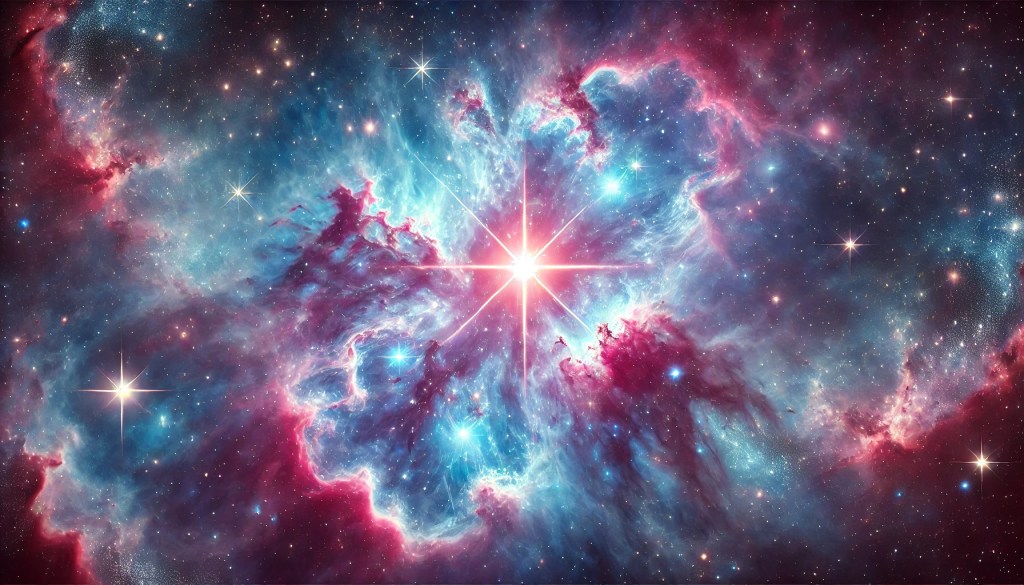
In this episode we’re stripping astronomy down to its essentials: stars. Discover how these glowing spheres of plasma form from vast stellar nurseries, evolve through dramatic life cycles, and shape the cosmic tapestry we see overhead. We’ll discuss the colors of stars — why some glow red while others blaze in brilliant blue-white — and how this reveals their temperature, size, and lifespan.
Ever wondered why we see different constellations from season to season, or why Polaris isn’t forever the North Star? We’ll explain precession, the celestial pole, and the ancient naming systems that still guide modern observers.
Plus, we’ll revisit last week’s jaw-dropping occultation of Mars by the Moon, plus, what you can expect to see in the night sky this week.
Transcript
[MUSIC]
Howdy stargazers and welcome to this episode of Star Trails. I’m Drew, and I’ll be your guide to the night sky for the week starting January 19th through the 25th.
This week, we’re getting back to the basics with a look at the building blocks of the night sky – stars – where they come from, what they are, their diverse colors and types, and how the night sky changes with the seasons.
Of course, we’ll look at what’s in the night sky this week. So let’s get started.
Hopefully you managed to catch last week’s stunning full moon occultation of Mars. Last Tuesday started as a gloomy, cloudy day here in my hometown, so I didn’t get my hopes up, but by 7 p.m., the clouds were rolling out, leaving a hazy, but workable night sky. Mars was visible below the moon.
By 9 p.m., I had a clear view of the moon, and it was almost painfully bright in my 11×70 binoculars. By then, Mars was exactly below the Moon, and because the Moon was so bright, it washed out Mars, meaning you’d need a scope or binoculars to even see it.
I found a comfortable chair in my backyard and braced my elbows against the chair arms to steady my binoculars then watched as Mars slowly approached the Moon. It finally vanished behind the Moon’s south pole around 9:12 p.m. Eastern time. I went back outside around 10 p.m. and waited until Mars emerged from behind the Moon’s northeast edge around 10:15 p.m., barely visible as a tiny dot, and finally separating from the Moon.
Across town, a few miles away, my friend Stewart was observing the phenomenon with his 10-inch Dobsonian reflector and reported being able to see ice caps on Mars. Overall, it was a stunning night of stargazing, and the first time I’ve witnessed an occultation of a planet.
[TRANSITION FX]
The Moon is in a waning gibbous phase at the start of the week, but shrinking to a crescent by week’s end, bringing darker skies for tracking down deep sky objects.
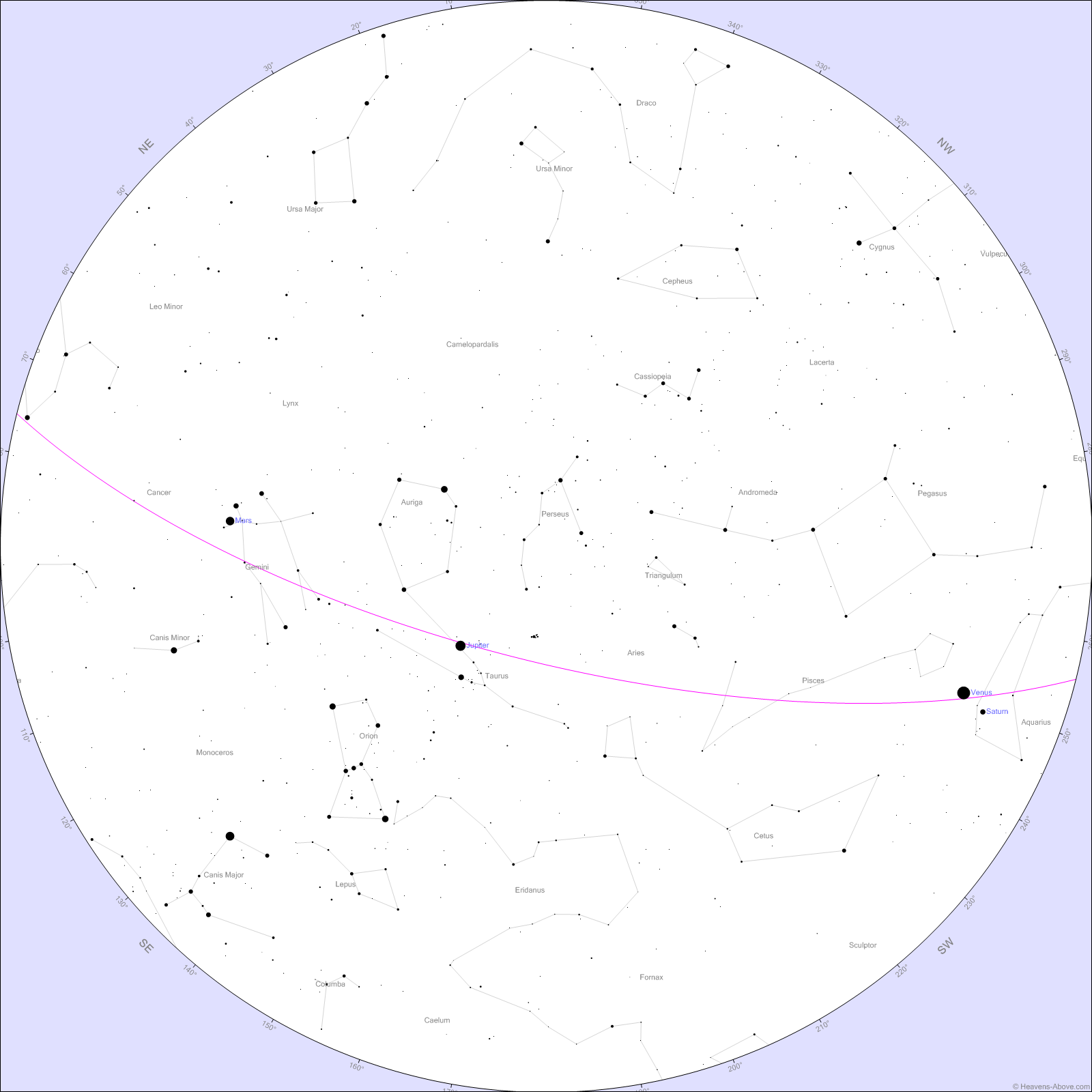
The planets haven’t shifted much in a week, with Venus still dominating the twilight and early evening in the southwest. Saturn is still dancing nearby. Jupiter is the brightest object in the southern sky, rising high in the evening. Mars, having just reached opposition last week, remains a striking red object in Gemini, lining up with the bright stars Castor and Pollux.
Winter’s famous constellations like Orion, Taurus, and Gemini are still up there, but here are a few others you might enjoy.
Look almost overhead if you’re in mid-northern latitudes to locate Cassiopeia. It’s a distinctive “W” shape of bright stars.
Just below Cassiopeia, Perseus arcs across the sky. This constellation boasts several star clusters, including the famous Double Cluster (NGC 869 and NGC 884). A pair of binoculars reveals these two close-knit clusters glimmering with countless stars.
High in the east to southeast after sunset, Auriga is marked by its brightest star, Capella. Within Auriga’s boundaries lie three lovely open clusters: M36, M37, and M38—all visible in a small telescope or even binoculars under dark skies.
[TRANSITION FX]
Let’s get really basic here. Of course, we all know “astronomy” is the study of celestial objects, but translated from its Greek roots, astr and nomia, it literally means, “name stars.” In this “Astronomy 101” segment, we’re taking a very top-level look at stars. There are so many of them when we look up, that it’s easy to overlook how fascinating they are.
In fact, if it weren’t for stars, we wouldn’t exist. More on that later.
A star is essentially a colossal, luminous sphere of gas—mostly hydrogen and helium—held together by its own gravity. At its core, nuclear fusion fuses hydrogen into helium, releasing immense energy that radiates outward and gives the star its distinctive glow. Stars form in nebulae, also called stellar nurseries. These are giant clouds of gas and dust where matter collapses under gravity.
The star’s life cycle depends heavily on its initial mass: small to medium stars like our Sun can live for billions of years, while massive stars burn through their fuel rapidly and often end in dramatic supernova explosions.
On a clear, dark night, you can typically see a few thousand stars with the naked eye, but all of them lie within our own Milky Way Galaxy, which contains hundreds of billions of stars. Although that number is staggering, our eyes aren’t sensitive enough to resolve stars in other galaxies. The Andromeda Galaxy, for instance, is visible from Earth with the naked eye under very dark skies, but only the most recent observations from space telescopes such as the James Webb scope, have been able to resolve stars outside our own galaxy.
Astronomers classify stars into different spectral types: O, B, A, F, G, K, and M, arranged from hottest and most massive to coolest and more common. O and B stars tend to be extremely hot, luminous, and blue-white in appearance; A and F stars are still quite bright but slightly cooler; G stars, such as our Sun, are moderate in temperature and often yellowish-white; K stars appear slightly cooler and more orange; and M stars are red and are the most common type, often known as red dwarfs.
The variety of colors you see among stars ties directly to their surface temperatures. Hotter stars can appear blue-white, while cooler stars will glow orange or red. This color, or spectral signature, reveals essential details about a star’s life stage and composition. Blue or blue-white stars generally burn through their hydrogen quickly because of their higher mass and temperature, whereas cooler red stars can have extraordinarily long lifespans, sometimes lasting tens of billions of years.
When you scan the sky on any given night, you’ll notice that some stars stand out more than others. This difference in brightness primarily comes from two factors: the star’s intrinsic luminosity and its distance from Earth.
Intrinsically luminous stars are simply more energetic because they are either larger, hotter, or both, which makes them shine with greater intensity. A star’s distance from us also plays a crucial role, because even a powerful star will appear fainter if it lies far enough away.
Astronomers distinguish between apparent magnitude, which measures how bright a star appears to us on Earth, and absolute magnitude, which describes how bright a star would appear if it were placed at a standard distance of about 32.6 light-years. Understanding both types of magnitude helps us separate the star’s true power from the effects of distance.
Over millennia, cultures around the world have observed patterns in the sky and woven them into myths or used them for practical navigation. These patterns became constellations, and modern astronomy officially recognizes eighty-eight of them, each marking a specific region of the celestial sphere.
However, not every familiar pattern you see is an official constellation. Asterisms are smaller or more informal arrangements of stars that span or subdivide constellations and serve as convenient guideposts when learning the night sky. People often use them to orient themselves, locate specific constellations, and teach newcomers the basics of stargazing. A great example of an asterism is the Big Dipper, which is actually a part of the larger constellation, Ursa Major.
One of the continually fascinating aspects of stargazing is the way the sky changes from one season to the next. As Earth orbits the Sun over the course of a year, the night side of our planet faces different regions of space. This means the stars you see in the sky will shift every few months.
Certain well-known constellations, such as Scorpius and Sagittarius, become prominent during summer evenings in the Northern Hemisphere, while others like Cygnus or Lyra might move closer to the western horizon. In winter, a different set of constellations takes center stage.
Greek letters are used to designate stars according to a system introduced by the German astronomer Johann Bayer in the early 17th century, a method often referred to as the “Bayer designation.” In this system, each star within a constellation is assigned a Greek letter—alpha, beta, gamma, and so on—paired with the constellation’s Latin name. Traditionally, the brightest star in a constellation is labeled “alpha,” the second brightest is “beta,” and so forth, although this rule isn’t always perfectly followed due to variations in historical brightness estimates and observational data.
For example, in the constellation Lyra, the brightest star is Alpha Lyrae (better known as Vega), while the second brightest is Beta Lyrae. This scheme helps astronomers refer to specific stars in a structured way. Other star-naming conventions exist, but Bayer’s Greek-letter labels are among the most recognizable to casual and seasoned stargazers alike.
Stars move relative to one another over very long periods. Given enough time, the familiar outlines of constellations will morph into completely different shapes. Right now, we see the Big Dipper as a ladle-like figure, but in 100,000 years, those same stars will no longer line up the same way.
In our last episode, we covered the ecliptic, which is the plane of the Earth’s orbit around the sun. The ecliptic is like a celestial highway in the sky, because the Moon, Sun, and planets line up along it. The group of constellations known as the Zodiac also lies along the ecliptic. There are 12 constellations in the Zodiac, 13 if you include Ophiuchus, and their names will probably be familiar to you – Capricorn, Virgo, Aries and so on.
Because the Sun appears to move through these constellations over the course of a year, the zodiac became a focus of ancient astrology.
If you’re in the Northern Hemisphere, you’ll notice the entire sky seems to revolve around one point near the north. That point is marked by Polaris, also known as the North Star, which lies near the north celestial pole where Earth’s axis of rotation meets the sky. Because Polaris is aligned with our planet’s axis, it appears almost stationary to us, while every other star, thanks to Earth’s rotation, rises in the east and sets in the west.
Observers in the Southern Hemisphere don’t have a single bright star near the south celestial pole, but they can still see the same circular rotation around a pivot point in the southern sky.
Here’s an interesting fact: The North Star hasn’t always been Polaris and won’t always be.
Earth’s axis slowly “wobbles” over a cycle of about 26,000 years, a phenomenon called precession. Because of this, the star closest to the north celestial pole changes over millennia. Thousands of years ago, the star Thuban, in the constellation Draco, was the North Star, and in about 12,000 years, Vega, in the constellation Lyra, will take that title.
Before we wrap this up, here are some other interesting notes about stars.
One, stars don’t really “twinkle.” The atmospheric turbulence around Earth causes the starlight to bend and makes it look as though stars are flickering. Seen from space, without an atmosphere in the way, stars appear steady. Planets also show less twinkling because their disks are larger in apparent size, so the effect of atmospheric distortion averages out more smoothly.
Two, looking at stars is like stepping into a cosmic time machine. Because light takes time to travel, when you see a star that’s, say, 100 light-years away, you’re actually seeing it as it was 100 years ago. For nearby stars, this effect is slight, but for very distant objects, you’re peering back into events that happened thousands—or even millions—of years ago.
Three, some stars spin fast enough to flatten themselves. Certain stars rotate at such high speeds that they appear more “oblate,” meaning flattened at the poles and bulging at the equator. For example, Altair in the constellation Aquila spins so rapidly that its equatorial diameter is significantly larger than its polar diameter.
Four, the biggest stars we know are mind-bogglingly large. While our Sun has a diameter of roughly 1.4 million kilometers, a star like UY Scuti is estimated to have a diameter more than 1,700 times that of the Sun. If you placed UY Scuti where our Sun is, it would extend far beyond the orbit of Jupiter.
And finally, we’re stardust, too. Heavy elements like carbon, oxygen, and iron are forged inside stars and spread throughout space when those stars die, especially in supernova explosions. That means the atoms in your body were once part of an ancient star—and that’s quite a humbling notion when looking up at the night sky.
[MUSIC]
If you found this episode helpful, let me know, and feel free to send in your questions and observations. The easiest way to do that is by visiting our website, startrails.show. This is also a great way to share the show with friends. Until next time, keep looking up and exploring the night sky. Clear skies, everyone!
Support the Show
Connect with us on Mastodon @star_trails or on Bluesky @startrails.bsky.social
If you’re enjoying the show, consider sharing it with a friend! Want to help? Buy us a coffee!
Podcasting is better with RSS.com! If you’re planning to start your own podcast, use our RSS.com affiliate link for a discount, and to help support Star Trails.
 Star Trails: A Weekly Astronomy Podcast
Leave a comment