Venus at Peak Brilliance and the Voyager Golden Record – Star Trails: A Weekly Astronomy Podcast
Episode 52
Join us for a skyward journey as Venus blazes at its brightest this week, offering a perfect chance to observe its changing phases—and a centuries-old enigma known as the Ashen Light. Discover the science behind Venus’ evolving crescent, Galileo’s historic observations, and the theories surrounding that mysterious glow on the planet’s night side.
Then, we travel far beyond the solar system to uncover the story of the Voyager Golden Record, humanity’s interstellar time capsule now drifting in the vast cosmic ocean.
Links
Transcript
[MUSIC]
Howdy stargazers and welcome to this episode of Star Trails. I’m Drew, and I’ll be your guide to the night sky for the week starting February 16th through the 22nd.
This week Venus takes center stage as it approaches peak brightness. We’ll discuss the phases of Venus, and why its brightness fluctuates over the course of a year. Plus, we’ll examine one of astronomy’s oldest mysteries, the Ashen Light of Venus.
Later in the show, we’ll hop aboard the Voyager space probes and listen to the Voyager Golden Record, humanity’s “message in a bottle” that’s still adrift in the cosmic ocean.
But first, let’s start with what you can see from your backyard this week, so, grab a comfortable spot under the night sky, and let’s get started!
Our Moon starts the week in a waning gibbous phase, gradually decreasing in illumination each night. By the 20th, the Moon will enter its third quarter, with exactly half of the surface illuminated. During this period the moon rises relatively late, around midnight, so you’ll have darker skies to chase down those dimmer objects, such as nebulae, galaxies, and star clusters.
Saturn is becoming challenging to observe as it moves closer to the Sun’s glare. By mid-February, it appears low in the western sky shortly after sunset and sets within a couple of hours.
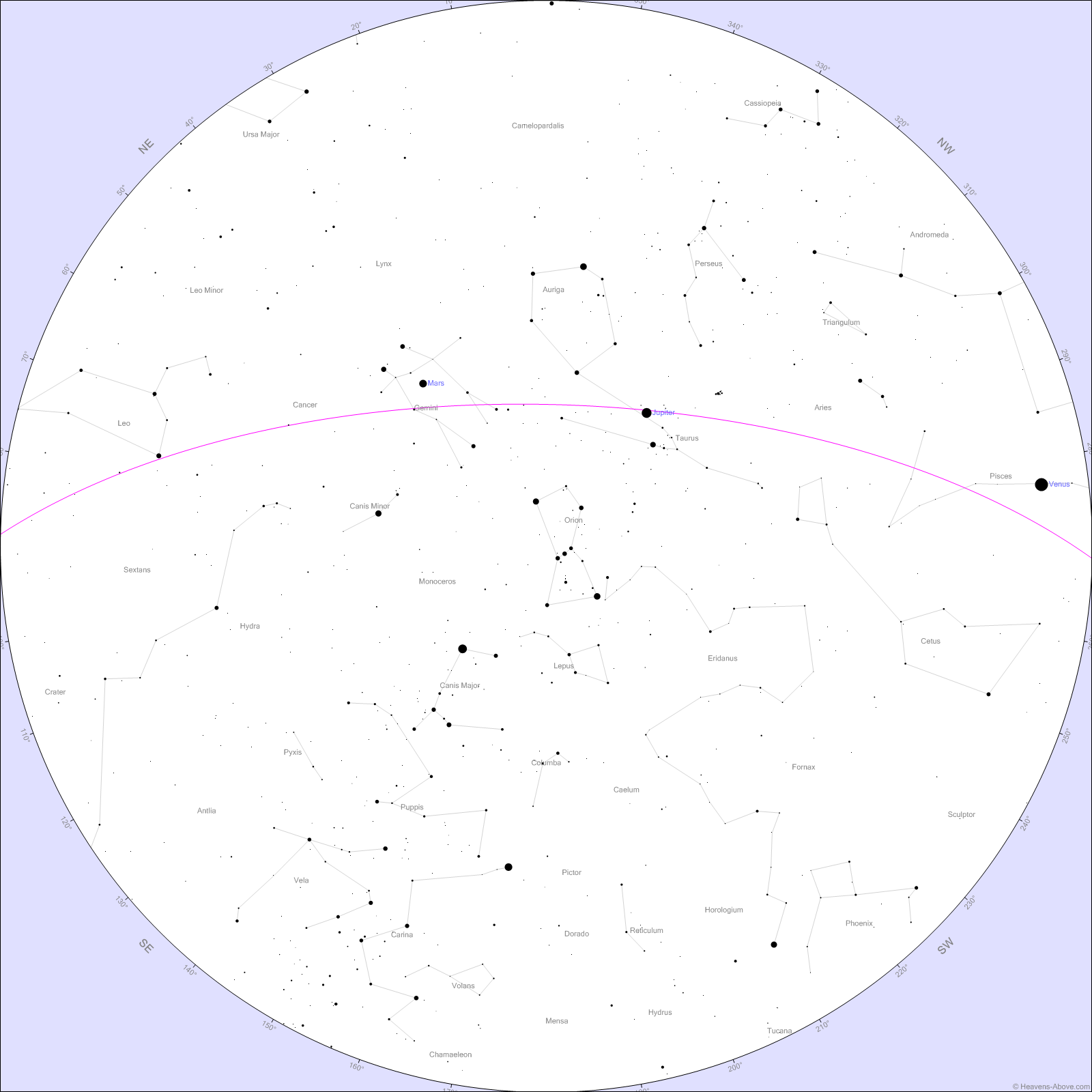
On February 16, Venus will reach its peak brightness for the year, shining at a very bright magnitude -4.2. It will be prominently visible in the western sky after sunset, remaining observable for several hours into the evening. This is an ideal opportunity for observation, as it will outshine all other celestial objects except the Moon.
Jupiter will be high overhead in the evening sky, appearing very bright. It’s an excellent time to observe the planet’s features and its Galilean moons through a telescope, and because it’s high in the sky, there’s less atmospheric turbulence, resulting in a clearer view.
Mars continues to be visible in the evening sky, located in Gemini high in the east after sunset. Its reddish hue makes it distinguishable from other celestial objects nearby.
While a complete seven-planet alignment, including Mercury, is expected around February 23, but this week you can still observe a notable alignment of Venus, Mars, Jupiter, and Saturn following the ecliptic plane across the evening sky. Uranus and Neptune are also positioned along this arc but require binoculars or a telescope to view.
As always, for optimal viewing, find a location with minimal light pollution and a clear view of the horizon. Using a stargazing app can help you identify and locate these celestial objects in the night sky.
[Transition FX]
As Venus is on its way to peak brightness this week, I thought I’d take a moment to offer up some viewing tips for our planetary neighbor, which is often referred to as the “Evening Star” or “Morning Star” depending on its visibility.
If you’ve never looked at Venus through a telescope, you may be surprised to learn it exhibits phases, much like our Moon. This cycle was first recorded by Galileo in the early 17th century and provided crucial evidence for the heliocentric, or Sun-centered, model of the solar system.
Through a telescope, you’ll notice that Venus is quite dynamic. It changes both in shape and apparent size over time, going through the following phases:
Full Venus occurs at Superior Conjunction, when Venus is on the far side of the Sun, completely illuminated but appearing small and distant. It’s also in the Sun’s glare, making it more difficult to see.
As Venus moves along its orbit toward Earth, we begin to see a shadowed portion, similar to a waxing or waning Moon. This is the Gibbous phase.
Half Venus occurs when it reaches greatest elongation, meaning it appears at its farthest angular distance from the Sun in the sky.
As Venus moves closer to Earth, the illuminated portion shrinks into a crescent, but the planet itself appears much larger in our sky. This phase is called Crescent Venus.
A “new Venus” – or inferior conjunction – occurs when it passes directly between the Earth and the Sun, appearing as a dark silhouette against the solar disk if perfectly aligned, a rare event known as a transit of Venus. Then, the cycle reverses as Venus moves back toward the far side of the Sun.
The phases of Venus occur because of its orbit around the Sun and our changing perspective from Earth. Unlike the Moon, which orbits Earth, Venus orbits the Sun in an inner orbit, meaning that it moves between us and the Sun periodically. This causes different portions of its sunlit side to be visible at different times.
Galileo’s observations of these phases were groundbreaking because they disproved the old geocentric model of the solar system. If Earth were at the center, Venus would not show the full range of phases.
Even though Venus is fully illuminated when it’s on the far side of the Sun, it appears smaller and dimmer because of its greater distance from us. Conversely, when it’s in its crescent phase and closer to Earth, it appears much larger and brighter. This is why Venus shines most brilliantly as a thin crescent, just before or after inferior conjunction.
The complete cycle of Venus’ phases—from full to crescent and back to full—takes about 19 months. This corresponds to Venus’ synodic period, which is the time it takes for Venus to return to the same position relative to the Sun as seen from Earth.
However, each phase does not last an equal amount of time because Venus’ movement is more apparent when it is closer to Earth and slower when it is farther away. Here’s a breakdown:
Full Venus to Half Venus, the Gibbous Phase, lasts about 146 days as Venus moves from fully illuminated but far away, to when it appears half-lit.
Half Venus to Crescent Venus, takes about 72 days as Venus moves toward Earth and its crescent becomes thinner. Crescent Venus to New Venus is much quicker, taking about 36 days, since Venus is moving rapidly in its closer, inner orbit.
These phases are the same lengths, but in reverse, as Venus cycles back to full – New Venus to Crescent, Crescent to Half and so on.
Venus watchers may also want to try chasing down the elusive Ashen Light.
It’s one of the most mysterious phenomena in planetary astronomy. Some observers have reported seeing a faint glow on the dark side of Venus—the side not directly illuminated by the Sun. No one knows what causes it, or if it’s even real.
Unlike Earthshine, where sunlight reflects off our planet to softly illuminate the Moon’s surface, Venus has no nearby celestial body to provide this kind of light. Yet, for centuries, astronomers have claimed to see a dim glow on Venus’ shadowed side.
There are several unconfirmed theories. One possibility is airglow—a faint emission of light from chemical reactions in Venus’ dense atmosphere, similar to Earth’s auroras. Another idea is lightning. Some researchers suspect that massive electrical storms could be producing the glow, but so far, we haven’t detected lightning on Venus.
Other theories suggest volcanic activity, where glowing lava or atmospheric reactions might illuminate the planet’s dark side. Some believe it’s simply an optical illusion, caused by the bright crescent of Venus tricking the human eye. And then there’s the idea of scattered sunlight, where Venus’ thick cloud cover might be redirecting light in unexpected ways.
It’s not easy to spot the ashen light, but if you want to try, you’ll need the right conditions. The best time to observe it is when Venus is in its crescent phase, just before or after New Venus—that’s when the dark side is most visible.
To have the best chance, use a high-quality telescope—at least 4 to 6 inches in aperture—and try observing from a dark location, far from city lights. Using averted vision—where you look slightly off to the side instead of directly at Venus—can sometimes make faint details more noticeable. And if you’re into astrophotography, long-exposure images and stacking techniques might reveal something your eyes can’t.
The ashen light has been reported as far back as the 1600s, and even famous astronomers like Sir William Herschel claimed to have seen it.
Most recently, NASA’s Parker Solar Probe, which made a series of flybys of Venus, seemed to confirm a glow in the visible spectrum. In the near-infrared spectrum, Venus’ hot surface glows like iron pulled from a forge. It’s thought some of this glow also creeps into the visible spectrum, and if cloud cover is translucent, perhaps we can see some of that surface glow.
Whatever the answer may be, the ashen light remains one of the great unsolved mysteries of Venus. If you ever manage to catch a glimpse of it, you’ll be joining a long history of observers trying to unlock one of the solar system’s greatest secrets.
[Transition FX]
A lone spacecraft drifts through the void, further from Earth than any human-made object has ever traveled. It carries no crew, no passengers—except, perhaps, a message. A golden disc, designed to last a billion years, etched with the sounds and sights of an entire planet. This artifact is the Voyager Golden Record—humanity’s time capsule for the universe.
We’ll take a look at the science, technology, and ingenuity that went into crafting this interstellar greeting. But to understand why the Golden Record exists, we have to start with the spacecraft carrying it: Voyager 1 and 2.
In the early 1970s, NASA was preparing for one of the most ambitious space missions in history. The space probes, Voyager 1 and 2, were designed to explore the outer planets of the Solar System—Jupiter, Saturn, Uranus, and Neptune—using a rare planetary alignment that occurs only once every 175 years.
But as these robotic explorers were being prepared for launch, a small team of scientists and visionaries saw an even greater opportunity—to attach a message for any future finders of the spacecraft.
The idea of sending an interstellar message wasn’t new. Pioneer 10 and 11, launched in 1972 and 1973, carried a small engraved plaque designed by Carl Sagan and Frank Drake, which depicted the location of Earth and a basic representation of humans. But the team wanted something more sophisticated for the Voyagers—something that could convey sights, sounds, and emotions from our world.
The idea for the Golden Record was championed by Sagan, an astrophysicist, planetary scientist, and one of the greatest science communicators of his time. He believed deeply in the idea of sending a message to the stars, not because he thought aliens were likely to find it, but because it was a powerful symbol of human curiosity and optimism. Here’s Sagan in his own words, describing the project:
[Carl Sagan quote from Cosmos]
NASA approved the idea, but Sagan and his team had just six weeks to design the record—a near-impossible deadline for a project of this scope. Members of Sagan’s team for this undertaking again included Frank Drake, famous for the Drake Equation, which estimates the probability of extraterrestrial life in the universe.
Ann Druyan, later Sagan’s wife, served as creative director of the project. She selected much of the music and sounds. Timothy Ferris, a science writer and journalist, produced the final version of the audio recordings. Artist and designer Jon Lomberg helped curate the images. And Linda Sagan – Carl Sagan’s then-wife, worked on the spoken greetings and messages.
The team’s mission was straightforward: Represent all of humanity. Sagan and his team wanted the record to be a true reflection of Earth’s cultures and civilizations. This meant including not just Western music and languages, but a broad range of human diversity. And it wasn’t limited to sounds. Using the technology of the time, a selection of images were encoded in the message. We’ll talk more about how that was accomplished in a moment.
How do you even begin to decide what to include? With only six weeks, the team had to make incredibly difficult choices. Here’s what made it onto the final record:
Sounds of Earth. These included natural sounds like wind, rain, ocean waves, thunder, and fire. Animal calls, like whale song, birds and elephants. Human sounds, such as footsteps, laughter, a baby crying, and a kiss.
[Montage of sounds]
There are also spoken greetings in 55 languages, ranging from English to ancient Sumerian.
[Sound bites]
And this iconic greeting:
[Hello from the children of planet Earth.]
There’s also a 90-minute playlist of global music, including examples of western classical music–
[Bach’s Brandenburg Concerto No. 2]
Traditional drumming from West Africa–
[Senegalese percussion]
Indigenous music, such as these Peruvian panpipes–
[Peruvian panpipes]
And modern American music: Louis Armstrong, Blind Willie Johnson, and even Chuck Berry’s Johnny B. Goode, which Sagan notably had to fight to get included.
A total of 115 color and black and white images were also included, ranging from illustrations of mathematical concepts to photos of humanity and nature.
The first images on the record are scientific—simple binary numbers, chemical structures, and mathematical relationships. Then, diagrams of DNA and human anatomy, the physics of gravity, and planetary orbits.
The human experience is represented by a mother nursing a child, a bustling city street, the Olympic sprinter Carl Lewis in mid-stride. And finally, Earth itself—forests, mountains, the Great Wall of China, and Taj Mahal.
NASA knew that if Voyager continued its journey for millennia, it might one day be discovered by another civilization. But why a record?
In 1977, this was still the preferred format for audio and music. Digital storage was still in its infancy when Voyager launched. Magnetic tapes degraded quickly. Hard drives were bulky and fragile. But a gold-plated copper record could last for millions—possibly even billions—of years in space.
Unlike digital formats, a record doesn’t require special software to decode. Any intelligent species with an understanding of sound waves could reconstruct the information—just like we decode hieroglyphics or cuneiform tablets.
Constructing a record player is remarkably simple. I think I learned this from Mr. Wizard’s World when I was a kid, but I once rolled up a piece of construction paper into a cone shape and taped a sewing needle to the point of the cone. By placing this needle on a spinning record, I was able to hear some fairly tinny, but recognizable, sounds coming out of my paper speaker.
By the way, I wouldn’t recommend doing this on a vinyl record nowadays, because you’ll likely damage it! The Golden Record isn’t quite that fragile. It was made of gold-plated copper—gold was chosen because it’s highly resistant to corrosion and can last for billions of years in space.
The record was designed to be played about half the speed of a traditional LP, at 16 ⅔ RPM. This allows for a longer playtime. A pictorial cover provides instructions on how to decode the record, and this cover is etched with a map designed by Frank Drake of known pulsars to show where Earth is located.
A small amount of Uranium is embedded in the case, allowing an advanced civilization to determine the record’s age using radioactive decay. The record also came with its own cartridge and needle, although the aliens would need to figure out a way to amplify the electrical signal generated by its stylus, because speakers weren’t included.
So, how were the images stored on the record? In 1977, there was no JPEG, no PNG, no digital compression. Instead, NASA used an ingenious method—analog frequency modulation—which is similar to how early slow-scan television (SSTV) worked.
[Encoding sound]
That’s what an encoded image sounds like.
Each image was scanned line by line, converting brightness levels into modulated frequencies. Dark areas had lower frequencies, bright areas had higher ones. The result is a sound that, when decoded properly, reveals a picture. The images are stored at 512 lines per picture, roughly the resolution of an early black-and-white TV.
The included color images required more processing—instead of a single image, they were stored as three separate grayscale layers: red, green, and blue, which could be reconstructed into a full-color image.
My ham radio brethren have likely heard of slow scan TV. It’s an antiquated, but charming way to send images over radio waves. The amateur station on the International Space Station occasionally transmits images in this manner, in fact, they are scheduled to send SSTV this week in celebration of World Radio Day, so if you have a receiver, try tuning in!
The images on the Golden Record are encoded using a unique scheme that isn’t compatible with any existing SSTV standards, so assuming an alien species happened upon the record and recognized the structured modulation as data, they’d need to develop their own methodology for translating those sounds into images.
If you are savvy with audio and programming, you can download the original audio and decode the images yourself. Fortunately NASA maintains an archive of the original images, so they are easily viewable online to anyone. I’ll include links in the show notes.
Sagan documented the process of creating the Golden Record in the 1978 book, Murmurs of Earth: The Voyager Interstellar Record. It’s worth checking out if you want to learn more about how the record was created.
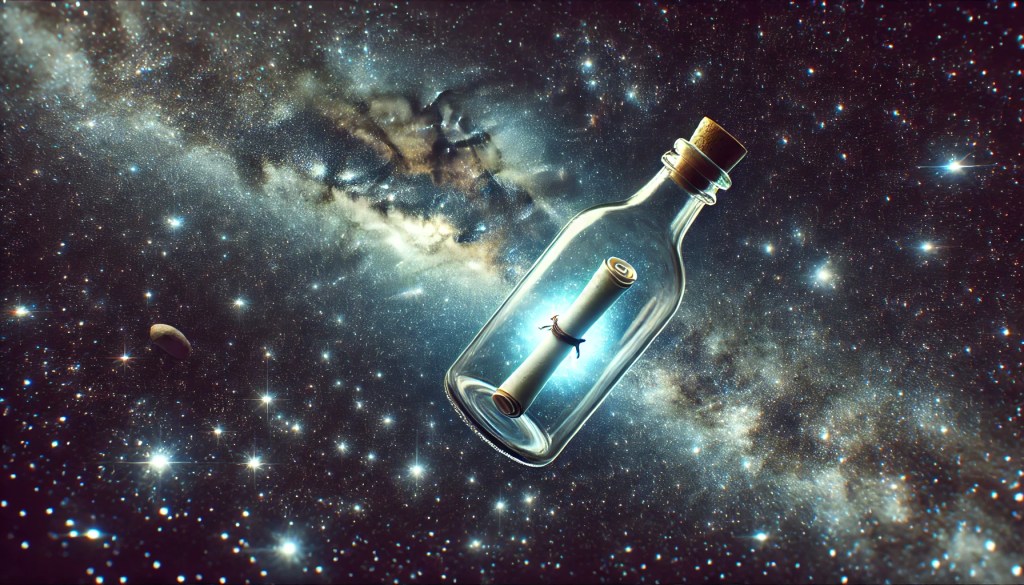
To quote Sagan, “The launching of this bottle into the cosmic ocean says something very hopeful about life on this planet.” That message in a bottle is still adrift.
After completing their planetary missions to study the gas giants, both Voyagers continued outward. Today, they are in interstellar space, beyond the influence of our Sun’s solar wind.
At this moment, Voyager 1 is more than 15 billion miles from Earth. It takes radio signals more than 22 hours to reach it. If you recall our discussion of the scale of the cosmos from last week’s episode, you know that space is an incredibly empty place. The chances of either Voyager encountering anything or anyone in their journey, is slim but not impossible.
Voyager I will pass within 1.6 light-years of the star Gliese 445 in about 40,000 years. If a civilization exists there, perhaps they’ll detect it and hear the echoes of our distant Earth.
[MUSIC]
If you enjoyed this episode, let me know! The easiest way to do that is by visiting our website, startrails.show. This is also a great way to share the show with friends, and you can find transcripts of every episode.
You can find us on BlueSky and Mastodon, and if you’d like to support the show, by buying me a cup of coffee, be sure to visit the links in the show notes, and on the website.
Until next time, keep looking up and exploring the night sky. Clear skies, everyone!
Support the Show
Connect with us on Mastodon @star_trails or on Bluesky @startrails.bsky.social
If you’re enjoying the show, consider sharing it with a friend! Want to help? Buy us a coffee!
Podcasting is better with RSS.com! If you’re planning to start your own podcast, use our RSS.com affiliate link for a discount, and to help support Star Trails.
 Star Trails: A Weekly Astronomy Podcast
Leave a comment