Dark Skies, Elusive Light, and Pluto’s Legacy – Star Trails: A Weekly Astronomy Podcast
Episode 53
With the New Moon arriving this week, we’re in for some of the darkest skies of the month—perfect for stargazing! In this episode, we’ll track down the elusive Zodiacal Light, a faint cosmic glow that many mistake for lingering twilight. Mercury returns to the evening sky, joining a stunning planetary lineup. Later, we’ll dive into a selection of deep-sky treasures, from open clusters to ghostly galaxies, all visible with binoculars or a small telescope.
And in case you missed it, February 18th marked the anniversary of Pluto’s discovery! We’ll revisit Clyde Tombaugh’s historic find, Pluto’s controversial reclassification, and why this distant world remains one of the most fascinating objects in the solar system.
Transcript
[MUSIC]
Howdy stargazers and welcome to this episode of Star Trails. I’m Drew, and I’ll be your guide to the night sky for the week starting February 23rd through March the 1st.
This week we welcome darker skies thanks to an upcoming New Moon. Mercury returns to the dusk sky, and right now is a great time to hunt for the elusive Zodiacal Light. Later in the show, I’ll cover some low-key deep sky objects that are worth tracking down in binoculars and small telescopes.
But first, let’s take a look at what you can see from your backyard.
This week the Moon will be a thin waning crescent, rising just before dawn. The New Moon occurs on the evening of February 27th. Nights around the New Moon are perfect for stargazing and astrophotography due to the absence of moonlight.
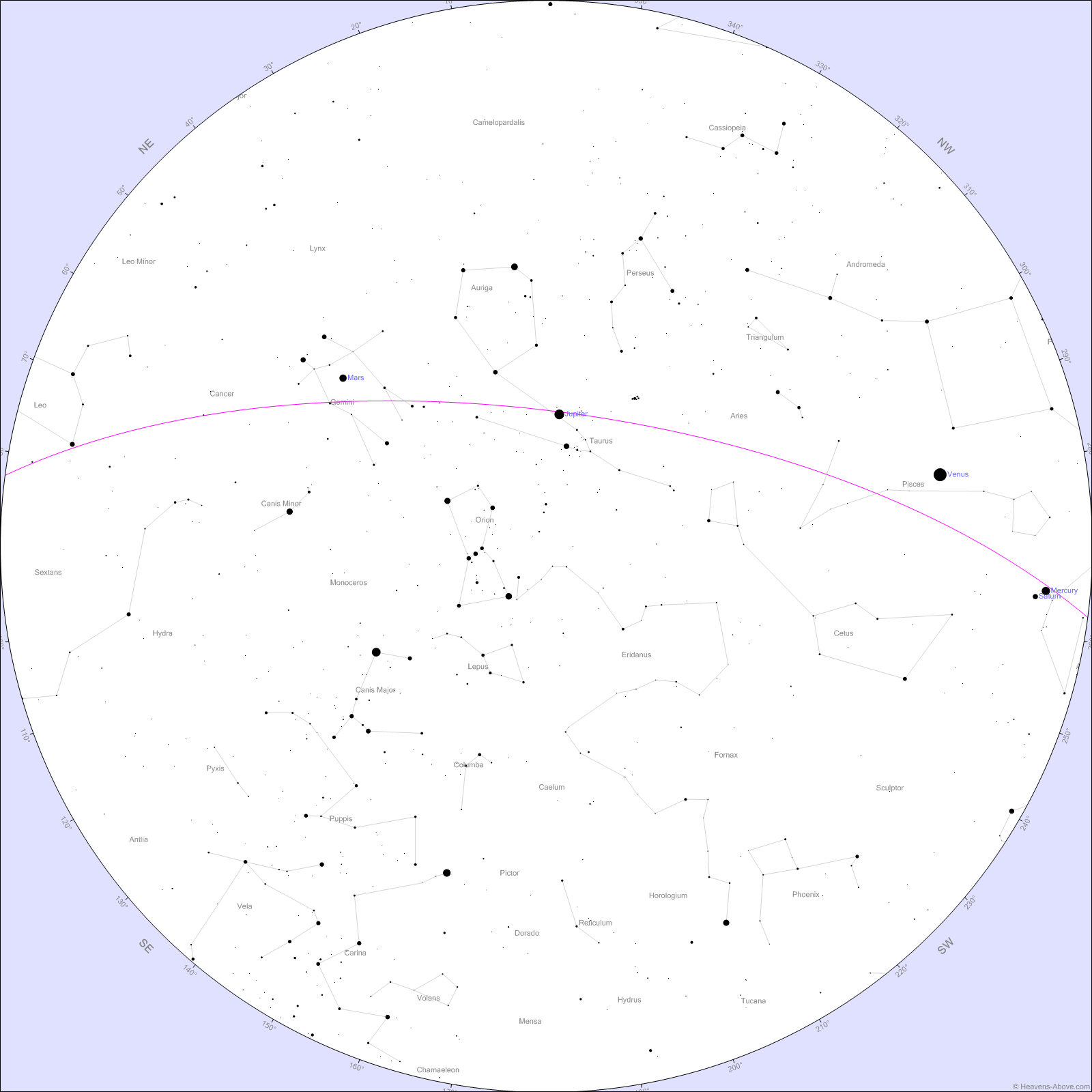
Mercury returns to our night skies this week, completing the parade of visible planets. Look for a close encounter between Mercury and Saturn, very low on the western horizon just after sunset on the 25th. The other planets are strewn out along the ecliptic plane. Venus remains in the west and extremely bright. Jupiter is still nearly directly overhead after sunset, and Mars is towards the east in Gemini.
On the evening of February 28, immediately after sunset, look towards the western horizon to spot a wisp of a crescent Moon just above the horizon. You’ll find Mercury less than five degrees above the moon. For a rough estimate, hold your fist out at arm’s length. That spans roughly 10 degrees. The brilliant Venus will be easily visible above the Moon and Mercury.
Plan to start your observations shortly after sunset to catch the planetary alignments. As the night progresses and the sky darkens further, shift your focus to constellations and deep-sky objects.
[Transition FX]
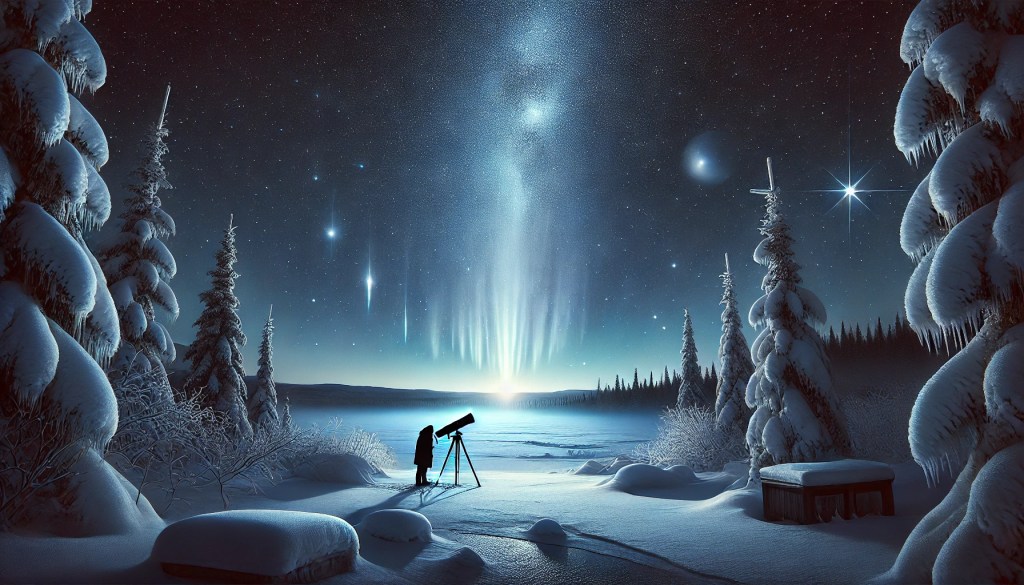
This is one of the best times of the year to catch the subtle, but fascinating phenomenon known as the zodiacal light—a soft, ethereal glow that appears in the sky just after sunset or before sunrise. It’s often mistaken for lingering twilight, but it’s actually something much more cosmic
The zodiacal light is a faint, triangular glow that extends from the horizon, tapering upward along the path of the ecliptic—the same celestial highway where the Sun and planets travel. Unlike city light pollution, this glow isn’t artificial. It’s sunlight scattering off a vast cloud of interplanetary dust, tiny particles left behind by comets and asteroid collisions over billions of years.
In the Northern Hemisphere, late winter and early spring are the best times to catch the zodiacal light in the evening. Look to the western horizon about 90 minutes after sunset, in a dark sky away from city lights. It appears as a soft, milky glow stretching upward from the horizon. If you’re an early riser, you can spot it before dawn in the opposite season—so, for the Northern Hemisphere, that means late summer and early autumn in the east before sunrise.
The dust creating this glow isn’t just floating aimlessly—it’s caught in the gravitational grip of the Sun, forming a disk-shaped cloud along the plane of our solar system. NASA’s Juno spacecraft even detected signs that some of this dust originated from Mars, meaning our cosmic neighborhood is constantly exchanging material. This same dust also plays a role in meteor showers when Earth plows through denser regions of it.
Ancient skywatchers noticed the zodiacal light long before we understood its origin. Some early astronomers thought it was part of the Milky Way, while in the Middle Ages, it was sometimes linked to supernatural omens. The name ‘zodiacal’ comes from the fact that the light follows the zodiac constellations—the backdrop for the Sun’s annual journey across the sky.
Remember, you’ll need very dark, clear skies to catch it, so make sure you let your eyes adjust to the darkness.
[Transition FX]
This week’s New Moon brings some of the darkest skies of the month, so what better time to chase down some deep-sky objects. While the Orion Nebula or the Andromeda Galaxy are always standouts, I want to highlight some hidden gems that are often overlooked. The best part is you don’t need a giant telescope to see them! Just grab your binoculars or a small telescope. For best results, use 10×50 or larger binoculars. The fainter targets will require a 4-6-inch telescope.
A quick side note, many of these objects are from the “New General Catalog of Nebulae and Clusters of Stars,” which contains some 7,840 objects. So when we refer to items as NGC, followed by a number, know that it’s from the New General Catalog. Many of you are probably familiar with the Messier catalog, and those objects simply start with an M.
The first target on our list is NGC 2362, also known as the Tau Canis Majoris Cluster. This bright open cluster sits in the constellation Canis Major, not far from the brilliant star Sirius. What makes it special is that a single, intensely bright blue star—Tau Canis Majoris—sits at its center, outshining the surrounding stars. This cluster almost looks three-dimensional, as if the stars are floating at different depths in space. It’s sometimes called the “Mexican Jumping Star” because the central star appears to hover, or jump out of the neighboring stars.
To find it, look south of Sirius, and a pair of binoculars will reveal a tight, glowing cluster of stars. In a small telescope, the surrounding stars become sharper, giving the cluster a jewel-like appearance.
If you’re a Star Trek fan, you’ll love this next object—NGC 1662, also known as the Klingon Bird-of-Prey Cluster. This small open cluster is located in Orion, near the bright star Bellatrix, which marks Orion’s left shoulder. What makes it unique is its distinctive V-shape, which strongly resembles a Klingon Bird-of-Prey spacecraft from the Star Trek universe.
With binoculars, you’ll notice a scattered V-shaped group of stars, but in a small telescope, the pattern stands out even more clearly. It’s a fun target and an easy one to find.
Now, let’s take a look at NGC 2232, a fantastic open cluster that often gets overlooked because it sits in the faint constellation Monoceros, the Unicorn. It lies roughly between Betelgeuse in Orion and Procyon in Canis Minor.
Through binoculars, you’ll see a beautiful, loose scattering of stars, with one noticeably bright central star. A small telescope will enhance the fainter members of the cluster, but it’s truly a binocular-friendly target that’s easy to spot even in suburban skies. If you’re looking for an open cluster that’s simple but rewarding, this is a great choice.
If you’re looking for a challenge, try tracking down NGC 247, also known as the Needle’s Eye Galaxy. This elongated spiral galaxy is located in Cetus, south of Pisces. What makes it interesting is that it appears lopsided, with a dark void on one side.
Under dark skies, a small telescope will show an oval-shaped patch of light, though binoculars may only reveal a faint smudge. This galaxy is part of the Sculptor Group, a collection of galaxies that includes the brighter Sculptor Galaxy (NGC 253), so if you’re in a truly dark location, it’s worth scanning the area for more galaxies.
Up next, we have a two-for-one special—M46 and M47, a stunning pair of open clusters in Puppis. These two clusters are located close together and look fantastic in binoculars.
M47 is bright and sparse, while M46 is fainter but more densely packed with stars. Inside M46, a small telescope reveals a faint planetary nebula, NGC 2438! It appears as a tiny glowing disk, almost like a ghostly bubble floating among the stars. This is a fun observing target because it lets you see both a young star cluster and the remnants of a dying star in the same view.
For something unique, check out NGC 2683, often called the UFO Galaxy. This spiral galaxy is located in the constellation Lynx, which sits between Gemini and the Big Dipper.
NGC 2683 is seen edge-on, meaning it looks like a classic saucer-shaped UFO. In a small telescope, you’ll see a thin, elongated glow with a slightly brighter center. It’s a great alternative to the Andromeda Galaxy, especially if you’re looking for a new galaxy to track down.”
The final target on our list is NGC 281, also known as the Pac-Man Nebula. This faint emission nebula is located near Schedar, the brightest star in Cassiopeia.
It gets its nickname because a dark notch in the nebula gives it the shape of Pac-Man from the classic arcade game. While binoculars won’t reveal much, a small telescope equipped with a nebula filter (like an OIII or UHC filter) will bring out its faint glow. If you’ve already observed the Orion Nebula and want to try something more subtle, the Pac-Man Nebula is a fun challenge.
To get the best views, find the darkest sky possible, use low magnification for clusters, and if you’re looking at nebulas, a nebula filter will improve contrast. Remember to consult with a night sky app, like Sky Safari or Stellarium if you’re having trouble locating your target.
That wraps up this week’s hidden deep-sky gems! If you happen to catch any of these objects, let me know what you saw.
[Transition FX]
In case you missed it, February 18th was “Pluto Day.”
On that day in 1930, astronomer Clyde Tombaugh made history when he discovered Pluto at the Lowell Observatory in Flagstaff, Arizona. At just 24 years old, Tombaugh had been systematically searching for a ninth planet, known then as “Planet X,” which had been predicted by Percival Lowell in the early 1900s.
Tombaugh used a device called a blink comparator, which allowed him to compare photographic plates taken on different nights to spot moving objects against the background of fixed stars. After months of painstaking work, he noticed a tiny dot shifting across the plates—Pluto.
The discovery was formally announced on March 13, 1930, which happened to be both Percival Lowell’s birthday and the anniversary of William Herschel’s discovery of Uranus in 1781. The name “Pluto” was suggested by an 11-year-old girl from England, Venetia Burney, who was fascinated by mythology. The name was fitting, as Pluto, the Roman god of the underworld, matched the distant and mysterious nature of the new planet. Plus, its first two letters, PL, honored Percival Lowell.
For 76 years, Pluto remained the ninth planet in our solar system, but as astronomers discovered more Pluto-like objects in the Kuiper Belt—like Eris, discovered in 2005—it became clear that our definition of a “planet” needed refining. On August 24, 2006, the International Astronomical Union redefined what it means to be a planet. Under the new criteria, a planet must: One, orbit the Sun; two, be massive enough to be rounded by its own gravity; and, three, have cleared its orbit of other debris.
Pluto failed the third criterion, as it shares its orbit with other Kuiper Belt objects. It was reclassified as a dwarf planet, sparking widespread controversy. Many people, including Tombaugh’s family and numerous astronomers, felt that Pluto should have remained a planet. The debate continues to this day, with some planetary scientists arguing that Pluto should still be considered a planet due to its complex geology, atmosphere, and possible subsurface ocean.
While Pluto may have been “demoted,” the New Horizons spacecraft, which flew past Pluto in July 2015, revealed it to be one of the most fascinating objects in the solar system. We now know Pluto has towering mountains made of water ice, nitrogen glaciers that flow like rivers, and a thin atmosphere that changes over time. Pluto’s surface even features a giant heart-shaped plain called “Tombaugh Regio” in honor of its discoverer.
So, while Pluto’s classification may have changed, its status as one of the most interesting worlds in our solar system remains unchallenged. And every February, we can celebrate the discovery that forever changed our understanding of the outer solar system.
[Music]
If you enjoyed this episode, let me know! The easiest way to do that is by visiting our website, startrails.show. This is also a great way to share the show with friends, and you can find transcripts of every episode.
You can find us on BlueSky and Mastodon, and if you’d like to support the show, by buying me a cup of coffee, be sure to visit the links in the show notes, and on the website.
Until next time, keep looking up and exploring the night sky. Clear skies, everyone!
Support the Show
Connect with us on Mastodon @star_trails or on Bluesky @startrails.bsky.social
If you’re enjoying the show, consider sharing it with a friend! Want to help? Buy us a coffee!
Podcasting is better with RSS.com! If you’re planning to start your own podcast, use our RSS.com affiliate link for a discount, and to help support Star Trails.
 Star Trails: A Weekly Astronomy Podcast
Leave a comment