
Cosmic Collisions: Asteroids, Comets, and the Science of Planetary Defense – Star Trails: A Weekly Astronomy Podcast
Episode 54
This week on Star Trails, we explore the fascinating world of space rocks—asteroids, comets, and meteors—and their impact on our planet and beyond. With recent talk of asteroid 2024 YR4 making headlines (don’t worry, it won’t hit us!), we break down what these celestial objects are, where they come from, and what makes them so important to study.
We’ll also take a look at the Tunguska and Chelyabinsk meteor events, the Chicxulub impact that wiped out the dinosaurs, and the Shoemaker-Levy 9 collision with Jupiter—real-life cosmic events that shaped our understanding of space hazards.
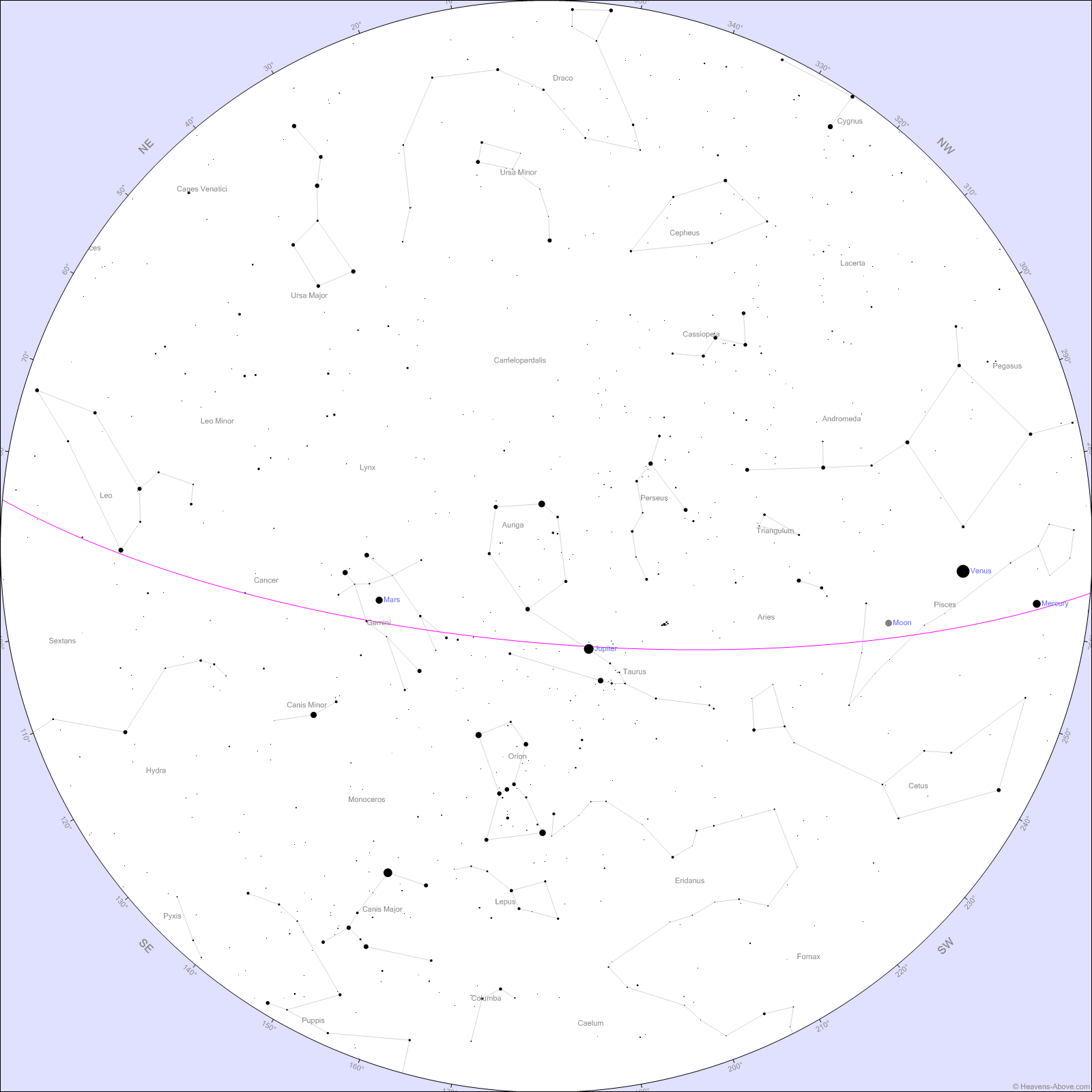
Plus, we’ll check in on T Coronae Borealis, a star on the verge of a once-in-a-lifetime nova. And don’t forget to step outside and catch Mercury’s rare appearance on the western horizon this week, as well as a beautiful pairing of Venus and the crescent Moon.
Transcript
[MUSIC]
Howdy stargazers and welcome to this episode of Star Trails. I’m Drew, and I’ll be your guide to the night sky for the week starting March 2nd through the 8th.
This week Mercury makes its presence known on the western horizon, we check in with the Blaze Star, and with recent talk of a potential asteroid collision with Earth – spoiler alert, it’s not going to hit us! – we’ll take a detailed look at space rocks, their dangers, and what can be done about them.
So, grab a comfortable spot under the night sky, and let’s get started!
We’re starting the week with a beautiful crescent Moon in the western sky, just three days past new, glowing at about 10% illumination on the evening of March 2. By March 7, the Moon reaches its First Quarter phase, making it a perfect target for binoculars or a small telescope, as its craters and mountain ranges cast dramatic shadows along the terminator line.
Planets are putting on a show this week, too. Venus, now in retrograde, will shine brilliantly in the western evening sky after sunset, and on March 2, it will form a stunning pairing with the crescent Moon—so be sure to step outside and catch that celestial duo! Meanwhile, Mercury is making a rare and fleeting appearance, reaching its greatest eastern elongation on March 8, meaning it will be at its best visibility for this period. Look low on the western horizon shortly after sunset, and you just might spot this elusive inner planet.
We still have our eyes on T Coronae Borealis, a star system that could erupt into a rare nova at any moment! This binary star, located in the constellation Corona Borealis, goes nova roughly once every 80 years—meaning it might become visible to the naked eye for the first time since 1946.
Known as the “Blaze Star,” T Coronae Borealis is expected to brighten from a dim magnitude of 10, which isn’t visible to the naked eye, to magnitude 2, which is as bright as Polaris.
[Transition FX]
Today, we’re talking about space rocks—asteroids, comets, meteors, and everything in between.
You might have heard the recent buzz about asteroid 2024 YR4, which briefly made headlines when early observations suggested a slim chance it could hit Earth in 2032. Of course, more recent calculations ruled that out, reducing the risk to almost zero. But it got me thinking—what else is out there, flying through space, occasionally paying our planet a visit?
From the massive asteroid that wiped out the dinosaurs to the Tunguska explosion that flattened a forest in Siberia, these space rocks have shaped Earth’s history. And speaking of dramatic impacts, we can’t forget Comet Shoemaker-Levy 9, which slammed into Jupiter in 1994, giving us front-row seats to a cosmic collision of epic proportions.
So, let’s break it all down—what are these objects, where do they come from, and should we be worried about them?
First up: asteroids.
Asteroids are rocky leftovers from the early solar system, basically the building blocks that never quite became planets. Most of them orbit in the asteroid belt, a vast region between Mars and Jupiter that’s home to millions of these space rocks, ranging from tiny pebbles to giant bodies hundreds of miles wide.
Some famous asteroids include Ceres and Vesta, which NASA’s Dawn spacecraft studied up close. Ceres is particularly interesting because it’s large enough to be classified as a dwarf planet, and scientists suspect it may have a subsurface ocean—hinting at the possibility of past or present life. To learn more about Ceres, go back and check out episode 46.
While most asteroids stay put in the asteroid belt, some venture closer to Earth. These are called Near-Earth Objects, or NEOs. This includes asteroids like Apophis, which once sparked fears of a collision in 2029—though now we know it will safely pass by.
That brings us back to 2024 YR4. When it was first discovered, its orbit was uncertain, and there was a slim chance it could impact Earth. But thanks to follow-up observations, astronomers refined its trajectory and ruled out any danger—for now. That’s exactly why space agencies like NASA and ESA track thousands of NEOs, ready to sound the alarm if one gets too close.
Space rocks hit Earth’s atmosphere every day, but most of the time, they burn up as meteors—what we call shooting stars. But sometimes, they’re big enough to cause real damage.
The most famous example is the Tunguska event of 1908, when a meteor—probably 60 to 100 meters wide—entered Earth’s atmosphere over Siberia and exploded 3-6 miles above the ground. The blast flattened 800 square miles of forest, with an energy release similar to a nuclear bomb.
For years, this event was a mystery. No impact crater was ever found because the object exploded in mid-air—a phenomenon called an airburst. If this had happened over a major city, the destruction would have been unimaginable.
Now fast forward to 2013, when something eerily similar happened over Chelyabinsk, Russia.
A 20-meter-wide meteor entered the atmosphere at over 40,000 mph, creating a brilliant fireball that was briefly brighter than the Sun. About 30 kilometers above the city, it exploded with the force of 30 atomic bombs, shattering windows and damaging buildings across six Russian cities.
Unlike Tunguska, this event was caught on thousands of dashcams, giving us an unprecedented look at a real-life meteor explosion.
The shockwave injured 1,500 people, mostly from shattered glass—serving as a stark reminder that even small space rocks can pack a serious punch.
The most infamous asteroid impact in history, that we know of, was the one that made the dinosaurs extinct. 66 million years ago, an asteroid roughly 6 miles wide slammed into what is now the Yucatán Peninsula in Mexico. The impact created the Chicxulub Crater, an enormous scar over 90 miles across.
The explosion released as much energy as 10 billion Hiroshima bombs. It triggered tsunamis, wildfires, and a global dust cloud that blocked out the Sun, causing temperatures to plummet. In the aftermath, nearly 75% of all life on Earth—including the dinosaurs—went extinct.
This single event reshaped evolution, clearing the way for mammals—and eventually, us—to take over.
And here’s the wild part: impacts of this magnitude aren’t just ancient history. They could happen again. Scientists estimate that asteroids large enough to cause global devastation hit Earth every few million years.
Through the years NASA has studied ways to alter the course of asteroids. The most successful test of this has been the DART mission.
DART stands for Double Asteroid Redirection Test, and in 2022, it became the first-ever attempt to intentionally alter the trajectory of an asteroid.
The target was a small asteroid called Dimorphos, which orbits a larger asteroid named Didymos. Neither of these were a threat to Earth, but they made the perfect test case for an asteroid deflection experiment.
NASA launched the DART spacecraft, a small probe about the size of a refrigerator, and sent it crashing into Dimorphos at more than 14,000 mph. The idea was simple: if we could hit the asteroid hard enough, we could change its orbit—just slightly.
And it worked! Before impact, Dimorphos took 11 hours and 55 minutes to orbit Didymos. After the collision? That orbit shortened by 32 minutes—a much bigger change than scientists expected!
So, how did we actually ‘move’ an asteroid? It comes down to momentum transfer—essentially, a cosmic game of billiards.
When DART hit Dimorphos, it transferred its momentum into the asteroid. But that’s not all—what really made a difference was the ejecta. The impact sent thousands of tons of rock and dust flying off into space, creating a kind of ‘recoil’ effect that amplified the push on the asteroid.
This was a huge breakthrough because it proved that if we ever find a real asteroid on a collision course with Earth, we might be able to nudge it away—given enough time.
DART was just the beginning. Future missions, like ESA’s Hera probe, will return to Dimorphos in 2026 to study the aftermath and help us refine asteroid deflection techniques.
Another way to potentially move an asteroid is using a so-called “gravity tractor.” This sounds like science fiction – a Star Wars tractor beam maybe. But it’s actually based on the physics of gravity and how the mass of two objects affect one another.
Instead of slamming into an asteroid at high speed, a gravity tractor spacecraft would hover near the asteroid and slowly pull it off course. Here’s how it would work:
We send a heavy spacecraft to a threatening asteroid—big enough that its gravitational pull can have an effect. The spacecraft parks near the asteroid, but instead of touching it, it hovers at a close distance. Even though the spacecraft is small compared to the asteroid, it still has mass, and its gravitational pull subtly tugs on the asteroid over time. Over years or even decades, this tiny but constant force slowly nudges the asteroid off its collision course with Earth.
This method only works if we detect an asteroid threat decades in advance because the gravitational pull is small and takes a long time to make a difference.It also requires a spacecraft with significant mass, which means launching a heavy probe into deep space—something that would take a lot of planning and resources.
So, while Hollywood loves the idea of blowing up asteroids with nukes – Armageddon style – in reality, a gentle nudge decades in advance is a much safer and more reliable way to protect our planet.
If asteroids are the rocky leftovers of the solar system, comets are the icy wanderers.
Comets are made of frozen gases, dust, and rock. They come from the Oort Cloud and the Kuiper Belt, regions far beyond Neptune where billions of these icy bodies orbit.
When a comet gets close to the Sun, the heat causes its icy surface to sublimate—turning directly from solid to gas. This creates the beautiful glowing coma and dusty tail we see from Earth.
Unlike asteroids, comets don’t usually pose a threat to Earth. But every once in a while, a rogue one might swing too close for comfort.
One of the most dramatic cometary events ever witnessed was the Shoemaker-Levy 9 impact on Jupiter in 1994.
This comet had been torn apart by Jupiter’s gravity, and over six days, its fragments slammed into the gas giant, creating massive explosions larger than Earth itself. The scars, seen in Jupiter’s atmosphere, lasted for months.
This was the first time humans had ever witnessed an impact between two solar system objects in real-time—and it showed how Jupiter acts as a sort of cosmic vacuum cleaner, sucking in potential threats before they reach us.
Before we wrap up, let’s talk about Earth’s second moon—well, sort of.
Recently, astronomers discovered 2024 PT5, a small asteroid that’s been caught in Earth’s gravity, temporarily making it a ‘mini moon.’ Unlike our actual Moon, it won’t be here long—it’ll likely drift away within a few months.
Earth has had several of these ‘temporary moons’ over the years. They’re tiny, often no bigger than a car, and eventually slip away. Perhaps one day, they could be targets for future space missions. I mentioned these mini moons in more detail back in episode 38, in a discussion of orbital resonances in our solar system, so if you missed it, go back and give it a listen!
[MUSIC]
If you found this episode helpful, let me know, and feel free to send in your questions and observations. The easiest way to do that is by visiting our website, startrails.show. This is also a great way to share the show with friends. Until next time, keep looking up and exploring the night sky. Clear skies, everyone!
Support the Show
Connect with us on Mastodon @star_trails or on Bluesky @startrails.bsky.social
If you’re enjoying the show, consider sharing it with a friend! Want to help? Buy us a coffee!
Podcasting is better with RSS.com! If you’re planning to start your own podcast, use our RSS.com affiliate link for a discount, and to help support Star Trails.
 Star Trails: A Weekly Astronomy Podcast
Leave a comment