Planets Fade, Leo Roars, and the Equinox Arrives – Star Trails: A Weekly Astronomy Podcast
Episode 56
The night sky is shifting this week as Venus and Mercury take their leave from the evening sky—at least for now. Jupiter shines in Taurus, Mars lingers near Gemini’s twin stars, and Leo rises high, showcasing its dazzling triplet of galaxies.
Speaking of cosmic wonders, a listener wrote in with a great question: Why do astronomers say “water ice” instead of just “ice”? We break it down, from Martian polar caps to the frozen landscapes of Europa and Enceladus.
Then, we take a look at the Pleiades, a stunning open star cluster best viewed with binoculars, and the mighty Leo Triplet, a trio of galaxies locked in a cosmic dance. And don’t forget—March 20th marks the Spring Equinox!
Transcript
[MUSIC]
Howdy stargazers and welcome to this episode of Star Trails. I’m Drew, and I’ll be your guide to the night sky for the week starting March 16th through the 22nd.
This week we say goodbye to some visible planets, at least for a little while. Leo roars into the night sky, resplendent with its fascinating triplet of galaxies, and this week’s equinox means that spring has officially arrived.
So, grab a comfortable spot under the night sky, and let’s get started!
Before we get into the main program, I’d like to take a moment to answer a listener’s request. A few days ago, a very generous, anonymous listener sent the podcast a donation and wrote in with an intriguing question. Here’s what they asked:
“Why do you choose to call frozen water ‘water ice’ and not just ‘ice’? I grew up in greater Philadelphia, and every time you say ‘water ice’ I wonder ‘lemon or cherry’?”
OK, I love this question. I was JUST in Philadelphia last week, and sadly I didn’t get any water ice, although I did enjoy maybe the best cheese steak I’ve ever had, in a dive bar near Fairmount.
But seriously, you’ve picked up on an important distinction that astronomers make when talking about “ice” in space. Here on Earth, when we say “ice,” we almost always mean frozen water—H₂O. But out in the cosmos, ice isn’t just limited to water.
In space, temperatures can be incredibly low, allowing many different substances to freeze into solid form. Some of the most common space ices include frozen methane, ammonia, carbon dioxide, often called “dry ice” on Earth, and even nitrogen. It’s safe to say you probably wouldn’t want to eat any of these ices.
Since all of these materials can exist in a frozen state, astronomers use the term “water ice” specifically to refer to frozen H₂O.
A great example of why this distinction matters is Mars’ polar ice caps. Both of Mars’ poles have layered ice caps, but they aren’t made of just one type of ice. The main component is water ice, similar to Earth’s polar ice caps. However, during the Martian winter, the caps are also coated with a seasonal layer of frozen carbon dioxide, which sublimates into gas in the warmer seasons. This seasonal cycle is a key part of Martian weather patterns.
The same kind of distinction applies when we study icy moons, comets, and distant planets. Saturn’s moon Titan, for instance, has surface ice, but much of it is actually frozen hydrocarbons like methane. Meanwhile, Europa and Enceladus are known for their subsurface oceans of liquid water beneath a thick crust of water ice, which is why they’re such exciting places to study for potential extraterrestrial life.
So, in astronomy, we clarify by saying “water ice” to be precise about what kind of ice we’re talking about. It’s just one of many frozen substances out there in the cold reaches of space. If we ever find blue raspberry water ice on another planet, it’ll certainly be the discovery of the century!
Thanks again for that question and especially for the thoughtful donation. I welcome anyone to write in, or just let me know what you’ve been enjoying in the night sky. If you feel inclined to donate, check the link in the show notes or on the show website. Scroll down on the homepage until you see the “donate” button.
[TRANSITION FX]
I hope everyone had the opportunity to see the stunning full lunar eclipse early Friday morning. At my location, we’d had clouds all day, but the sky cleared around 9 p.m., and the full moon was extremely bright.
Some hours later, I went outside around 2:30 a.m. to check out the eclipse, which was nearing totality. The moon was almost right overhead, and all the bright moonlight from earlier was gone. The moon was a subtle red color, with a slightly brighter coloring along the northern limb. Through binoculars, it almost reminded me of Mars, with its red shading and ice caps.
Every time I’ve watched a total lunar eclipse, at least one side of the Moon seems brighter than the rest. Apparently this is owing to the Earth’s uneven shadow density. The Earth’s umbra is not an evenly distributed, perfectly dark shadow. The outer edges of the umbra allow more sunlight to refract through Earth’s atmosphere, meaning parts of the Moon near the umbral edge receive more scattered light than the deeper central regions.
Also, the way our atmosphere filters the sunlight could cause some shadow variations. The red color of the Moon during totality comes from Rayleigh scattering—the same effect that makes sunrises and sunsets red. Earth’s atmosphere bends sunlight around the planet, filtering out shorter blue and green wavelengths and casting a reddish hue onto the Moon. However, the amount of dust, pollution, or clouds in Earth’s atmosphere at the time of the eclipse can vary, causing uneven filtering. Some areas of the Moon might receive slightly more light than others, leading to patches of dim orange or yellow instead of deep red.
I was also struck by how small the Moon looks right now. Back around the end of last year, when we had several consecutive super moons, the Moon was noticeably larger and more dominant in the sky. Of course, the Moon’s distance to Earth changes throughout the year owing to its elliptical orbit. The Moon will reach apogee – it’s point farthest from Earth, on March 17, so it’s much smaller in the sky right now. The difference between apogee and perigee – the closest point to Earth – can be more than 30,000 miles, so the difference is significant.
Also, its high point in the sky during the eclipse means that we don’t experience the so-called Moon illusion, where it seems larger in the sky as it gets closer to the horizon.
If you saw the eclipse, I’d love to hear your observations, so visit startrails.show and send me a report!
[TRANSITION FX]
With the eclipse behind us, we begin the week with the Moon in a waning gibbous phase, just following last week’s full Moon. It’s still nearly full early in the week, with nearly 96% illumination tonight, but by Saturday we’ll reach the Last Quarter Moon. At this phase, half of the Moon appears illuminated, but only in the morning sky. That means deep-sky observers still enjoy darker skies to work with, at least until 3 a.m. or so.
If you’re into astrophotography, the last quarter is a great time to capture the Moon’s rugged terrain! With the light coming in from the side, you’ll get great contrast on lunar mountains and craters along the terminator—the line between night and day on the Moon’s surface.
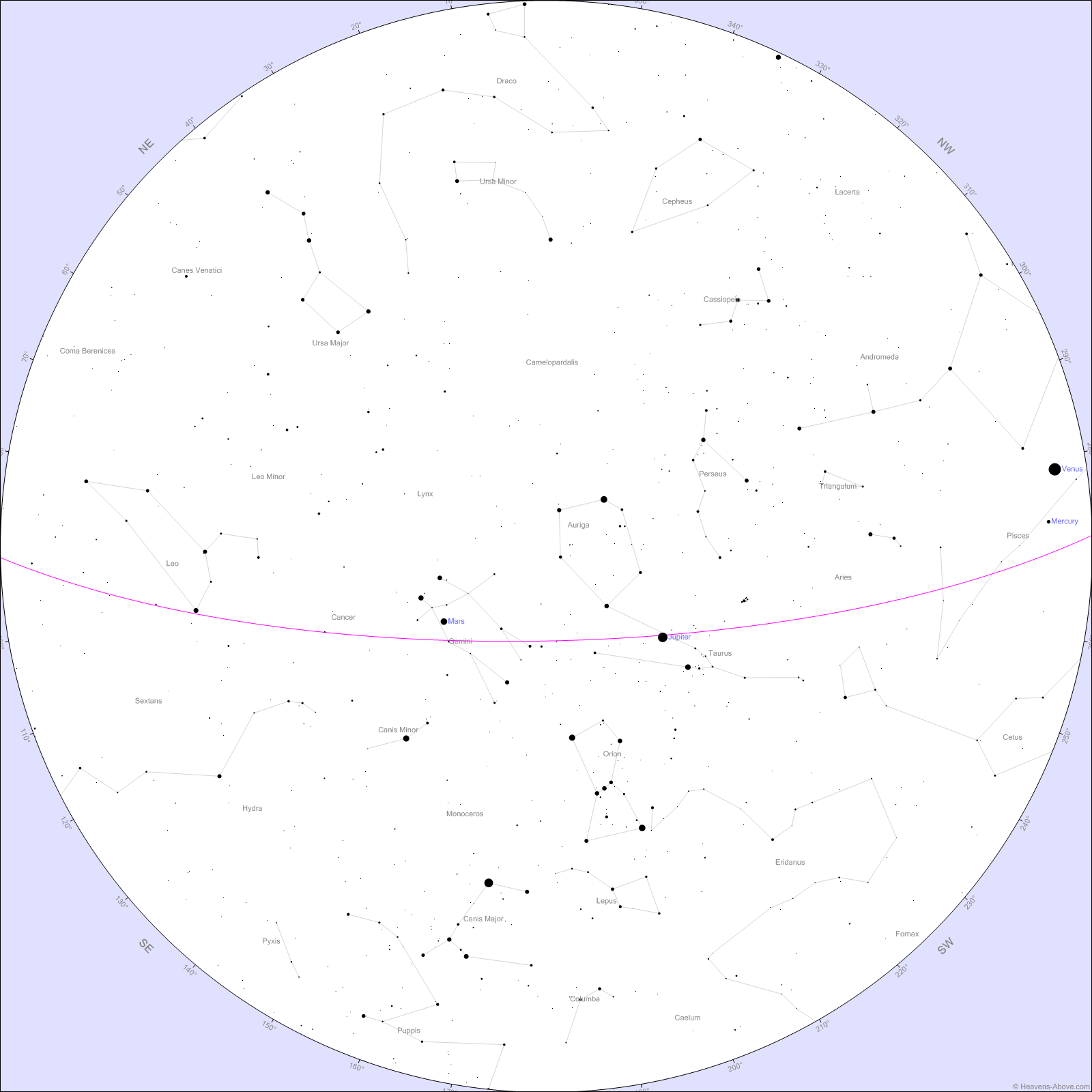
Now, onto the planets. After the recent spectacular parade of planets that gave some observers the chance to see all the visible planets lined up across the sky, we’ve basically lost three of them. Mercury is once again too close to the Sun, and it’s joined by Venus and Saturn. All three bodies are bunched up with the Sun this week.
You may still be able to catch a glimpse of Mercury and Venus tonight, just after sunset and very low on the western horizon, but as the week progresses, our two inner planetary companions will dip closer to the horizon each night at sunset, until we can’t see them anymore.
By the week’s end, Venus will be ahead of the Sun, and by next week, will transition to a morning star, rising in the east, just before the sun. This transformation happens roughly every 19 months as Venus moves between Earth and the Sun in its orbit. We’ve been enjoying the presence of Venus in the evening sky since last fall – the third brightest object in the sky after the Sun and Moon. By the month’s end, you’ll need to be an early riser to catch its brilliance in the predawn sky.
Jupiter, the king of planets, is still high and bright in the early evening, located in the constellation Taurus, and with Venus gone, it claims its place as the brightest object after the Moon. Look for it near Aldebaran, the orange giant star that marks the eye of the bull. If you have a telescope, this is a great time to check out Jupiter’s four largest moons—Io, Europa, Ganymede, and Callisto—easily visible as tiny points of light near the gas giant.
Mars is nearby, sitting in Gemini, close to the twin stars Castor and Pollux. Unlike the flickering glow of those stars, Mars has a distinct and constant reddish hue.
[TRANSITION FX]
Now, let’s turn our attention to some of the constellations that dominate the night sky in March.
Taurus is a powerhouse this season, home to some of the best-known deep-sky objects. Along with Aldebaran, look for Messier 45, the Pleiades—that’s the little cluster of stars that looks like a tiny dipper.
In mythology, the Pleiades were seven sisters pursued by Orion, and in modern astronomy, this cluster is one of the closest and brightest open star clusters to Earth. Even without any equipment, the Pleiades appears as a small, hazy patch in the constellation Taurus. Most people can see six or seven stars under dark skies.
Interestingly the best view of the Pleiades comes with binoculars. The cluster is larger than the full Moon – so it’s actually too spread out to fit entirely in most telescope views. With binoculars, the brightest stars become distinct, each glowing in shades of blue-white. You’ll also start to notice that the cluster contains dozens of fainter stars that blend into the glow when seen with the naked eye.
A small telescope will show even more stars, possibly up to 100 members of the cluster scattered across the field of view. It’s best to use a low-power, wide-field eyepiece. If you’re in an extremely dark location, you might catch a glimpse of a faint bluish reflection nebula. This is leftover dust that the cluster is currently passing through, reflecting the light of its young, hot stars. It’s faint, so long-exposure astrophotography does a much better job of bringing it out than visual observation.
Fun fact – while the Pleiades is generally called the “Seven Sisters,” in Japanese, it’s known as “Subaru”—and if you look closely at the Subaru car logo, you’ll see a stylized version of the cluster.
Leo, the Lion, is another March favorite. This constellation rises in the east in the evening and is easy to spot thanks to its backward question mark shape—that’s called “The Sickle.” In ancient cultures, Leo was often associated with royalty, strength, and the Sun—which is fitting, since it’s a sign that warmer days are ahead!
The brightest star in Leo is Regulus, a bluish-white star that’s about 79 light-years away, and fun fact—it actually spins so fast that it’s not quite a sphere, but slightly flattened. One of the highlights of Leo is The Leo Triplet, a stunning group of three spiral galaxies—Messier 65, Messier 66, and NGC 3628—all located about 35 million light-years away.
M65 is slightly tilted toward us, giving it a classic spiral shape. It has a yellowish core, meaning it has older stars, but also some dust lanes where new stars are forming.M66 is more distorted, likely due to gravitational interactions with its neighboring galaxies. It has strong spiral arms and huge dust clouds.
NGC 3628, also called the “Hamburger Galaxy” is the third member of the triple. This galaxy has a thick dust lane cutting across it, making it look like a cosmic sandwich! It’s a little fainter than M65 and M66, but if you’re in a dark location with a telescope, you might catch it.
The Leo Triplet is an active, dynamic group, meaning these galaxies are pulling and warping each other due to their gravitational interactions. They may eventually merge millions of years from now, but for now, they make a spectacular sight for skywatchers.
To find them, look just below the lion’s belly, near the star Chertan. If you have a telescope with a wide field of view, you can see all three galaxies together in a single frame.
[TRANSITION FX]
A notable astronomical event this week is the Spring Equinox, happening on March 20th.
Twice a year, Earth’s tilt lines up perfectly perpendicular to the Sun. That means for a brief moment, day and night are nearly equal all over the world. The word “equinox” comes from the Latin for “equal night.”
This is the official start of spring in the Northern Hemisphere, and cultures around the world have celebrated it for millennia. Ancient civilizations like the Mayans built entire structures—like the Temple of Kukulkan at Chichen Itza—that align with the Sun on the equinox, creating a serpent-like shadow on the pyramid’s steps.
Astronomically, the equinox is a halfway point—it’s when the Sun crosses the celestial equator, moving from the southern half of the sky into the northern half. From now on, our days will keep getting longer until we reach the summer solstice in June, when the Sun is at its highest point.
[MUSIC]
If you found this episode helpful, let me know, and feel free to send in your questions and observations. The easiest way to do that is by visiting our website, startrails.show. This is also a great way to share the show with friends. Until next time, keep looking up and exploring the night sky. Clear skies, everyone!
Support the Show
Connect with us on Mastodon @star_trails or on Bluesky @startrails.bsky.social
If you’re enjoying the show, consider sharing it with a friend! Want to help? Buy us a coffee!
Podcasting is better with RSS.com! If you’re planning to start your own podcast, use our RSS.com affiliate link for a discount, and to help support Star Trails.
 Star Trails: A Weekly Astronomy Podcast
Leave a comment