
Galaxy Season: A Deep Sky Adventure – Star Trails: A Weekly Astronomy Podcast
Episode 58
In this episode, we’re kicking off Galaxy Season, that magical stretch of springtime nights when the Northern Hemisphere gets some of the clearest views of deep-sky galaxies. From Bode’s Galaxy and the Cigar Galaxy in Ursa Major to the stunning Whirlpool Galaxy and the elusive Needle Galaxy, we’ll explore some of the best targets for backyard stargazers.
We’ll also talk about why galaxies are so captivating for astrophotographers and how long-exposure photography can reveal breathtaking details and colors our eyes can’t see.
Plus, we’ll check in with the planets and the Moon, including some gorgeous conjunctions happening this week.
Links
Transcript
[MUSIC]
Howdy stargazers and welcome to this episode of Star Trails. I’m Drew, and I’ll be your guide to the night sky for the week starting March 30th through April 5th.
We’ve just entered Galaxy Season, that time of year when astronomers often set their sites on deep sky objects. We’ll cover some potential targets and offer up viewing tips later in the show. But now, let’s see what’s happening closer to home.
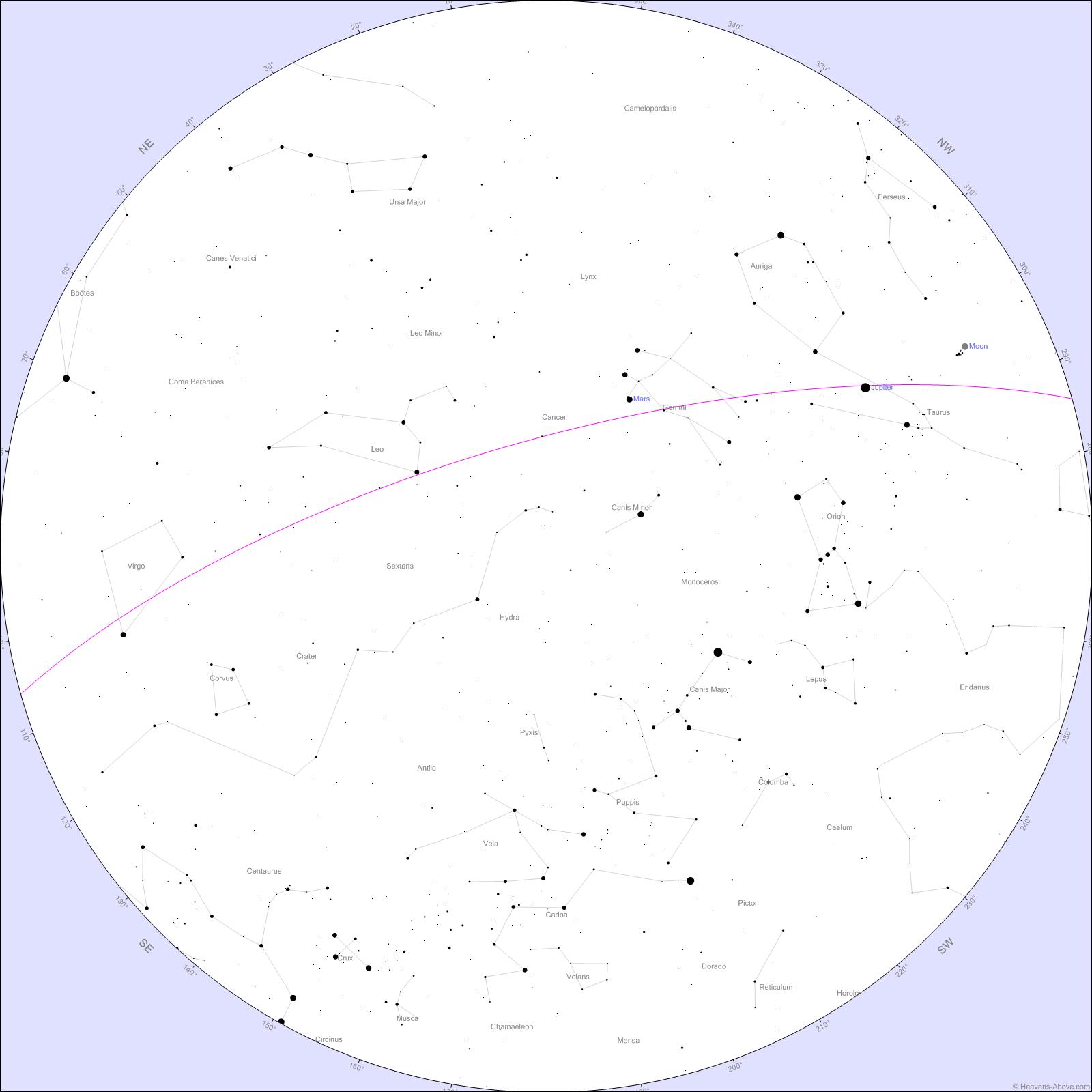
We begin the week with a Waxing Crescent Moon, barely noticeable at just 2% illumination. It grows gradually brighter each night, reaching First Quarter Moon by week’s end. The moon is worth keeping an eye on, as it’s going to make a couple of lovely appearances near planets this week, more on that in a moment.
Now, let’s talk about the planets. Venus is back! But not where you might expect. It’s now the Morning Star, shining brilliantly in the eastern sky before sunrise. By April 1st, it’ll be rising about an hour before the Sun. Through your telescope, you might spot it as a slender crescent. But even to the naked eye, it’s a spectacular, dazzling sight.
Mars is still hanging out in the evening sky, tucked away in the constellation Gemini. You’ll spot it as a reddish point of light. And if you’re looking for a great viewing moment, circle April 5th on your calendar. That night, the First Quarter Moon will cozy up near Mars, right alongside the twin stars Castor and Pollux, creating a beautiful gathering in the western sky after sunset.
Jupiter is still shining brightly in Taurus. Look for it on April 2nd, when the Waxing Crescent Moon will be close to the King of Planets. Look toward the western sky just after sunset for that eye-catching conjunction.
Saturn, Mercury and Neptune are all in the Sun’s glare, so you won’t spot them this week. For an extra challenge, telescope and binocular astronomers may want to hunt down Uranus. It’s visible at magnitude 5.8, about 7 to 8 degrees below the Pleiades, near Taurus. As always, consult with a star chart or app for the exact location.
[TRANSITION FX]
Tonight, we’re diving into one of the most exciting times of the year for deep-sky observers: Galaxy Season. This stretch of springtime nights — typically from late March to early May — offers some of the best views of distant galaxies, especially for those of us in the Northern Hemisphere.
During Galaxy Season, Earth’s position in its orbit around the Sun tilts our view away from the bright, star-packed plane of the Milky Way. With less interference from the Milky Way’s dense core, we’re treated to some of the clearest and darkest views of the universe beyond our own galaxy.
So, let’s explore some galaxies that haven’t been getting the spotlight lately but absolutely deserve some attention. Here’s what to point your telescope at this Galaxy Season:
Number 1: Bode’s Galaxy (M81) & The Cigar Galaxy (M82)
Located in the constellation Ursa Major, these two galaxies make an intriguing pair. M81 is a grand spiral galaxy, while M82 is a striking, elongated starburst galaxy. They’re just about 12 million light-years away from us and show up in smaller telescopes as faint patches of light.
Number 2: M101 – The Pinwheel Galaxy
Also located in Ursa Major, M101 is a gorgeous face-on spiral galaxy. It’s known for its large size and distinct spiral arms. Under dark skies with a 6-inch or larger telescope, you can start to make out some of its delicate structure. It’s approximately 21 million light-years away.
Number 3: M51 – The Whirlpool Galaxy
Found in the constellation Canes Venatici, the Whirlpool Galaxy is a stunning interacting galaxy that’s just about 31 million light-years away. What’s amazing about this galaxy is that, with a telescope of 6 inches or more, you can actually see hints of its spiral arms and even its smaller companion galaxy, NGC 5195, seemingly connected by a bridge of stars.”
Number 4: NGC 4565 – The Needle Galaxy
Located in the constellation Coma Berenices, the Needle Galaxy is a spectacular edge-on spiral galaxy. Its slender, elongated shape makes it stand out. With a large telescope, you can catch a clear view of its bright central bulge bisected by a dark dust lane. It’s around 40 million light-years away.
And finally, number 5: M106 – The Splinter Galaxy
Also in the constellation Canes Venatici, you’ll find M106, a bright and fairly large spiral galaxy that’s about 22 million light-years away. Its bright core is easy to spot even with a small telescope, and if you have a larger scope, you might even notice some of its spiral structure.
To get the best view of all these galaxies, use a telescope with at least 6 to 8 inches of aperture. Make sure you’re observing from a dark-sky site with minimal light pollution. Using averted vision — that’s looking slightly off to the side of the object — can help make faint details more noticeable. If you’re using binoculars, you’ll be able; to catch M81 and M82, but most of these galaxies will require a telescope.
Galaxies are always popular with astrophotographers, and for good reason. Keep in mind, most galaxies will appear as faint, grayish smudges against the darkness. Astrophotographers have the unique advantage of using long-exposure photography to reveal incredible details that our eyes simply can’t capture in real-time.
When a camera’s sensor collects light over minutes or even hours, it brings out the intricate structure of galaxies — For example the glowing spiral arms of the Pinwheel Galaxy, the dust lanes in the Needle Galaxy, or the swirling interactions of the Whirlpool Galaxy and its companion.
Astrophotography also allows us to capture the colors of these galaxies, from the reddish glow of star-forming regions to the bluish hues of hot, young stars. These details provide important information about the galaxies’ composition, age, and evolution.
For budding astrophotographers, Galaxy Season is a fantastic time to push your equipment’s capabilities. Even a modest setup with a DSLR or mirrorless camera and decent lens on a tracking mount can produce some jaw-dropping images. And with more advanced gear — like dedicated astro-cameras and larger telescopes — you can create breathtaking, high-resolution views of these distant worlds.
So, if you’ve been thinking about trying your hand at astrophotography, there’s no better time than right now.
We can’t forget the Messier Marathon! Attempting to view all 110 Messier objects in a single night is a fantastic challenge during Galaxy Season. Many of the objects on the list are galaxies, making this time of year perfect for a marathon. Try to complete the challenge when skies are darkest, like during the April New Moon. Many of these objects can be viewed with a cheap pair of binoculars.
The Astronomical League publishes an excellent field guide for viewing all the Messier objects. I’ll include a link in the show notes.
[MUSIC]
If you found this episode helpful, let me know, and feel free to send in your questions and observations. The easiest way to do that is by visiting our website, startrails.show. This is also a great way to share the show with friends. Until next time, keep looking up and exploring the night sky. Clear skies, everyone!
Support the Show
Connect with us on Mastodon @star_trails or on Bluesky @startrails.bsky.social
If you’re enjoying the show, consider sharing it with a friend! Want to help? Buy us a coffee!
Podcasting is better with RSS.com! If you’re planning to start your own podcast, use our RSS.com affiliate link for a discount, and to help support Star Trails.
 Star Trails: A Weekly Astronomy Podcast
Leave a comment