Sky Serpents and Space Legends – Star Trails: A Weekly Astronomy Podcast
Episode 59
This week we journey through a sky filled with symbolism, science, and stories. April’s Full “Pink Moon” makes its appearance — this time as a micromoon, smaller and subtler than a supermoon, yet just as rich in seasonal lore. In the early morning hours, Venus, Saturn, and Mercury gather in a rare planetary trio low on the eastern horizon.
As night falls, the great celestial serpent Hydra winds its way across the southern sky. We’ll discuss how to spot this sprawling constellation and explore its mythological roots, from the labors of Hercules to the lonely glow of Alphard, its brightest star.
Then, we turn our gaze to a different kind of trailblazer: Yuri Gagarin. On the anniversary of his historic 1961 flight, we remember the first human to orbit the Earth—and the legacy of wonder and possibility he left behind.
Transcript
[MUSIC]
Howdy stargazers and welcome to this episode of Star Trails. I’m Drew, and I’ll be your guide to the night sky for the week starting April 6th through the 12th.
This week we welcome another full moon, three planets become morning risers, Hydra dominates the night sky, and we take a moment to celebrate the anniversary of the first human in space, Russia’s Yuri Gagarin. So grab a comfortable spot under the night sky, and let’s get started.
We’re building up to a Full Moon on Saturday, April 12th. This one is known as the “Pink Moon.” Now, despite what the name might suggest, the Moon won’t actually turn pink. The name comes from a North American wildflower — Moss Phlox — which blooms around this time each spring and has a pink hue.
Ancient traditions, especially among Indigenous peoples and early European settlers, gave each month’s full moon a name tied to seasonal change, and April’s Pink Moon is all about new life blossoming after winter.
But this Full Moon has a little twist. It’s also a Micromoon. That means it reaches its full phase just a day before the Moon hits apogee, the farthest point in its orbit around Earth. Because it’s farther away than usual, this Full Moon will appear slightly smaller and dimmer in the sky – about 14% smaller than a so-called “supermoon.” It’s a reminder that the Moon’s orbit isn’t a perfect circle, but rather, an ellipse.
Now, on to the planets.
You’ll want to grab a cup of coffee for this: In the pre-dawn hours, there’s a fascinating gathering happening low in the eastern sky. Venus, Saturn, and Mercury are forming a tight celestial trio. Venus is by far the brightest, shining like a beacon before sunrise. Just nearby are Saturn and Mercury.
Now here’s the catch: because they’re so close to the horizon and the Sun is coming up fast, Mercury and Saturn will be tricky to spot. You’ll need an unobstructed view of the eastern horizon—think open fields or the ocean—and a bit of luck with atmospheric clarity. Binoculars can help, but be sure the Sun is fully below the horizon to avoid eye damage. If you catch them, though, it should be a stunning sight: Three planets clustered less than 10 degrees apart in a small corner of the sky.
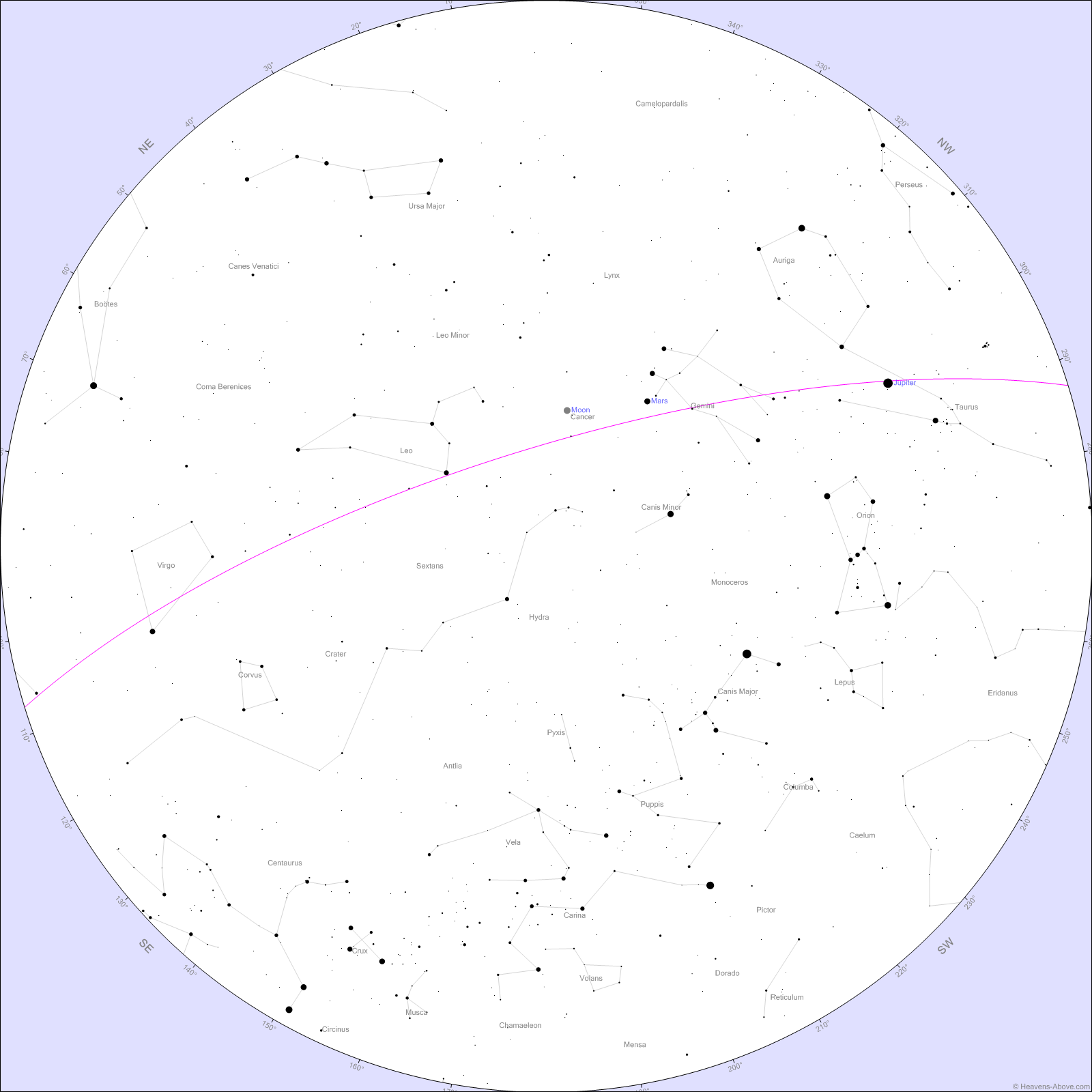
In the evening, Jupiter and Mars are also making appearances. Jupiter sets before midnight and shines bright in the west, hanging out in the constellation Taurus. Mars is further east in Gemini, fading a bit now that it’s slipping away from Earth, but still visible with its signature reddish glow.
[TRANSITION FX]
This week, let’s deep into the cosmic coils of Hydra, the largest constellation in the night sky.
Hydra slithers across the southern sky in April, stretching more than 100 degrees from just below Cancer in the west to Libra in the southeast. It’s a massive, winding constellation that can take some effort to trace.
In mythology, Hydra was the serpent slain by Hercules as one of his Twelve Labors. The creature had multiple heads—and when one was cut off, two more would grow in its place. Hercules had to burn each neck after decapitation to stop the heads from regenerating. The constellation captures that serpentine nature with a long, meandering line of stars that slinks across the sky.
Hydra’s brightest star is Alphard, which means “the solitary one” in Arabic. Alphard sits alone in a relatively dark patch of sky, glowing with an orange hue. It’s a giant star, more than 50 times the size of our Sun, and about 177 light-years away.
Within Hydra’s boundaries, you’ll also find a few deep-sky gems if you have binoculars or a small telescope. Look for the Ghost of Jupiter Nebula, also known as NGC 3242, a planetary nebula that looks like a small, pale disk—sort of like a tiny version of Jupiter, hence the name. There’s also the Hydra Cluster of galaxies, though that one’s best left to larger telescopes under dark skies.
Despite its size, Hydra doesn’t have many bright stars, which makes it a bit of a challenge. Once you find Alphard, start tracing eastward and let your imagination wind along the serpent’s spine.
[TRANSITION FX]
Before we wrap things up, let’s shift our gaze from the stars we see… to the people who have dared to go there.
April 12th marks the 64th anniversary of a moment that changed the course of human history. On this day in 1961, a 27-year-old Soviet pilot named Yuri Gagarin climbed aboard a tiny spherical spacecraft called Vostok 1… and became the first human being to travel into space.
It’s one of those “before and after” moments – not just for science or space exploration, but for how we see ourselves as a species. Before Gagarin’s flight, space was something distant, something untouchable. After his single orbit around the Earth, we knew: it was possible. A human had left the atmosphere and come back.
Gagarin’s fame took off. He became an international icon, a symbol of hope, curiosity, and the courage it takes to go where no one has gone before.
Let’s set the scene.
The Cold War was in full swing. The space race between the Soviet Union and the United States was accelerating after the launch of Sputnik in 1957, and both nations were pouring resources into developing manned spaceflight. The Soviets had a lead in the early stages, and on April 12th, 1961, they stunned the world again.
Gagarin was chosen from more than 200 cosmonaut candidates. By all accounts, he was calm under pressure, highly skilled, and incredibly charismatic—which didn’t hurt when the mission made him a global celebrity overnight.
Vostok 1 launched from the Baikonur Cosmodrome in Kazakhstan at 6:07 AM UTC. The spacecraft was fully automated, with no manual controls—just in case Gagarin became disoriented in microgravity. Gagarin’s job was to monitor systems, report back to ground control, and survive.
The flight lasted just 108 minutes, completing one full orbit of the Earth at a peak altitude of about 200 miles. Gagarin saw something no human had seen before—the curve of the Earth. He conveyed the experience to mission control, saying: “I see the horizon of the Earth … And I see such a beautiful blue halo along the horizon, along the edge of the Earth.”
[Gagarin Audio Clip]
For the first time, we had confirmation from someone who had been there, looking down.
The reentry process was just as dramatic. The Vostok capsule didn’t have a soft landing system like modern spacecraft. Gagarin ejected from the capsule at about 23,000 feet and parachuted to the ground separately. The Soviets kept that detail secret for years because it didn’t technically comply with the international definition of a complete spaceflight, which required the pilot to land with the spacecraft. But he went to space and made it back. He earned his wings.
When he landed in a rural area of Russia, he surprised a farmer and her daughter who weren’t quite sure what to make of the man in the orange suit and helmet. According to reports, he smiled and reassured them, “Don’t be afraid. I am a Soviet like you, who has descended from space and I must find a telephone to call Moscow.”
Overnight, Yuri Gagarin became the most famous person on Earth. He was paraded through Red Square, visited by heads of state, and sent on goodwill tours across the globe. But even as he became a symbol of Soviet success, people everywhere—regardless of politics—recognized the deeper significance of what he had done.
He wasn’t just the first Soviet in space. He was the first human in space. And for one brief moment, the boundaries between nations faded away, and all of humanity had something to cheer for.
Tragically, Gagarin’s life was cut short. He died in a training jet crash in 1968, just seven years after his historic flight. But his legacy endures—in statues, in spacecraft bearing his name, and in the hearts of everyone who dreams of the stars.
Every year, on April 12th, space agencies, museums, and fans around the world celebrate Yuri’s Night—an international party for space that honors not just Gagarin’s flight, but all of human space exploration. It’s a reminder that space belongs to all of us.
[MUSIC]
If you found this episode helpful, let me know, and feel free to send in your questions and observations. The easiest way to do that is by visiting our website, startrails.show. This is also a great way to share the show with friends. Until next time, keep looking up and exploring the night sky. Clear skies, everyone!
Support the Show
Connect with us on Mastodon @star_trails or on Bluesky @startrails.bsky.social
If you’re enjoying the show, consider sharing it with a friend! Want to help? Buy us a coffee!
Podcasting is better with RSS.com! If you’re planning to start your own podcast, use our RSS.com affiliate link for a discount, and to help support Star Trails.
 Star Trails: A Weekly Astronomy Podcast
Leave a comment