Crows, Cosmic Collisions, and the Coming Lyrids – Star Trails: A Weekly Astronomy Podcast
Episode 60
This week is a period of shifting moonlight, planetary pairings, and hidden wonders – oh, and there’s a new comet on its way around the sun, now visible in binoculars in the morning sky!
We spotlight two underrated constellations: Corvus, the mythic crow tangled in Apollo’s wrath, and Canes Venatici, the quiet hunting dogs guarding a treasure trove of galaxies.
Plus, we gear up for the Lyrids meteor shower, Earth’s oldest recorded celestial light show. Discover what to look for, when to watch, and how to make the most of your spring stargazing session.
Transcript
[MUSIC]
Howdy stargazers and welcome to this episode of Star Trails. I’m Drew, and I’ll be your guide to the night sky for the week starting April 13th through the 19th.
This week we welcome a new comet to the morning sky. We’ll take a look at a pair of animal-themed constellations that are hiding some intriguing deep sky objects, and the Lyrids meteor shower is on the horizon. So grab a comfortable spot under the night sky, and let’s get started!
Early risers are in for a treat, because amateur observers have just spotted a new comet. Comet C/2025 F2, also known as “SWAN” was spotted just a couple weeks ago on March 29th, using data from the solar wind instrument aboard SOHO – that’s the Solar and Heliospheric Observatory.
It’s currently lighting up the morning twilight and is already brightening fast as it heads toward its closest approach to the Sun, which happens on May 1st.
In the pre-dawn hours, Comet SWAN is visible low in the east-northeast, not far from Alpheratz, the bright star in the corner of Pegasus. You’ll want binoculars or a small telescope for the best view, but if it keeps brightening, we might be able to see it with the naked eye by the end of the month!
This comet is glowing green, thanks to sunlight exciting carbon molecules in its coma, a signature look for a comet nearing the Sun.
So, if you’re up early this week, find a dark spot with a clear view of the eastern horizon, and try to catch a glimpse before sunrise.
Prior to its current journey, SWAN had an orbital period of about 70,000 years. Post-perihelion, gravitational interactions are expected to extend its orbital period to nearly 740,000 years, meaning it won’t return to the inner solar system for many millennia.
I’ll keep you posted in the coming weeks as it climbs toward peak brightness. Comets, as we always say, are notoriously unpredictable, so we’ll be keeping an eye on this one.
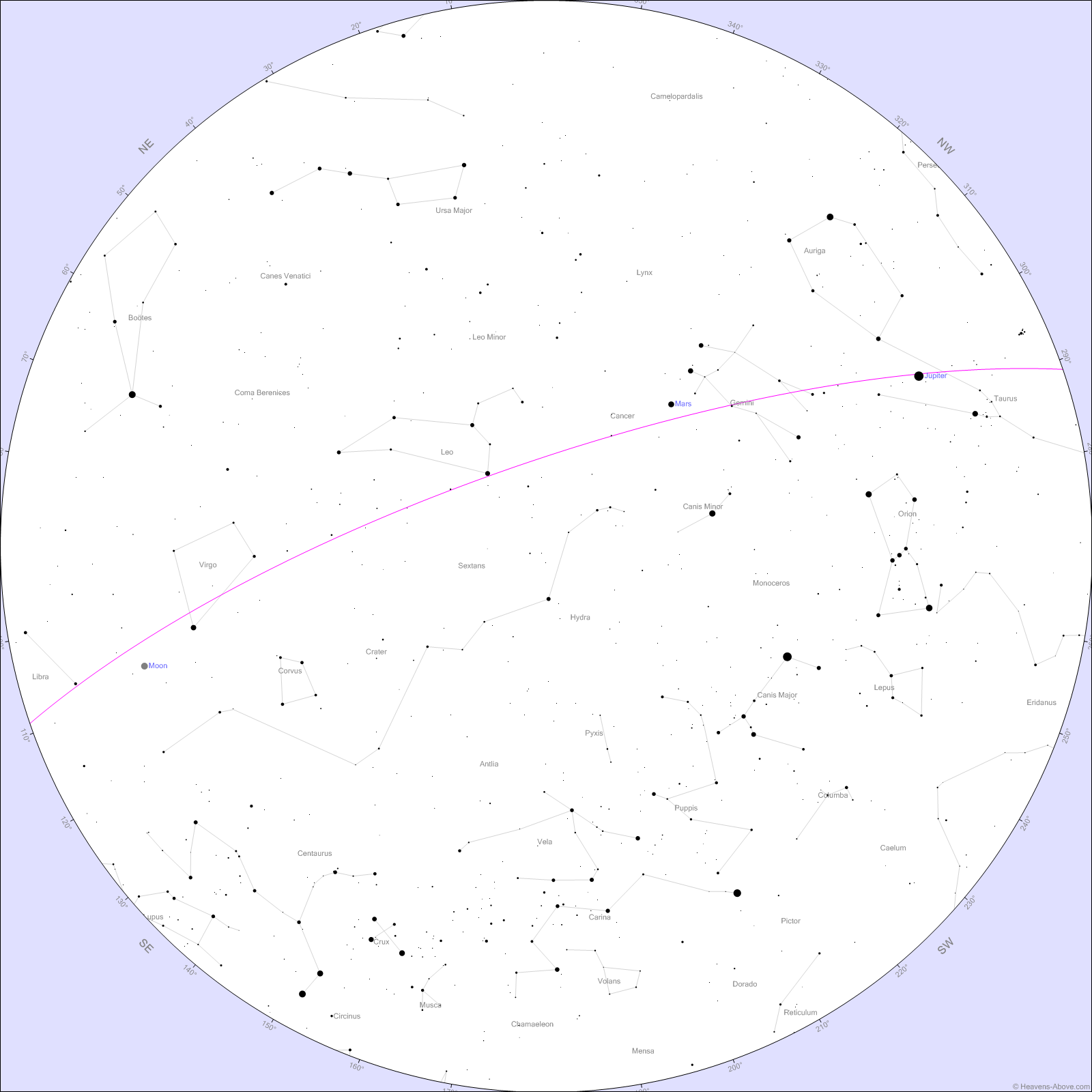
A little closer to home, the Moon is in transition this week. Last night was the full Pink Mini Moon, and it’s still nearly full tonight. As the week progresses, the Moon enters the Waning Gibbous phase, with its illuminated portion decreasing each night. By April 19, the Moon’s illumination will be approximately 64%.
Jupiter still dominates the evening sky after sunset. Although the window to observe this gas giant narrows as the days lengthen, it’s still a magnificent sight in the western sky during twilight. Be sure to check it out in a telescope if you can. Depending on your instrument, you’re likely to see some cloud bands and its four Galilean moons.
Mars, The Red Planet, remains positioned near the twin stars of Gemini: Castor and Pollux, before moving into the constellation Cancer. It’s visible in the evening sky, shining slightly brighter than the twin stars.
Mercury, Venus, and Saturn are now targets for early risers. Before dawn, look to the eastern horizon to spot them. Venus, in particular, will be exceptionally bright and hard to miss. This trio will be in a tight grouping – clustered in an area of less than 10 degrees, for much of the month. As Mercury exited retrograde earlier this month, it will start drifting away from Venus and Saturn, which will be very close to one another by month’s end.
Let’s venture farther out on a celestial side quest to view some constellations. While the big players like Leo, Virgo, and the Big Dipper tend to hog the spotlight this time of year, there are a few lesser-known constellations that deserve some love. Tonight, we’re zooming in on two underrated groupings — one in the southeast, and one just hanging out beneath the Dipper’s tail.
Let’s start low on the horizon with Corvus, the Crow.
Corvus isn’t flashy — in fact, it’s made up of just four main stars forming a kind of lopsided square. However, this constellation comes with a dramatic backstory. In Greek mythology, Corvus was Apollo’s sacred bird. One day, the god sent the crow to fetch water in a cup — represented by the neighboring constellation Crater. But the crow got distracted — some say by unripe figs, others say he just flaked — and he came back late, making excuses. Apollo didn’t buy it. As punishment, he flung the crow, the cup, and a long water snake — that’s Hydra — into the sky. And there they sit to this day, Corvus forever reaching for the cup, but blocked by the serpent.
You can catch Corvus rising in the southeast around 9 or 10 PM. Just look for a small, boxy pattern of stars beneath Virgo. The brightest of the bunch is a blue-white giant star about 165 light-years away — it marks the crow’s wing.
And if you have a good telescope, check out the Antennae Galaxies — NGC 4038 and 4039 — two galaxies in the middle of a cosmic collision. They’re fusing together, flinging stars and dust into wild arc shapes. They’re not easy to spot; you’ll need dark skies and the right optics.
Now let’s head northward for our next stop.
Look just below the handle of the Big Dipper, and you’ll find Canes Venatici — the Hunting Dogs.
This constellation has a quirky origin. Back in the 1600s, astronomer Johannes Hevelius meant to depict Boötes holding a staff. But a printing error split the stars off into their own constellation — and we got the hunting dogs instead. They’re usually imagined as a pair — Asterion and Chara, chasing after the Big Bear alongside their master, Boötes.
Canes Venatici is subtle — there are no bright star patterns — but it’s hiding some deep-sky treasures.
The constellation’s brightest star is Cor Caroli, a binary system whose name means “Heart of Charles,” in honor of King Charles I of England. With binoculars or a small scope you might catch its companion star — a lovely double when seeing conditions are right.
But the real showstopper here is the Whirlpool Galaxy — M51. Just about 31 million light-years away, this face-on spiral galaxy is actually interacting with a smaller companion, creating these incredible tidal tails and swirling arms. It’s a favorite among astrophotographers and a great galaxy to spot with a decent backyard telescope.
Also tucked in here: the Sunflower Galaxy — M63, with its delicate spiral structure, and the Cat’s Eye Galaxie, M94, a compact galaxy with a bright core and faint ring. This patch of sky is basically a galaxy playground.
[TRANSITION FX]
Before we wrap up this week’s tour of the night sky, I want to give you a heads-up—because something special is on the way.
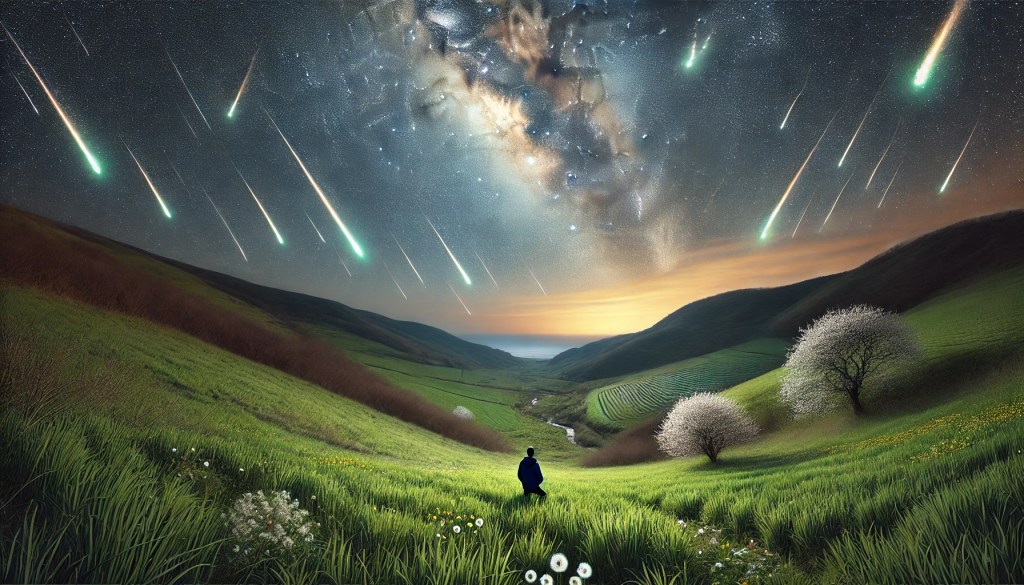
Starting in mid-April, we enter meteor shower season. And the first major shower of the year is right around the corner. I’m talking about the Lyrids, which will peak on the night of April 21st into the early morning hours of April 22nd.
There’s something extra special about the Lyrids: they’re one of the oldest meteor showers ever recorded. Chinese astronomers documented them more than 2,700 years ago, around 687 BCE. That means people have been watching these same bits of celestial debris burn up in the sky since before the rise of the Roman Empire.
So, what are we actually seeing when we catch a meteor streaking across the sky?
Every meteor shower is the result of Earth passing through the debris trail of a comet, and the Lyrids are no exception. These meteors come from Comet Thatcher, a long-period comet that orbits the Sun about once every 415 years. As the comet travels through the solar system, it leaves behind tiny bits of dust and rock. When Earth crosses that path in April, some of those particles slam into our atmosphere at high speed—about 110,000 miles per hour—and burn up, creating the bright streaks we call meteors.
The Lyrids aren’t the most prolific meteor shower of the year, but they’re a solid mid-tier performer, typically producing 15 to 20 meteors per hour at their peak under dark skies. But every once in a while, they surprise us. Back in 1982, skywatchers saw a burst of 90 meteors an hour. Earlier outbursts in the 1920s and 1800s were even more dramatic. So while a big outburst isn’t guaranteed, it’s always a possibility—and that unpredictability makes watching the Lyrids a little more thrilling.
The shower gets its name from the constellation Lyra, because that’s where the meteors appear to radiate from. More specifically, the radiant point is near Vega, one of the brightest stars in the sky. You don’t need to find Vega to enjoy the show—meteors can appear all over the sky—but knowing the general area helps you orient yourself. Look to the northeast after midnight, and give your eyes about 20 minutes to adjust to the dark.
This year, there’s one thing to keep in mind: the Moon will be in a waning gibbous phase, just a few days past full. That means it’ll rise late in the evening and brighten the sky quite a bit, potentially washing out the fainter meteors. But don’t let that stop you. Even with moonlight, the brighter Lyrids can still shine through, and some leave behind glowing trains that linger for a second or two—like contrails.
The Lyrids peak around April 21st into the early morning of the 22nd, but you’ll be able to see them before and after the peak period.
To get the best view, try to find a dark spot away from city lights. Lie back with a wide view of the sky. There’s no need for a telescope or binoculars. Also, be patient. Meteors often come in clusters, so you might wait ten minutes with nothing, and then get a sudden flurry.
And here’s a fun fact: since the Lyrids were observed more than 2,000 years ago. Every meteor you see from this shower is part of a cosmic tradition that spans human history. It’s the same sky, the same dust, and the same sense of wonder.
[MUSIC]
If you found this episode helpful, let me know, and feel free to send in your questions and observations. The easiest way to do that is by visiting our website, startrails.show. This is also a great way to share the show with friends. Until next time, keep looking up and exploring the night sky. Clear skies, everyone!
Support the Show
Connect with us on Mastodon @star_trails or on Bluesky @startrails.bsky.social
If you’re enjoying the show, consider sharing it with a friend! Want to help? Buy us a coffee!
Podcasting is better with RSS.com! If you’re planning to start your own podcast, use our RSS.com affiliate link for a discount, and to help support Star Trails.
 Star Trails: A Weekly Astronomy Podcast
Leave a comment