Tracking Vesta and Exploring Alien Worlds – Star Trails: A Weekly Astronomy Podcast
Episode 63
This week we start with the waxing Moon as it heads toward May’s micromoon, the Flower Moon. Jupiter and Mars light up the western sky, while Venus, Saturn, and elusive Mercury put on a show before sunrise.
Don’t miss your chance to spot Vesta — one of the brightest and biggest asteroids visible from Earth — as it reaches peak visibility this week.
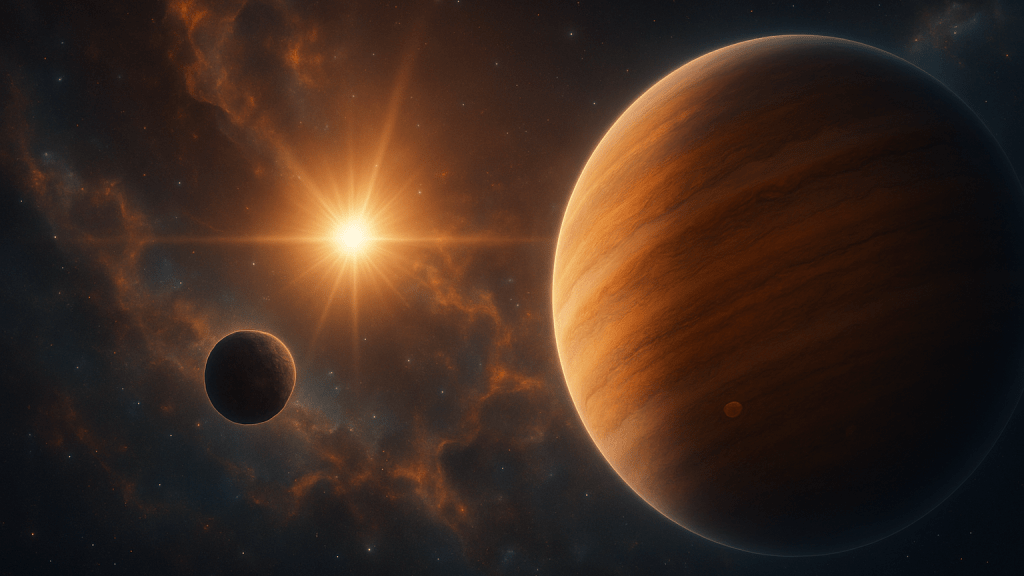
Later in the show, we venture far beyond our solar system to explore the wild world of exoplanets: planets orbiting other stars. From glass rainstorms to twin-star systems, we take a look at the science behind discovering distant worlds.
Transcript
[MUSIC]
Howdy stargazers and welcome to this episode of Star Trails. I’m Drew, and I’ll be your guide to the night sky for the week starting May 4th through the 10th.
This week the moon brightens, some familiar planets are still hanging around, and we have a unique opportunity to potentially view an asteroid. Later in the show, we’ll take a look at one of the most exciting fields in astronomy, the study of exoplanets, and some of the weird worlds that have been discovered in recent years.
So, grab a comfortable spot under the night sky and let’s get started.
[MUSIC FADES]
We kick things off with the First Quarter Moon, which arrives tonight. That means each night this week, the Moon will be waxing, getting brighter and rising a bit later each evening. It’s a great time for lunar observing. The shadows cast across the surface give craters and mountain ranges some awesome 3D definition through binoculars or a telescope.
By the end of the week, the Moon will be edging towards this month’s Full Moon, the Flower Moon, which also happens to be another micromoon. That simply means that it’s farther from Earth in its slightly elliptical orbit, and about 14% smaller than a supermoon.
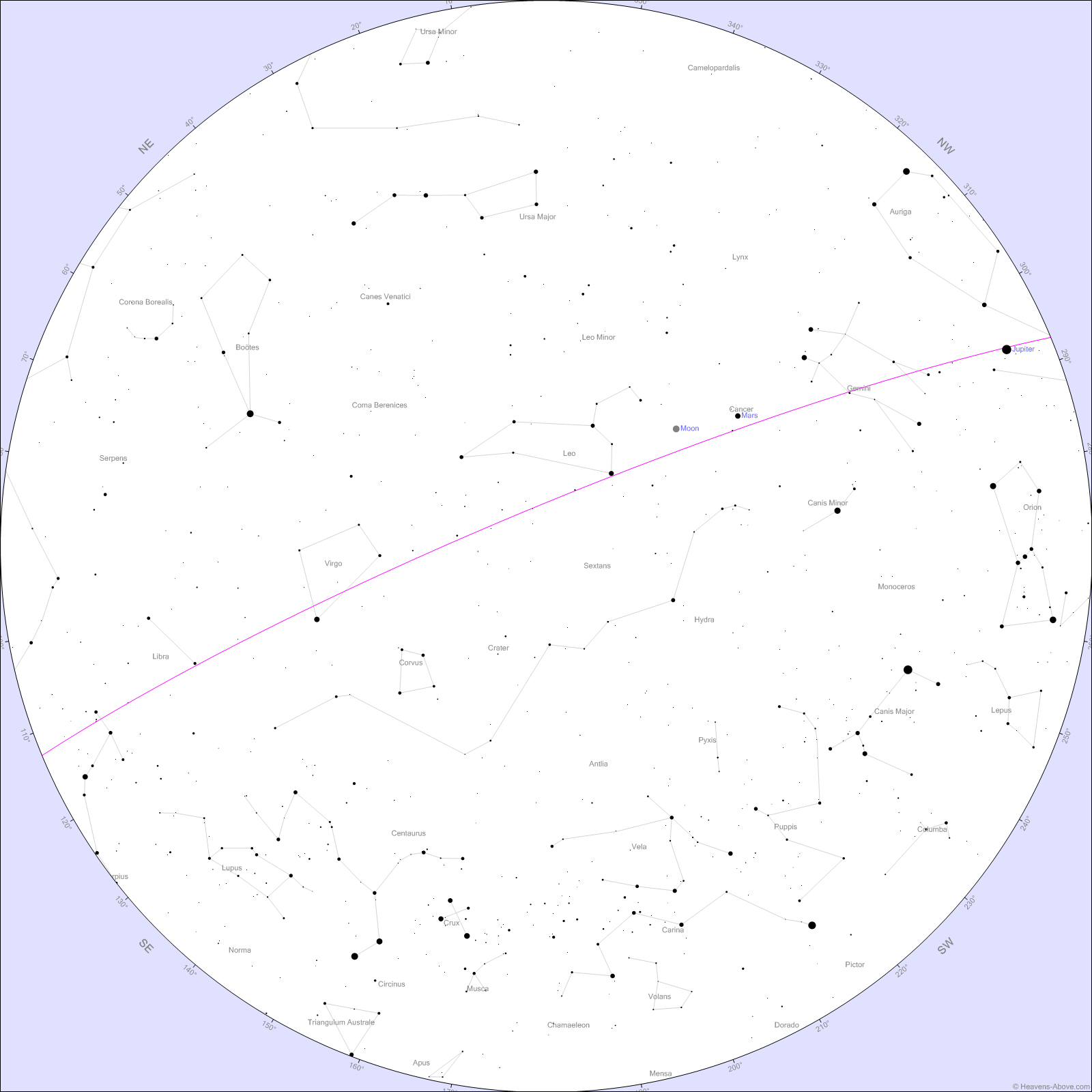
Now, on to the planets. Let’s start with the evening show. Right after sunset, look to the west and you’ll spot Jupiter, still holding on in the twilight. It’s bright and steady, easy to spot with the naked eye. It’ll set before midnight, so catch it early.
A little higher up you’ll find Mars, the Red Planet. It’s fainter than Jupiter, but that warm, ruddy glow gives it away. This week, the Moon passes near Mars in the evening sky, resulting in a lovely pairing to check out tonight, just after sunset.
Let’s shift our gaze to the early morning.
Venus, the Morning Star, is rising in the east about 30 to 40 minutes before sunrise. It’s brilliant, by far the brightest planet in the sky, and if you’ve got a clear eastern horizon, it’s hard to miss.
Just above Venus sits Saturn, fainter and more subdued in golden light, but still visible with binoculars, and definitely worth a look through a telescope if you’re up before dawn.
Mercury is also hanging out low in the eastern sky, but this one’s a bit trickier. It’s hugging the horizon and may get lost in the morning light. If you want to try for it, aim for about 20 minutes before sunrise and make sure you have a completely unobstructed view of the east.
[TRANSITION FX]
This week, we have a special opportunity to see an asteroid. From now until the end of the week is an excellent viewing window to spot Vesta, the brightest asteroid visible from Earth.
Vesta is one of the largest bodies in the asteroid belt, hanging out between Mars and Jupiter. It spans about 326 miles across — that’s roughly the size of Arizona — and it’s the second-largest asteroid after Ceres. What makes Vesta especially cool is that it’s big and reflective enough that you can actually see it with binoculars. Under really dark skies, you might even catch it with the naked eye.
Right now, Vesta is near opposition. That just means it’s directly opposite the Sun in our sky, and also the closest it’ll get to Earth this year. It rises around sunset, stays up all night, and sets at sunrise; those are prime viewing conditions.
To find it, look toward the constellation Libra, which is climbing in the southeastern sky after dark. It’s nestled just to the east of Virgo, so if you can find the bright star Spica, you’re on the right track. You’ll need a good star chart or a stargazing app to pinpoint Vesta’s exact location, since it just looks like a faint star. One handy trick: if you make note of Vesta’s position one night, and come back a day or two later, you’ll notice that it’s moved. That slow shift is how you know you’re looking at an asteroid!
Right now, Vesta is shining at about magnitude 5.6, which puts it right on the edge of naked-eye visibility, but binoculars will give you a much better chance. A basic pair of 7x50s or higher will do just fine.
So if you’re outside this week enjoying the night sky, take a few minutes to track down Vesta. And if you’d like to know more about the asteroid belt, go back and listen to episode 46, where we also take a moment to highlight Ceres, the largest object in the belt.
[TRANSITION FX]
We’ve gazed at the Moon and planets of our solar system, we’ve chased meteor showers, we’ve traced the constellations. But tonight, we’re heading out even farther — to planets orbiting stars that aren’t our Sun. These are the exoplanets. And once you start exploring them, it’s hard not to feel a sense of wonder that borders on science fiction — except it’s all very real.
For most of human history, we had no solid evidence that exoplanets existed at all. We guessed. Philosophers like Epicurus in ancient Greece thought other worlds must exist — after all, why would the universe be built for just us? But until the late 20th century, the existence of other planetary systems was a complete unknown.
Throughout my childhood, I always wondered if there were other planets out there. The science to find them simply didn’t exist.
That started to change in 1992, with a discovery that was both groundbreaking and… weird. Astronomers Aleksander Wolszczan and Dale Frail found two planets orbiting a pulsar — that’s a dead, collapsed star, spinning like a cosmic lighthouse and blasting out radiation. Not exactly a peaceful place. But there they were: two exoplanets, small and rocky, caught in the gravitational grip of a dead sun.
The way they discovered the exoplanets was unique: Pulsars are like cosmic clocks and pulse in very regular intervals. In this case, the pulsar being studied is about 2,300 light years away. Every now and then, scientists noticed the pulses were a little off, although the “off beats” still came at predictable intervals. After some theorizing, Wolszczan and Frail determined there had to be two planets, up to four times the mass of Earth, orbiting the pulsar approximately every 67 and 98 days.
Just three years later came the breakthrough that truly kick-started the exoplanet era: 51 Pegasi b. This was the first planet discovered orbiting a Sun-like star. It’s a gas giant, but it orbits extremely close to its star — completing a full orbit in just over four days. Imagine if your year lasted less than a school week.
This type of world came to be known as a “hot Jupiter” — massive like our own Jupiter, but much closer to its star. The reason we found hot Jupiters first is simply because they are big, they orbit fast, and they interact with their stars in a way we can actually detect.
And that brings us to the big question: How do we find these distant worlds?
You’d think we’d just point our telescopes at stars and spot their planets, right? It’s not that easy. Imagine trying to see a tiny, unlit mosquito buzzing around a floodlight from hundreds of miles away. The star completely overwhelms the faint light from the planet — especially since exoplanets don’t give off their own light, they just reflect it.
So astronomers had to get clever. The first method that really worked was the radial velocity method, also called the “wobble” method. As a planet orbits a star, its gravity tugs on the star just a little bit — enough to make the star wobble very slightly. We can measure that wobble by looking at the star’s spectral lines — those are the fingerprints of elements in the starlight. If the lines shift back and forth, like a Doppler effect, we know the star is being tugged — and a planet is the likely culprit.
Then came the transit method, which completely changed the game. If a planet happens to pass in front of its star from our line of sight, the light from the star dips just a tiny bit. If it does this on a regular schedule — we probably have a planet.
This method is what made the Kepler Space Telescope a superstar. Launched in 2009, Kepler stared at more than 150,000 stars and ended up discovering more than 2,600 confirmed exoplanets, with thousands more candidates. It was like turning on a light in a dark room — suddenly, we weren’t just hoping there were other worlds. We knew.
But even with Kepler and now TESS (the Transiting Exoplanet Survey Satellite), it’s still a challenge. Planets have to line up just right for the transit method to work — if their orbit tilts even slightly, we might miss them entirely. And some signals are so faint they can get lost in stellar noise, like trying to hear a whisper during a rock concert.
But the tools keep getting better. Enter the James Webb Space Telescope. Not only can Webb detect exoplanets, it can analyze their atmospheres. That’s done through something called transmission spectroscopy — when a planet passes in front of its star, a tiny bit of starlight filters through the planet’s atmosphere. By studying that light, we can tell what the atmosphere is made of — water vapor, methane, carbon dioxide, and more. It’s like doing a chemical test on something 100 light-years away.
Let’s talk about some notable exoplanets, and some of these are quite weird.
– HD 189733 b, is a cobalt-blue gas giant with winds up to 5,400 mph and is thought to have glass rain that whips sideways.
– Kepler-16b, orbiting two suns in a real-life Star Wars scenario – like the planet Tatooine, where Luke Skywalker grew up.
– WASP-12b, which is so close to its star that it’s being slowly consumed — it’s actually falling apart.
– GJ 1214 b, a “mini-Neptune” covered in thick clouds of water vapor — maybe even has a planet-wide ocean.
– And you may have of this one, TRAPPIST-1, a red dwarf star with seven rocky planets, at least three in the habitable zone — a place where liquid water might exist.
We’re still trying to answer the big questions: How common are Earth-like planets? Are we likely to find one nearby? And the biggest of them all: Could any of them harbor life?
We’re getting closer to finding the ingredients for life. And future missions like the Nancy Grace Roman Space Telescope and the European Space Agency’s PLATO mission will keep scanning the skies. Some upcoming concepts even include starshades — screens that block out a star’s light so we can see the faint planets next to it.
So next time you’re looking at the sky, pick a star. Odds are, it has planets. Maybe rocky, maybe gaseous, maybe icy… maybe just like Earth. We’ve gone from guessing they existed to discovering more than 5,000 of them — and we’re just getting started.
[MUSIC]
If you found this episode helpful, let me know, and feel free to send in your questions and observations. The easiest way to do that is by visiting our website, startrails.show. This is also a great way to share the show with friends. Until next time, keep looking up and exploring the night sky. Clear skies, everyone!
[MUSIC FADES OUT]
Support the Show
Connect with us on Mastodon @star_trails or on Bluesky @startrails.bsky.social
If you’re enjoying the show, consider sharing it with a friend! Want to help? Buy us a coffee!
Podcasting is better with RSS.com! If you’re planning to start your own podcast, use our RSS.com affiliate link for a discount, and to help support Star Trails.
 Star Trails: A Weekly Astronomy Podcast
Leave a comment