A Crown, a Ghost Planet, and a Star That Ate Another Star – Star Trails: A Weekly Astronomy Podcast
Episode 64
In this week’s episode we’re chasing mysteries in all directions — from the icy edges of our solar system to the fiery hearts of dying stars.
First, we explore the renewed buzz around Planet Nine, the theoretical ninth planet that may be lurking far beyond Pluto. New infrared data from decades-old space telescopes has astronomers wondering if we’ve finally glimpsed this long-suspected giant — or perhaps something even stranger.
Then, it’s time to bask in the glow of May’s Flower Moon and spot a planetary conjunction in the early morning sky. We’ll also check in on the last few stragglers from the Eta Aquarid meteor shower and take a guided tour of Corona Borealis, the Northern Crown — a small but mythically rich constellation that just might be harboring a nova-in-waiting.
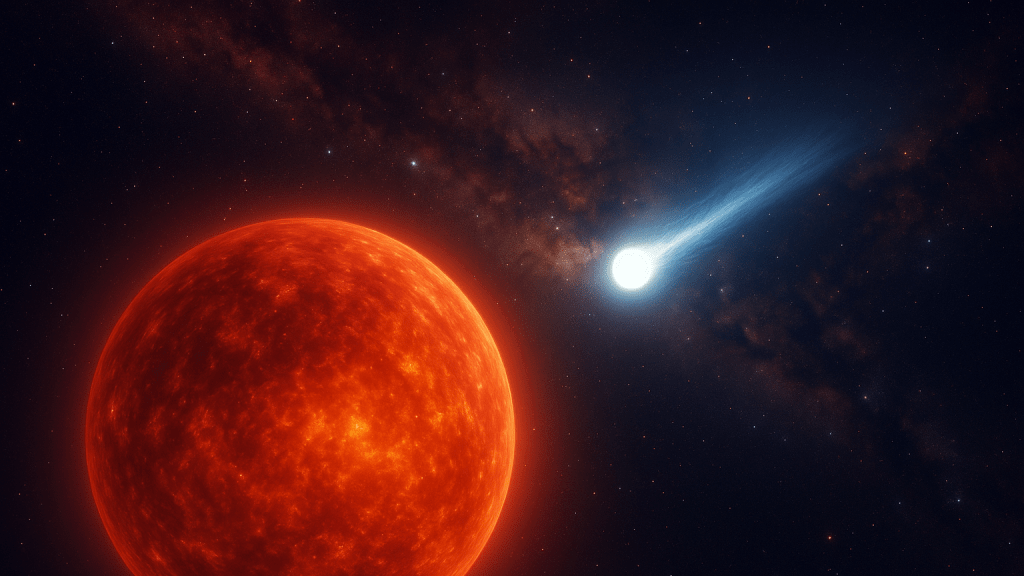
Finally, we explore one of the wildest stellar phenomena ever proposed: the Thorne–Żytkow object — a red supergiant with a neutron star trapped inside its core. It’s cosmic horror meets astrophysics, and it just might be real.
Transcript
[MUSIC]
Howdy stargazers and welcome to this episode of Star Trails. Drew here, and I’ll be your guide to the night sky for the week starting May 11th through the 17th.
This week we welcome the Flower Moon, say goodbye to the last remnants of the Eta Aquarid Meteor Shower, and we revisit a topic from a previous episode to learn what happens when a red giant eats a neutron star. The universe can be a very weird place.
Whether you’re tuning in from the backyard, the balcony, or just your imagination, I’m glad you’re here. So, find a cozy spot, let your eyes adjust, and let’s see what the sky holds for us this week.
[MUSIC FADES]
Before we take a look at this week’s night sky, I wanted to briefly mention a topic that’s been showing up in my news feeds recently, and maybe yours too.
There have been a number of headlines in recent weeks concerning the discovery of what could be a candidate for the elusive Planet 9 – also known as Planet X – a massive, enigmatic world in our own solar system lurking somewhere out beyond Pluto.
The idea of an undiscovered planet isn’t new. In fact, it stretches back more than a century. Early astronomers in the 1800s noticed discrepancies in the orbits of Uranus and Neptune that led them to suspect another planet was tugging on them gravitationally. This theoretical body was often referred to as Planet X. While Pluto was discovered in 1930 during that search, it was quickly deemed too small to explain the gravitational anomalies, and the mystery persisted.
Fast forward to 2016: a pair of Caltech astronomers, Mike Brown and Konstantin Batygin, reignited the Planet Nine discussion. They were looking at the odd clustering of several distant trans-Neptunian objects, or TNOs — icy bodies way out in the Kuiper Belt and beyond. Their orbits seemed to be shepherded by something massive. The best explanation? A yet-undiscovered planet at least five to ten times the mass of Earth, orbiting far beyond Pluto on a highly elliptical, tilted path. If real, this ninth planet would take 10,000 to 20,000 years to complete a single orbit.
Since then, astronomers have been combing sky surveys and telescope archives looking for any sign of this ghostly planet. And just recently, there’s been a possible breakthrough.
Using infrared data from two old space missions — NASA’s IRAS satellite from 1983 and Japan’s AKARI observatory from the 2000s — researchers may have spotted a faint object moving slowly across the sky in images taken 23 years apart. That kind of motion, combined with its faintness, is exactly what you’d expect from a distant planet orbiting hundreds of times farther from the Sun than Earth.
This candidate object appears to be roughly the right mass — somewhere between five and ten Earth masses. Its orbit seems to be tilted about 120 degrees relative to the plane of the solar system. That’s far more extreme than what the Planet Nine model predicts, which puts the tilt more around 15 to 25 degrees – because remember, our solar system is largely flat. In other words, this might not be THE Planet Nine, but it could be A Planet Nine — a new, unknown planetary body in the far outer solar system.
Mike Brown, the same astronomer who helped revive the Planet Nine theory, has expressed skepticism about this new candidate. He points out that the extreme tilt doesn’t match what they expected. Still, the discovery is intriguing and adds fuel to the idea that we really don’t know everything about what’s lurking in the solar system’s deep freeze.
We’re expecting a lot more clarity in the coming years. The Vera C. Rubin Observatory in Chile, set to begin operations soon, will conduct an incredibly deep, wide-field sky survey that could either confirm this object or uncover something even more compelling.
So if you’ve been seeing headlines about Planet Nine lately — you’re not alone. The hunt is heating up again, and we may be closer than ever to discovering a whole new world orbiting in the shadows.
And if you want to learn more about this search, look way back into our archive to Episode 14.
[TRANSITION FX]
On Monday, we witness May’s full Moon, traditionally known as the “Flower Moon.” The name originates from Native American cultures, notably the Algonquin people, who associated the May full Moon with the abundance of blooming flowers during this time of year.
This full Moon is also a “micromoon,” occurring when the Moon is near its apogee, making it appear slightly smaller than usual. Despite its size, it will illuminate the night sky beautifully.
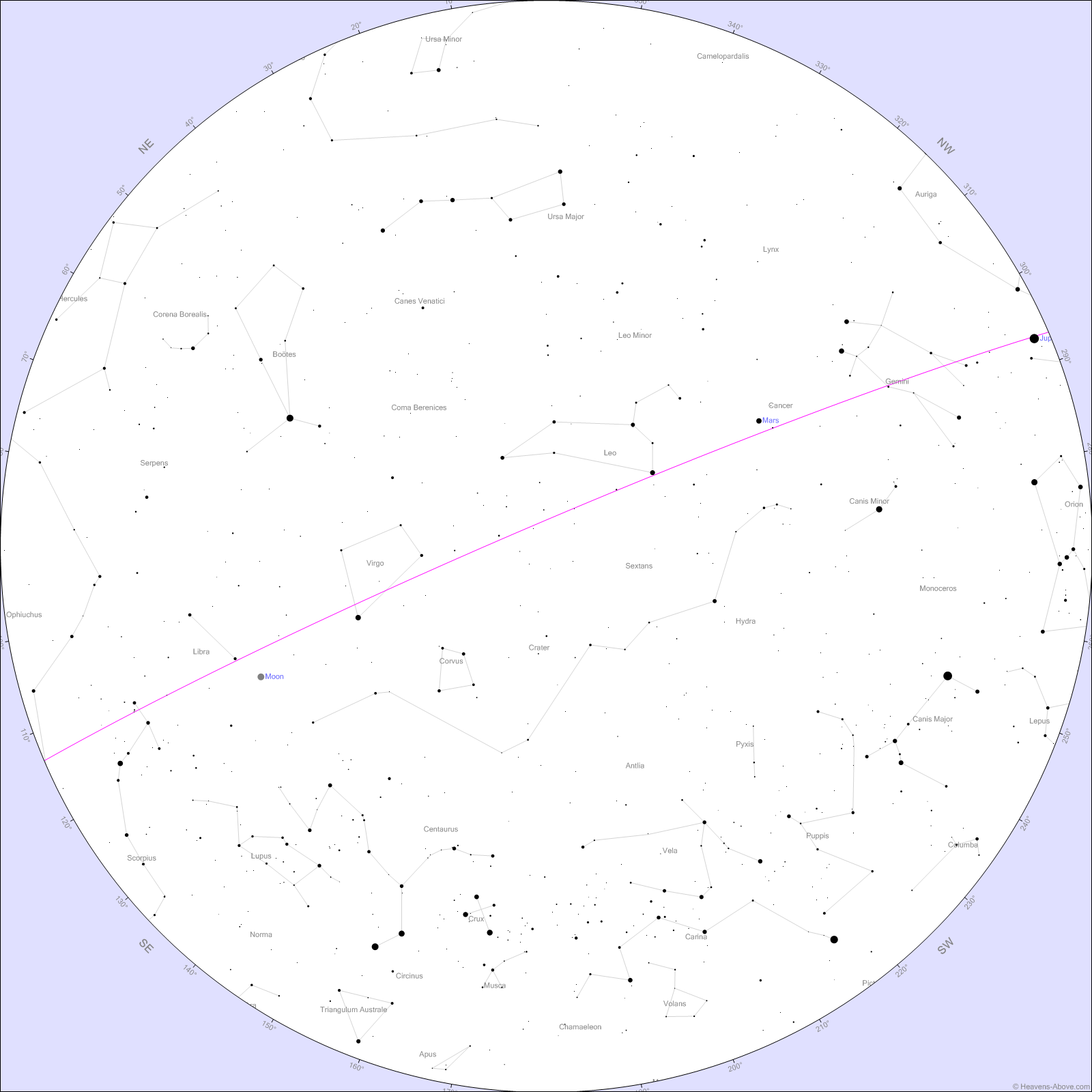
The planets are very much the same as they’ve been for the past few weeks. In the evening sky Jupiter shines brightly in the west after sunset, setting before midnight. Mars remains reddish and prominent, located higher in the sky above Jupiter, passing through Cancer. You’ll be able to see it until about 2 a.m.
In the morning sky, Venus remains visible in the east after about 4:30 a.m. until just before sunrise. Venus is currently at a very bright -4.3 magnitude, so you can’t miss it. Venus and Saturn are in conjunction, less than 10 degrees apart. Look for Saturn a bit above and to the right of Venus. It’s currently at a magnitude of 1.
Mercury remains elusive – lost in the morning sun’s glare.
While its peak occurred earlier in May, the Eta Aquariid meteor shower remains active through May 21. It’s best viewed in the pre-dawn hours, especially in areas with minimal light pollution. These meteors are caused by debris from Halley’s Comet, and they will appear to radiate from the southeast sky, from the constellation Aquarius, although you’ll be able to see them in any portion of the sky.
High in the eastern sky, you’ll find Corona Borealis, the “Northern Crown.” In Greek mythology, this semicircular constellation represents the crown of Princess Ariadne of Crete, gifted to her by the god Dionysus on their wedding day. After her death, Dionysus placed the crown in the heavens to honor her.
This constellation is home to the Blaze Star, T Coronae Borealis, a binary star system, located about 3,000 light-years away. TCB is a recurrent nova and we know it’s erupted at least twice before, in 1866 and 1946, roughly 80 years apart. Astronomers anticipate its next eruption could occur soon, potentially making it visible to the naked eye for about a week – about as bright as Polaris. We’ll keep watching for it.
[TRANSITION FX]
Two weeks ago on Star Trails, we explored the wild phenomenon of runaway stars — celestial bodies ejected from their stellar neighborhoods at incredible speeds, often owing to violent gravitational interactions or supernova kicks. But what happens when a runaway star doesn’t escape, but crashes into another star instead?
That brings us to one of the weirdest and most intriguing star types ever proposed: the Thorne–Żytkow object.
Back in the 1970s, physicist Kip Thorne — who you might know from his work on gravitational waves and as the science advisor for the film Interstellar — teamed up with Polish astrophysicist Anna Żytkow. Together, they theorized the existence of a bizarre kind of star that could form under extreme circumstances: a neutron star — that’s the dense core remnant of a supernova — merging into a red supergiant.
The science is mind-bending: a neutron star is roughly the size of a city but contains more mass than our Sun. If such an object were to collide with a red supergiant, it wouldn’t just pass through. It would sink to the core of the larger star, embedding itself there, and essentially take over its inner workings.
This hybrid, part zombie-star and part Frankenstein experiment, is what we now call a Thorne–Żytkow object, or TŻO.
These objects are difficult to locate. On the outside, they look almost exactly like normal red supergiants. But inside, the neutron star is altering the star’s fusion process in bizarre ways. TŻOs are expected to produce unusual amounts of certain heavy elements — like rubidium, molybdenum, and lithium — that aren’t typically abundant in red giants.
So far, only one strong candidate has emerged: a star known as HV 2112, located in the Small Magellanic Cloud. This star shows a chemical fingerprint that fits the profile — though some scientists argue alternative explanations are still on the table.
If confirmed, HV 2112 would be the first real-life Thorne–Żytkow object ever discovered — a neutron star cocooned inside a swollen red giant envelope, the aftermath of a stellar collision or a failed binary.
It’s essentially a star that died, then was reborn inside another — invisible to the eye, yet rewriting the physics of its host from within.
Eventually, it’s theorized the star’s structure destabilizes, and the whole system may collapse into a black hole, leaving behind almost no trace of what once was.
[MUSIC]
If the stars spoke to you this week, or if a question’s been on your mind, I’d love to hear it. Visit our website, startrails.show, where you can contact me and explore past episodes. Be sure to follow us on Mastodon, Bluesky, and YouTube — links are in the show notes.
Until we meet again beneath the stars… Clear skies everyone!
[MUSIC FADES OUT]
Support the Show
Connect with us on Mastodon @star_trails or on Bluesky @startrails.bsky.social
If you’re enjoying the show, consider sharing it with a friend! Want to help? Buy us a coffee!
Podcasting is better with RSS.com! If you’re planning to start your own podcast, use our RSS.com affiliate link for a discount, and to help support Star Trails.
 Star Trails: A Weekly Astronomy Podcast
Leave a comment