Erased from the Charts, but Still Etched in the Stars – Star Trails: A Weekly Astronomy Podcast
Episode 65
As the Moon wanes and the morning planets take center stage, we turn our gaze to a part of the sky rarely discussed on Star Trails: the Southern Hemisphere. In this episode, we take a journey through time and space to uncover the story of Argo Navis, the largest constellation that no longer exists.
We explore the celestial ship’s breakup into Carina, Vela, and Puppis, and dive into the nebulae, star clusters, and pulsars that remain in its wake. Along the way, we also meet a few other retired constellations, including a long-lost housecat named Felis.
We’ll offer up some tips for viewing Mars, Venus, Saturn, and Mercury, and mention deep sky gems to chase under moonless skies.
Transcript
[MUSIC]
Howdy stargazers and welcome to this episode of Star Trails. Drew here, and I’ll be your guide to the night sky for the week starting May 18th through the 24th.
This week the moon wanes and the early morning sky comes alive. We’ll also take a journey back into history and learn about one of the largest constellations in the sky, and why it doesn’t exist anymore. Also, did you know there was once a housecat in the sky? More on that later.
Whether you’re tuning in from the backyard, the balcony, or just your imagination, I’m glad you’re here. So, find a cozy spot, let your eyes adjust, and let’s see what the sky holds for us this week.
[MUSIC FADES]
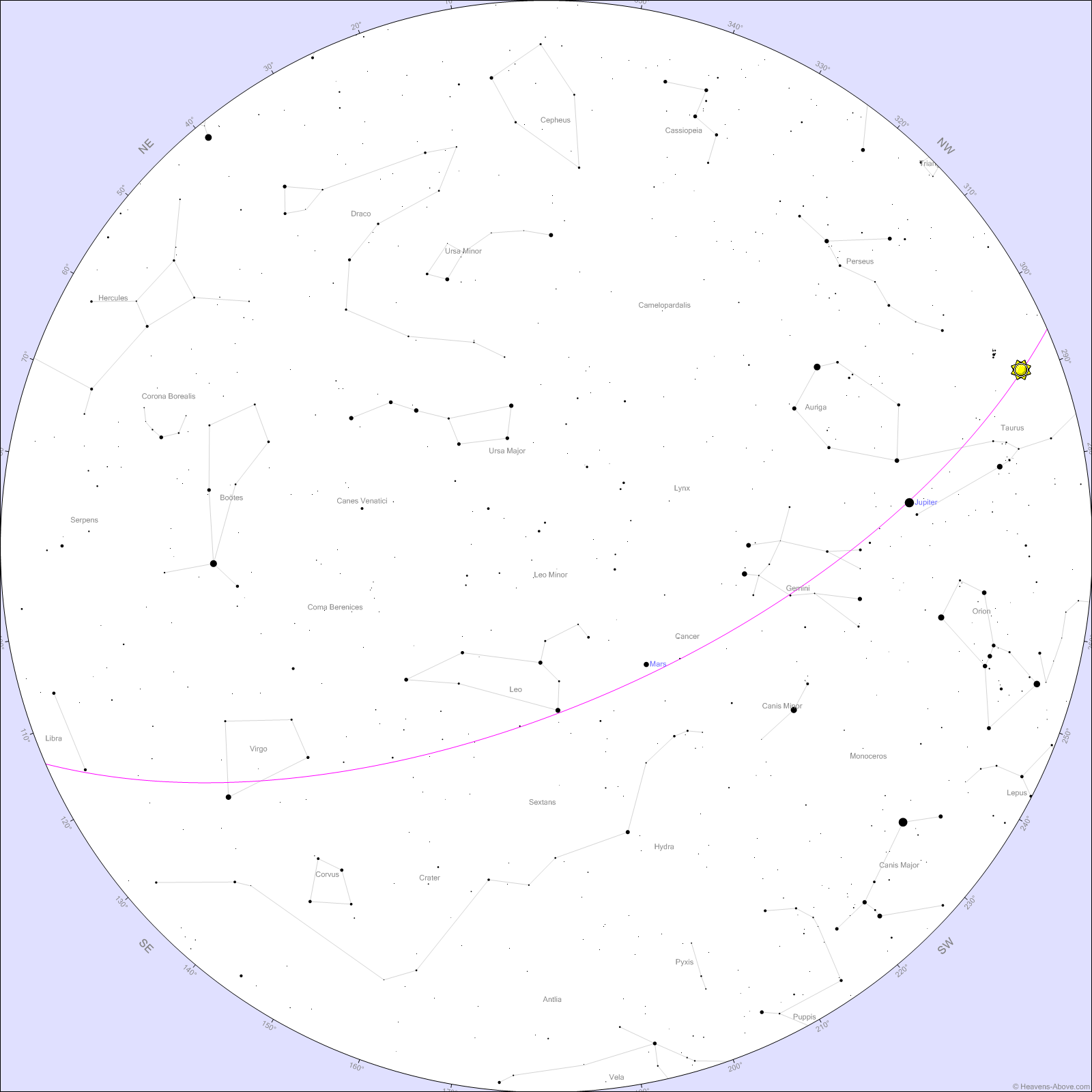
Let’s start with the Moon. On May 18th, it’s in a waning gibbous phase, still bright in the sky but shrinking each night. By the 20th, we hit the last quarter, meaning the Moon rises around midnight and leaves us with dark skies after it sets. And by the end of the week, we’re deep into the waning crescent phase, which means prime conditions for hunting faint galaxies and star clusters.
Now onto the planets. In the evening, Jupiter is hanging low in the western sky after sunset. It’s getting closer to the Sun’s glare each night, so catch it while you can! Mars is much easier to spot—glowing reddish high overhead after dark. It’s a great target this week, especially with less moonlight to compete.
If you’re an early riser, the morning sky has even more going on. Venus is blazing away in the eastern pre-dawn hours—it’s the brightest thing in the sky other than the Moon. Look above it and you’ll find Saturn, more subdued but still visible without a telescope. And just before sunrise, try spotting Mercury—it’s hugging the eastern horizon and can be tricky, but it’s worth the challenge.
Meanwhile, spring constellations are still putting on a show. Look south for Virgo and Leo, or trace the arc of Boötes, where bright orange Arcturus anchors the view. This is also a fantastic week to aim for deep-sky gems like M13 in Hercules or M5 in Serpens, especially now that the Moon isn’t hogging the spotlight.
[TRANSITION FX]
Before we get into the second half of the show, I have a little housekeeping to discuss. As we end May and head into summer, astronomy starts becoming difficult for many of us. Moving towards the summer solstice, the days will grow much longer, affording us less observation time. Increased heat and crazy summer weather can be a problem for some of us. For example, here in the southeast US, summer brings haze, humidity and daily thunderstorms, not to mention 90-degree temperatures, mosquitoes and other pests.
So, all this to say, I won’t be doing a lot of observation for the next three or four months. I haven’t decided if the show will continue to be weekly during the summer months, or whether I’ll try releasing every two weeks. If you have any opinions on this, go to startrails.show and let me know.
Also, last year right before our December break I mentioned that I’d be reading NightWatch: A Practical Guide to Viewing the Universe, by Terence Dickenson, a popular book for backyard astronomers. Well, sadly I never got around to reading it, so I apologize to anyone who was hoping for a Star Trails book club moment.
I do plan to start reading it soon, especially since observation will be rough for me in the coming weeks. I’ll report back with my thoughts on this book in a future episode. This book is often cited as a must-read for backyard astronomers. Be sure to get the 5th edition, which is the latest version.
[TRANSITION FX]
Today we’re going to discuss some constellations of the Southern sky. Regular listeners know that we generally focus on the skies over North America, so this may be unfamiliar territory.
I was once told by an astronomer that the southern hemisphere wasn’t as impressive as the northern. He said, and I quote, “all they have are some magellanic clouds.” This couldn’t be farther from the truth. I once spent several weeks in Australia, and one night in the country, I was able to see a stunningly dark, clear night sky, filled with dazzling unfamiliar patterns.
While the northern sky is home to some of the most iconic and familiar constellations—like Ursa Major, Orion, and Cassiopeia—it offers a more edge-on view of the Milky Way. That means we see a thinner, less dense section of our galaxy, but it’s rich in recognizable shapes and nearby objects like the Andromeda Galaxy and the Pleiades cluster. Polaris, the North Star, also makes navigation easy, and centuries of mythology have helped etch these constellations deep into cultural memory.
But head south, and the sky explodes with drama. The Southern Hemisphere gives us a direct line of sight to the galactic core — where the Milky Way appears brighter, denser, and far more intricate. It hosts the Southern Cross, the dazzling Carina Nebula, which we’ll discuss in a moment, the massive Omega Centauri cluster, and even entire satellite galaxies: the Large and Small Magellanic Clouds that my astronomer friend was so dismissive of.
The reason I mention this is because the southern sky was home to a fascinating constellation that doesn’t exist anymore. There’s actually a whole cast of constellations that used to exist, and don’t anymore.
And none of them were quite as grand — or as doomed — as Argo Navis, the ship that got sunk by astronomers. This was once a constellation so big, so sprawling, it had to be broken up like a decommissioned schooner at a shipyard. To explore this one, we’ll need to sail into the southern hemisphere – a place we don’t often talk about because this show is generally focused on what we can see in North America
Argo Navis was named after the mythical ship Argo — the one Jason and the Argonauts sailed on during their legendary quest for the Golden Fleece. This is classic Greek mythology.
The constellation was first catalogued by Claudius Ptolemy in the 2nd century CE, during the golden age of ancient astronomy. Back then, they weren’t too concerned with how huge this thing was — it sprawled across a massive chunk of the southern sky.
To give you an idea of its size, if you took Orion, Canis Major, and Gemini and smashed them all into one mega-constellation, that’s the scale we’re talking about.
For centuries, Argo Navis stood as the largest single constellation in the sky. But it had a problem. Simply, it was really, really impractical.
By the 1700s, astronomers started to feel like Argo Navis was less of a constellation and more of a mess. It had hundreds of stars and no clear borders. Trying to map or reference anything inside it was like trying to navigate a ship with three captains shouting different directions.
Enter Nicolas-Louis de Lacaille, an 18th-century French astronomer. He was mapping the southern skies from the Cape of Good Hope in South Africa. In 1763, Lacaille decided enough was enough. He chopped Argo Navis into three new nautical-themed constellations, and they’ve stuck ever since.
There’s Carina, the keel of the ship, Puppis, the stern, also known as the “poop deck,” and Vela, the sails. And just like that, the mighty Argo Navis was no more.
Of course, just because the name disappeared doesn’t mean the stars did. These three new constellations inherited all kinds of celestial treasures.
Carina is home to Canopus, the second-brightest star in the night sky, just behind Sirius. For viewers in the Southern hemisphere, Canopus is a brilliant white beacon low on the horizon.
Deep in Carina lies the Carina Nebula — one of the largest star-forming regions visible from Earth. Inside it we find the massive and unstable Eta Carinae, a binary star system so volatile it once brightened the sky in the 1800s to become the second-brightest star for a time.
Let’s drift over to Vela. Its most famous feature is the Vela Supernova Remnant, a massive bubble of gas and dust left behind by a star that exploded about 11,000 years ago. Its ghost is still expanding through space.
Inside the remnant is the Vela Pulsar, a rapidly spinning neutron star beaming out radio waves like a cosmic lighthouse.
Puppis is home to Messier 93, an open star cluster tightly packed with hot, young stars. There’s also NGC 2467, a vibrant nebula sometimes called the “Skull and Crossbones Nebula.” Despite its eerie nickname, it’s actually a stellar nursery.
So even though Argo Navis as a name is gone, its pieces are alive and well — filled with some of the most dazzling and active regions of the Milky Way.
Of course, Argo wasn’t the only constellation to get the axe. Here are a few other sky-figures that were edited out of the final draft.
Quadrans Muralis was a northern hemisphere constellation created in the 18th century, and named after a wall-mounted astronomical instrument — the quadrant. It no longer exists officially, but its name survives in the Quadrantid meteor shower that peaks in early January.
Felis, The Cat, was a housecat in the sky. It was introduced by French astronomer Joseph Jérôme de Lalande in 1799 — because, as he put it, “cats deserve to be represented.” The IAU disagreed and poor Felis got booted in 1922.
The constellation was located near Hydra. While it’s not acknowledged anymore, its brightest star, Felis, is a reminder that it existed, and is quite an interesting star in its own right. Located more than 600 light years from Earth, Felis is an orange-red giant with a high proper motion – that’s the apparent movement of the star compared to others in the sky.
And finally, Antinous is another constellation that was quietly retired. A tragic figure from Roman history, Antinous was Hadrian’s young lover. He was later deified and immortalized as a star pattern. The constellation was removed from charts in 1922 and became part of the constellation Aquila.
More recently, the IAU Working Group on Star Names approved the name Antinous for the star Theta Aquilae in 2024 in honor of the defunct constellation.
If there’s any lesson here, it’s that the sky is always evolving. Constellations aren’t permanent. They’re cultural artifacts—shaped by who we are, what we believe, and how we explore the universe. They remind us that the tapestry of the cosmos is a mirror of our evolving time here on Earth.
[MUSIC]
If the stars spoke to you this week, or if a question’s been on your mind, I’d love to hear it. Visit our website, startrails.show, where you can contact me and explore past episodes. Be sure to follow us on Mastodon, Bluesky, and YouTube — links are in the show notes.
Until we meet again beneath the stars… Clear skies everyone!
[MUSIC FADES OUT]
Support the Show
Connect with us on Mastodon @star_trails or on Bluesky @startrails.bsky.social
If you’re enjoying the show, consider sharing it with a friend! Want to help? Buy us a coffee!
Podcasting is better with RSS.com! If you’re planning to start your own podcast, use our RSS.com affiliate link for a discount, and to help support Star Trails.
 Star Trails: A Weekly Astronomy Podcast
Leave a comment