New Moon Week and the Mystery of Missing Green Stars – Star Trails: A Weekly Astronomy Podcast
Episode 66
This week the New Moon arrives—perfect conditions for spotting deep-sky wonders. Discover five must-see celestial objects to track down while the skies are dark, from ancient globular clusters to swirling galaxies.
Then, we dig into a colorful cosmic mystery: why do we see red, blue, and yellow stars—but never green ones? We explain how star temperatures and light spectra play a role in the colors we perceive in the night sky.
It’s a shorter episode this week (Drew’s voice is a bit under the weather), but there’s still plenty to marvel at above. So let your eyes adjust, and come along for the view.
Transcript
[MUSIC]
Howdy stargazers and welcome to this episode of Star Trails. Drew here, and I’ll be your guide to the night sky for the week starting May 25th through the 31st.
This week a new moon promises darker skies. And, have you ever wondered why we have red, blue and yellow stars, but no green ones? More on that in a moment. Also, this is going to be a shorter episode this week, because I’m losing my voice – I apologize for the raspy narration.
Whether you’re tuning in from the backyard, the balcony, or just your imagination, I’m glad you’re here. So, find a cozy spot, let your eyes adjust, and let’s see what the sky holds for us this week.
We kick things off this week with the Moon in a waning crescent phase, just a sliver in the pre-dawn sky—only about 4 percent illuminated. It’s a great time for stargazers to enjoy truly dark skies before moonlight returns. Then on the night of May 26th, we hit the New Moon. That means this is your prime window for deep-sky observing—no moonlight at all to wash out faint galaxies or nebulae.
By May 31st, the Moon is back as a waxing crescent, now about 24 percent illuminated and beginning to reappear in the western sky after sunset. It’s just enough to show off that beautiful “Earthshine” glow – that’s light reflected off Earth, that dimly illuminates the shadowed portion of the moon.
Now, onto the planets, and if you’ve been listening in recent weeks, this is going to all sound familiar, because not much has changed.
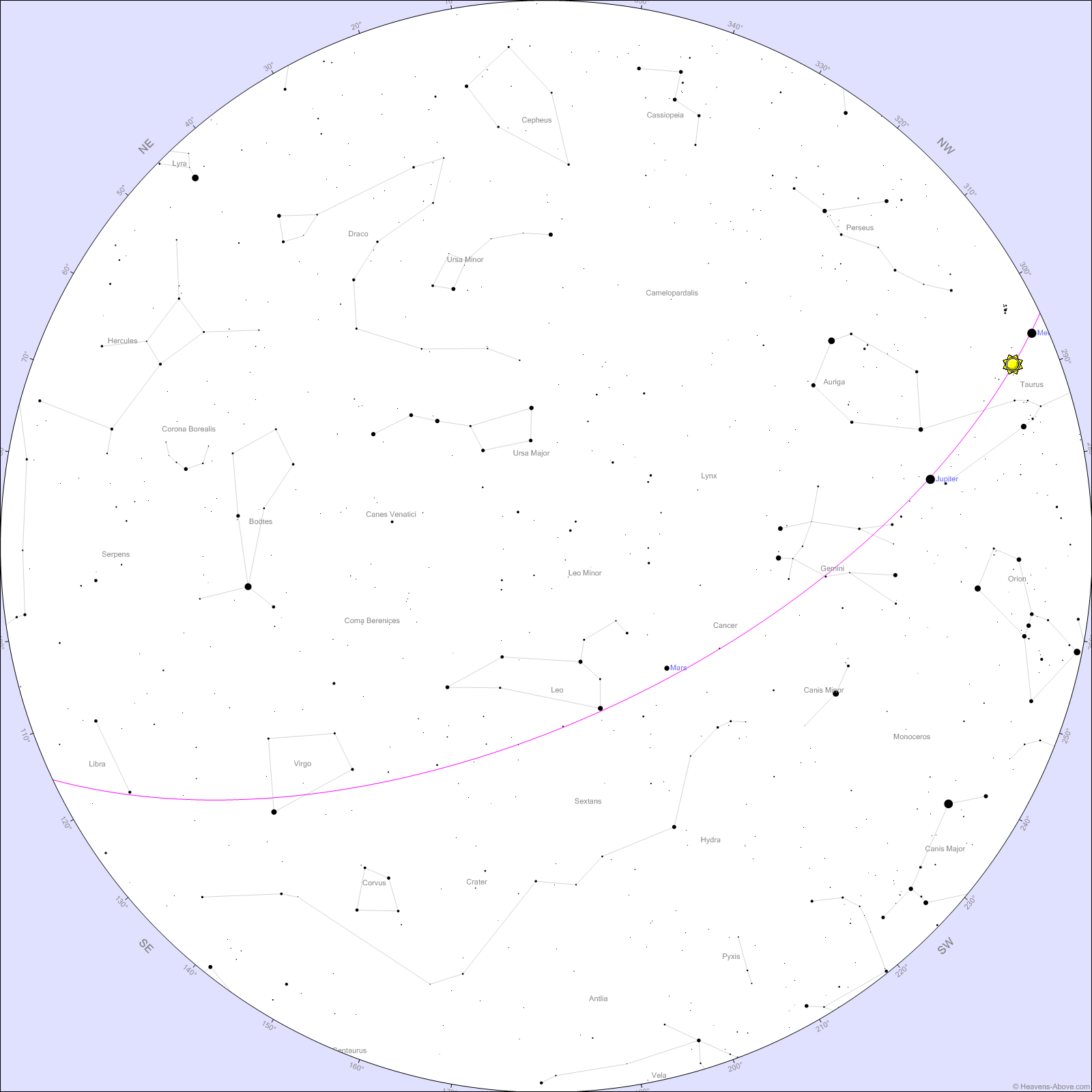
In the evening sky, you can still catch Jupiter just after sunset in the northwest. It’s bright, but slipping closer to the horizon each night as it moves toward conjunction with the Sun. If you want a look, get out early—around twilight—before it sets.
Mars is much easier to spot. You’ll find it high overhead after dark, shining with its trademark reddish hue. It’s not as bright as it was earlier in the year, but still a rewarding target for binoculars or a telescope.
Meanwhile, in the morning sky, Venus continues to dominate the east before dawn. It’s the brightest object in the sky aside from the Moon, and it rises well before the Sun—perfect for early risers.
Just above Venus, you’ll find Saturn in the southeastern sky. It’s much fainter than Venus, but still visible to the naked eye under clear skies—and a telescope will reveal those iconic rings.
[Transition FX]
With the New Moon arriving on May 26th, we have a perfect window for deep-sky viewing. So if you’ve got a telescope, or even just a decent pair of binoculars, here are five cosmic showpieces worth tracking down.
First up is Messier 13, the Great Hercules Cluster. This dense ball of stars lies about 22,000 light-years away and is easy to find in the constellation Hercules. Through a telescope, it sparkles with thousands of tiny stars—like someone spilled stardust across the void.
Next is Messier 5, in the constellation Serpens. It’s one of the oldest globular clusters we know—about 13 billion years old. That means it’s been around since nearly the dawn of the galaxy. Look for a tightly packed core surrounded by a soft halo of light.
Over in Virgo, check out the Sombrero Galaxy, or Messier 104. It’s a spiral galaxy seen almost edge-on, with a bright central bulge and a dark dust lane that gives it that classic hat shape. It stands out even in modest scopes.
Then we have Messier 3, a globular cluster in Canes Venatici. It’s packed with variable stars—more than 270 of them—which makes it a real laboratory for studying how stars evolve. It’s bright, round, and rewarding through almost any telescope.
And finally, for a true showstopper, aim for the Whirlpool Galaxy, or Messier 51. It’s a face-on spiral interacting with a smaller companion galaxy, and under dark skies, you might even glimpse the spiral arms twisting outward. It’s a favorite for a reason.
[Transition FX]
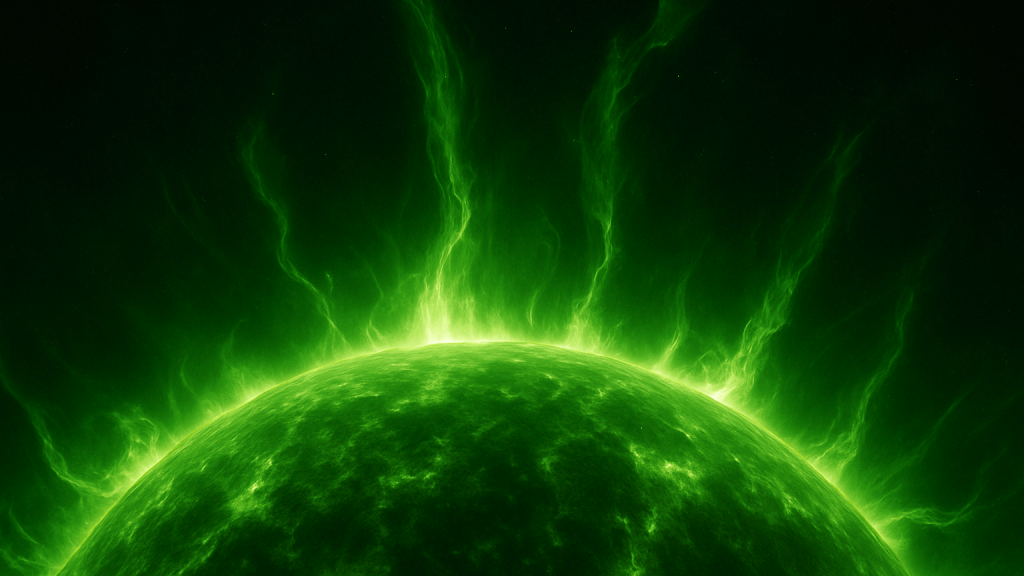
I’m sure you’ve noticed that some stars are different colors. Some appear a little red or bluish. A star’s color depends on its temperature. But here’s the twist: for all the colors we CAN see in stars, there’s one that’s curiously missing—green.
You’ve got red stars, orange stars, white, blue… but green is nowhere to be found. And that’s strange, because the universe is packed with glowing, energetic objects, and plenty of them emit green light. So why doesn’t the sky have any green stars?
Stars shine because of their surface temperature. The hotter the star, the bluer its light appears. The cooler it is, the redder. Our own Sun, for example, is classified as a G-type star with a surface temperature of about 5,800 Kelvin. It actually emits most of its light in the green part of the spectrum—but we don’t see it as green.
Why? Because stars don’t shine in just one color. They emit light across a wide range of wavelengths, and our eyes—clever as they are—don’t pick out individual bands. When a star’s spectrum peaks in the green zone, our brain blends all the surrounding colors together and interprets the result as white.
It’s exactly the same principle used in old-school televisions and computer monitors. Those screens create white by blending just three colors of light—red, green, and blue—at the right intensity. When all three are mixed evenly, your eye sees white. So when a star peaks in green but also gives off a balanced amount of every other color, your brain says, “That’s white,” even if green is doing most of the heavy lifting.
If a star somehow emitted only green light—just that wavelength, no extras—we would see it as green. But that’s not how stars work. Their energy is spread out in a smooth curve, not a laser-sharp spike. So the green gets blended out.
That’s why we see red and blue stars, but not green ones. Red and blue stars are lopsided—they emit strongly in just one part of the spectrum, so their color stands out. Mid-range stars are too balanced. Their colors cancel out visually, and what’s left is white.
While there may be no green stars, the universe is still full of color.
Take Betelgeuse, the reddish shoulder of Orion. That color comes from its relatively cool temperature—about 3,500 Kelvin. Then there’s Rigel, at Orion’s knee, blazing blue-white with a temperature more than 11,000 Kelvin.
Sometimes, atmospheric conditions even create fake color effects. Stars near the horizon, for example, can appear to shimmer red, blue, or even green as their light passes through layers of Earth’s atmosphere. It’s like the twinkling version of a prism.
And then there are optical illusions. Take Albireo, a famous double star in Cygnus. One component appears gold, the other blue. That contrast can be so striking that some observers describe the blue star as looking slightly green. It’s not actually green—but your eyes get a little tricked by the color pairing.
And let’s not forget: stars emit light beyond what our eyes can see. Some glow fiercely in ultraviolet or infrared wavelengths. That’s where telescopes like the James Webb and Hubble come in. They can detect these invisible colors and convert them into images we can see—giving us a richer, more complete view of the universe.
[MUSIC]
If the stars spoke to you this week, or if a question’s been on your mind, I’d love to hear it. Visit our website, startrails.show, where you can contact me and explore past episodes. Be sure to follow us on Mastodon, Bluesky, and YouTube — links are in the show notes.
Until we meet again beneath the stars… Clear skies everyone!
[MUSIC FADES OUT]
Support the Show
Connect with us on Mastodon @star_trails or on Bluesky @startrails.bsky.social
If you’re enjoying the show, consider sharing it with a friend! Want to help? Buy us a coffee!
Podcasting is better with RSS.com! If you’re planning to start your own podcast, use our RSS.com affiliate link for a discount, and to help support Star Trails.
 Star Trails: A Weekly Astronomy Podcast
Leave a comment