Urban Alignments and Cosmic Parking Spots – Star Trails: A Weekly Astronomy Podcast
Episode 67
As June begins, the night sky greets stargazers with a blend of familiar favorites. This week we highlight a picturesque conjunction between Mars and the crescent moon, and Venus shines brightly as the Morning Star. Saturn lingers low in the early morning hours, and the Summer Triangle begins to dominate the eastern sky, signaling the slow approach of summer nights.
We take a look at some of the action around the Galactic Core, home to deep sky gems like the Lagoon and Trifid Nebulae, and the supermassive black hole known as Sagittarius A*, before taking a detour into New York City, where the phenomenon of Manhattanhenge dazzles viewers. Plus, learn what other cities experience similar solar alignments, and how to find out if your own town has its own “henge.”
Finally, we explore the gravitational architecture of space by introducing the Lagrange Points—those curious and incredibly useful spots in the Earth–Sun system where spacecraft can “park” with minimal effort.
Transcript
[MUSIC]
Howdy stargazers and welcome to this episode of Star Trails. Drew here, and I’ll be your guide to the night sky for the week starting June the 1st through the 7th.
This week the rising summer triangle lets us know that warmer nights are ahead. We take a moment to explore a peculiar solar alignment in New York City known as “Manhattanhenge” and later, we explore the parking lots of space, known as the Lagrange points.
Whether you’re tuning in from the backyard, the balcony, or just your imagination, I’m glad you’re here. So, find a cozy spot, let your eyes adjust, and let’s see what the sky holds for us this week.
The moon is currently waxing. Tonight it’s in a crescent phase, wth about 6% illumination. It will reach first quarter on June 3rd, with the full moon arriving around the middle of next week.
Venus is shining brilliantly at magnitude -4, Venus reaches its greatest western elongation on June 1, making it a prominent “Morning Star” in the eastern sky before sunrise. Saturn is still visible in the early morning sky, rising in the east during the pre-dawn hours. While not as bright as Venus, it’s distinguishable by its steady, yellowish glow.
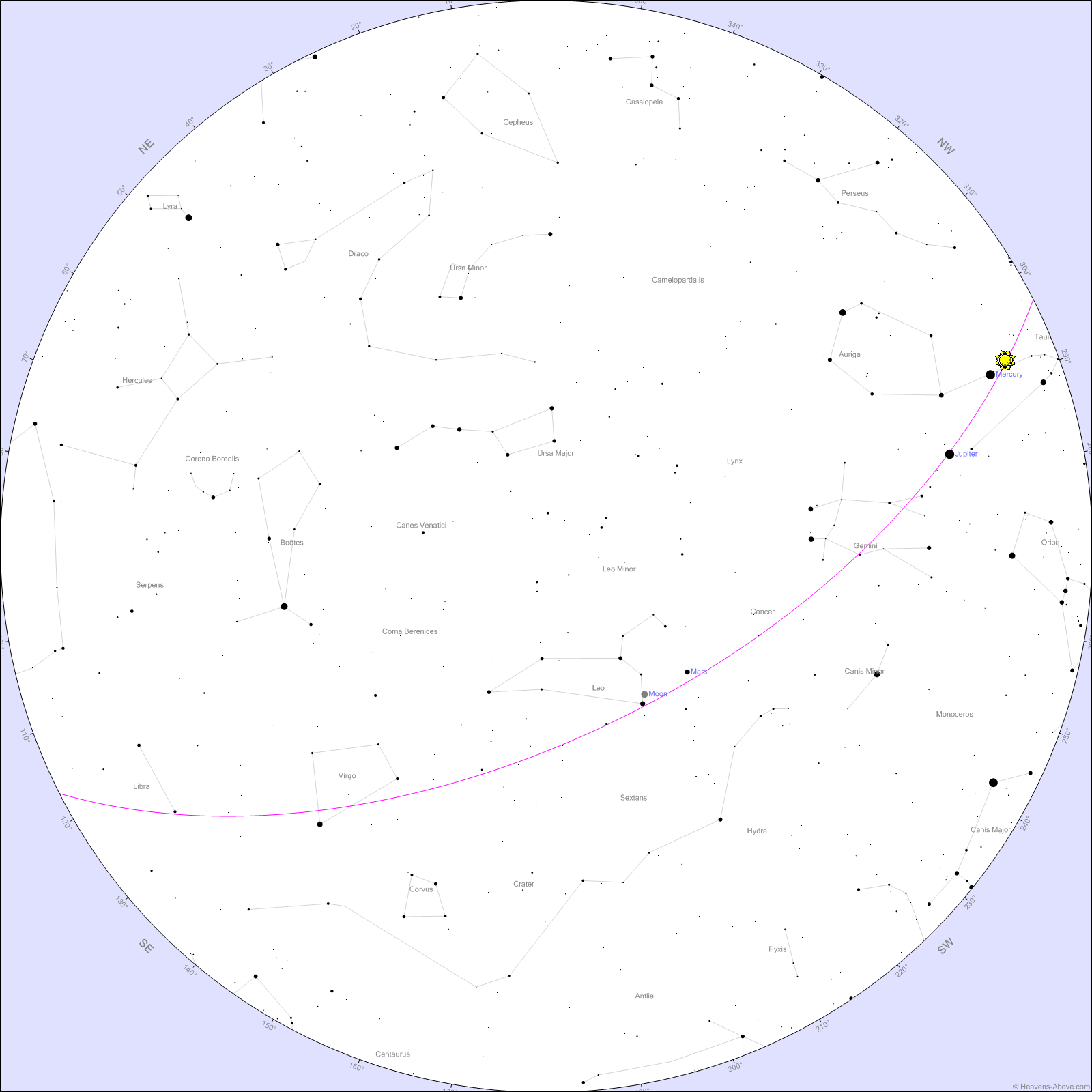
Look westward after sunset tonight to spot a conjunction of the Moon and Mars. The waxing crescent Moon will appear close to Mars, offering a picturesque pairing for evening observers.
Mercury is currently too close to the Sun to be easily observed, but it will become more visible in the evening sky later in the month.
As summer creeps closer, the night sky starts to show off its southern stars—and this week, you’ll have some real stunners to track down.
Low in the southeast after dark, you’ll spot the curve of Scorpius, one of the few constellations that actually looks like what it’s named after. Its brightest star, Antares, Antares, whose name means “rival of Mars,” is a massive red supergiant nearing the end of its life, and it glows with a deep, rusty hue.
Just to the west of Antares is M4, a dense globular cluster that looks like a fuzzy star in binoculars.
Right next door to Scorpius is Sagittarius, home to the famous “Teapot” asterism. If you can trace the teapot shape, imagine steam rising from its spout—that glowing “steam” is actually the densest part of the Milky Way, and it’s pointing straight toward the Galactic Core.
Now, you can’t see the center of the galaxy directly—it’s hidden behind gas and dust. But you can look in the exact direction of it, which is kind of amazing. Right there, about 26,000 light-years away, lies Sagittarius A*, a supermassive black hole anchoring the Milky Way’s spiral arms.
The area around it is absolutely loaded with deep-sky gems:
There’s M8, the Lagoon Nebula, a bright stellar nursery. M20, the Trifid Nebula, a beautiful mix of newly born stars and dark dust. Also, check out M22, one of the best globular clusters in the sky, and easy to spot with binoculars.
Even to the naked eye under dark skies, this part of the Milky Way looks puffier, brighter, and deeper. It’s like the galaxy is exhaling.
And of course, the Summer Triangle is rising. Hiigh in the east later in the evening, you’ll see three bright stars forming a giant triangle: Vega, Altair, and Deneb. The Triangle is up for most of the night and offers a gateway to other fun targets, like the Ring Nebula (M57) in Lyra, and the North America Nebula near Deneb.
[Transition FX]
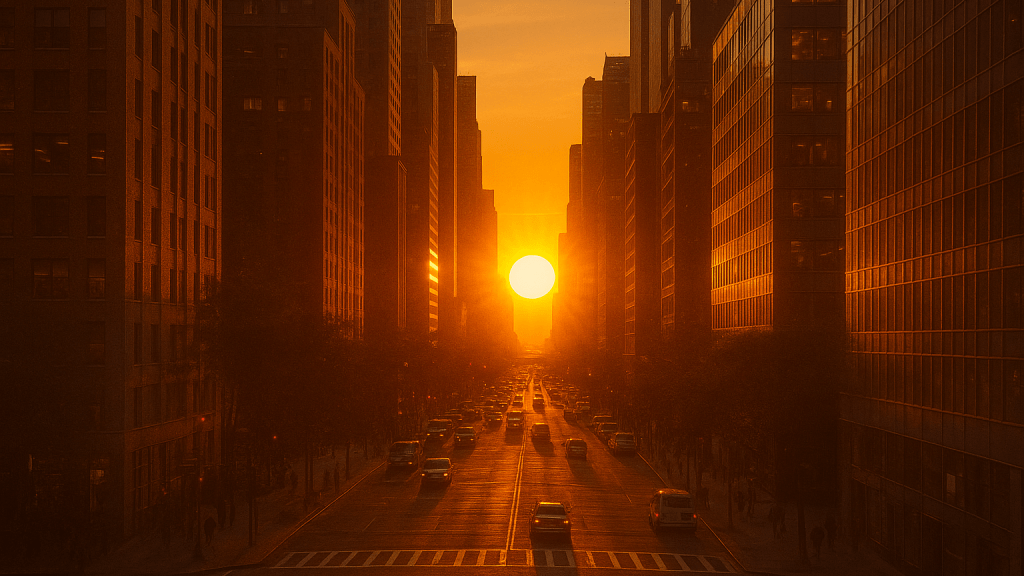
Have you ever seen the sun set perfectly between city buildings, like it was aiming right down the street just for you? If you were in New York last week, you might’ve caught Manhattanhenge. That’s when the sun lines up just right with Manhattan’s grid, beaming down the east–west streets like a spotlight.
But if you missed it, and you happen to be in New York City in a few weeks, you’ll get another shot to see it. The next Manhattanhenge is happening around July 12 and 13. And if you’re nowhere near Manhattan, stick around—because your city might have its own version of this urban sky alignment. More on that in just a bit.
So what exactly is Manhattanhenge? It’s a twice-a-year event when the setting sun aligns with Manhattan’s slightly tilted street grid. The result? For a few minutes, the sun drops directly between the buildings, lighting up the avenues in a perfect glowing frame.
New York’s street grid is rotated about 29 degrees off true east–west, so this solar alignment happens only when the sun’s path intersects that angle—once in late May, and again in mid-July. Some top spots to view it include 42nd Street, 34th Street, and 14th Street.
The phenomenon was dubbed “Manhattanhenge” by science educator Neil deGrasse Tyson, and that of course is a reference to Stonehenge – the prehistoric stone circle in England that forms a cosmic calendar, and aligns with the summer solstice sunrise and winter solstice sunset. Stonehenge has modern pagans who gather to experience the solar phenomenon, while New York City has, well, taxis.
New York isn’t the only place that gets this light show. Cities like Chicago, Toronto, Montreal, Philadelphia, and Salt Lake City all experience similar events—sometimes at sunset, sometimes at sunrise—depending on the grid orientation. For example, Chicago has “Chicagohenge” near the spring and fall equinoxes, because its street grid runs true east–west.
So how can you tell if your city has a henge of its own? This is where a little digital astronomy comes in handy.
There’s a great tool called The Photographer’s Ephemeris. It lets you map the sun’s path for any date and place on Earth. You can overlay that info on your city’s street grid and figure out when the sun will align with your favorite thoroughfare. Super useful if you’re chasing that perfect golden-hour photo—or just want to know when your city might surprise you with a solar corridor. Maybe there’s a “henge” waiting just a few blocks from you.
[Transition FX]
Alright, let’s shift gears a little, from stargazing with your eyes, to something that’s mostly invisible, but incredibly important. Tonight, I want to take you behind the scenes of the solar system, into the hidden architecture that holds things steady in space. We’re talking about Lagrange Points, those weird, gravitational sweet spots that make spaceflight smarter, smoother, and in some cases, just a little bit spooky.
If you’ve never heard of them before, Lagrange Points, sometimes just called “L points,” are specific spots in space where the gravity of two large objects, like the Earth and the Sun, balances out just right. So right, in fact, that a third, much smaller object—like a satellite—can just sort of hang there. No thrusters, no major fuel burns. It just drifts along in harmony with the big cosmic players.
Picture this: you’ve got the Earth orbiting the Sun, and both of them are tugging on a satellite with their combined gravity. Normally, that would yank the satellite around unpredictably. But at a Lagrange Point, the gravitational pulls and the orbital motion all sync up perfectly, like a cosmic dance step where the satellite always lands right on beat.
There are five of these Lagrange Points in any two-body system. In our case, Earth and the Sun have five, and Earth and the Moon have five of their own. But let’s stick with the big show for now: the Earth–Sun system.
L1 is for Sun Watchers.
The first Lagrange Point, L1, sits directly between Earth and the Sun. It’s about a million miles from Earth—closer to the Sun than we are, but locked in Earth’s orbital path. This is where we park solar observatories like SOHO and the DSCOVR spacecraft because L1 gives them an uninterrupted view of the Sun, which is perfect for studying solar flares, sunspots, and space weather that can affect satellites and even power grids down here on Earth.
It’s the front-row seat for solar drama, and it’s always in the light.
L2 is a nice place for Deep-Space Stargazers.
L2 is located about a million miles away from Earth—but on the far side, away from the Sun. This spot is special because it allows telescopes to stay in Earth’s shadow, with the Sun, Earth, and Moon all behind them. That makes it incredibly cold and dark—just what you want for observing faint galaxies and distant stars.
This is where the James Webb Space Telescope lives. Its mirrors and instruments are designed to pick up the faintest heat signatures in the universe, so it needs that cold, quiet neighborhood.
Think of L2 as the astronomer’s porch, but with the light turned off.
L3 is sometimes called the Phantom Point.
L3 sits on the far side of the Sun, directly opposite Earth. It’s always hidden from our view. You can’t see it from here, and that’s given rise to all kinds of fun science fiction ideas, like secret planets, alien outposts, or doppelgänger Earths hiding in the blind spot.
But in real life? L3 isn’t all that stable. If you tried to park a satellite there, it would eventually drift away.
Think of L4 and L5 as the Cosmic Rest Stops.
These points form the tips of an equilateral triangle with the Earth and the Sun. That means they lead and trail Earth in its orbit, about 60 degrees ahead and behind.
L4 and L5 are really stable. Objects placed there tend to stay put, even if they get nudged a little. They often collect space debris, dust clouds, and even asteroids. Jupiter, for example, has thousands of asteroids camped out at its L4 and L5 points.
Earth has a few too—though they’re much smaller and harder to spot. Some scientists even speculate that alien probes, if they existed, would choose L4 or L5 as a parking spot. They’re hidden, stable, and offer a great long-term view of Earth.
So, what makes these places so valuable? For one, they reduce the energy needed to keep spacecraft in a fixed position. That means less fuel, longer missions, and more stable instruments. And for future space infrastructure – things like observatories, solar power stations, or even planetary defense systems – Lagrange Points offer premium real estate.
They also give us strategic vantage points. Whether we’re monitoring solar storms, peering into deep space, or preparing for interplanetary travel, these points let us place our tools exactly where they’ll be most effective.
So the next time you hear about a new space telescope or satellite mission, listen closely. There’s a good chance it’s heading for one of these gravitational sweet spots, where the math of motion and the poetry of space come together just right.
[MUSIC]
If the stars spoke to you this week, or if a question’s been on your mind, I’d love to hear it. Visit our website, startrails.show, where you can contact me and explore past episodes. Be sure to follow us on Mastodon, Bluesky, and YouTube — links are in the show notes.
Until we meet again beneath the stars… Clear skies everyone!
[MUSIC FADES OUT]
Support the Show
Connect with us on Mastodon @star_trails or on Bluesky @startrails.bsky.social
If you’re enjoying the show, consider sharing it with a friend! Want to help? Buy us a coffee!
Podcasting is better with RSS.com! If you’re planning to start your own podcast, use our RSS.com affiliate link for a discount, and to help support Star Trails.
 Star Trails: A Weekly Astronomy Podcast
Leave a comment