Space Oddity: The Harmony of Isolation – Star Trails: A Weekly Astronomy Podcast
Episode 68
This week there’s a sky full of surprises. From the lowest full moon in nearly two decades—the golden-hued Strawberry Moon—to the elusive Arietid meteor shower peaking in broad daylight, there’s a lot to see… or at least know is happening above.
We’ll also track the current planetary lineup, including Mercury’s brief appearance next to Jupiter and some early morning views of Venus and Saturn. Then, in the second half, we shift our focus to the Sun, which is ramping up toward solar maximum.
We’ll explore the Sun’s 11-year magnetic cycle, why we’ve been seeing auroras farther south than usual, and what all of this means for ham radio operators and other technology.
Transcripts
[MUSIC]
Howdy stargazers and welcome to this episode of Star Trails. Drew here, and I’ll be your guide to the night sky for the week starting June 8th through the 14th.
This week we take a look at the Sun’s roughly 11-year cycle, in which its magnetic field flips, bringing enhanced levels of solar activity. We’ll also check out a daytime meteor shower, and of course, this month’s full moon, which is a little extra special this year.
Whether you’re tuning in from the backyard, the balcony, or just your imagination, I’m glad you’re here. So, find a cozy spot, let your eyes adjust, and let’s see what the sky holds for us this week.
[MUSIC FADES OUT]
The night of June 10 marks the appearance of this month’s full moon, the Strawberry Moon, and this one is unique for a couple of reasons.
The name of this full moon comes from Native American tribes, particularly the Algonquin, who used the June full moon as a signal to gather ripening strawberries. It’s not about the moon’s color but rather the timing of the harvest season.
This year’s Strawberry Moon is notable for being the lowest full moon in 18 years. Because of the Moon’s orbital path and its position relative to the Earth and Sun, it will appear unusually close to the horizon during its rise and set, and never get more than 30 degrees or so at its highest point over the horizon. Remember, if you hold your fist out at arm’s length, that represents about 10 degrees in the sky.
When the Moon is near the horizon, our brains perceive it as larger than when it’s higher in the sky — a phenomenon known as the “moon illusion.” So, on the evening of June 10, as the Strawberry Moon rises in the southeast, it will appear enormous and golden-hued, creating a breathtaking sight.
For the best experience, find a location with an unobstructed view of the eastern horizon. The Moon will rise around 8:30 PM local time, so be ready with your camera to capture this stunning event. Early risers may want to catch it before sunrise, as it will be setting in the southwest just before dawn.
This week offers an array of planetary sightings for both evening and early morning observers, including a close encounter with Jupiter and the elusive Mercury.
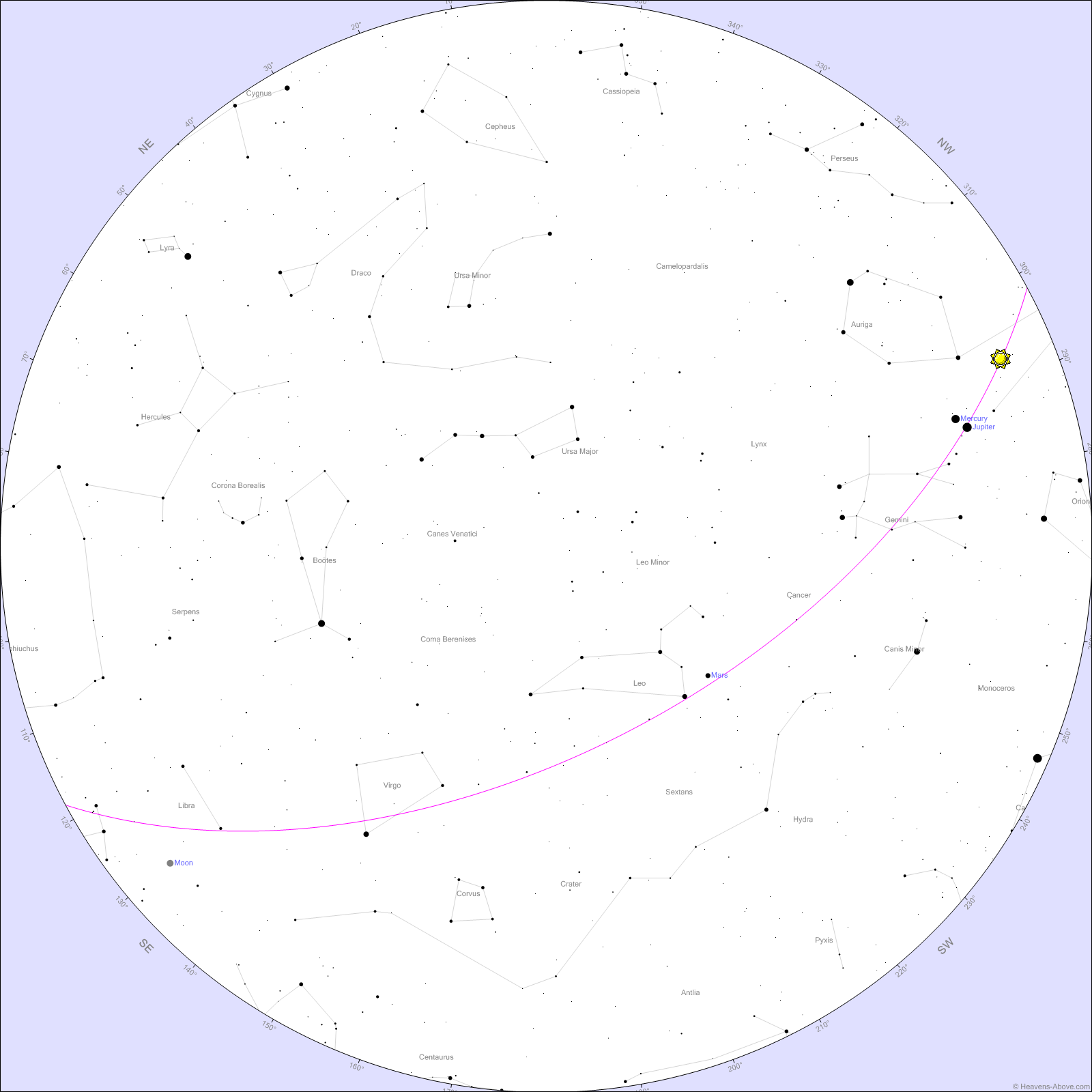
Starting around June 12th, Mercury becomes visible low in the western sky about 45 minutes after sunset. It reaches its best evening elongation mid-month, offering a brief but worthwhile viewing opportunity. Tonight, June 8th, Mercury will be just 2 degrees north of Jupiter, providing a chance to see both planets in close proximity shortly after sunset.
Visible in the early evenings during the first week of June, Jupiter shines low in the western sky after sunset. However, it quickly descends and becomes lost in the Sun’s glare as the month progresses.
Mars, the Red Planet, graces our western sky for a couple of hours after sunset throughout June. It’s gradually descending lower each evening but remains a prominent feature in the constellation Leo.
Notably, next week Mars will pass close to Regulus, the brightest star in Leo, appearing about half a degree apart — roughly the width of the full Moon.
Morning observers are still being dazzled by our brightest planet, Venus. It rises about two hours before the Sun and dominates the eastern pre-dawn sky throughout June. It’s a brilliant beacon that’s hard to miss, and remains the brightest object in the sky after the Moon.
Saturn rises in the southeastern sky around 3 a.m. in early June. It’s a bit fainter than Venus but still noticeable.
For those with telescopes, Uranus and Neptune are also in the morning sky. Near the end of the month into the middle of July, Neptune will appear within 1 degree of Saturn, making it a convenient target for those already observing Saturn. Be sure to consult with a star chart or app to determine the exact locations of these icy gas giants.
For an easy deep sky object, check out the Butterfly Cluster, Messier 6. M6 is an open star cluster located in the constellation Scorpius. Its name comes from its resemblance to a butterfly, with stars forming patterns akin to wings.
This cluster is approximately 1,600 light-years away from Earth and contains several dozen stars, including some bright blue giants. This Cluster is best viewed in mid-June. Look toward the southern horizon after 11:30 PM. The cluster will be about 20 degrees above the horizon at its peak.
M6 has an apparent magnitude of 4.2, making it challenging to see with the naked eye under light-polluted skies. It’s easily visible through binoculars. To locate it, find the constellation Scorpius and look near the “stinger” stars, Shaula and Lesath. From there, scan slightly northwest to spot the cluster.
[Transition FX]
The Arietid meteor shower is happening right now, but you’re not likely to see them. Most meteor showers are best viewed under the cover of night, but the Arietids are a bit of an oddball — they’re a daytime meteor shower.
Peaking around June 7 each year, the Arietid’s originate from the constellation Aries and are known for their high meteor rates. However, because they occur during daylight hours, they’re notoriously difficult to observe with the naked eye. Despite that, there’s a brief window just before dawn when you might catch a glimpse.
For us in North America, that means heading out around 4:30 AM or so looking eastward. The radiant point in Aries rises above the horizon around this time, offering a slim chance to see meteors streaking across the pre-dawn sky.
But the Arietids reach their peak activity when the Sun is up. Radar and radio observations have detected up to 200 meteors per hour during the Arietids’ peak, making them one of the most prolific meteor showers – just not for visual observers like us.
[Transition FX]
We’ve talked about meteors, planets, and a full moon, but now, we’re turning our gaze toward the star that makes all this possible: the Sun.
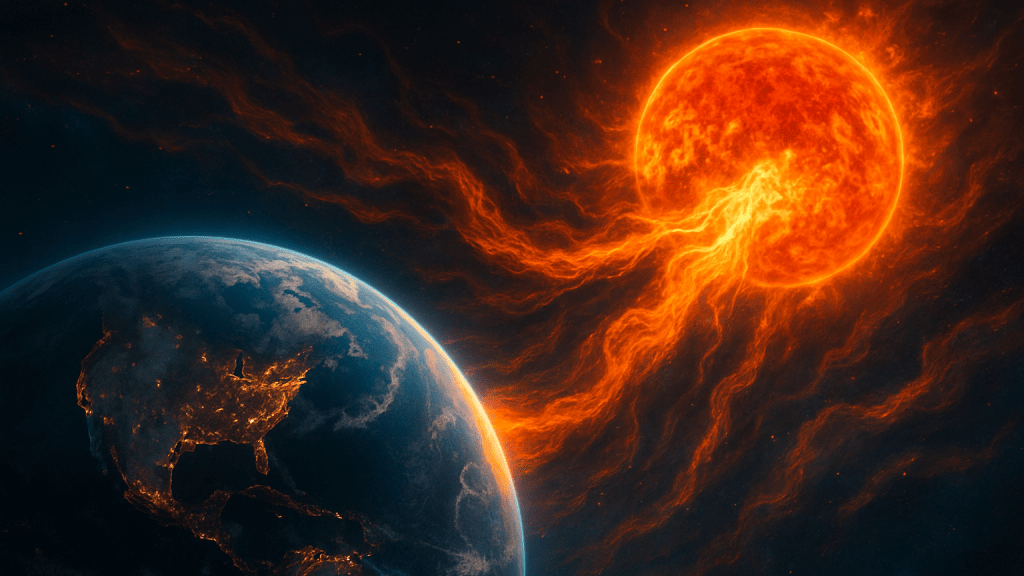
Lately, the Sun’s been putting on quite a show: throwing off solar flares, launching clouds of charged particles into space, and lighting up the night with spectacular auroras that reached far farther south than usual. Auroras have been spotted in states like Alabama and even parts of Texas, not exactly your standard aurora country. You may remember around this time last year when I reported on catching aurora here in my home state – a phenomenon I thought I’d never see here in the deep south.
So what’s going on up there? Well, the short answer is: we’re heading into the peak of the Sun’s 11-year activity cycle. And in this episode, I want to unpack what that really means, not just for the skywatchers among us, but for ham radio operators, satellite tech, power grids, and really anyone with a smartphone.
Let’s start with the fundamentals. The Sun goes through a natural cycle of magnetic activity that repeats roughly every 11 years.
Interestingly, over that roughly 11-year period the Sun’s magnetic field undergoes a complete flip – meaning the Sun’s north and south magnetic poles switch places. This cycle influences the number of sunspots – dark, cooler areas on the Sun’s surface caused by magnetic activity.
At the beginning of a cycle—called solar minimum—the Sun is relatively quiet. You might go weeks without seeing a single sunspot, which are dark, cooler regions caused by magnetic field tangles on the Sun’s surface.
But as the cycle ramps up, those magnetic fields become more active, twisting and snapping in powerful ways. This leads to the appearance of more sunspots—and more solar flares and coronal mass ejections, or CMEs. These are massive bursts of charged particles and magnetic fields hurled into space.
Eventually, we reach solar maximum, the peak of activity, when the Sun’s surface is crawling with sunspots and popping off flares and CMEs on a regular basis. Then, gradually, things calm back down into the next solar minimum. And the whole dance starts again.
Right now, as we speak in June 2025, we are approaching solar maximum. In fact, this cycle—known as Solar Cycle 25—is shaping up to be one of the more intense in recent memory. Some scientists think we may see activity levels not reached since the late 1990s or even the peak of the so-called “Space Weather Superstorm” era of the early 2000s.
When a CME or solar flare is aimed toward Earth, it slams into our planet’s magnetic field. Most of the time, we’re well shielded—our magnetic field does a pretty good job deflecting all that charged plasma.
But during strong solar storms, the energy overwhelms our magnetic defenses and flows into the atmosphere near the poles, where it excites oxygen and nitrogen molecules. That’s what creates those famous green and red ribbons in the sky: the aurora borealis in the north, and aurora australis in the south.
When the storm is especially powerful, the auroral oval expands. That’s how we get auroras far south of the usual high-latitude zones. A couple of months ago, folks as far south as Arizona, Georgia, and even parts of Mexico saw northern lights with the naked eye.
Now, if you’re an amateur radio operator, or ham, you’re probably already tracking solar activity. For folks in the amateur radio community, the Sun’s cycle isn’t just academic—it can make or break the ability to make contact around the globe.
When I became a ham radio operator, we were coming out of a solar maximum and I was able to talk to other hams all over the world on my 100 watt transceiver. As we approached the solar minimum some years ago, the bands seemingly went dead.
Here’s the science in a nutshell: when solar activity is high, the Sun pumps out more ultraviolet and X-ray radiation. That radiation hits Earth’s upper atmosphere—specifically the ionosphere—and charges it up, creating layers of ionized gas that can reflect radio waves back to the surface. That reflection allows radio signals to bounce around the world, especially on high-frequency bands like 10, 15, and 20 meters.
Essentially your signal bounces off the upper atmosphere and lands on the other side of the planet. The ionosphere acts as a powerful mirror, and hams can chat with stations across oceans using just a modest rig and a simple wire antenna. Using low bandwidth modes like Morse code and some of the newer digital protocols intended for weak signal work, communications can be copied even farther away.
But there’s a flip side. When solar storms get too strong, they can actually overload the ionosphere, causing rapid changes in its density. That leads to signal fading, distortion, or complete blackouts, especially on lower frequencies.
So for ham operators, it’s a bit of a Goldilocks situation. A little solar activity? Great. A lot? Amazing. Too much, all at once? Time to grab a book and wait it out.
The Sun’s temper tantrums don’t just affect auroras and radio enthusiasts. They also impact commercial aviation, GPS, communications satellites, and even the electrical grid. A strong enough geomagnetic storm can induce electric currents in long-distance power lines, potentially damaging transformers and causing blackouts.
Airlines sometimes reroute polar flights during solar storms to reduce radiation exposure and avoid radio blackouts. Satellite operators monitor solar flare alerts, because high-energy particles can fry electronics or interfere with navigation signals.
Even your smartphone can feel the effects. If GPS seems a little less reliable or satellite-based weather apps are lagging, the Sun might be to blame.
For most of us, all this activity is a reminder that we’re riding around a very dynamic star.
If you’re a stargazer hoping to catch auroras, keep an eye on the Kp index, which is a measure of geomagnetic activity. When it hits 6 or higher, auroras are likely to reach mid-latitudes. Apps like Aurora Alerts or websites like SpaceWeather.com can give real-time forecasts.
And if you’re a ham, now’s the time to dust off your HF rig and make some DX contacts. The bands have been hot for more than a year now, and we’re just along for the ride.
[MUSIC]
If the stars spoke to you this week, or if a question’s been on your mind, I’d love to hear it. Visit our website, startrails.show, where you can contact me and explore past episodes. Be sure to follow us on Mastodon, Bluesky, and YouTube — links are in the show notes.
Until we meet again beneath the stars… Clear skies everyone!
[MUSIC FADES OUT]
Support the Show
Connect with us on Mastodon @star_trails or on Bluesky @startrails.bsky.social
If you’re enjoying the show, consider sharing it with a friend! Want to help? Buy us a coffee!
Podcasting is better with RSS.com! If you’re planning to start your own podcast, use our RSS.com affiliate link for a discount, and to help support Star Trails.
 Star Trails: A Weekly Astronomy Podcast
Leave a comment