
Under the Same Stars: Ancient Astronomy – Star Trails: A Weekly Astronomy Podcast
Episode 69
This week we’re standing at the crossroads of present wonder and ancient wisdom. The week of June 15th to the 21st includes a waning Moon approaching perigee, a lineup of bright planets at both dusk and dawn, and the breathtaking rise of the Milky Way’s galactic core in the southeastern night sky.
But we’re also turning back the celestial clock. To honor the summer solstice on June 21st, the longest day of the year. We’ll explore how ancient cultures around the world used the sky to tell time, navigate, worship, and survive. From Stonehenge’s solar alignment to the jaw-dropping mechanics of the Antikythera device, we’ll journey through the earliest forms of astronomy and the tools that shaped humanity’s understanding of the cosmos.
Along the way, we’ll marvel at Polynesian star compasses, Babylonian eclipse charts, Chinese supernova records, and the mythological constellations that connected skywatchers across continents.
Transcript
[MUSIC]
Howdy stargazers and welcome to this episode of Star Trails. Drew here, and I’ll be your guide to the night sky for the week starting June 15th through the 21st.
This week, we’ll check in on the Moon, a few bright planets, and the rising galactic core. Then, we’ll take a step back in time to explore how ancient cultures watched and tracked the skies, including the story of a 2,000-year-old device pulled from a shipwreck that turned out to be the world’s first computer.
Whether you’re tuning in from the backyard, the balcony, or just your imagination, I’m glad you’re here. So, find a cozy spot, let your eyes adjust, and let’s see what the sky holds for us this week.
[MUSIC FADES OUT]
Let’s start with the Moon, since it tends to dominate our evening sky this week.
Tonight the Moon is still in its waning gibbous phase—about 87% illuminated—and rises a little after sunset. Each night this week, it’ll rise later and later, shrinking as it does. By Wednesday the 18th, it reaches the Last Quarter, looking like a perfect half-circle in the pre-dawn hours. After that, the Moon becomes a waning crescent, rising in the wee hours of the morning and becoming harder to spot as it approaches the New Moon on the 25th.
One subtle treat arrives on June 23rd, when the Moon reaches perigee—its closest approach to Earth in its monthly orbit, sitting about 225,000 miles away. Perigee also means slightly stronger ocean tides and, for the keen-eyed, a slightly larger lunar disc.
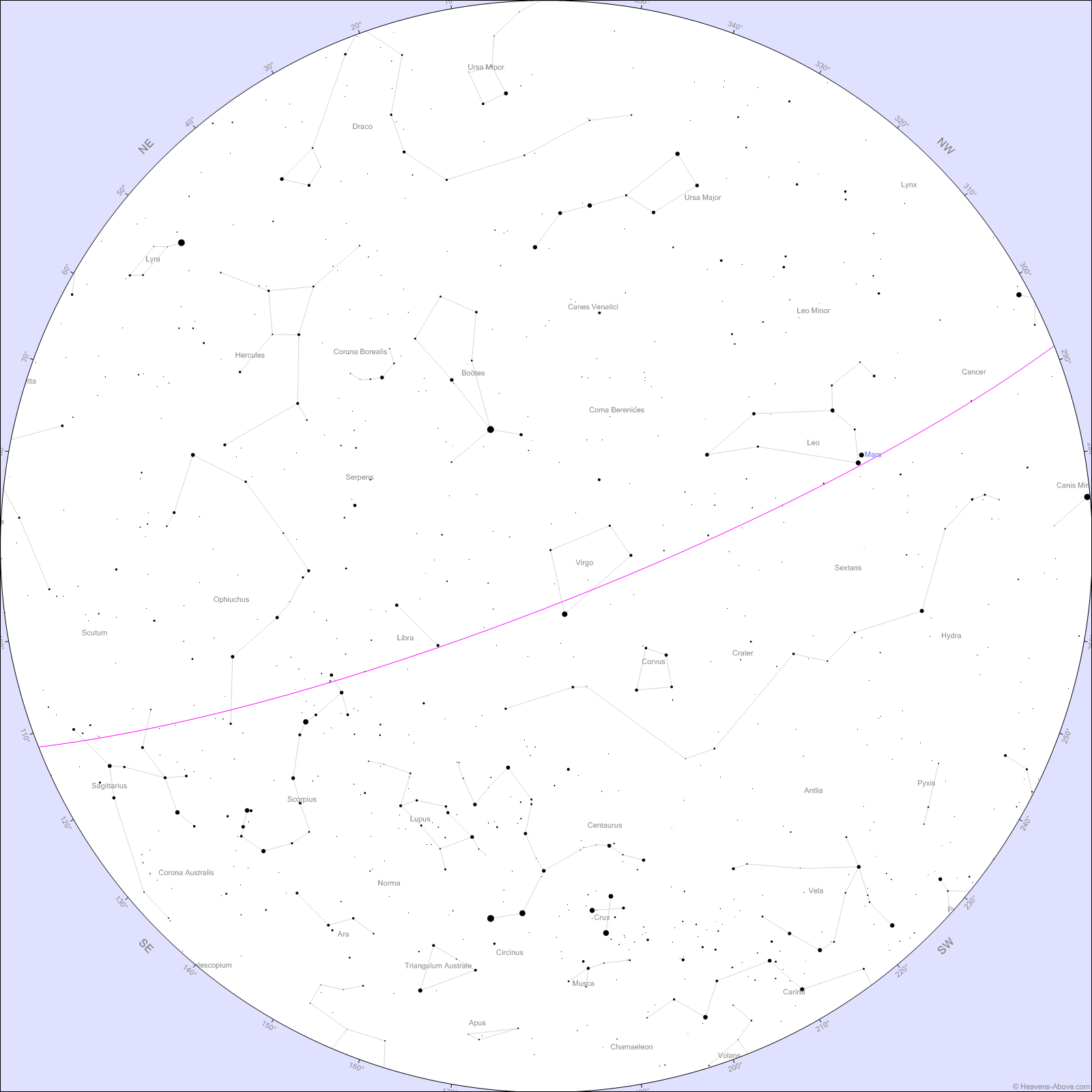
The planetary lineup this week spans both dusk and dawn. Right after sunset, the western sky gives us two familiar travelers: Mercury and Mars.
Mercury is beginning a brief but favorable evening sight. On the 15th, it appears about 74% illuminated through a telescope and shines at magnitude +0.3 — not its brightest, but visible if you’ve got a clear, flat western horizon. Mercury sets about 90 minutes after the Sun, so you’ll need to catch it quickly.
By June 24th, it’ll be part of a neat line-up with the bright Gemini twins — Castor and Pollux — hovering just above the western horizon. If you catch it at twilight, you’ll see Mercury sitting below those two stars in a graceful vertical line.
A little higher in the sky, Mars is making its slow passage through the constellation Leo. Its orange glow contrasts beautifully with Regulus, Leo’s bright blue-white heart star. Look for a close approach with these objects on the 16th and 17th.
The pre-dawn sky is where the real planetary action unfolds this week.
There, you’ll find Venus, rising brightly in the east about 90 minutes before sunrise. At magnitude –3.9, it’s the brightest object in the sky besides the Moon and Sun.
Just to its upper right, you’ll find Saturn, glowing pale yellow in the constellation Aquarius. On the 19th, the Moon will drift nearby Saturn in the early morning sky, creating a gorgeous pre-dawn pairing. If you’re up around 3 or 4 a.m., it’s worth stepping outside for.
Jupiter, on the other hand, is making its quiet exit. It’s low in the west before dawn and gets lost in the Sun’s glare by June 24th, when it reaches solar conjunction—passing directly behind the Sun from our point of view. It won’t be visible again until it emerges in the morning sky in mid-July.
For telescope users, Uranus and Neptune are both technically visible—but they’re faint and require effort. Neptune sits near Saturn in the sky this week, though it’s at magnitude +7.9 and invisible without optical aid. Uranus rises before dawn in Aries, but remains difficult to spot until it climbs higher in coming weeks.
Now, let’s pull back from the planets and take in the broader canvas of stars — because this time of year, the Milky Way really begins to show off.
By mid-evening, say around 10 p.m., the Milky Way’s bright central band begins to rise in the southeast. If you’re under a dark sky free from streetlights and urban haze, you’ll see a faint, cloudy river of stars running from horizon to zenith. That’s the galactic core, and June is one of the best times to see it in the Northern Hemisphere.
Overhead, the Summer Triangle is fully visible. This prominent asterism is formed by three bright stars: Vega in the constellation Lyra, Deneb in Cygnus, and Altair in Aquila. Vega is the brightest of the three and nearly overhead. Deneb marks the tail of the celestial Swan, and Altair, the eye of the Eagle, flaps along the Milky Way’s edge.
Cygnus, also known as the Northern Cross, is a rich area to explore with binoculars. Look for clusters, dark nebulae, and star clouds tucked along the Milky Way’s spine.
To the west, Boötes and Arcturus still dominate the early evening. Arcturus is easy to find—just follow the curve of the Big Dipper’s handle and “arc to Arcturus.” This orange giant star is relatively close — about 37 light-years away — and heading towards up.
Near Boötes, you’ll find Corona Borealis, the Northern Crown—a small but elegant arc of stars. And rising later in the east, the teapot-shaped Sagittarius begins to ascend, marking the gateway to the galactic center.
We’re still a few weeks away from major meteor showers, but sporadic meteors can be seen any clear night. And with the Moon waning toward New this week, darker skies will make even these background meteors easier to spot.
[Transition FX]
The summer solstice occurs on Friday. It’s the longest day of the year and the moment when the Sun reaches its highest point in the sky. The solstice is a reminder of a truth as old as humanity itself: people have always looked up.
Long before telescopes or scientific journals, humans were watching the sky, tracking its rhythms, and embedding its stories into stone, memory, and myth. The solstices, both summer and winter, acted as celestial bookmarks for ancient cultures, fixed points in the rhythm of the seasons. From the Arctic Circle to the Andes, they marked time by the sky — planting, harvesting, hunting, and praying according to the movements of the Sun, Moon, and stars.
Let’s begin in prehistoric Europe, where monuments like Stonehenge align almost precisely with the rising Sun on the summer solstice. When sunlight breaks over the Heel Stone and pours into the monument’s center, it creates a striking visual that likely held spiritual, agricultural, or communal meaning. Constructed in several phases between roughly 3000 and 2000 BCE, Stonehenge incorporated massive rock formations transported from more than 150 miles away in Wales. Beyond solstice alignments, theories suggest Stonehenge may have functioned as a burial ground, ceremonial center, or a lunar calendar.
Similar alignments appear in Ireland and Orkney, where solar events dictate how light enters stone passageways at exact times of year. These early engineers didn’t use metal tools or mathematics as we know them—but they built with precision, using horizon markers and the human eye to measure time itself.
Across the world in Mesopotamia, the Babylonians were developing what we might recognize as the first scientific astronomy. They recorded the rising and setting of stars, tracked eclipses, and used a base-60 number system that still influences how we measure time today.
They also discovered the Saros cycle — an 18-year period after which lunar and solar eclipses repeat. All of this was done without lenses, telescopes, or even basic optics. Their most sophisticated tools were observation, recordkeeping, and patience.
But for sheer ingenuity, few artifacts of the ancient world rival the Antikythera Mechanism. Pulled from the sea off the coast of Greece in 1901, this corroded mass of bronze gears remained a mystery for over a century. Today, we know it to be an ancient computer — a mechanical device designed around 100 BCE to track the motions of the Sun, Moon, and five known planets. It even predicted eclipses and synchronized with the Olympic Games. Recent studies revealed it used differential gearing and a sophisticated epicyclic model to account for the Moon’s elliptical orbit—a level of mechanical sophistication not seen again until the 18th century.
Its back dials also recorded the Metonic cycle – that’s a 19-year cycle in which lunar phases recur at the same time – and eclipse predictions using Babylonian-style glyphs. It’s the only device of its kind ever found, suggesting a lost tradition of high-precision astronomical engineering in the Hellenistic world.
The Greeks also gave us some of the earliest theoretical frameworks for understanding the sky. Aristarchus proposed a heliocentric model of the solar system around the 3rd century BCE — nearly 1800 years before Copernicus. Hipparchus, often called the “father of trigonometry,” developed the first comprehensive star catalog and discovered precession, the slow wobble in Earth’s axis. And of course, Ptolemy’s geocentric model, though incorrect, dominated astronomical thought for more than a millennium owing to its mathematical sophistication and explanatory power. These thinkers were beginning to shift astronomy from observational tradition into formal science.
Over in ancient China, astronomers during the Shang Dynasty and later eras kept detailed records of comets, eclipses, and planetary motions. They identified “guest stars” (what we now know as supernovae) and connected celestial events to the emperor’s legitimacy.
Royal astronomers operated with high stakes: failing to predict an eclipse could cause political unrest or even cost them their lives. The Chinese were among the first to document phenomena like Halley’s Comet, and their star charts helped preserve sky positions across centuries.
That theme repeats across civilizations. In the Inca Empire, solar observation was central to statecraft. Temples like Machu Picchu were aligned with solstices, and ritual pillars were believed to hold the Sun in its proper path. Likewise, Mayan kings scheduled battles and ceremonies according to the Venus cycle. The Dresden Codex, one of the few surviving Maya texts, contains incredibly precise Venus tables. Its appearances and disappearances were used to guide warfare, coronations, and sacrifices.
Islamic scholars preserved and expanded on Greek knowledge. They developed astrolabes, improved star catalogs, and calculated planetary orbits with remarkable precision.
And speaking of star maps—some of the most astonishing weren’t drawn at all. They were sung.
The Polynesians, navigating vast stretches of the Pacific, memorized the rising and setting points of stars to guide them between islands thousands of miles apart. Without metal tools or written maps, they used oral knowledge, wave patterns, bird behavior, and the stars to sail across the world’s largest ocean.
Their star compass divided the horizon into more than 30 sectors, each marked by a key star. This mental map was passed down through chant, ritual, and experience.
We also see astonishing sky knowledge in Indigenous cultures of North America and Australia. The Navajo, Lakota, and other Native American nations wove constellations into their moral teachings, agricultural cycles, and healing practices. In some traditions, the Milky Way was seen as the Path of Souls or a great river in the sky.
What kinds of tools made all this possible? Most ancient astronomers relied on naked-eye observation and simple but clever instruments:
– The gnomon — a stick planted vertically in the ground—could track the Sun’s shadow to measure time and solstices.
– Egyptians used plumb lines and stars to align structures and keep time at night.
– The armillary sphere, quadrant, and water clocks were used by Greeks, Chinese, and Arabs to refine measurements.
Of course, the stars weren’t only mapped, they were mythologized.
Cultures around the world gave names and stories to the constellations, turning the night sky into a canvas of meaning. The Pleiades, or Seven Sisters, appear in Greek, Japanese (Subaru), and Aboriginal lore. The Greek Orion the hunter is mirrored in myths from the Americas and Africa, often with similar traits — chasing, boasting, or falling.
The Inuit interpret Orion as a caribou hunter. The Greeks imagined Scorpius chasing Orion, which is why they appear on opposite sides of the sky. And the Milky Way itself might be a road, a river, a trail of birds, or the backbone of night, depending on where you’re standing.
Sky lore helped people remember when to plant, when to harvest, when to fish, and when to pray. The night sky is part calendar, part compass, and part sacred text.
And maybe that’s the biggest through-line of all: ancient astronomy wasn’t some esoteric discipline. It was life. Watching the sky meant understanding your place in time, your duties to your community, and your connection to something larger than yourself.
Today, when we glance at an app to check the phase of the Moon or use GPS to navigate a backroad, it’s easy to forget how deep our relationship with the sky runs. But every time we look up we’re tapping into an ancient tradition. One that crosses borders, bridges millennia, and ties us to the people who built stone circles, carved eclipse charts into clay, or sang the constellations into memory.
We’re not just watching the sky, we’re participating in humanity’s oldest shared story.
[MUSIC]
If the stars spoke to you this week, or if a question’s been on your mind, I’d love to hear it. Visit our website, startrails.show, where you can contact me and explore past episodes. Be sure to follow us on Mastodon, Bluesky, and YouTube — links are in the show notes.
Until we meet again beneath the stars… Clear skies everyone!
[MUSIC FADES OUT]
Support the Show
Connect with us on Mastodon @star_trails or on Bluesky @startrails.bsky.social
If you’re enjoying the show, consider sharing it with a friend! Want to help? Buy us a coffee!
Podcasting is better with RSS.com! If you’re planning to start your own podcast, use our RSS.com affiliate link for a discount, and to help support Star Trails.
 Star Trails: A Weekly Astronomy Podcast
Leave a comment