

Blazars, Bootids and a Blackout Moon – Star Trails: A Weekly Astronomy Podcast
Episode 70
This week we explore one of the darkest, and most dynamic, weeks of the season for stargazing. With a New Moon on June 25th, we get a prime window to explore the deep sky, from the glowing heart of the Milky Way to the subtle shimmer of noctilucent clouds and the unpredictable June Bootids meteor shower.
There’s also a stunning series of planetary pairings, including Venus and the Moon at dawn, and a twilight dance featuring Mercury, Mars, and Regulus. Plus, we preview a lunar occultation of Mars and offer tips for timing the event in your local sky.
Later we venture far beyond the Solar System to investigate blazars: relativistic jets from feeding black holes in distant galaxies. We break down how these dynamic cosmic particle accelerators are helping scientists unlock secrets of the universe, one ghost particle at a time.
Transcript
[MUSIC]
Howdy stargazers and welcome to this episode of Star Trails. Drew here, and I’ll be your guide to the night sky for the week starting June 22nd through the 28th.
This week a New Moon offers up darker skies, Mars dances with Mercury, and we look at the weird world of blazars – particle accelerators from galaxies far, far away.
Whether you’re tuning in from the backyard, the balcony, or just your imagination, I’m glad you’re here. So, find a cozy spot, let your eyes adjust, and let’s see what the sky holds for us this week.
[MUSIC FADES OUT]
Let’s kick things off with the Moon. A New Moon arrives on June 25th, which means dark skies all week long, perfect for spotting galaxies, nebulae, and those elusive faint stars.
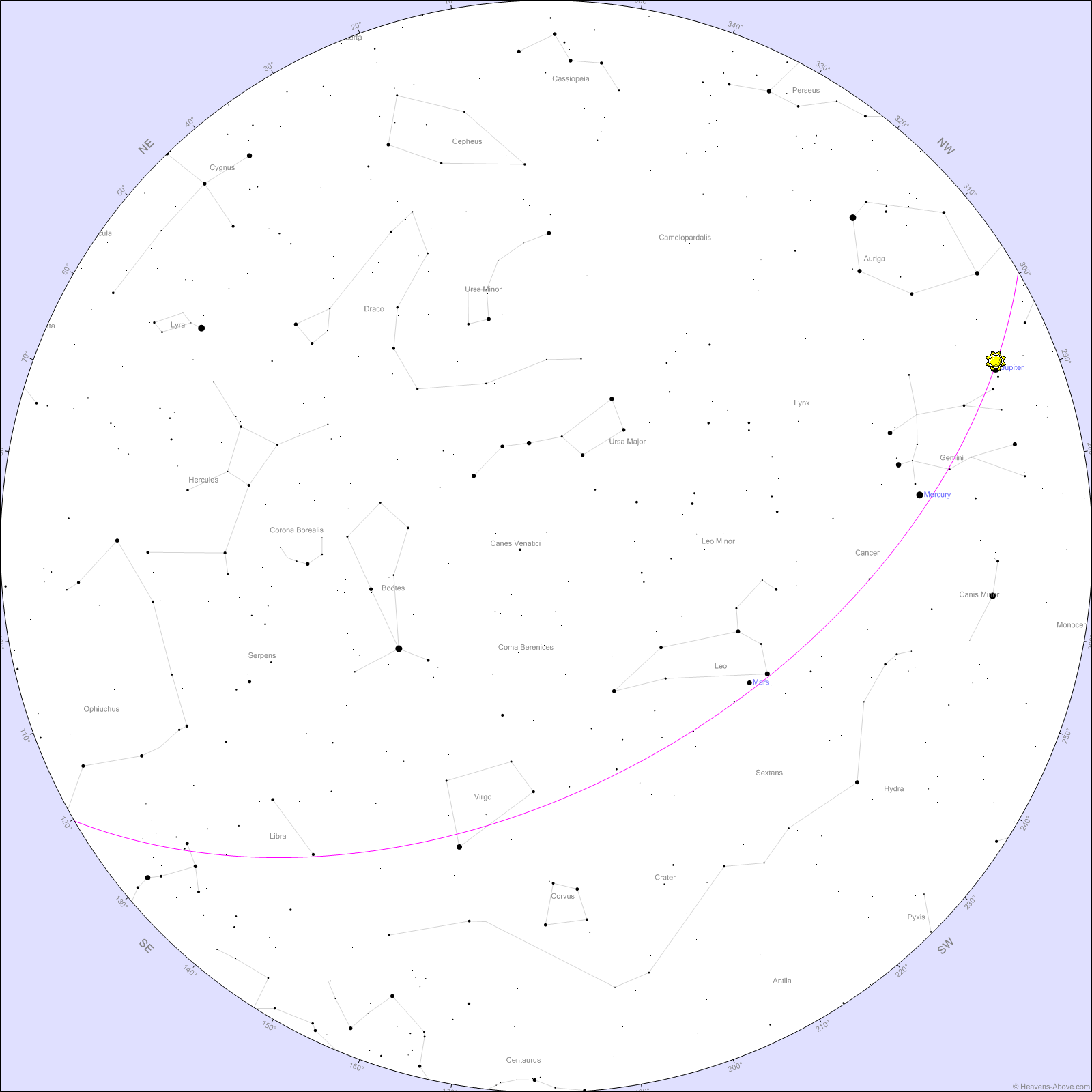
But the Moon’s not taking the whole week off! On the mornings of June 23rd, look low in the eastern sky before sunrise. You’ll catch a slender crescent Moon hanging just above Venus, glowing brightly at magnitude -4. It should look great through a pair of binoculars.
Then, after sunset on the 26th and 27th, the crescent Moon returns, cozying up with Mercury, and even Castor and Pollux, the twin stars of Gemini, just above the western horizon. Look for this enchanting grouping just as twilight fades.
And here’s something rare: on the nights of June 28th and 29th, the Moon slips between Mars and Mercury, with the bright star Regulus nearby. If you’re in the right part of the world, the Moon will actually pass in front of Mars, a lunar occultation, just after midnight Coordinated Universal Time on the 30th.
Keep in mind, midnight in UTC time is actually the night of the 29th here in North America. For example, for those of us on Eastern Daylight Time, we’re four hours behind UTC time.
Be sure to use an astronomy app, or an online service like Stellarium Web for the exact time of the occultation in your area. I just checked my location and while the Moon will come very close, it won’t be covering Mars from my point of view. Perhaps it will in your area.
Even if you don’t catch the occultation itself, the trio will make for a brilliant visual cluster.
Speaking of planets, here’s who’s on stage this week:
Venus is that blazing morning “star,” best seen in the early dawn, rising in the east. Mercury is just starting to show up after sunset, hugging the western horizon.
Mars is tagging along with Regulus, the heart of Leo the Lion, and they’ll be putting on quite a show in the western sky. Saturn is your pre-dawn companion, glowing steadily in the southeast before sunrise.
Jupiter is slipping out of view now, setting shortly after the Sun.
If you’re into deep-sky observing, this is your week. With no Moon to compete, the core of the Milky Way in Sagittarius and Scorpius is at its best. From a dark location, you’ll see it stretch across the sky, and tucked inside it, things like the Lagoon Nebula, the Trifid, and bright open clusters like NGC 6633 in Ophiuchus are all waiting to be explored.
One more thing to watch for: the June Bootids meteor shower peaks around June 28th. This is usually a quiet one, but it’s been known to surprise, so keep an eye out for slow, graceful meteors drifting through the sky.
And for those of you up north, keep your eyes peeled for noctilucent clouds. These shimmering, electric-blue wisps can appear just after sunset or before sunrise, glowing way up at the edge of space. They’re composed of icy dust particles that reflect sunlight even when the Sun is well below the horizon. They’re most common in summer at high latitudes, and they’re as eerie as they are beautiful.
[TRANSITION FX]
This week, we’re heading into the wild frontier of deep space to meet one of the universe’s most extreme objects: the blazar.
Now, if you’ve been listening for a while, you’ve heard me chat about pulsars and quasars before. So, what’s a blazar, and how is it different from all these other space “‑ars”?
A blazar is a special type of active galactic nucleus, that’s the energetic heart of a distant galaxy, where a supermassive black hole is actively feeding on gas and dust.
Now, when a black hole is gobbling up matter fast enough, it doesn’t just sit quietly. The whole area around it heats up and glows with incredible brightness, sometimes outshining the galaxy itself.
Some of that material gets caught in magnetic fields and blasted out of the galaxy’s poles in two narrow beams called jets. These are streams of particles and energy being launched at nearly the speed of light.
When one of those jets is pointed almost directly at us here on Earth, that’s what we call a blazar.
These jets are moving so fast, they’re categorized as relativistic. That just means they’re blasting out at speeds close to the speed of light. At those speeds, the rules of physics get weird. Time slows down, mass changes, and light bends. That’s Einstein’s theory of relativity kicking in.
So when we say a blazar is “pointing a relativistic jet at us,” we mean we’re in the direct line of fire of one of these high-speed energy beams. That makes blazars look incredibly bright and variable to us, even if they’re billions of light-years away.
Now here’s where things get even stranger.
In 2017, scientists using a detector buried deep in the ice at the South Pole, called the IceCube Neutrino Observatory (yes, that really is its name), spotted a very special kind of subatomic particle – a neutrino.
Neutrinos are often nicknamed “ghost particles” because they barely interact with anything. Trillions of them are passing through your body right now, and you don’t even feel it.
They’re difficult to detect, but in this case, IceCube caught one. And when astronomers traced it back to its source, it lined up with a flaring blazar called TXS 0506+056. It’s located around the left shoulder of the constellation Orion. This was the first time we’d ever linked a neutrino to a known object outside our galaxy.
IceCube isn’t a telescope in the traditional sense. It’s made of more than 5,000 sensors frozen in a cubic kilometer of Antarctic ice.
When a neutrino occasionally hits a molecule of ice, it produces a tiny flash of blue light. IceCube watches for those flashes and helps determine the direction the neutrino came from.
Other observatories, like KM3NeT in the Mediterranean, are doing the same thing underwater. These detectors are opening up a new kind of astronomy, where we study the universe not just with light, but with particles.
This is what astronomers call multi-messenger astronomy. We’re not just looking at starlight anymore, we’re listening to the universe in new ways, through particles, waves, and everything in between.
Here’s the big picture, and why scientists find blazars so fascinating. Blazars are natural particle accelerators.
You’ve probably heard of the Large Hadron Collider, that massive underground ring in Europe where scientists use magnets and superconductors to smash particles together to study what the universe is made of. Blazars are doing the same thing, but on a cosmic scale.
They’re accelerating protons and other particles to energies millions of times higher than anything we can do here on Earth. These particles then travel across the universe, sometimes for billions of years, and some of them reach Earth.
By detecting these particles we’re learning what’s happening in the hearts of galaxies, how black holes interact with their surroundings, and what kind of extreme environments the universe is capable of creating.
Somewhere out there, in a distant galaxy, a black hole is hurling particles into space at nearly the speed of light, and one of them might just pass silently through you, carrying a message from the edge of the universe, telling us what conditions are like near these black holes, how matter behaves in extreme gravity, and how the most energetic phenomena in the cosmos operate.
[MUSIC]
If the stars spoke to you this week, or if a question’s been on your mind, I’d love to hear it. Visit our website, startrails.show, where you can contact me and explore past episodes. Be sure to follow us on Bluesky, and YouTube — links are in the show notes. Until we meet again beneath the stars… Clear skies everyone!
[MUSIC FADES OUT]
Support the Show
Connect with us on Bluesky @startrails.bsky.social
If you’re enjoying the show, consider sharing it with a friend! Want to help? Buy us a coffee!
Podcasting is better with RSS.com! If you’re planning to start your own podcast, use our RSS.com affiliate link for a discount, and to help support Star Trails.
 Star Trails: A Weekly Astronomy Podcast
Leave a comment