Cosmic Fireworks and a Crazy Week of Space News – Star Trails: A Weekly Astronomy Podcast
Episode 71
As the U.S. prepares to light up the skies for the Fourth of July, the cosmos is already putting on a spectacular show of its own. Highlights include a close encounter between the Moon and Mars, a subtle meteor shower, and a dazzling pre-dawn lineup of planets.
In the second half of the show, we check out some of the most fascinating space news of the season, including:
- An asteroid that could impact the Moon in 2028
- The largest comet ever discovered, already active far beyond Saturn
- A distant spiral galaxy challenging our ideas about how galaxies form
- And a breakthrough in the decades-long search for the universe’s missing matter
Then, we zoom in on the Vera C. Rubin Observatory, which just released its first images from the largest astronomical camera ever built. From new asteroids to deep galaxy clusters, Rubin is poised to change everything we know about the dynamic sky.
Transcript
[MUSIC]
Howdy stargazers and welcome to this episode of Star Trails. Drew here, and I’ll be your guide to the night sky for the week starting June 29th through July 5th.
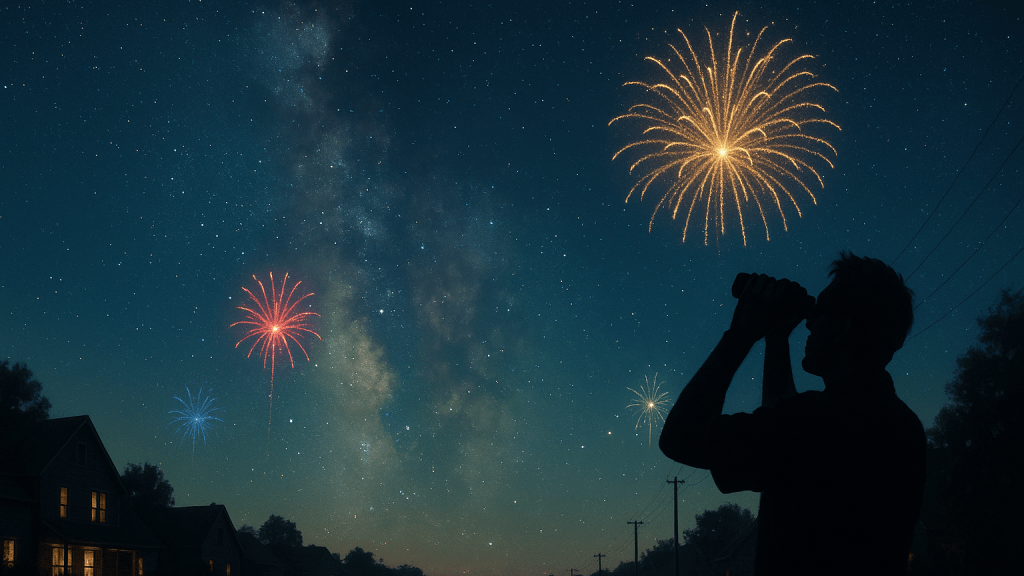
If you’re in the US, many of us will be out on the evening of July 4th, catching fireworks with friends or family. But there’s a cosmic fireworks show overhead too. Also, last week seemed to bring a never-ending array of wild astronomy news – from the largest comet ever detected, the oldest galaxy ever photographed, to discoveries in the weird world of dark matter, we’ll talk about all that and even more in the second half of the show.
Whether you’re tuning in from the backyard, the balcony, or just your imagination, I’m glad you’re here. So, find a cozy spot, let your eyes adjust, and let’s see what the sky holds for us this week.
[MUSIC FADES OUT]
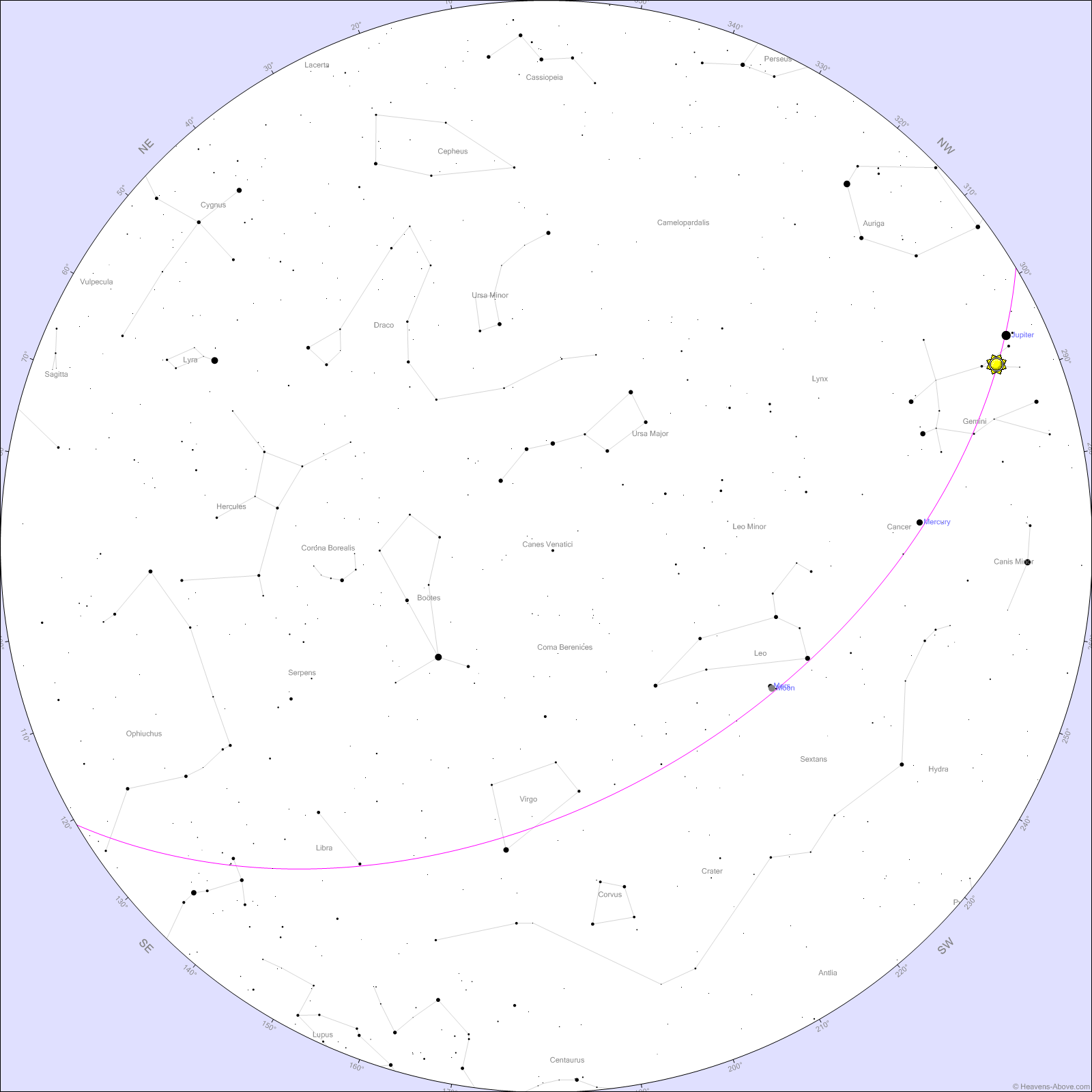
Let’s start with one of the prettiest pairings of the week. Tonight, June 29th, look to the western sky just after sunset. There, you’ll see a delicate waxing crescent Moon — only about 22% illuminated — hanging close to the planet Mars.
Nearby, you’ll also spot Regulus, the brightest star in the constellation Leo. If you have a pair of binoculars, this little triangle of light, the Moon, Mars, and Regulus, makes a perfect early evening target.
And for those of you in North and South America, there’s a chance the Moon might even briefly pass in front of Mars, what astronomers call an occultation. We won’t all be able to see it, so check in on an astronomy app such as Stellarium, to see if the occultation is visible in your area.
Between now and July 5, we’re also catching the tail end of the June Bootid meteor shower. This one’s usually pretty mellow, maybe a few meteors per hour, but every now and then, it surprises us with a sudden outburst.
If you’re outside late in the coming days, especially under dark skies, keep an eye out for slow, bright streaks drifting out of the northern sky, near the constellation Boötes.
There’s a small planetary parade for early risers. Just before sunrise, look toward the eastern sky to catch Venus, shining like a cosmic spotlight. It’s the brightest thing in the sky after the Moon right now. Further to the east, Saturn is climbing higher each day. Jupiter is rising as well, but it’s just ahead of the morning sun, and lost in the glare. Uranus is hanging out around the Pleiades, but as usual, you’ll need a telescope to see it.
Back in the evening sky, Mercury is peeking out of the twilight haze. Between now and June 30th, it passes near the Beehive Cluster, also known as Messier 44, in the constellation Cancer.
Grab a pair of binoculars and try to catch this pairing in the northwest right after sunset. The Beehive Cluster looks like a soft sprinkling of stars, and Mercury will be just nearby, like a bright pearl in a field of fireflies. It will set quickly and you’ll need a clear view to the western horizon.
Now is also the perfect time to get reacquainted with the Summer Triangle. This asterism, made up of the bright stars Vega, Deneb, and Altair, dominates the southern sky by 10 PM and leads you right into the rich star fields of the Milky Way.
Look higher overhead and you’ll find Cygnus, the Swan, flying along the Milky Way’s path, while Boötes and its bright orange star Arcturus glide westward.
If the night is clear you’ll be able to see the Milky Way as a faint, misty band stretching across the sky from northeast to southwest. It’s one of the best times of year to see our galaxy from the inside.
The New Moon just passed on June 25, which still means we’re getting darker skies early in the week. The First Quarter Moon lands around July the 2nd, and will rise near sunset, staying bright until past midnight. It’s a good opportunity to study lunar craters with a small telescope.
[TRANSITION FX]
You know, some weeks it feels like the universe is just showing off—and lately? It’s been putting on a real show.
Whether it’s ancient galaxies turning up in the deep field, mysterious matter finally stepping into the light, the largest comet ever spotted, or an asteroid on a Moonshot trajectory, there’s been no shortage of cosmic headlines to catch our eye this past week.
Oh, and I almost forgot, down south in my neck of the woods, we had a giant daytime meteor light up the summer skies a few days ago, complete with a sonic boom. It was caught by everything from security cameras to dashcams across the southeast states.
Before we dig into our big story about one of the most powerful telescopes ever built finally opening its eye on the universe, let’s take a quick spin through some of the quirkiest and most fascinating space news of the week.
First up: an asteroid dubbed 2024 YR4 — a near-Earth object roughly 250 meters across — has made headlines for a pretty unusual reason. Unlike most asteroids we worry about hitting us, this one’s projected to strike the Moon sometime in late 2028.
And while that sounds like a sci-fi movie plot, scientists are actually taking it seriously — not because it’ll destroy the Moon, but because it could create a blast visible from Earth and possibly threaten satellites orbiting nearby.
Even more fascinating? The impact would provide an unplanned but valuable experiment in lunar geology and space debris dynamics. Instruments from NASA and ESA could get real-time data on the effects of a mid-sized asteroid collision on the Moon’s surface.
So yes, it’s technically a “city-killer.” But fortunately it’s not aiming for us.
Next up: meet Zhúlóng, which means Red Dragon in Mandarin. This beauty is the most distant grand-design spiral galaxy ever discovered, spotted by the James Webb Space Telescope at an eye-watering 12.3 billion light-years away. And remember the universe is believed to be around 13.8 billion years old, so the light from this galaxy has taken almost as long to travel here as the universe has been in existence. That’s absolutely mind-blowing when you think about it.
Here’s the kicker: spiral galaxies – those majestic pinwheels like our Milky Way – aren’t supposed to be this well-formed so early in the universe. At this distance, we’re seeing Zhúlóng as it looked just 1.5 billion years after the Big Bang. That’s a baby photo, cosmically speaking.
Most galaxies back then were chaotic blobs, still in their awkward teenage phase. But Zhúlóng is already posing for the Hubble catalogue. Its existence suggests galaxy formation models may need some tweaking, or that cosmic order arrived much sooner than we thought.
And speaking of cosmic giants, one of the solar system’s true leviathans is stirring out past Saturn. Meet Comet C/2014 UN271, also known as Bernardinelli–Bernstein, a name almost as massive as the object itself.
This isn’t your typical icy visitor. Bernardinelli–Bernstein is estimated to be between 120 and 150 kilometers wide. That’s about 10 times the size of a typical comet and roughly the size of Rhode Island.
It’s currently inbound from the Oort Cloud, that distant shell of icy bodies that surrounds our solar system like a cosmic deep freezer. Even though it’s still more than 16 astronomical units from the Sun — that’s beyond the orbit of Uranus — it’s already active, venting gas in long, frosty jets. In fact, it was one of the most distant comets ever observed with a visible coma.
Its closest approach will bring it only as near as 11 AU – and you may recall one AU is the distance from the Earth to the Sun. It will remain well outside Saturn’s orbit by 2031. But its sheer size and activity make it an incredible subject of study. It’s basically a time capsule from the solar system’s earliest days, and we’re getting a front-row seat as it thaws out.
And here’s one more quick news item. It’s a true mystery with a twist ending. For decades, astronomers have known that the visible matter in the universe, the stuff made of protons, neutrons, and electrons, aka baryonic matter, just didn’t add up.
The math said it should be there. But when we looked? Only about half of it could be found in stars, gas clouds, and galaxies.
Enter fast radio bursts, or FRBs, those strange, ultra-short flashes of radio waves from deep space. Scientists realized they could use FRBs like X-rays, tracking how much ordinary matter each signal passed through.
Using a network of these bursts, astronomers found the missing baryons in long, wispy filaments of gas stretched between galaxies. Like finding socks that fell behind the dryer—except on a cosmic scale. The science is evolving as we speak, so hopefully we’ll learn more in the near future.
And now for the big story this week: the Vera C. Rubin Observatory, named after the pioneering astronomer who helped discover dark matter, is finally awake. And it’s already making waves.
Last Monday, the Rubin team released the telescope’s first full-color “first light” image, taken with its 3,200-megapixel camera, the largest digital camera ever built for astronomy.
This thing is an absolute monster in the best possible way. Imagine a camera the size of a small car, sensitive enough to detect a flashlight from the Moon, snapping the entire sky again and again, for ten years.
The Rubin Observatory is located in northern Chile, taking advantage of some of the clearest skies on Earth. Its main project is the Legacy Survey of Space and Time, a decade-long scan of the southern sky that will create the most detailed time-lapse of the universe ever made.
Three things make Rubin standout from other observatories.
One, its size and speed. Rubin has an 8.4-meter mirror and can image the entire southern sky every few nights. Two, its resolution. With 3.2 gigapixels per image, Rubin can pick up faint, fast, and fleeting objects, like asteroids zipping by or supernovae popping off across the universe.
And three, it’s collecting a massive amount of data. Over ten years, Rubin will collect about 20 terabytes of data per night, building a vast database of how the sky changes over time.
The first image from Rubin is a beauty. The debut features regions including the Virgo Cluster, with hundreds of galaxies packed into view; the Lagoon and Trifid Nebulae, bursting with color and gas; and a segment of the Large Magellanic Cloud that looks like a cosmic wave cresting.
Even more impressively, in just its first 10 hours of scanning, Rubin detected more than 2,000 new asteroids, most of which were unknown to previous sky surveys.
Eventually, Rubin is expected to detect billions of galaxies, millions of supernovae, and track hundreds of thousands of near-Earth objects, all while helping scientists tackle the biggest questions in astronomy, from dark matter and dark energy to the origin of the Milky Way.
And with the data pouring in, who knows what surprises the telescope might catch next? Rogue planets? Asteroid impacts? Or the blink of a dying star?
[MUSIC]
If the stars spoke to you this week, or if a question’s been on your mind, I’d love to hear it. Visit our website, startrails.show, where you can contact me and explore past episodes. Be sure to follow us on Bluesky, and YouTube — links are in the show notes. Until we meet again beneath the stars… Clear skies everyone!
[MUSIC FADES OUT]
Support the Show
Connect with us on Bluesky @startrails.bsky.social
If you’re enjoying the show, consider sharing it with a friend! Want to help? Buy us a coffee!
Podcasting is better with RSS.com! If you’re planning to start your own podcast, use our RSS.com affiliate link for a discount, and to help support Star Trails.
 Star Trails: A Weekly Astronomy Podcast
Leave a comment