Weighty Matters and Wandering Worlds – Star Trails: A Weekly Astronomy Podcast
Episode 72
This week we kick things off with a deceptively simple listener question: What exactly is mass? From beach balls to black holes, we explore how mass shapes the universe, and our understanding of gravity.
Then we turn our eyes to the night sky, where the Full Buck Moon rises low on the horizon, showing off the inspiring Moon Illusion. We’ll cover what planets are visible, what to look for in the coming nights, and keep in mind, meteor shower season is right around the corner.
Finally, we journey to the outermost reaches of the solar system, to the Kuiper Belt and the distant, mysterious Oort Cloud. These frozen zones may hold the keys to our cosmic past and are home to icy relics like Comet Bernardinelli–Bernstein, one of the largest comets ever discovered.
Transcript
[MUSIC]
Howdy stargazers and welcome to this episode of Star Trails. Drew here, and I’ll be your guide to the night sky for the week starting July 6th through the 12th.
This week we answer some listener mail and explore the mystery of mass. A big full moon looms low on the horizon, and we take a detour into the icy reaches of our solar system, where relics of the early universe hide away in the darkness.
Whether you’re tuning in from the backyard, the balcony, or just your imagination, I’m glad you’re here. So, find a cozy spot, let your eyes adjust, and let’s see what the sky holds for us this week.
[MUSIC FADES OUT]
Before we get into the night sky this week, I’d like to kick off this episode with a listener question, and this one really hits the sweet spot — simple on the surface, but it opens the door to something surprisingly deep.
Last week, Dale from Omaha wrote:
“Can you explain mass. I don’t understand how mass is calculated or what that means. I have heard astrophysicists say two planets are the same size but have different masses. A simple explanation would be greatly appreciated.”
Dale, first off, thanks for writing in with this question, and I know you asked for a simple explanation, and I intend to provide one, but mass, although a reasonably straightforward concept in and of itself, is connected to some of the real mysteries of astrophysics and the workings of the universe itself. I’ll get into a few of those in a moment, but let’s first figure out what’s going on at the most basic level.
Mass is basically how much “stuff” is packed into something. It’s not about how big something looks — it’s about how much material is actually in there. Think about two identical suitcases. One is filled with clothes, the other is packed with bricks. They take up the same space, but the one with bricks is a lot heavier. That’s because it has more mass.
Astronomers talk about mass all the time. Just like your question, two planets can be the same size, but one has more mass. That means one is denser — maybe it has a larger metal core or more rock and less gas. Same outside dimensions, but more weight on the inside. Let’s consider Earth’s planetary sister, Venus. Both Earth and Venus are roughly the same size, but Earth has more mass thanks to its larger, metallic core.
Let’s take another example. Because it’s summer, let’s consider a beach ball compared to a bowling ball. Maybe a good 16-pounder. The beach ball is very light, but much larger than the bowling ball. The beach ball contains mostly air, while the bowling ball is filled with, well, whatever bowling balls are made of – dense resin or plastics I assume.
It’s that density that matters, rather than size. And density is what determines mass. Now here’s where things start to become fascinating.
Let’s shrink ourselves down to the molecular level. If you were to stand next to a beach ball and a bowling ball at this tiny size, you’d feel a gravitational pull towards the bowling ball.
Mass is directly tied to gravity. The more mass something has, the stronger its gravitational pull. Earth pulls harder than the Moon because it has more mass. The Sun keeps the planets in orbit because it’s massive – not just in size, as the term is often used, but in actual weight.
In astronomy, we can’t weigh things directly, so we figure out mass by watching how objects move — for example, how fast a moon orbits a planet. That motion tells us how much gravity there is, and gravity tells us the mass.
Now, let’s get weird. Mass accounts for some of the most fascinating phenomena in the universe, including one of the most extreme – black holes. These are the ultimate examples of mass and gravity gone wild.
A black hole forms when a giant star collapses — and all that mass gets squeezed into an incredibly tiny space. Imagine taking something more massive than the Sun and cramming it into something the size of a city, or smaller. The result is unbelievably dense.
Now remember, gravity depends on mass, and our distance to an object alters how much gravity we experience. Because black holes are so compact, you can get extremely close to them, but if you get too close, you get sucked in and there’s no turning back. The gravity near them is so strong that even light can’t escape. That’s why they’re black.
If — purely as a thought experiment — our Sun turned into a black hole, Earth would keep orbiting just like it does now. Same mass, same distance. But if you flew close to that black hole you’d cross a point of no return, where gravity takes over and there’s no way back.
We’ve understood the relationship between mass and gravity for a while. This was Isaac Newton’s great breakthrough, later expanded by Einstein and his theories of relativity and space-time. Einstein also taught us that energy and mass are basically interchangeable. That, of course, is his famous equation, E=mc2.
But interestingly, we don’t really know why mass affects gravity. This is one of the real unsolved mysteries of the universe. We just know that it does, and that we can directly observe its effect. There are some interesting theories: Gravitons for instance – particles that somehow influence gravity. There are string theories, and theories based on that energy-to-mass relationship. But so far, we just don’t really know.
But we do know what mass is. And we know it shapes gravity, motion, orbits, and the entire cosmic dance.
I know we went down a bit of a rabbit hole there, but hopefully I answered the question. If anyone out there listening has a question or a topic they’d like for me to cover, just visit our website, startrails.show and hit the contact link.
Dale, thanks so much for writing in!
[TRANSITION FX]
The night sky is fairly quiet this week, and it will be dominated by the upcoming full moon. On Thursday, we’re treated to the Full Buck Moon, rising in the evening sky. The Buck Moon is the traditional name given to July’s full moon. It comes from – you guessed it – Native American traditions, named after the time of year when male deer begin to grow their new antlers.
It’s a moment that marks high summer, and this year’s Buck Moon has a little extra drama. Because it’s rising low on the horizon, we’ll experience what’s known as the Moon Illusion, that trick of the eye where the moon looks huge when it’s near the horizon, especially just after it rises. Our brains compare it to nearby objects, like trees or rooftops, and we perceive it as being much larger. It’s a gorgeous effect, and one of the best full moons of the year to photograph if you have clear skies in your area.
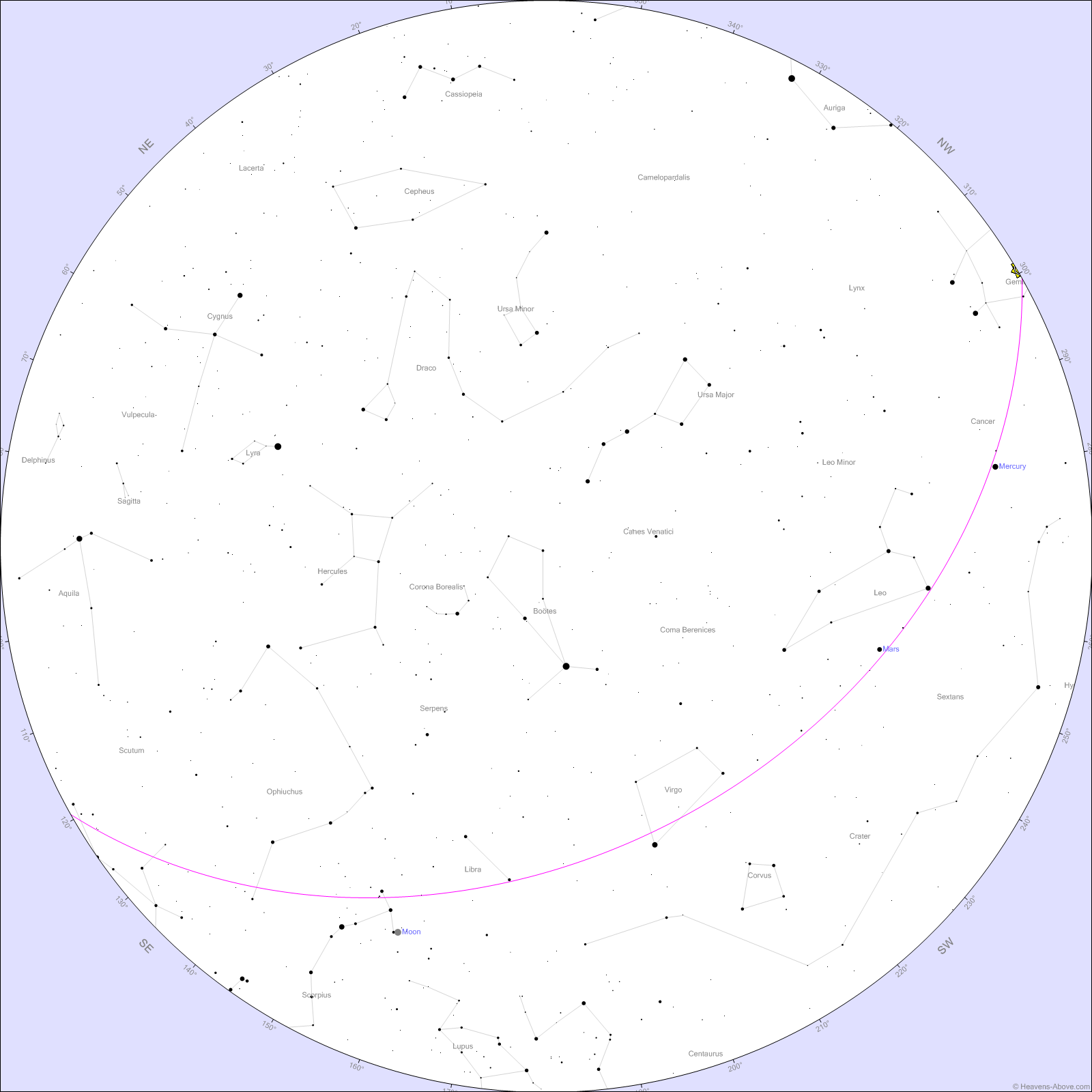
On to the planets. Mercury is hanging out low in the west-northwest just after sunset around magnitude .3, best seen early this week if you have a clear view of the horizon. Mars is hanging out in the west, still reddish, but fading into the twilight.
Saturn and Neptune are up in Pisces, rising late and sticking around into the night. Over in the predawn sky, Venus is bright and unmistakable in the east. Later in the week, it’s joined by faint Uranus, hiding in Taurus. As always, you’ll need a scope or good binoculars to spot Uranus and Neptune.
While it’s still early, meteor season is just around the corner. The Alpha Capricornids begin trickling in this week: Slow-moving fireballs, best later in July. And if you’re a Perseid fan, we’re only about a week away from the start of that shower’s long lead-up.
[TRANSITION FX]
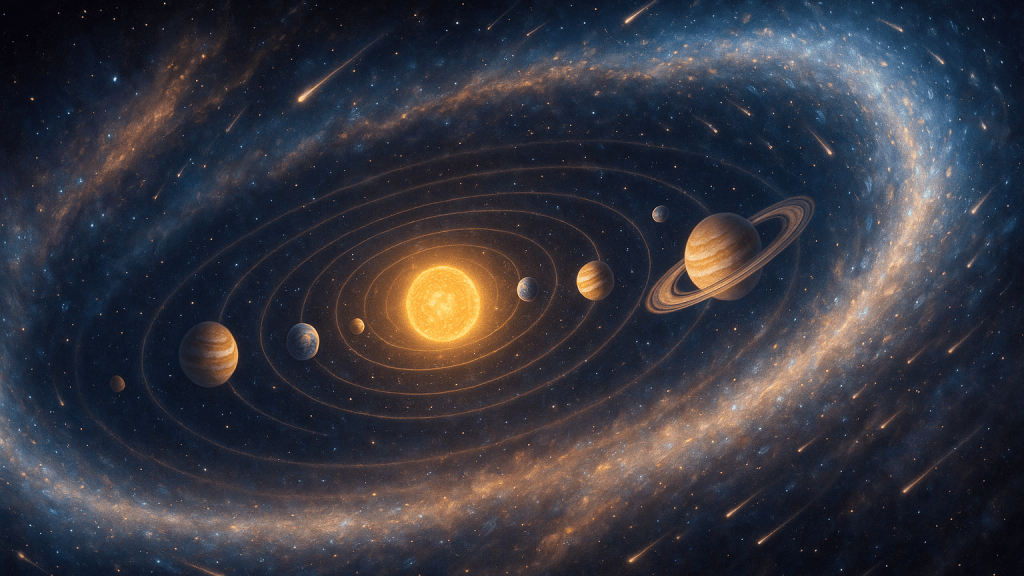
Have you ever considered how far our solar system extends from the Sun? In this episode we’re taking a little detour beyond the outer planets into the frozen frontiers of our solar system. We’ll explore two of the most mysterious regions we’ve never actually seen with our own eyes: the Kuiper Belt and the Oort Cloud.
These are the deep-freeze zones of the cosmos, full of ancient icy leftovers, silent travelers, and even the occasional super-sized comet. Let’s start with the one closer to us.
The Kuiper Belt, named after Dutch-American astronomer Gerard Kuiper, is a ring of icy bodies orbiting the Sun beyond Neptune, starting around 30 astronomical units out. At that distance, sunlight is a pale glow, and the temperature is hundreds of degrees below zero.
The Kuiper Belt is the solar system’s icy junkyard. It’s full of leftover material from when the planets formed, about 4.6 billion years ago. We’re talking rocks, frozen gases, chunks of water ice, and other elements that never made it into planets.
It’s also home to some famous objects:
Pluto, of course, demoted from planet status in 2006, is proudly orbiting in the Kuiper Belt.
Eris is slightly smaller than Pluto but helped force that whole redefinition of what a “planet” is.
Then there’s Haumea, shaped like a football and spinning so fast it completes a rotation every four hours. And Makemake, another dwarf planet named after a Polynesian creator god.
These icy worlds are known as Kuiper Belt Objects, or KBO. Many of them have moons. Some have strange orbits. And there are probably hundreds of thousands more we haven’t even seen yet, some as small as city blocks, others hundreds of miles wide.
NASA’s New Horizons mission flew past Pluto in 2015, revealing its icy mountains, nitrogen glaciers, and unexpected complexity. And then it kept going, sending back images of another KBO: Arrokoth, a reddish, snowman-shaped object about 21 miles long. That flyby in 2019 gave us our very first close-up of a true Kuiper Belt object.
Let’s take a quick detour about comets — snowballs in space with glowing tails.
Short-period comets swing by the Sun every few decades and often come from the Kuiper Belt. Think of Comet Halley, or Comet Tempel-Tuttle. These objects orbit in more or less the same plane as the planets, and their orbits are usually predictable.
But then there are the weird ones — the comets with giant, lopsided orbits that take millions of years to return. That brings us to our next destination.
Far beyond the Kuiper Belt—somewhere between 2,000 and 100,000 astronomical units from the Sun, is a theoretical shell of icy bodies called the Oort Cloud.
Unlike the flat, disc-shaped Kuiper Belt, the Oort Cloud is spherical. Imagine a vast snow globe surrounding our entire solar system. And inside that globe are potentially trillions of icy fragments – comets, planetesimals, ancient debris – left over from the very formation of the Sun.
We’ve never directly seen the Oort Cloud. It’s just too far. But we know it’s there because of those long-period comets that suddenly appear from deep space on incredibly eccentric orbits. Comets like:
Comet Hale-Bopp, which passed by in 1997 and won’t return for another 2,500 years.
Comet C/2012 S1, which was hyped in 2013 but broke apart near the Sun.
And more recently the mega comet that we mentioned last week.
In 2021, astronomers Pedro Bernardinelli and Gary Bernstein spotted something strange in data from the Dark Energy Survey—a fuzzy, slow-moving object as wide as 85 miles across. That’s bigger than some small moons!
Named Comet Bernardinelli–Bernstein, it’s considered the largest comet nucleus ever discovered. It’s not coming anywhere near Earth. At its closest approach in 2031, it’ll still be out past Saturn.
Even though we won’t see it with the naked eye, this comet is giving scientists a rare opportunity to study a pristine, early solar system object, probably untouched since the Sun was born. That’s like getting a piece of solar system history frozen in deep space for billions of years.
These frozen regions are like the archives of the solar system. The Kuiper Belt and the Oort Cloud preserve the raw materials from the early days of planet-building—before Earth had oceans or life, even before Jupiter finished forming.
Some scientists believe that comets from these outer zones delivered water and organic molecules to the early Earth. Others are looking into whether Oort Cloud comets could help explain the odd tilt of Uranus or even the idea of a hypothetical Planet Nine lurking in the darkness.
And that’s our journey to the far edge of the Sun’s influence. From Pluto’s neighborhood to the Oort Cloud’s distant reaches, the outer solar system is more than just empty space, it’s a museum of frozen time.
[MUSIC]
If the stars spoke to you this week, or if a question’s been on your mind, I’d love to hear it. Visit our website, startrails.show, where you can contact me and explore past episodes. Be sure to follow us on Bluesky, and YouTube — links are in the show notes. Until we meet again beneath the stars… Clear skies everyone!
[MUSIC FADES OUT]
Support the Show
Connect with us on Bluesky @startrails.bsky.social
If you’re enjoying the show, consider sharing it with a friend! Want to help? Buy us a coffee!
Podcasting is better with RSS.com! If you’re planning to start your own podcast, use our RSS.com affiliate link for a discount, and to help support Star Trails.
 Star Trails: A Weekly Astronomy Podcast
Leave a comment