A Star in Someone Else’s Sky – Star Trails: A Weekly Astronomy Podcast
Episode 73
This week we take a look at the night sky from July 13th to the 19th, highlighting a waning Moon, brilliant morning planets, and the first whispers of the Perseid meteor shower.
We’ll check in on Venus dancing near the Pleiades, Saturn’s steady climb toward opposition, and Jupiter’s quiet return to the predawn sky. You’ll also hear what deep-sky targets are best viewed under the darkening moonlight—like the Dumbbell Nebula, Ring Nebula, and the Milky Way’s glowing heart through Sagittarius.
Later, we flip the telescope around and ask: What does Earth look like from other worlds? From Venus’s twilight view of our blue planet to Mars’s telescopic gaze, to Saturn’s distant snapshot in “The Day the Earth Smiled”, and the iconic “Pale Blue Dot” image, we reflect on how our planet appears in someone else’s sky—and what that perspective tells us about ourselves.
Transcript
[MUSIC]
Howdy stargazers and welcome to this episode of Star Trails. Drew here, and I’ll be your guide to the night sky for the week starting July 13th through the 19th.
This week we welcome darker skies, the return of Jupiter and the first traces of the Perseid Meteor Shower. Later in the show, we turn the telescope around and examine how the Earth looks from different areas of our solar system.
Whether you’re tuning in from the backyard, the balcony, or just your imagination, I’m glad you’re here. So, find a cozy spot, let your eyes adjust, and let’s see what the sky holds for us this week.
[MUSIC FADES OUT]
Let’s start with the Moon. We’re coming off the Full Buck Moon, which reached its peak on July 10th. Hopefully some of you managed to catch this big moon, as it stayed fairly low to the horizon. Sadly, we had thunderstorms here, so it wasn’t visible.
The Moon will spend the early part of this week in its waning gibbous phase, gradually shrinking in brightness each night.
By Thursday it reaches the Last Quarter phase, with about half the Moon illuminated. Through a scope or binoculars, you’ll see shadows stretching across the surface, highlighting craters and mountain ranges near the terminator line.
By the end of the week the Moon will be entering a waning crescent phase. That means darker skies for tracking down faint galaxies, star clusters, and nebulae.
Now on to the talk planets!
In the evening sky, you’ll still be able to spot Mars, glowing with its characteristic reddish hue. It’s faint this time of year, but still visible just after sunset, low in the western sky.
Mercury is also hanging around after sunset, especially early in the week. But it’s hugging the horizon, so you’ll need a clear, flat view and some luck with twilight timing.
The best planetary viewing is for early risers.
Venus remains dazzling in the morning sky. This week it’s shining bright as ever, almost like a headlight, and gliding near the famous Hyades and Pleiades star clusters in the constellation Taurus. This alignment creates a beautiful cosmic scene through binoculars or a small telescope.
Saturn rises in the late evening and climbs higher into the southern sky before dawn. It’s slowly moving closer to opposition later this summer, so the ringed planet is looking especially good. Look for its golden glow near the constellation Aquarius.
Uranus is up too, hovering close to the Pleiades in Taurus, not far from Venus. Neptune is nearby, a little east of Saturn. The two gas giants are less than a degree apart this week—roughly the width of the full Moon! But as always, you’ll need a good scope or binoculars to see them.
And finally, Jupiter is slowly creeping back into the morning sky. It’s faint right now, but you may catch it just above the eastern horizon before sunrise by the weekend.
Our constellations and deep sky treasures are much the same as previous weeks.
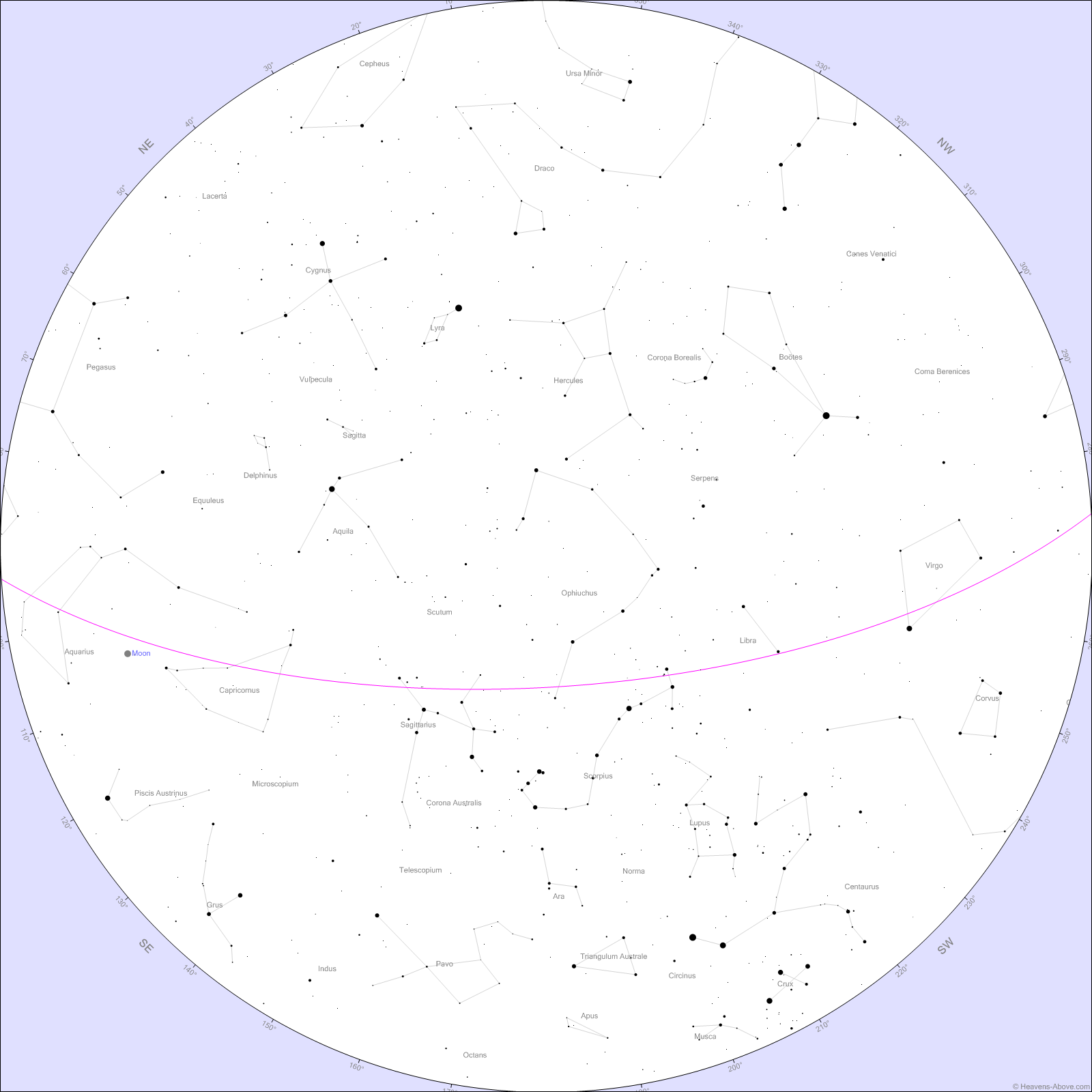
Overhead, the Summer Triangle, made up of the bright stars Vega, Deneb, and Altair, is dominating the sky after dark.
In Lyra, try spotting the famous Ring Nebula, also known as M57. You’ll need a telescope to see its donut-like shape, but it’s well worth the effort.
Over in Cygnus, the Swan, check out the Dumbbell Nebula, or M27. This is a planetary nebula visible even through binoculars under dark skies. And if you’ve got a scope and a good OIII filter, swing over to the Veil Nebula, a supernova remnant that stretches like wisps of smoke across the sky.
Draco coils high in the north, and if you have a telescope, see if you can spot the tiny but fascinating Cat’s Eye Nebula.
Looking lower toward the southern horizon, Scorpius and Sagittarius are rich with targets. Scorpius hosts the bright red supergiant Antares, and Sagittarius, the “teapot,” is packed with nebulae and star clouds along the heart of the Milky Way.
In that area, check out the Lagoon Nebula, M8, the Wild Duck Cluster, M11, and the Butterfly Cluster. The Milky Way’s core is glowing this time of year, so take your time scanning through this star-rich region.
And here’s a heads-up. The Perseid meteor shower begins this week. While it won’t peak until mid-August, the first few meteors may begin to streak across the sky by July 17th.
With the Moon waning and rising later each night, early morning hours this week offer a growing window of dark skies. If you’re out between midnight and dawn, you just might catch an early Perseid or two!
And if you’re observing Saturn this week, keep an eye out for Titan, its largest moon. A Titan shadow transit is predicted for the early hours of July 18. This transit is visible in backyard telescopes. I’ll include a link in the show notes with additional information on this phenomenon, upcoming transits, and how to catch them.
[TRANSITION FX]
Each week we peer out into the cosmos — describing the planets and constellations that grace our sky. We chart the orbits of worlds, track their brightness, and note how their appearances change with the seasons. We talk about how bright Venus is, and the red glow of Mars. We’re always describing what these distant places look like from here on Earth.
But what if we flipped that around? What if, instead, we asked: What does Earth look like from other planets? How do we appear in someone else’s sky?
Let’s take a little journey — not outward, but inward — and look at ourselves through distant eyes.
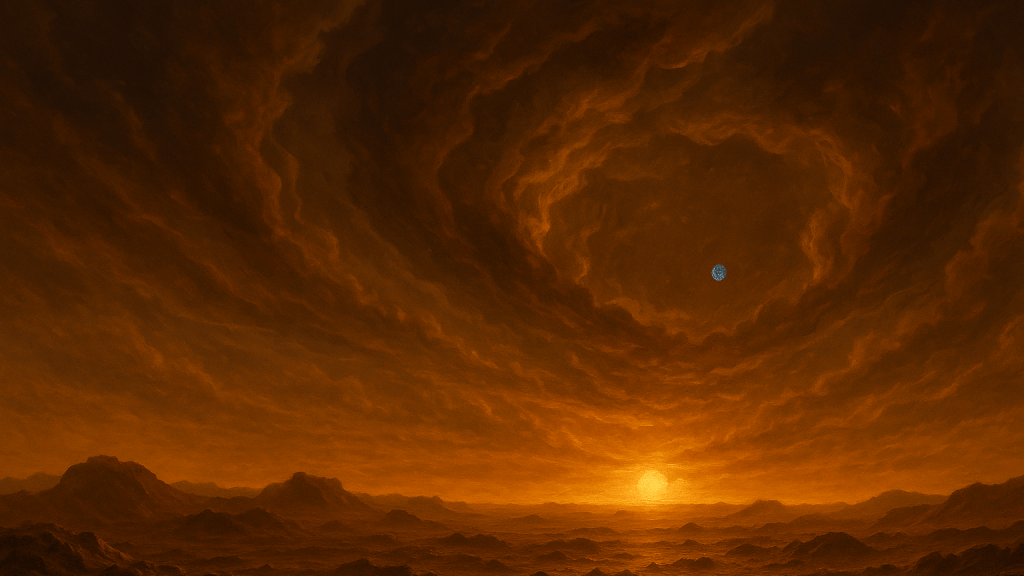
To begin, we head over to our nearest neighbor, Venus. If you could stand on the surface of Venus, and somehow peer through the thick sulfuric clouds, you’d see Earth as a brilliant bluish star, never far from the Sun.
Just as Venus plays the role of morning star or evening star for us, we play that same role for them. Always close to the Sun, always confined to the twilight sky.
At its brightest, Earth would gleam at magnitude –4.1, nearly as bright as Venus looks from Earth. With a nice telescope on Venus, you’d see the Moon as a dot alongside Earth.
From Venus, Earth would show slight phases — waxing and waning, shifting from gibbous to full and back again. You’d never see Earth as a crescent from Venus — it’s too far out for that — but the phase would be clear.
Now, from Earth, we never see the outer planets in phases. So why would we see Earth in phases from Venus? It has to do with the Earth-Venus-Sun angle, which can become quite significant depending on where the planets are in their respective orbits.
At greatest elongation (when Earth is at the maximum angle away from the Sun in the Venusian sky), Earth appears not directly opposite the Sun but offset — so only part of its day side is visible, rendering Earth as a bright gibbous disc. When it’s directly behind the Sun at superior conjunction, Earth is fully illuminated, and looks full from Venus.
And Earth has been seen from even closer to the Sun.
In 2005, NASA’s MESSENGER probe, en route to Mercury, turned its camera outward and photographed Earth from 66 million miles away.
We appeared as a bright star, outshining everything else in the field.
Now, let’s journey out to Mars.
From the red planet, Earth appears smaller and dimmer. To Martian eyes, Earth would be a bright speck rarely far from the Sun. A telescopic view of Earth has been recorded from Mars, and it’s a stunning image.
In 2007, NASA’s Mars Reconnaissance Orbiter turned its camera back toward us and captured the Earth and the Moon, floating side by side in space, both in half phase. You can actually see detail — not just light, but texture, weather systems and the oceans. That’s from 127 million miles away.
Let’s go even farther out, to the orbit of Saturn.
In 2013, the Cassini spacecraft took a moment from its study of the ringed giant to look homeward. There, just below Saturn’s vast rings, was a tiny point of light. That point was us.
The photo was titled The Day the Earth Smiled. For the first time, people on Earth were invited to look up — and wave — while a camera out in the Saturnian system captured our image. From nearly a billion miles away, Earth was just a pixel. A flicker of sunlight reflecting off oceans, ice, clouds, and continents — all flattened into one shining speck.
And that image echoes another.
Back in 1990, the Voyager 1 spacecraft, just past Neptune, was instructed to turn around and take one final photo of its home planet.
What it captured became one of the most iconic images in human history.
We talked about that image back on Episode 51 earlier this year. Of course, this is the famous “pale blue dot,” image of Earth, less than a pixel in size, caught in a ray of sunlight.
It was Carl Sagan who gave the photo its name — and its voice.
“That’s here. That’s home. That’s us. On it, everyone you love, everyone you know, everyone you ever heard of, every human being who ever was, lived out their lives.”
That image wasn’t just a picture. It was a mirror, a chance to see ourselves not as giants, but as fragile, temporary, and rare.
From out there, we’re not the center of the universe. We’re not even especially noticeable. We’re just another point of light among billions — brighter than some, fainter than others.
It’s a useful shift in perspective. Looking back at Earth reminds us that astronomy isn’t only about the distant and the unfamiliar. Sometimes, it’s about remembering where we are in all of this — how we fit into the grand map of the solar system, and the quiet role we play in someone else’s sky.
[MUSIC]
If the stars spoke to you this week, or if a question’s been on your mind, I’d love to hear it. Visit our website, startrails.show, where you can contact me and explore past episodes. Be sure to follow us on Bluesky, and YouTube — links are in the show notes. Until we meet again beneath the stars… Clear skies everyone!
[MUSIC FADES OUT]
Support the Show
Connect with us on Bluesky @startrails.bsky.social
If you’re enjoying the show, consider sharing it with a friend! Want to help? Buy us a coffee!
Podcasting is better with RSS.com! If you’re planning to start your own podcast, use our RSS.com affiliate link for a discount, and to help support Star Trails.
 Star Trails: A Weekly Astronomy Podcast
Leave a comment