The Quiet Planet and the Loud Sky – Star Trails: A Weekly Astronomy Podcast
Episode 74
With the Moon going dark midweek, we take a look at some targets in deep-sky territory, plus some dazzling planetary pairings. Also, learn why now might be a good time to rise to the bold (and slightly bonkers) challenge of trying to spot Pluto! It’s not for the faint of aperture, but it’s a fun stretch goal for the ambitious skywatcher.
Then, in the second half of the episode, the night gets stranger. We’ll revisit the legendary Wow! Signal from 1977—a mysterious 72-second radio burst that never repeated. It’s the perfect launchpad into the latest real-life cosmic mysteries, including bizarre radio pulses, celestial Morse code, and signals that challenge everything we thought we knew about stars and space.
Transcript
[MUSIC]
Howdy stargazers and welcome to this episode of Star Trails. Drew here, and I’ll be your guide to the night sky for the week starting July 20th through the 26th.
This week we welcome one of the best windows all month for deep-sky observing, thanks to a moonless sky midweek. I’ll offer up an insane challenge to spot Pluto. That’s no joke! And later in the show, we examine mysterious signals from space that defy explanation.
Whether you’re tuning in from the backyard, the balcony, or just your imagination, I’m glad you’re here. So, find a cozy spot, let your eyes adjust, and let’s see what the sky holds for us this week.
[MUSIC FADES OUT]
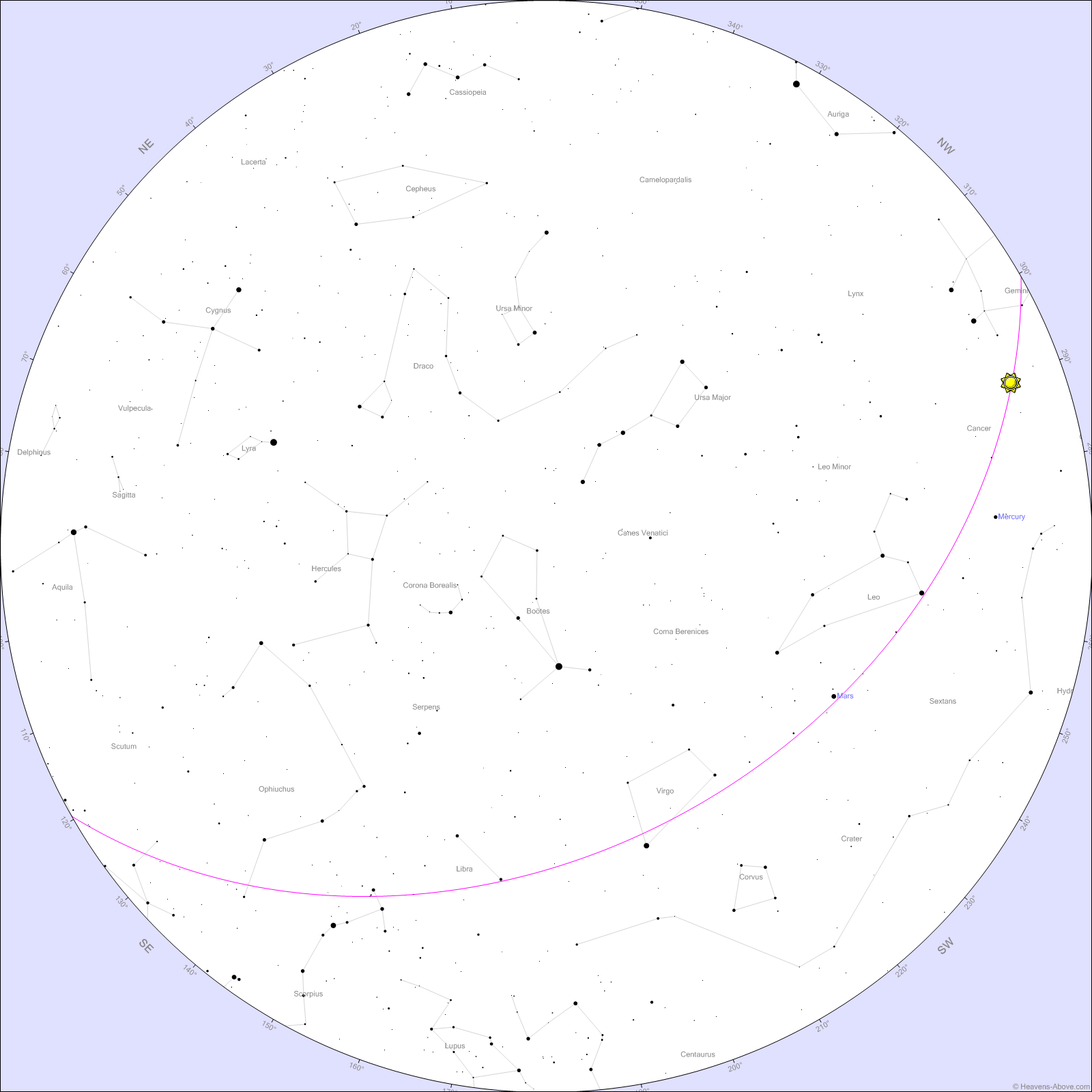
We start the week with a waning crescent Moon, just about 23% illuminated tonight. And it’s not just hanging around, it’s making moves.
Over the next couple of mornings, the crescent Moon continues eastward and pulls up alongside Venus and Jupiter in the pre-dawn sky. Mark your calendar for the mornings of Monday and Tuesday. The Moon will appear near Venus first, then Jupiter, low on the eastern horizon about an hour before sunrise. It’s an easy pairing to spot and makes for an amazing photo op if you can get some trees or skyline in the frame.
On Wednesday, we hit the New Moon, which means dark skies all night long for the second half of the week, and a perfect window for deep-sky observing.
By Saturday a thin waxing crescent will reappear in the evening sky near Regulus, the brightest star in Leo.
So in short: the Moon’s on tour this week. And it’s showing off.
Our planetary lineup this week is for the early risers and late night owls.
Venus is blazing away in the east just before dawn. It’s your easiest target, bright, unmistakable, and a great way to get others interested in skywatching.
Jupiter is right there with it, rising a bit higher and earlier each day. The two will be fairly close in the sky this week, with the Moon sliding past them on the 21st and 22nd.
Saturn rises later, around midnight, and is best viewed in the pre-dawn hours low in the south.
Mars is visible in the west after sunset. It’s not as bright as the morning show, but still worth a look as it moves from Leo into Virgo.
And if you’re really feeling adventurous, here’s a real challenge. Pluto reaches opposition on July 25th. That means it’s as close and bright as it gets, and naturally, you’re going to need a substantial telescope, a good star chart, and maybe a camera to even catch the dimmest glimpse of it.
Here’s how you can spot it. First, know that even though Pluto is at opposition, it’s at magnitude 14.3, which means it’s 10,000 times dimmer than the faintest thing your eye can see.
Obviously, you’ll need the darkest skies you can find, preferably Bortle 3 or less, and a telescope of 10 inches or larger to even detect Pluto as a dim dot. Use a 12 to 16-inch scope if you can.
Remember, Pluto doesn’t stand out visually. It looks like just another faint star. Tracking its motion over several nights is often how observers confirm they’ve found it, as it shifts slightly against the background stars. This is exactly how it was discovered back in 1930 by Clyde Tombaugh and his team.
Even in the highest powered scopes on the planet, Pluto appears as a faint, star-like point. It has no visible disk, and shows no details. You’re seeing an icy dwarf planet as a speck of light about 3 billion miles away.
Getting eyes on Pluto is beyond the means of most backyard astronomers and casual observers, but if you know an advanced astronomer or are a member of a club with great equipment, it would be an amazing feat to see it with your own eyes.
Going deeper, the middle to end of the week is a prime time to scan the summer Milky Way, especially the rich fields around Scorpius and Sagittarius, rising in the southeast after dark.
Try your hand at the Lagoon Nebula (M8) or the Trifid Nebula (M20) in Sagittarius. Both are binocular-visible under dark skies.
In Cygnus, near Deneb, the North America Nebula (NGC 7000) is a great target for wide-field scopes or long-exposure astrophotography.
And speaking of Deneb, that star forms one corner of the Summer Triangle, along with Vega and Altair. By 10 p.m., it’s high in the eastern sky and a great landmark for stargazing.
Closer to home, the Delta Aquariid meteor shower is active right now, ramping up toward its late July peak. You might catch a few stray meteors overnight, especially in the early morning hours under dark skies. Everyone’s favorite shower, the Perseids are coming soon, and will kick off in early August.
[TRANSITION FX]
We spend a lot of time looking up, watching for meteor showers, planets, or constellations drifting through the night. But sometimes we listen.
And sometimes, what we hear is stranger than anything we could’ve imagined.
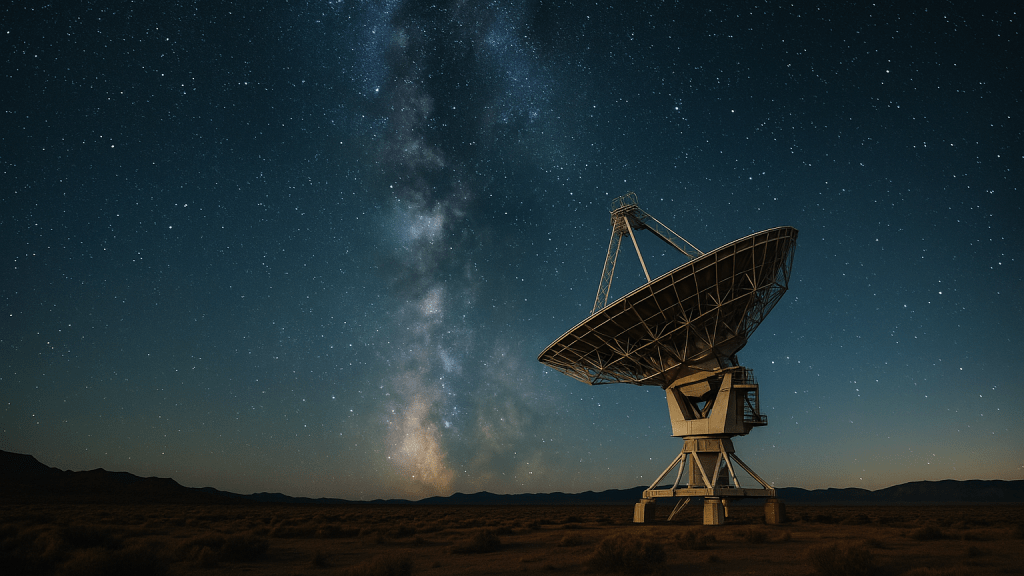
Let me take you back to an August night in 1977. Disco is still everywhere, Star Wars had just come out a few months before, and a team of astronomers at Ohio State University were scanning the skies with a radio telescope the size of a football field. It’s called The Big Ear, and on August 15th, it picked up something odd.
A signal. Not just static. Not a satellite. But a strong, narrowband radio burst that lasted 72 seconds. Exactly the duration the telescope could observe a fixed point in the sky as Earth rotated.
The printout, a long string of computer data, recorded the burst as 6EQUJ5. That’s just a code to describe signal strength, but it stood out from all the surrounding background noise. One of the astronomers, Jerry Ehman, was so stunned he grabbed a red pen and circled it, and in the margin, he wrote one word:
“Wow!”
And just like that, the most famous anomaly in radio astronomy was born.
The signal seemed to come from the direction of the constellation Sagittarius. It lined up suspiciously close to the “hydrogen line” — a frequency some researchers believe alien civilizations might choose to broadcast on, since hydrogen is the most common element in the universe.
Naturally, scientists scrambled to observe that region again. But the signal never came back. It was never confirmed, or explained.
For nearly 50 years, the Wow! Signal has stood as this eerie one-time whisper from the stars, a cosmic cold call that never called back.
But here’s the thing, lately, the universe has gotten a whole lot louder.
In just the last year, astronomers have been picking up brand new signals, many just as baffling, and some even stranger than the Wow! Signal itself.
One of the weirdest is called ASKAP J1832–0911. Yeah, the name doesn’t roll off the tongue, but the behavior is wild.
Discovered earlier this year by the Australian Square Kilometre Array Pathfinder – ASKAP for short — this object lies somewhere in the Milky Way. It pulses every 22 minutes. It blasts out powerful radio waves and X-rays. Then it vanishes again, hiding for nearly three-quarters of an hour.
It’s like clockwork. But we’ve never seen anything like it.
Astronomers think it might be a kind of magnetar, that’s a hypermagnetic neutron star, or maybe a white dwarf with a companion. But even those theories don’t quite line up. It’s as if this object is doing something it physically shouldn’t be able to do, leading the team studying to call it “unlike anything we have seen before.”
A decade ago, another discovery came out of the cosmos, like waves from a Lovecraftian ham radio station. This time, the culprit was a white dwarf star in a tight orbit with a red dwarf, just 1,600 light-years away, which is basically next door in cosmic terms.
Every 125 minutes, it sends out a little burst of radio waves, like a slow tap-tap-tap, almost like Morse code from space.
Turns out the two stars are locked in a chaotic magnetic handshake, and their flares produce this oddly timed signal. It’s the first time we’ve ever seen a white dwarf binary system behave this way and it expands the kinds of places we now know can generate cosmic radio noise.
And of course, no modern conversation about space signals is complete without talking about Fast Radio Bursts, or FRBs.
These are ultra-short, ultra-energetic bursts of radio waves from distant galaxies. Some last just a millisecond, but in that flash, they can release more energy than our Sun does in several days.
We’ve been detecting FRBs since 2007, and while many seem to be one-off events, some repeat. A few do so at regular intervals. And one, discovered earlier this year, FRB 20240114A, has been firing off bursts so frequently it’s become one of the most active repeaters ever recorded.
Even stranger: another FRB this year was traced to an ancient, “dead” elliptical galaxy. These kinds of galaxies don’t have young stars or much magnetic activity, so where’s the burst coming from? We really don’t know.
Which brings us back to that lonely radio burst in 1977.
After all these years, and after all the weirdness we’ve found since, there’s still never been another signal quite like it.
No second call. No follow-up ping. Just 72 seconds of radio silence broken by one remarkable blip. It may have been a cosmic prank by nature. A one-time flare from a strange stellar object, or something else.
We just don’t know. And really, that’s what makes astronomy so thrilling. What keeps all of us staring up is that every discovery deepens the mystery, and maybe the next “Wow!” is just waiting to be heard.
[MUSIC]
If the stars spoke to you this week, or if a question’s been on your mind, I’d love to hear it. Visit our website, startrails.show, where you can contact me and explore past episodes. Be sure to follow us on Bluesky, and YouTube — links are in the show notes. Until we meet again beneath the stars… Clear skies everyone!
[MUSIC FADES OUT]
Support the Show
Connect with us on Bluesky @startrails.bsky.social
If you’re enjoying the show, consider sharing it with a friend! Want to help? Buy us a coffee!
Podcasting is better with RSS.com! If you’re planning to start your own podcast, use our RSS.com affiliate link for a discount, and to help support Star Trails.
 Star Trails: A Weekly Astronomy Podcast
Leave a comment