Meteors, Mars, and a Betelgeuse Breakthrough – Star Trails: A Weekly Astronomy Podcast
Episode 75
This week we’re watching the skies—and catching up on a stellar mystery. Dual meteor showers light up the pre-dawn hours, Mars gets cozy with the Moon, and a recently discovered nova continues to shimmer faintly in the south.
Later in the show, we check out a brand new discovery that may have finally cracked a thousand-year-old puzzle. Betelgeuse, the red supergiant in Orion, has long puzzled astronomers with its strange long-term brightness variations.
Now, thanks to cutting-edge observations from the Gemini North telescope, we may finally know why. Spoiler: Betelgeuse isn’t alone.
Transcript
[MUSIC]
Howdy stargazers and welcome to this episode of Star Trails. Drew here, and I’ll be your guide to the night sky for the week starting July 27th through August 2nd.
This week dual meteor showers have the potential to light up the sky, Mars dances with the Moon, and a recent supernova may be visible, depending on where you live. And later in the show, another groundbreaking discovery has likely solved one of the long-standing mysteries of the constellation Orion.
Whether you’re tuning in from the backyard, the balcony, or just your imagination, I’m glad you’re here. So, find a cozy spot, let your eyes adjust, and let’s see what the sky holds for us this week.
[MUSIC FADES OUT]
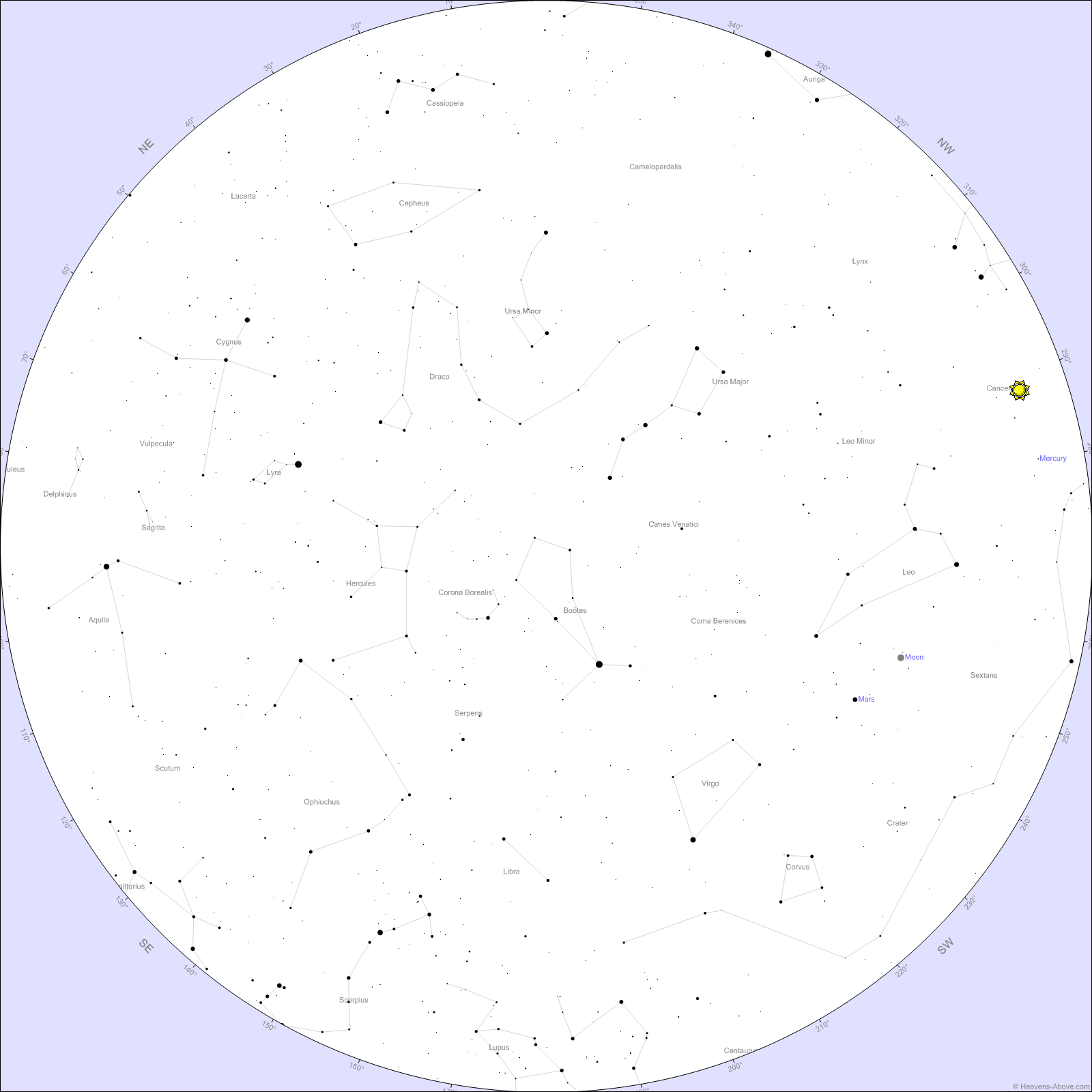
Tonight and tomorrow, a very thin waxing crescent Moon glides through the western evening sky. Tonight it appears just a few degrees from Mars, and by the 28th it has shifted slightly to lie southeast of the red planet. This makes for a simple but beautiful binocular and naked-eye pairing shortly after sunset. By the end of the week the Moon reaches its first quarter phase, rising at sunset and dominating the early evening sky, before continuing to wax toward full in early August.
Late July brings a celestial double feature: the Southern Delta Aquariids and Alpha Capricornids peak during the night of July 29th into the early hours of July 30th. Under pre-dawn darkness, these two showers can combine for as many as 25 meteors per hour, with the Capricornids often producing slower-moving fireballs. With a low Moon just after first quarter, the dimmer meteors should still be visible, especially if you face south under clear skies.
From your backyard around sunset, Mars, as we’ve already mentioned, glows in the western sky, sinking lower each night as it transitions from Leo into Virgo. Saturn climbs the eastern horizon later in the evening and becomes an inviting target after 10 p.m., rising higher through the night. In the pre‑dawn eastern sky, Venus and Jupiter make for a stunning duo, with Venus blazing brightly and Jupiter steadily climbing beside it. This pairing continues into early August, setting the stage for a dramatic conjunction around mid‑month.
Let’s talk about some constellations and deep sky objects.
As night falls, look east to spot Aquila the Eagle soaring higher, with its brilliant star Altair, forming one of the vertices of the famous Summer Triangle, along with stars Vega and Deneb. By about 11 p.m., that triangle is high overhead and unmistakable.
Low to the south, Scorpius and Sagittarius reveal a rich tapestry of Milky Way starfields, nebulae and clusters, especially early in the evening before they dip too low.
Using binoculars or a small telescope check out NGC 6709, a bright open cluster in Aquila, shining with dozens of stars scattered across the field.
You may also want to turn your optics toward NGC 5634, a compact globular cluster within Virgo, which presents a tight ball of faint stars just beyond what’s visible to the naked eye.
[TRANSITION FX]
Viewers in the southern hemisphere have been enjoying a very rare cosmic event: Nova V462 Lupi.
Discovered back in June, it rose from an invisible magnitude +22 star to become visible to the naked eye in less than a week. It peaked around magnitude +5.5 on June 20th, briefly shining as a new point of light in the constellation Lupus.
This explosion occurred in a binary system where a white dwarf siphoned gas from a companion star until reaching ignition. That thermonuclear blast suddenly super‑brightened the system without destroying the white dwarf itself.
Observers in the Southern Hemisphere had the best view, but lucky stargazers in southern parts of the U.S. including Texas, Florida, and California also reported seeing it low on the southern horizon.
By late July, the nova is still estimated around magnitude +5.9, so it’s fading slightly, but remains within reach using binoculars or small telescopes under dark skies if you have an unobstructed southern horizon.
If you’re located below roughly 40–45° North latitude, step outside between 10 and 11 p.m. local time, face the south, and look within a few degrees of Delta and Beta Lupi and Kappa Centauri to find the nova using star‑hopping techniques. As always, a stargazing app, such as Stellarium, will help you easily locate these stars.
Coming up, we’ll explore a new discovery that has likely unlocked one of the secrets of the constellation Orion. That’s after the break! Stay with us.
[Ad Break]
It’s no exaggeration to say this summer has been one for the books when it comes to space news. From the discovery of one of the most massive comets ever spotted, to distant spiral galaxies that challenge ideas of how galaxies form, we’ve been swimming in discoveries lately.
And they keep coming. Today, we set our sights on a red supergiant that’s been a fixture in our sky for centuries, and a mystery that’s endured for just as long.
We’re talking about Betelgeuse, the unmistakable crimson star marking the shoulder of Orion. If you’ve spent time under winter skies, you’ve definitely seen it. And if you’ve followed astronomy headlines over the past few years, you’ve maybe heard about its antics, from unexpected dimming events to speculation that it might be gearing up for a supernova.
But one mystery surrounding Betelgeuse has remained unsolved, until now.
Astronomers have long known that Betelgeuse pulses and varies in brightness. It swells and contracts on a regular cycle of about 400 days. That’s not unusual for a star in its late stages of life. But Betelgeuse also shows a second, far slower rhythm, brightening and dimming over the course of about six years. For decades, this longer cycle has baffled scientists.
This summer, researchers may have finally cracked the case.
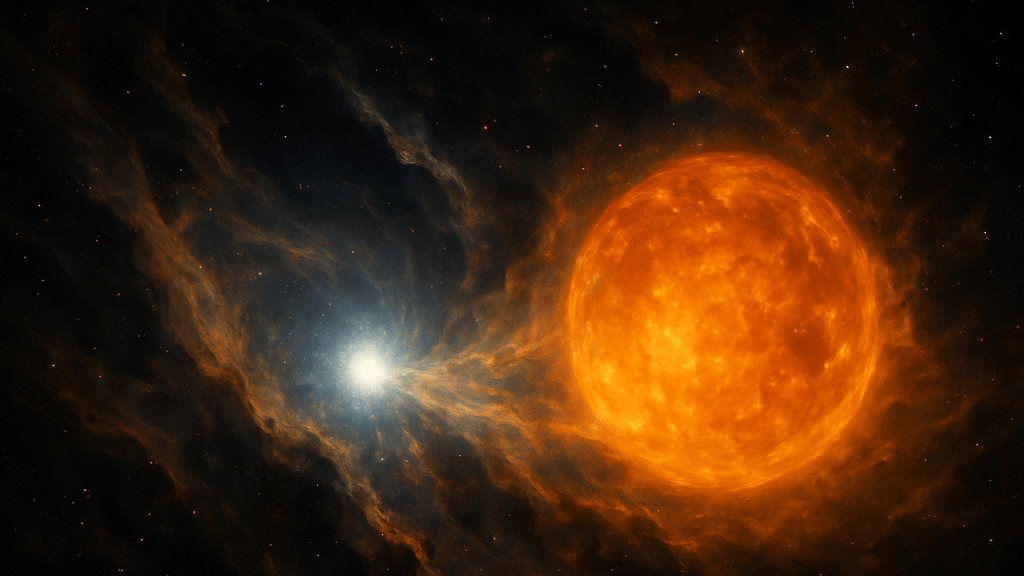
Using a cutting-edge high-resolution imager attached to the Gemini North telescope in Hawaii, astronomers caught sight of something hiding in plain sight: a small, faint companion star nestled right up against Betelgeuse’s glowing atmosphere. It’s being nicknamed “Betelbuddy,” and it might be the key to solving this 1,000-year-old puzzle.
Betelgeuse is so massive and bright that spotting a companion is incredibly difficult. It’s like trying to see a firefly next to a spotlight. But the Gemini North scope is designed for exactly this kind of work. Using rapid-fire exposures to cancel out atmospheric turbulence, it was able to tease out the faint signature of a blue-white star orbiting close to Betelgeuse.
This tiny companion is thought to be a young, hot star, about one and a half times the mass of our Sun. That makes it minuscule compared to Betelgeuse, which is hundreds of times the Sun’s diameter and so distended it’s practically spilling into space. But what this smaller star lacks in size, it makes up for in drama.
The discovery helps explain the strange six-year cycle. As the companion star orbits, it moves through Betelgeuse’s thick cloud of expelled dust and gas, essentially clearing a temporary path, like a snowplow carving a lane through a fog of cosmic debris. When this happens, more of Betelgeuse’s light reaches us here on Earth, making the star appear brighter for a time. Once the companion continues on its orbit and the dust drifts back in, Betelgeuse dims again. This orbital dance appears to happen every 2,100 days, just about six years, perfectly matching the observed long-period variation.
But there’s more. The two stars are shockingly close. The companion star lies just about four astronomical units away from Betelgeuse, or roughly the distance from the Sun to Jupiter. That’s a very tight orbit for a red supergiant and a recipe for cosmic intimacy. Tidal forces are already at play, and simulations suggest Betelgeuse may one day engulf its companion entirely. If that happens, we could witness a kind of stellar cannibalism — the slow spiraling merger of two stars. Maybe within the next 10,000 years, Betelbuddy could become one with the beast.
Interestingly, this is the first time astronomers have directly imaged a close companion orbiting a red supergiant, which is something that was only theoretical until now. It shows that some of the long-term brightness variations we see in giant stars may not be caused by internal pulsations alone, but by the gravitational influence of a companion stirring up their outer layers.
Betelgeuse, which once seemed like a lone giant nearing the end of its life, is now revealed to be part of a binary system. And that changes the way we think about its future and its past.
In 2027, the companion star will swing around to the far side of its orbit, reaching its maximum separation from Betelgeuse. That will be the next big opportunity for astronomers to observe and study it again, possibly with even greater detail.
So the next time you spot that glowing red dot in Orion, remember: Betelgeuse has company. And it’s not just putting on a solo act. It’s dancing with a partner, one we’ve only just discovered, after centuries of watching and wondering.
[MUSIC]
If the stars spoke to you this week, or if a question’s been on your mind, I’d love to hear it. Visit our website, startrails.show, where you can contact me and explore past episodes. Be sure to follow us on Bluesky, and YouTube — links are in the show notes. Until we meet again beneath the stars… Clear skies everyone!
[MUSIC FADES OUT]
Support the Show
Connect with us on Bluesky @startrails.bsky.social
If you’re enjoying the show, consider sharing it with a friend! Want to help? Buy us a coffee!
Podcasting is better with RSS.com! If you’re planning to start your own podcast, use our RSS.com affiliate link for a discount, and to help support Star Trails.
 Star Trails: A Weekly Astronomy Podcast
Leave a comment