The Sturgeon Moon and the Fossil in the Dark – Star Trails: A Weekly Astronomy Podcast
Episode 76
This week we bask in the glow of the bright Sturgeon Moon, trace the shifting positions of planets from twilight to dawn, and watch as a few late-season meteors streak across the sky.
Later in the show, we journey beyond Neptune to meet a newly discovered distant object named Ammonite—a cosmic fossil whose strange orbit may upend one of the most compelling mysteries in astronomy: the existence of Planet Nine.
We’ll explore how this icy world fits into a tiny family of ultra-distant objects known as sednoids, and why its misaligned path challenges the idea of a hidden giant planet at the edge of our solar system.
Transcript
[MUSIC]
Howdy stargazers and welcome to this episode of Star Trails. Drew here, and I’ll be your guide to the night sky for the week starting August 3rd to the 9th.
This week brings us a bright summer Moon, planets in both the evening and morning skies, and a few lingering meteors. Later in the episode, we’ll head to the frozen frontier of the solar system to meet a brand‑new world nicknamed Ammonite, and explore what it means for the ongoing mystery of Planet Nine.
So, let’s step outside and see what’s happening overhead.
[MUSIC FADES OUT]
Our first stop is always the Moon.
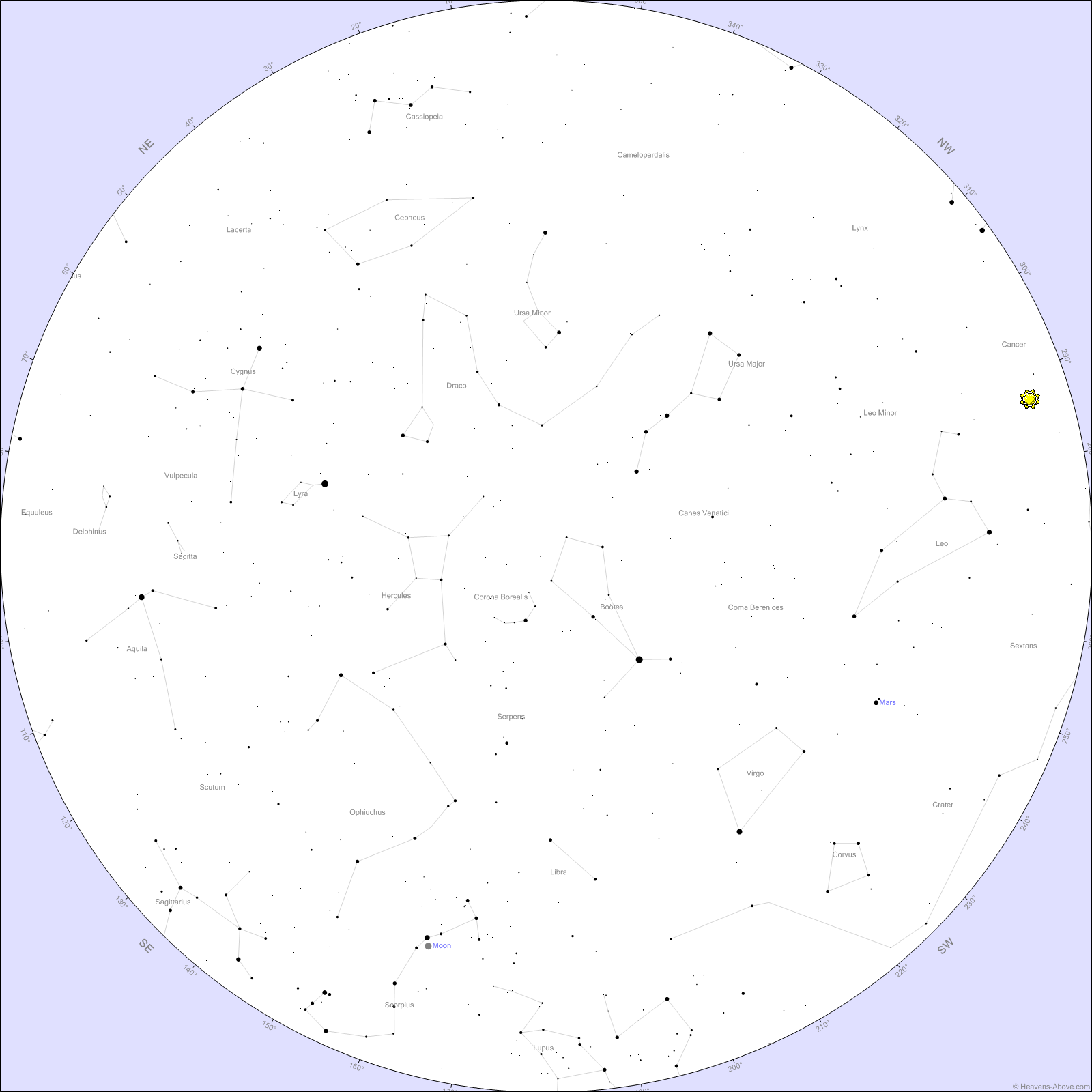
Tonight, it’s a waxing gibbous, about 69% illuminated. If you head out shortly after sunset, you’ll find it sliding just beneath Antares, the bright red heart of Scorpius, making a perfect binocular target.
Each night, the Moon grows fatter and brighter. By Saturday, August 9th, we reach the Full Sturgeon Moon. It rises already brilliant in the early evening.
The Sturgeon Moon is the traditional name for the full Moon in August, and it comes from Native American and colonial folklore, particularly from the Great Lakes and northeastern North America.
According to Algonquin and other Indigenous tribes in the northeastern U.S. and parts of Canada, August was the time of year when sturgeon were most readily caught in the Great Lakes and other large bodies of water. These massive, ancient fish, some of which can grow more than 6 feet long, would surface in greater numbers during this time, making them easier to harvest.
As a result, tribes that relied on fishing for sustenance saw August as a season of abundance, and they marked the full Moon of this time with a name reflecting the height of the sturgeon fishing season.
Binocular and telescope users will want to get in their observations early in the week, especially if you want to see craters and mountain ranges along the lunar terminator.
This week’s planets are split between evening and dawn. Mars is fading into the western twilight, a small orange ember low on the horizon.
Saturn rises in the east-southeast after sunset and remains visible all night. Through a telescope, its rings are stunning, and Neptune lurks nearby, a faint bluish dot best seen with optics. Just shift slightly up 1° to 2° from Saturn to locate Neptune.
In the pre‑dawn sky, the real show begins. Venus dominates as the morning star, blazing over the eastern horizon. Jupiter shines nearby, and the two planets inch closer each morning, heading toward a tight conjunction on August 12th.
Uranus is faint but trackable just below the Pleiades star cluster. This is a good binocular challenge for dedicated early risers.
The Southern Delta Aquariid and Alpha Capricornid meteor showers are tapering off this week. You might catch a handful of lingering streaks early in the week, with the Alpha Capricornids occasionally producing a bright fireball.
The Perseids are already active and will peak next week, around August 12th or 13th, but a bright Moon will wash out many fainter meteors. Even so, pre‑dawn observers under dark skies can still spot some early Perseids tracing long paths through the sky.
Looking deeper into the cosmos, check out a few open clusters in Auriga, like M36, M37, and M38. They’re visible overhead in the early evening; Auriga is high after dark and rich with bright stars like Capella.
Scorpius crouches low in the southwest, with Antares glowing red. Early in the week, watch the Moon drift past it.
In very dark areas, look along the Milky Way, from Cygnus through Sagittarius. This region is rich with star clouds, dark nebulae, and the Sagittarius “Teapot” asterism pointing to the galactic center.
Aim a small telescope or binoculars along this Milky Way stretch, where open clusters like M7 in Scorpius and M11 in Scutum sparkle amid the star fields.
Coming up, a distant relic of the solar system is proving to be a bit of a troublemaker, shaking up theories that point to the existence of the fabled Planet Nine. That’s after the break! Stay with us.
[Ad Break]
This week, we’re venturing far beyond Neptune, into the quiet, frozen frontier of the solar system, where astronomers have discovered a mysterious new world.
Its official name is 2023 KQ14, but scientists call it Ammonite, after the coiled fossil. And its orbit is challenging one of the most tantalizing ideas in planetary science: the search for Planet Nine.
Ammonite was discovered in March 2023, by astronomers using Japan’s Subaru Telescope on Mauna Kea. Recently detailed in a Nature Astronomy paper published just last month, Ammonite’s orbit is a highly elongated, tilted trajectory, stretching from 66 AU at closest to more than 250 AU at farthest. That’s hundreds of times farther from the Sun than Earth.
Ammonite is estimated to be around 220–380 km across, making it comparable in size to other mid‑sized trans‑Neptunian objects—not Pluto‑class, but substantial enough to merit the “dwarf planet” tag. Importantly, its orbit has remained stable for roughly 4.5 billion years, marking it as a cosmic fossil of the early solar system.
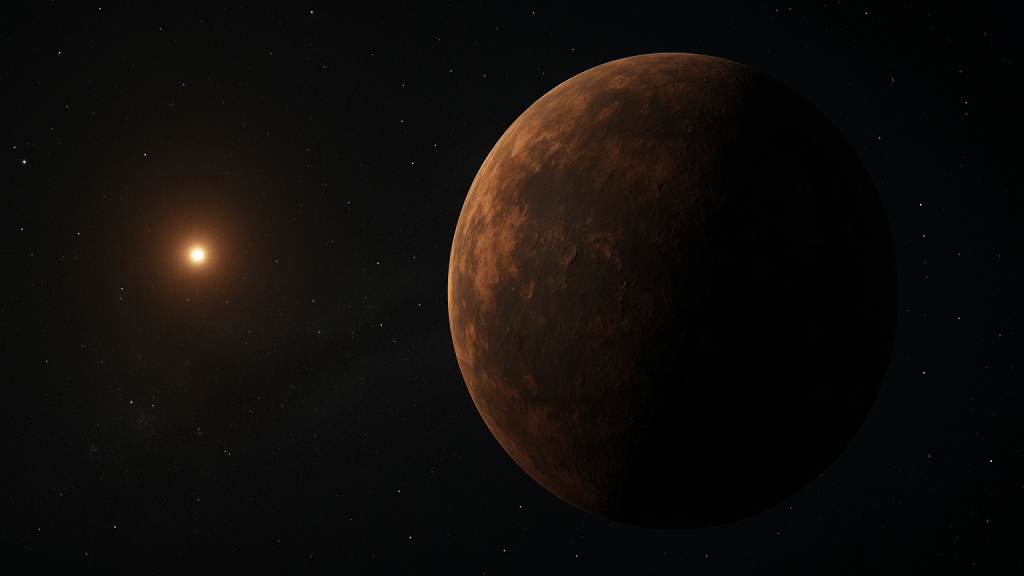
What might it look like? Picture a dark, reddish‑brown icy world, like a charcoal‑toned snowball. Its surface is probably a mix of frozen water and rock, cratered and rugged after billions of years in deep freeze.
In sunlight, a few patches of bright frost might glimmer on the horizon. No telescope on Earth can show us details yet—it’s far too small and faint—but its orbit tells the story.
Ammonite is part of an elite family of worlds called sednoids.
Only three others are known: Sedna, Leleakuhonua, and one other smaller object called 2012 VP.
All of them live beyond Neptune’s influence, like fossils of the early solar system, untouched for billions of years.
These objects suggest the presence of the elusive Planet Nine — a hypothetical object of maybe 5–10 Earth masses, orbiting hundreds of AU from the Sun. Its gravity could shepherd small icy bodies into similar orbits, creating a cluster pointing in the same direction.
Here’s the twist: Ammonite doesn’t line up with the cluster.
Its orbit points almost the opposite way, which weakens the main piece of evidence for the existence of Planet Nine.
Does that mean Planet Nine isn’t real? Maybe. Or maybe it’s farther out, or on a different orbit than we imagined.
The good news is, we’re entering a golden age for discoveries like this. In the next couple of years, the Vera C. Rubin Observatory will begin the Legacy Survey of Space and Time, creating a decade‑long movie of the night sky. It’s expected to reveal hundreds of new distant objects, giving us the numbers we need to confirm or refute Planet Nine once and for all.
No doubt, there are many more tiny frozen worlds like Ammonite silently orbiting at the edge of our solar system. They are fossils of our solar system’s youth, and each one whispers a story that might lead us to the next great discovery.
[MUSIC]
If the stars spoke to you this week, or if a question’s been on your mind, I’d love to hear it. Visit our website, startrails.show, where you can contact me and explore past episodes. Be sure to follow us on Bluesky, and YouTube — links are in the show notes. Until we meet again beneath the stars… Clear skies everyone!
[MUSIC FADES OUT]
Support the Show
Connect with us on Bluesky @startrails.bsky.social
If you’re enjoying the show, consider sharing it with a friend! Want to help? Buy us a coffee!
Podcasting is better with RSS.com! If you’re planning to start your own podcast, use our RSS.com affiliate link for a discount, and to help support Star Trails.
 Star Trails: A Weekly Astronomy Podcast
Leave a comment