Perseids, Planets, and the Smell of Space – Star Trails: A Weekly Astronomy Podcast
Episode 77
This week we’re chasing Perseids and planetary pairings while the Moon slowly makes room for darker skies. We’ll explore which constellations are hiding in plain sight, from the narrow spear of Sagitta to the twisting coils of Draco, and we’ll take a tour of some underappreciated deep sky objects along the way.
You’ll learn when and where to spot the Venus-Jupiter conjunction, how Mercury is making its return, and why August’s meteor showers come with both brilliance and baggage this year. We’ll even travel back to 1972 to revisit one of the most spectacular meteor events ever witnessed in daylight: the Great Daylight Fireball.
Then we ask a strange but very real question: what does space smell like? Astronauts have reported scents of welding fumes, gunpowder, even barbecued steak. We’ll explore the chemistry, the molecules responsible, and the surprising connection between nebulae and that curious post-EVA aroma.
Transcript
[MUSIC]
Howdy stargazers and welcome to this episode of Star Trails. Drew here, and I’ll be your guide to the night sky for the week starting August 10th to the 16th.
This week the Perseids peak, Mercury returns, Jupiter and Venus cozy up, and in the second half of our show, we turn our noses to the sky, and learn what space smells like.
Whether you’re tuning in from the backyard, the balcony, or just your imagination, I’m glad you’re here. So, find a cozy spot, let your eyes adjust, and let’s see what the sky holds for us this week.
[MUSIC FADES OUT]
We’re coming off the bright and bold Sturgeon Moon, which peaked just before this week began. That means we start with a waning gibbous, and as each night passes, the moon shrinks and rises later, giving us a little more breathing room for darker skies.
By week’s end, we’ll reach Last Quarter, the half-moon phase that rises around midnight and lingers through the early morning. So while the moon’s brightness will wash out the fainter stars and objects for a few nights, conditions improve dramatically midweek for stargazing and meteor hunting.
Speaking of meteor showers, this is the one. The Perseids are peaking this week, officially on August 12th and 13th. Normally this would be a real showstopper, with upwards of 100 meteors per hour under ideal conditions.
But… we’ve got a problem.
The bright, waning gibbous moon is going to be hanging out near the radiant point, Perseus, and flooding the sky with light. That doesn’t mean you won’t see anything, but it will cut the number of visible meteors way down. Expect perhaps a dozen or so per hour, and mostly the brightest ones.
Your best bet? Get out during the pre-dawn hours of the 13th, find a spot with a clear view of the sky, and try to block the moon with a building or a tree.
And here’s a wild card: the Kappa Cygnids. They’re a minor shower that also peaks around August 16th, and while they only deliver a few meteors per hour, they’re known for occasional fireballs. If you’re out late anyway, it’s worth keeping an eye out. Their origins are still a bit mysterious — just the way we like it.
Now let’s talk planets, because this week brings one of the prettiest planetary pairings of the year.
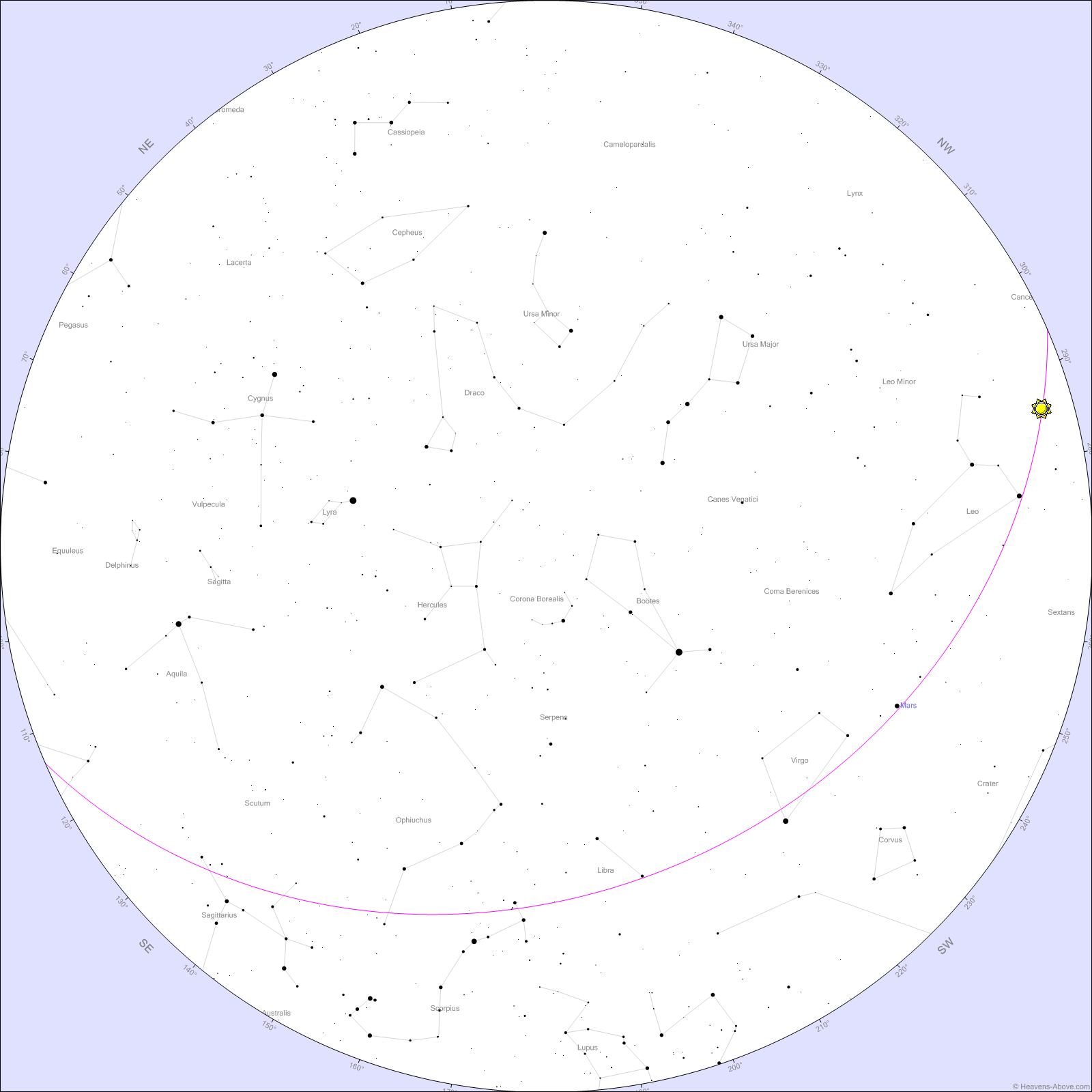
In the pre-dawn eastern sky, look low near the horizon around August 11th and 12th and you’ll spot Venus and Jupiter just a single degree apart. That’s close enough to cover with your fingertip at arm’s length. Venus is the brighter of the two, but both will be striking especially if you’re up early.
And there’s more: Mercury ends its retrograde on August 11th, and while it’s still tricky to see, it’s starting to climb back into the dawn.
Meanwhile, Saturn rises in the southeast just after midnight and is beautifully placed for telescope viewing by the wee hours.
Neptune is hanging around nearby too, but at magnitude 7.8, you’ll need binoculars or a scope. Still, it’s fun to know you’re staring at a planet nearly 3 billion miles away.
It’s August, so you’ll still see the Summer Triangle this week: Vega, Deneb, and Altair holding court high overhead. But let’s talk about some underdogs.
First up: Sagitta, the Arrow. This one’s tiny, just four stars forming a narrow spear below Vulpecula, but it punches above its weight in charm. Its brightest star, Gamma Sagittae, is an orange giant that’s quietly burning out in the background of the Milky Way.
Another one worth your time is Draco, the Dragon. It winds its way around the Little Dipper and never really sets for those of us in the Northern Hemisphere. Hidden within its coils is the Cat’s Eye Nebula, one of the most complex planetary nebulae we know of. If you’ve got a scope and good skies, go check it out.
We’ve talked about the Ring Nebula before, but what about its louder cousin? Check out the Dumbbell Nebula, also known as Messier 27, hanging out in Vulpecula. It’s a planetary nebula about 1,200 light-years away, formed when a dying star blew off its outer layers. You’ll find it nestled within the Summer Triangle, and it’s bright enough to spot with binoculars under dark skies.
If you want a challenge, go after the Cocoon Nebula in Cygnus. It’s a beautiful combination of reflection and emission nebula with a dark tail of dust, called Barnard 168, that makes it look like a tiny comet with its hair on fire.
And if you have a telescope and a dark southern horizon, you might just catch a glimpse of the Helix Nebula in Aquarius. Sometimes called the Eye of God, it’s one of the closest planetary nebulae to Earth, and also one of the most haunting.
For an added challenge, try finding V Sagittae, a star in the Sagitta constellation I mentioned earlier. It’s a binary system destined to merge and explode in a nova sometime around 2083. When it does, it’ll briefly rival Sirius in brightness. For now, it’s just another humble speck, but you’ll be able to say, “I saw it before it blew.”
[Transition FX]
While you’re out watching the Perseids this week consider this:
Back on August 10th, 1972, something extraordinary happened. In broad daylight, a massive fireball streaked across the skies of the western United States and Canada. Not at night. In daylight. It was so bright, it cast shadows. It triggered sonic booms. And it scared the hell out of anyone who happened to be looking up.
Known as the “Great Daylight Fireball,” it entered Earth’s atmosphere at a shallow angle, about 35 miles above Utah, and traveled northward at hypersonic speed, eventually exiting back into space somewhere over Alberta. That’s right – it didn’t burn up. It bounced off our atmosphere, like a cosmic skipping stone.
Scientists call it an Earth-grazing fireball. And this one was big, estimated to be the size of a small car, and moving at nearly 9 miles per second. Had it entered at a steeper angle, it could have struck with the force of a small nuclear device.
Instead, it just gave us a show and left behind an eerie contrail that lingered in the sky. The entire event was photographed, filmed, and even tracked by U.S. military satellites. In a time before smartphones, it still managed to go viral, at least by 1972 standards.
Before we head on, I want to pause for a moment to remember Commander Jim Lovell, who passed away last week at the age of 97. Lovell flew on Gemini 7, Gemini 12, Apollo 8, and of course, Apollo 13. These were missions that carried humanity to new heights, and in one case, brought a crew safely home against staggering odds.
He was there for Earth’s first journey around the Moon, and he was the calm center during Apollo 13’s long, dangerous return. His legacy isn’t just written in mission logs, it’s in the way he showed us that even when things go wrong, ingenuity and teamwork can carry us through.
Coming up: Astronauts can’t take their helmets off to catch a whiff of outer space, but we do know what it smells like. That’s after the break! Stay with us.
[Ad Break]
Today, I want to talk about something that’s just a little out of left field. Or out of the airlock, really. Something that you’ve probably never associated with astronomy. Let’s talk about the smell of space.
By now I know you’re thinking: space doesn’t have an atmosphere, so how can it have a smell? And that’s true. Space is a vacuum, and a vacuum doesn’t carry scent the way air does. But if you talk to astronauts, especially those who’ve done spacewalks outside the International Space Station, they’ll tell you otherwise.
In fact, some have remarked that when they come back in from the void, their suits, and even the airlock, carry a distinct smell. One they often describe as… metallic. Burnt. Like welding fumes. Or seared steak. Or ozone after a lightning storm.
So basically, space stinks.
Okay, maybe that’s a little harsh. But there’s definitely a smell. NASA astronauts like Peggy Whitson, Thomas Jones, and Chris Hadfield have all reported it. When the cabin repressurizes and they crack open the hatch, they say there’s a unique, lingering odor that clings to their suits.
Hadfield described it as “a rather pleasant metallic sensation, [like] sweet-smelling welding fumes.” Others have likened it to the smell of gunpowder, burnt metal, or a hot engine. One astronaut even said it reminded him of the air after a fireworks display.
So what causes it?
Although space doesn’t have an atmosphere like Earth, it does contain trace elements: free-floating atoms, ions, solar particles, and cosmic dust. Most of the time, they’re too sparse to notice, but in certain conditions, especially outside a space station where machinery is exposed to a vacuum, UV radiation, and solar wind, interesting things happen.
One of the main suspects behind the “space smell” is a group of molecules known as polycyclic aromatic hydrocarbons. These are complex carbon-based molecules formed when carbon atoms bond together in ring shapes. You’ll find them here on Earth in things like grilled meat, car exhaust, forest fires, and industrial fumes.
Basically, anything that’s been burned or scorched probably released these hydrocarbons. And as it turns out, they’re pretty common in space, too, especially in places where stars are forming or dying.
So when an astronaut goes for a spacewalk, their suit gets bombarded by high-energy particles. The materials of the suit and the station itself interact with oxygen and ultraviolet radiation, triggering subtle chemical changes. When they return inside, the sudden reintroduction of air allows those altered particles to react, and that’s when the smell kicks in.
It’s not space itself that has a scent, it’s what space does to the things we send into it.
Let’s take a deeper look, or smell.
Those aromatic hydrocarbons I mentioned? They’re found in vast clouds of gas and dust throughout the galaxy. In fact, when we peer into nebulae with space telescopes like the James Webb or the old Spitzer infrared telescope, we often detect these hydrocarbons by the light they emit.
These molecules are ancient. Some scientists believe that they could’ve played a role in the origin of life on Earth. They’re carbon-rich, complex, and durable – three things life tends to like.
So when astronauts say space smells like burnt steak or welding fumes, they’re literally catching a whiff of starstuff. Cooked carbon. The chemical echoes of dying stars and expanding galaxies. It’s cosmic perfume.
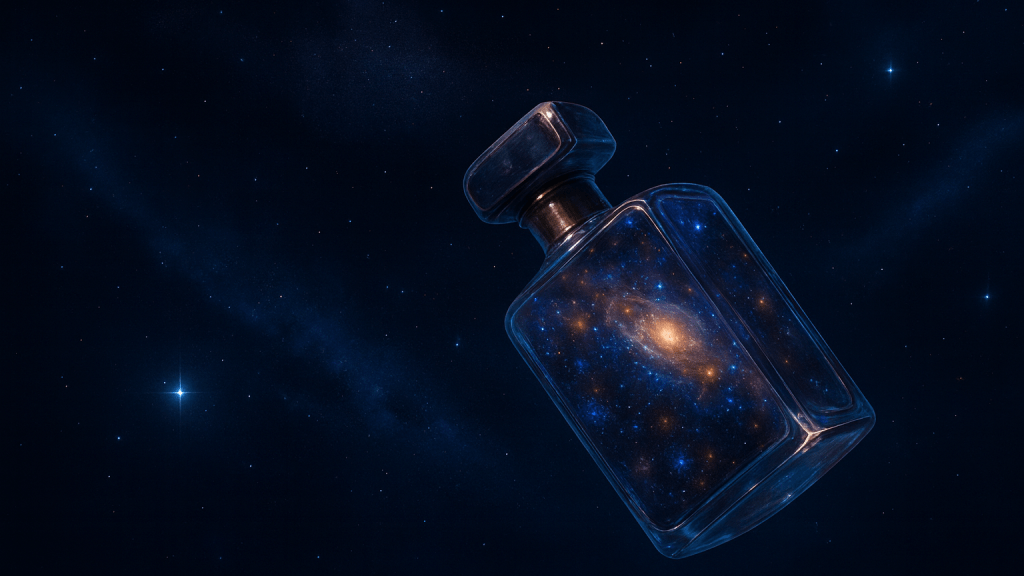
And speaking of perfume: NASA actually commissioned a chemist and perfumer named Steve Pearce to recreate the smell of space back in the early 2000s. They wanted to use it in astronaut training simulations so space rookies wouldn’t be surprised when that burnt-metal scent hit them post-EVA.
Pearce worked with astronaut reports and chemical analysis to design a fragrance that mimicked the effect. He even worked on a scent profile for the Moon, something like spent gunpowder mixed with dust and dry minerals, as described by Apollo astronauts.
Years later, these scents were released commercially in limited fashion under names like “Eau de Space” and “Moon Smell.”
I’d caution against trying these as date-night fragrances. Unless your date is into planetary science. In which case, you’ve probably hit the jackpot.
While we think of the universe as cold, empty, and silent, it’s also textured. Tangible. And even aromatic.
We tend to think of smell as something grounded and earthly — baking bread, fresh rain, hot asphalt. But space has its own language of scent through the chemistry of combustion and radiation, and through the invisible fingerprints of molecules drifting across the cosmos.
Space doesn’t smell like roses. It smells like creation.
[MUSIC]
If the stars spoke to you this week, or if a question’s been on your mind, I’d love to hear it. Visit our website, startrails.show, where you can contact me and explore past episodes. Be sure to follow us on Bluesky, and YouTube — links are in the show notes. Until we meet again beneath the stars… Clear skies everyone!
[MUSIC FADES OUT]
Support the Show
Connect with us on Bluesky @startrails.bsky.social
If you’re enjoying the show, consider sharing it with a friend! Want to help? Buy us a coffee!
Podcasting is better with RSS.com! If you’re planning to start your own podcast, use our RSS.com affiliate link for a discount, and to help support Star Trails.
 Star Trails: A Weekly Astronomy Podcast
Leave a comment