
Tempus Fugit: Time in Space and Sky – Star Trails: A Weekly Astronomy Podcast
Episode 80
This week we explore both the night sky and the cosmic tick-tock of time itself. The Moon waxes from half-lit to nearly full, while Saturn shines golden in Pisces with its razor-thin rings. Jupiter and Venus rule the morning skies, and the faint Aurigid meteors and Comet Lemmon make cameo appearances for early risers.
In the second half of the show, we dive into the strange and fascinating world of “time in space.” From NASA engineers living on Martian sols with their custom-built Mars watches, to the Omega Speedmasters strapped to Apollo astronauts’ suits, to the atomic clocks aboard GPS satellites that literally rely on Einstein’s relativity to keep us from getting lost—this is a journey through the cosmic heartbeat that guides explorers and Earthlings alike.
Transcript
[MUSIC]
Howdy stargazers, and welcome to Star Trails. I’m Drew, and I’ll be your guide to the night sky for the week of Sunday, August 31st to September 6th.
This is a week when the Moon climbs from half-lit to nearly full, brightening each evening, and the outer planets take center stage. We’ll also wander through a few oft-ignored constellations that hold some real treasures for small scopes and binoculars. Later in the show, we take a look at time, from the watches worn on space missions, Martian days, and the time-warping science behind GPS satellites.
Whether you’re tuning in from the backyard, the balcony, or just your imagination, I’m glad you’re here. So, find a cozy spot, let your eyes adjust, and let’s see what the sky holds for us this week.
[MUSIC FADES]
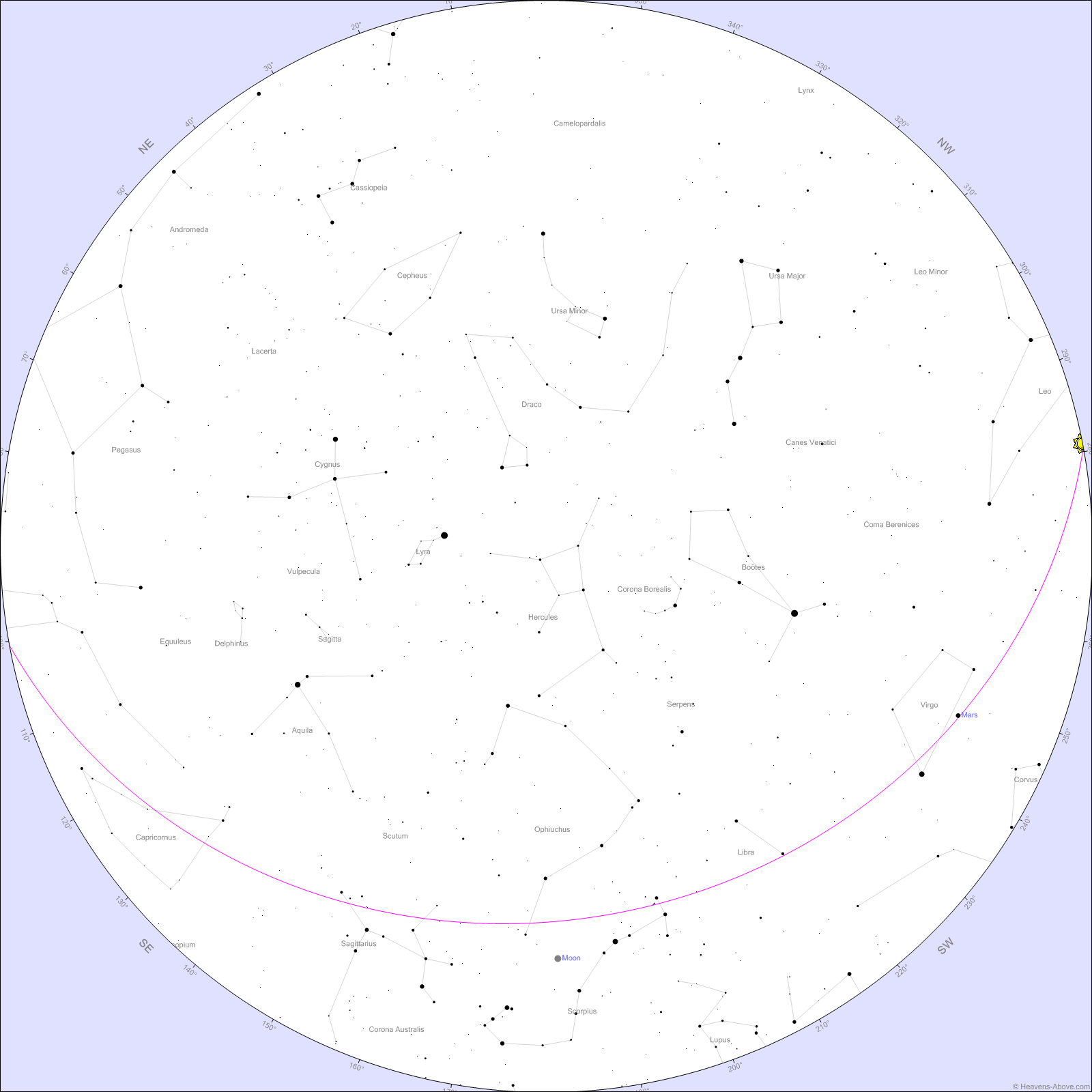
We start with our nearest neighbor. The Moon reached first quarter in the early hours of Sunday morning, and now it’s waxing steadily through gibbous all week. By Saturday it’s a brilliant lantern, nearly full, with the official full Moon arriving on Sunday the 7th. So your deep-sky hunting windows shrink quickly—favor the first half of the week if you want darker skies after midnight.
Farther away, Saturn is a best bet right now. It’s glowing in Pisces all evening, a bright golden ember. The rings are at their thinnest in decades, edge-on and knife-like, but still a thrill in any telescope. Saturn reaches opposition later this month, so it will only get better.
Neptune, also in Pisces, is nearby for late-night telescopic hunters, and Uranus comes up after midnight in Taurus. Mars is a low ember in the western twilight, hard to spot, but technically present.
Meanwhile, the mornings belong to Venus and Jupiter. Venus continues as the dazzling morning star, while Jupiter rises earlier each night and sits near Gemini’s bright twins, Castor and Pollux. A fine pairing to greet the dawn.
If you’re out in the early hours Monday morning, keep an eye on Auriga for the Aurigid meteor shower. It’s usually faint, but has a history of surprise outbursts. And in the same part of the sky, Comet Lemmon—C/2025 A6, is sliding near Gemini. It’s faint now, more a telescopic quarry, but worth noting as it brightens toward October.
The brighter Moon pushes us toward star clusters, doubles, and brighter planetaries, objects that punch through moonlight.
In Delphinus, the little diamond-shaped dolphin high in the southeast, you’ll find two globular clusters: NGC 6934, a compact grainy ball, and NGC 7006, a distant halo globular so far away it appears as a mere smudge in the eyepiece.
Slide westward to Sagitta, the tiny arrow pointing between Aquila and Vulpecula. Here you’ll find M71, a cluster that sits right on the border between open and globular, granular, loosely packed, and striking at medium power.
Up in Vulpecula, telescopes reveal NGC 6940, a lush field of faint suns.
In Scutum, the Wild Duck Cluster, M11, is one of the sky’s finest open clusters, with stars packed like glitter. And for a challenge, hunt nearby for IC 1295, a delicate planetary nebula that responds beautifully to an OIII filter.
Faint little Equuleus, the “Little Horse” near Delphinus, offers a fine double star, epsilon Equulei, a classic seeing test. And in Lacerta, the lizard crawling high overhead later at night, NGC 7243 sprawls as a pleasing, scattered open cluster.
The Milky Way still arcs bright through the south in early evening, but the Moon’s glow will wash it out more and more as the week goes on. Take advantage of the first few nights after midnight for darker glimpses, then shift your focus to planets, clusters, and lunar landscapes once the Moon dominates.
Next week brings the full Moon, and elsewhere in the world, a total lunar eclipse, but it’s not visible here in the Americas.
You may have heard the Latin expression “Tempus Fugit” – which simply means, “time flies.” We’re going to examine that in a very literal way, as we explore watches in space, atomic clocks, and how time passes on other planets. This is a segment for my watch fanatics out there.
That’s coming up after the break. Stay with us.
[MUSIC]
Welcome back!
Let’s take a break from the sky and talk about something we can’t escape, no matter what planet we’re on: time.
Here on Earth, time feels fixed. The Sun rises, the Sun sets, and our clocks keep a steady rhythm. But once you leave Earth, or even just start thinking like an interplanetary explorer, time starts to slip and bend in ways that are both subtle and profound.
Let’s start with Mars. A Martian day, or what scientists call a sol, lasts 24 hours, 39 minutes, and 35 seconds. Only about 40 minutes longer than an Earth day, but enough to wreak havoc on human schedules.
Whenever NASA lands a rover, like Spirit, Opportunity, Curiosity, or Perseverance, the mission team shifts to Mars time. Their schedules drift by forty minutes each day, so within a couple of weeks scientists are working the night shift, then the day shift, then back again. It’s jet lag without ever leaving Pasadena. Families of engineers even reported being pulled into this Martian rhythm, living in a haze of perpetual time-zone changes. It’s known as “Martian insomnia.”
The engineers at JPL actually commissioned Mars watches. They look like ordinary chronographs, but the second hand ticks just a little slower, stretching the day to match a sol. It’s one of the few times in history people have worn a watch calibrated to another planet.
And that brings me to a portion of the show I call “WATCHES… IN… SPACE!”
First off, I’m a geek when it comes to watches in general. Watches worn by astronauts are a niche interest of mine, one that peaked a few years ago when I saw in person the Omega Speedmaster worn by astronaut Charles Duke. I once had the opportunity to meet shuttle astronaut Clayton Anderson, and I spent most of that time talking to him about ham radio on the ISS, and of course, his Omega X33 watch.
The tradition of timekeeping in space runs deep. Early in human space expiration, NASA selected the Omega Speedmaster chronograph, a fully mechanical, handwound watch.
Mechanical watches can’t crash or short out in a vacuum or when exposed to radiation. Additionally, the Speedmaster has an acrylic crystal – that’s the glass over the dial – which is shatter resistant, unlike the sapphire crystals that are often used in luxury timepieces.
In old mission photos, you can see astronauts wearing the Speedmaster, strapped over the wrist of their spacesuit during Gemini EVAs, and on moonwalks. My favorite image of the Speedmaster was taken on Apollo 11, being worn by Buzz Aldrin inside the command module.
Once on the lunar surface, Neil Armstrong actually left his watch in the lunar module as a backup timer, so it was Aldrin’s that became the first watch on the Moon.
If you’ve seen the film Apollo 13, you might remember when a crucial course correction burn was timed by the stopwatch hand on the Speedmaster, or “Speedy” as it’s affectionately known in watch nerd circles.
Omega has embraced this history, and still produces the original “Moonwatch” to this day. They include a NASA-style nylon strap you can attach for real astronaut authenticity, along with the engraving, “First watch on the Moon” on the caseback. If you have $7 grand or so burning a hole in your pocket, it can be yours.
Or you can buy the plastic lookalike “Moon Swatch” for about $270. This one is a special edition from Omega’s parent company, the Swatch Group — if you grew up in the 80s, you might remember the Swatch Watch, those colorful, plastic timepieces that were all the rage, along with neon colors on everything, parachute pants, jelly bracelets, and Trapper Keepers.
The Omega isn’t the only moon watch. Bulova makes a version, inspired by watches worn on the Apollo 15 mission, although it eschews the mechanical innards for a super-accurate high-beat quartz movement.
NASA isn’t as picky about watches nowadays. Crews have worn Sinns, Fortises, even digital watches. Today, astronauts often bring personal choices, like Garmins, and Apple Watches, but the core idea is the same: you need reliable timekeeping when every maneuver, every engine burn, every oxygen check is life or death.
What happens when you need extreme precision? Right now, your phone’s navigation app depends on clocks in space: the atomic clocks onboard GPS satellites. Each satellite carries multiple clocks tuned to within billionths of a second. The system works by measuring how long it takes signals to reach your device. Even the tiniest error in timing would put you miles off course.
And here’s where relativity sneaks in. Einstein showed us that time doesn’t tick the same everywhere. If you move very fast, your clock slows down compared to someone standing still, that’s “special relativity.” If you climb higher out of a planet’s gravity, your clock actually ticks faster, and that’s “general relativity.”
GPS satellites are in both situations at once: they’re zipping around Earth at nearly 9,000 miles per hour, which makes their clocks run a little slow. But they’re also about 12,500 miles above Earth’s surface, in weaker gravity, which makes their clocks run a little fast. Add the two effects together and the “fast” wins. Their clocks tick about 38 microseconds ahead each day compared to clocks on Earth.
That sounds tiny, but if engineers didn’t correct for it, your location on Google Maps would drift by several miles in a matter of hours. In other words: without taking relativity into account, we’d all be lost.
So whether it’s engineers struggling to live on Martian time, astronauts strapping Speedmasters to their sleeves, or atomic clocks whispering to your smartphone, space reminds us that time is not universal. It’s a local rhythm, tied to gravity, velocity, and the turning of worlds.
Here on Earth, we march to a 24-hour beat. On Mars, the tempo slows by forty minutes. In orbit, atomic clocks tick just differently enough to keep us humble. Time is not some absolute metronome in the background of the universe. It’s pliable and contextual. And as we push farther into space, we’ll discover just how many ways we can bend it, stretch it, and live by it.
[MUSIC]
If the stars spoke to you this week, or if a question’s been on your mind, I’d love to hear it. Visit our website, startrails.show, where you can contact me and explore past episodes. Be sure to follow us on Bluesky, and YouTube — links are in the show notes. Until we meet again beneath the stars… Clear skies everyone!
[MUSIC FADES OUT]
Support the Show
Connect with us on Bluesky @startrails.bsky.social
If you’re enjoying the show, consider sharing it with a friend! Want to help? Buy us a coffee!
Podcasting is better with RSS.com! If you’re planning to start your own podcast, use our RSS.com affiliate link for a discount, and to help support Star Trails.
 Star Trails: A Weekly Astronomy Podcast
Leave a comment