Unsolved Mysteries of the Cosmos (and a Supermoon Too) – Star Trails: A Weekly Astronomy Podcast
Episode 82
The Harvest Supermoon rises over crisp autumn nights as Saturn reigns in the southeast and Pegasus climbs the eastern sky. In this week’s episode of Star Trails, we examine the celestial highlights of October 5–11 — including lunar encounters with Saturn and the Pleiades, the Draconid meteor shower, and a check-in on interstellar Comet 3I/ATLAS.
Then, as the night deepens, we open the cosmic case files: five enduring unsolved mysteries of the universe. From the invisible grip of dark matter to the baffling Hubble tension, these are the riddles that defy physics and haunt the night sky.
Whether you’re observing from your backyard or just viewing the stars in your imagination, this episode blends practical stargazing with spine-tingling cosmic intrigue.
Transcript
[MUSIC]
Howdy stargazers, and welcome to Star Trails. I’m Drew, and I’ll be your guide to the night sky for the week of October 5th to 11th.
This week the bright Harvest Supermoon takes center stage, Saturn continues its evening reign, and autumn constellations emerge in full force. Later in the show, we’ll examine some truly weird stuff – five unsolved mysteries of the cosmos.
Whether you’re tuning in from the backyard, the balcony, or just your imagination, I’m glad you’re here. So, find a cozy spot, let your eyes adjust, and let’s see what the sky holds for us this week.
[MUSIC FADES]
Folks, again let me apologize for the lack of shows in September. In addition to it being a very busy month at my day job, I had a birthday last month, and it’s one of the ones that no one looks forward to: Age 50. And to be honest, this one put me in a bad place for a week or so. As I tried to stave off the imminent collapse of my own wavefunction, I looked to quantum physics for the answers to life’s questions.
And here’s what I landed on: Fifty isn’t a gateway to old age, it’s proof of improbable survival against entropy, against chance, and against the noise of the universe. I like to think that the fact I’m still here is a superposition of sorts.
At least that’s what I’ve been telling myself to stay sane.
I’m also happy to report the weather here in the south has finally cooled off a little, and we’re seeing clear skies in the evenings again. Hopefully that’s been the case for you also. Fall officially arrived last month, and that means it’s time to dust off the binoculars and scopes as we enjoy longer, cooler nights.
Your first target for observation this week is likely going to be the Moon. The full moon arrives Monday night, and this is not only the Harvest Moon, but a supermoon, meaning it’s slightly closer to Earth than usual and will look just a bit larger and brighter.
For most of the week, the bright Moon will wash out fainter deep-sky objects, but it also gives us some spectacular lunar conjunctions with planets and star clusters. More on those in a moment.
Now, last week, in my brief update episode, I mistakenly said September’s full Moon was the Harvest Moon. That was an oversight on my part. The Harvest moon can occur in either September or October – It’s simply the full Moon closest to the autumnal equinox. This year, October’s full moon has that honor.
The name of the Harvest Moon dates back to when farmers used to rely on this extra moonlight to bring in the last of the harvest after sunset. So what was September’s full moon called? That was the Corn, or Barley Moon.
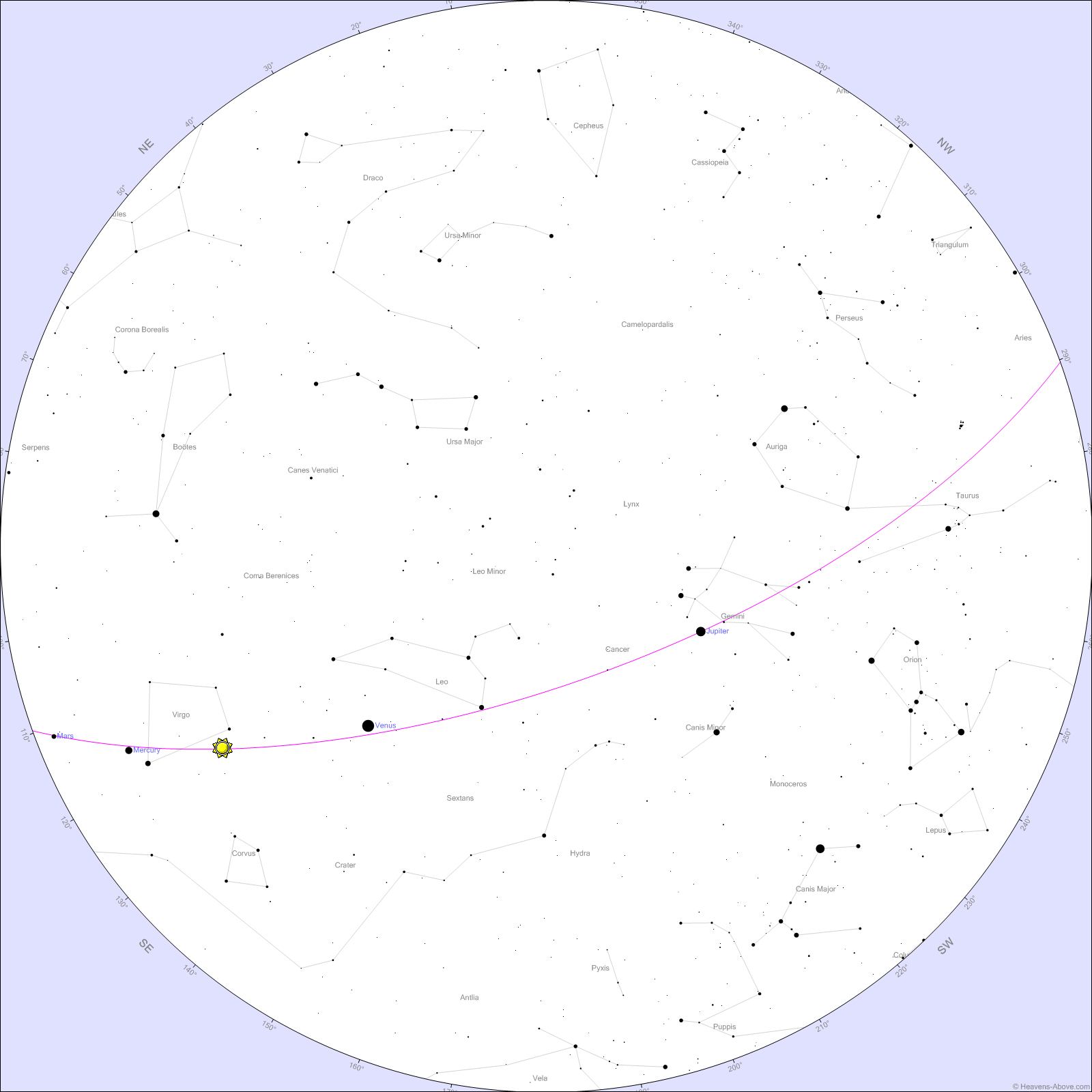
Looking further out, Saturn continues to dominate the evening sky. It reached opposition just a couple of weeks ago, so it’s still bright and well-placed for observation. Step outside after sunset and look toward the southeast to find it.
Tonight, the Moon slides close to Saturn, making for a lovely pairing. Binoculars show them beautifully together, and a moderately-powered telescope will reveal Saturn’s rings, although they may look a little thinner than expected.
Saturn’s “thin rings” this year aren’t an illusion — they’re a matter of Earth’s changing vantage point. The planet’s ring system is tilted about 27 degrees relative to its orbit, and as Saturn moves around the Sun, we see that tilt from different angles.
Roughly every 14 to 15 years, Earth passes through the plane of Saturn’s rings, an event called a ring-plane crossing. Around these times, the rings appear edge-on and seem to “disappear” in small telescopes. They don’t actually vanish — the rings are just extraordinarily thin, so they present almost no reflective surface when seen edge-on.
Fun side note: ring-plane crossings often allow astronomers to spot some of Saturn’s smaller moons that are normally lost in the ring glare, so these periods are scientifically valuable even if the visual show dims a bit.
Later at night, Jupiter rises, dazzling in the pre-dawn sky. It’s a brilliant beacon, currently in Gemini.
Venus is also in the morning sky, hugging the eastern horizon before sunrise. If you have a flat view toward the east, you can’t miss it. It’s the brightest object in the sky after the Moon.
Mars and Mercury are too close to the Sun to observe this week.
From October 6th through the 10th, we get a visit from the Draconid meteor shower. The predicted peak is the evening of Wednesday, October 8.
This is an unusual shower because the best time to watch is right after nightfall, not before dawn. The radiant is high in the northwest after sunset, so grab a chair, face away from the Moon, and scan the sky during twilight’s fade.
The waning gibbous Moon will drown out many of the fainter meteors, so expect just a handful per hour — but the Draconids are famous for surprise outbursts, so it’s worth a look.
On the nights of October 9th and 10th, the Moon passes very close to the Pleiades star cluster, also known as the Seven Sisters. For some observers in North America, the Moon will actually occult, or pass in front of, several of the brighter stars in the cluster.
If you have binoculars or a small telescope, this is a magical sight — watch stars disappear behind the Moon’s bright limb and reappear on the dark side. As always, refer to a stargazing app like Sky Safari or Stellarium to see if this phenomenon is visible in your area.
Summer’s constellations are on their way out. By mid-evening, Pegasus stands tall in the east, marked by the Great Square. Trace a line from the Great Square into Andromeda, and you can find M31, the Andromeda Galaxy, visible in binoculars even from suburban skies.
Above Pegasus, Cassiopeia forms her distinctive “W,” which is a reliable signpost to M31 as well. The larger point of the “W” seems to form an arrow that points the way to M31. This is how I’ve always located the Andromeda Galaxy.
Meanwhile, Perseus and the Double Cluster rise in the northeast — a binocular favorite.
To the south, the bright star Fomalhaut shines alone, low on the horizon, while the Summer Triangle still lingers in the west, slowly giving way to the stars of autumn.
There’s been another giant comet in the news. Comet 3I/ATLAS, also known as C/2025 N1, is the third confirmed interstellar object to enter our Solar System, after ʻOumuamua and Borisov.
Despite breathless headlines, this is not a naked-eye spectacle. This week, it’s actually too close to the Sun in the evening sky to observe safely. The comet will reach perihelion on October 29th, then gradually reappear in the pre-dawn sky in December, mostly for large telescopes.
Early Hubble data suggest a nucleus no larger than about five kilometers, and its peak brightness is expected around magnitude 11 to 12 — faint, but scientifically thrilling. It’s interstellar, after all.
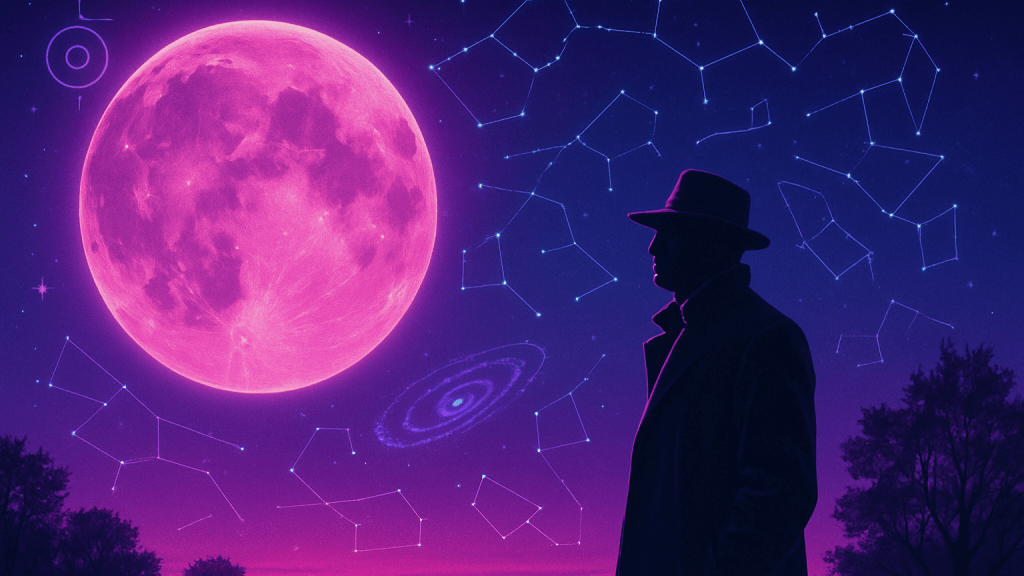
It’s October, so that means it’s time for some eerie topics. Imagine a smoke machine running, Robert Stack in his trench coat, and that creepy synth-heavy theme whispering into the void – yes, we’re about to explore some “unsolved mysteries” of the cosmos.
That’s coming up after the break. Stay with us.
[MUSIC]
Welcome back!
The universe. Vast. Silent. Filled with mysteries beyond imagination.
Everywhere we look, the cosmos is brimming with enigmas — riddles that defy our laws of physics and confound even the sharpest minds. They are the cold cases of astronomy, the unsolved puzzles of astrophysics.
Tonight, we open the cosmic case file. Five mysteries, each as unsettling as it is profound. These are the questions that haunt the night sky, waiting for answers that may change everything we think we know.
Let’s dim the lights, and step into the shadows of the universe.
Case One: The Dark Sector — Matter and Energy We Cannot See
It begins with a crime of omission. A hidden force at work. Galaxies, those magnificent pinwheels of stars, are not behaving as they should. According to Newton, according to Einstein, stars at the edges should drift lazily, moving slower than those near the core. Instead, they whirl around at the same breakneck speed — as if an invisible hand is holding the galaxy together.
That invisible hand is called dark matter. We can’t see it, can’t touch it, but the evidence is overwhelming. Dark matter doesn’t glow, reflect, or absorb light. Yet it outweighs the visible stars five to one. Like a shadowy suspect, it makes its presence known only through its gravitational pull.
And then there’s its partner in mystery: dark energy. In 1998, astronomers studying distant exploding stars — supernovae — noticed something shocking. The universe isn’t just expanding. It’s accelerating, as if some unseen energy is stretching the fabric of space itself.
Dark matter and dark energy together make up about 95% of the universe. Ninety-five percent. That means everything we see — stars, planets, gas clouds, even ourselves — amounts to a cosmic rounding error.
Theories abound. Perhaps exotic particles are hiding in plain sight. Perhaps there are unseen dimensions warping the rules. Or maybe the very laws of gravity need rewriting. But no experiment has yet revealed the culprit.
Case Two: The Matter–Antimatter Asymmetry
Rewind the clock to the first second of the universe. The Big Bang should have created equal amounts of matter and antimatter. For every proton, an antiproton. For every electron, a positron. Matter and antimatter are mirror images: same mass, opposite charge. When they meet, they annihilate, vanishing in a burst of light.
By that logic, the universe should have destroyed itself almost instantly. Yet it didn’t. Somehow, matter gained the upper hand. Antimatter vanished. And we are the survivors of that imbalance.
But why? Physicists call this puzzle baryon asymmetry. The smoking gun lies in something known as CP violation.
Here’s the translation. “C” stands for charge conjugation: swap a particle for its antiparticle.
“P” stands for parity: flip the universe like a mirror image.
If the laws of physics were fair, a process should look the same under both flips. But experiments show that’s not always true. In the 1960s, researchers found that certain subatomic particles — kaons — decayed differently than their antimatter twins. Nature had shown a preference.
This CP violation is the universe’s tiny cheat code, favoring matter ever so slightly over antimatter. But here’s the problem: the CP violation we’ve measured isn’t strong enough to explain why the universe is filled with matter instead of empty light.
That’s why physicists are chasing neutrinos. These ghostly particles, able to slip through a trillion miles of lead unhindered, may hold the answer. Neutrinos oscillate between different “flavors”—electron, muon, tau—and in doing so, they might break CP symmetry in ways far more dramatic than quarks do.
If so, we’ll finally know why matter won. Until then, the trail is cold.
Case Three: Black Holes and the Information Paradox
There is no greater locked room in the cosmos than a black hole. Cross its boundary — the event horizon — and escape is impossible. Gravity there is absolute. Light itself cannot flee.
Einstein’s equations tell us matter falls inward, collapsing to a singularity, a point of infinite density. But infinities are the mathematician’s red flag, a sign our theories are broken.
What happens to the information carried by particles that fall in? Quantum mechanics says information can never be destroyed. Yet black holes seem to erase it completely. This contradiction is called the information paradox.
Stephen Hawking offered a clue: black holes aren’t perfectly black. They radiate faint energy — now called Hawking radiation — and slowly evaporate. If they vanish completely, what becomes of the information they devoured? Does it escape scrambled in the radiation? Is it somehow preserved on the surface of the event horizon, like a cosmic hologram?
Some theories suggest “firewalls” of energy at the event horizon — violent boundaries that incinerate matter instantly. Others propose that our universe itself may be holographic, and black holes are the proof.
The Event Horizon Telescope gave us our first images of these beasts, shadows of darkness against glowing disks of gas. But their inner secrets remain sealed.
Case Four: Ultra-High-Energy Cosmic Rays
Every second, Earth is bombarded by cosmic rays — charged particles hurled through space at near-light speed. Most are modest in energy, spawned by exploding stars. But sometimes, a monster arrives: a cosmic ray with energies so vast it staggers belief.
In 1991, one such particle hit a detector in Utah. Its energy was so extreme — more than 10^20 electron volts — that physicists nicknamed it the Oh-My-God particle. Packed into a single proton, it carried as much energy as a baseball traveling at 90 kilometers per hour. Imagine something that tiny carrying that much punch.
But here’s the paradox: physics says such particles shouldn’t reach us. On their journey, they should collide with the faint glow of the cosmic microwave background — the afterglow of the Big Bang — and lose energy in the process. This predicted cutoff is known as the GZK limit. And yet, they arrive anyway.
Where do they come from? Some point to active galactic nuclei — jets from supermassive black holes. Others suggest gamma-ray bursts, the most violent explosions known. A few even whisper about exotic physics, remnants of the Big Bang itself decaying into cosmic bullets.
Detectors like the Pierre Auger Observatory in Argentina and IceCube in Antarctica are on the case, scanning the skies. But the source remains unidentified.
Case Five: The Hubble Tension
At the heart of cosmology lies a deceptively simple number: the Hubble constant, the rate at which the universe expands. Measure it carefully, and you know the age, size, and fate of the cosmos.
But here the case takes a strange turn. Using the “cosmic distance ladder” — measuring Cepheid variable stars and certain supernovae — astronomers get a value of about 73 kilometers per second per megaparsec. But when they measure the same expansion through the ancient light of the cosmic microwave background, they get 67.
Two methods. Two results. And they refuse to agree.
This disagreement, known as the Hubble tension, is no minor discrepancy. The gap is now statistically significant, suggesting something fundamental is missing in our picture of the universe.
Could there be new physics in the early universe? A hidden form of energy — “early dark energy” — that vanished long ago? Or subtle interactions between dark matter and neutrinos?
If the tension holds, it means our standard cosmological model, the proud achievement of 20th – century science, may be incomplete. The universe may still have surprises waiting.
Five mysteries. Five case files still open. The dark sector that hides 95% of reality. The disappearance of antimatter, cheated out of existence by subtle violations of symmetry. Black holes—the cosmic vaults where information may vanish. Ultra-high-energy cosmic rays, impossible bullets from nowhere. And the Hubble tension, a crack in our cosmic foundation.
Each of them a shadow in the night sky. Each of them a locked door, daring us to find the key.
With each new telescope, each detector buried in ice or lofted into orbit, the case grows warmer. Maybe one day, one of these mysteries will be solved.
But for now, they remain the unsolved mysteries of the cosmos.
[MUSIC]
If the stars spoke to you this week, or if a question’s been on your mind, I’d love to hear it. Visit our website, startrails.show, where you can contact me and explore past episodes. Be sure to follow us on Bluesky, and YouTube — links are in the show notes. Until we meet again beneath the stars… Clear skies everyone!
[MUSIC FADES OUT]
Support the Show
Connect with us on Bluesky @startrails.bsky.social
If you’re enjoying the show, consider sharing it with a friend! Want to help? Buy us a coffee!
Podcasting is better with RSS.com! If you’re planning to start your own podcast, use our RSS.com affiliate link for a discount, and to help support Star Trails.
 Star Trails: A Weekly Astronomy Podcast
Leave a comment