The Mid-October Sky and The House of a Thousand Mirrors – Star Trails: A Weekly Astronomy Podcast
Episode 83
The nights are growing longer, the air is sharpening, and the Moon is finally stepping aside. In this week’s episode, we look to the skies from October 12th through the 18th, and discover a season in transition: Saturn still reigning in the south, Jupiter climbing before dawn, Venus returning to the morning sky, and the Orionid meteor shower quietly stirring to life. With the waning Moon, late-week skies will be perfect for deep-sky observing — from the Andromeda Galaxy to the Helix Nebula.
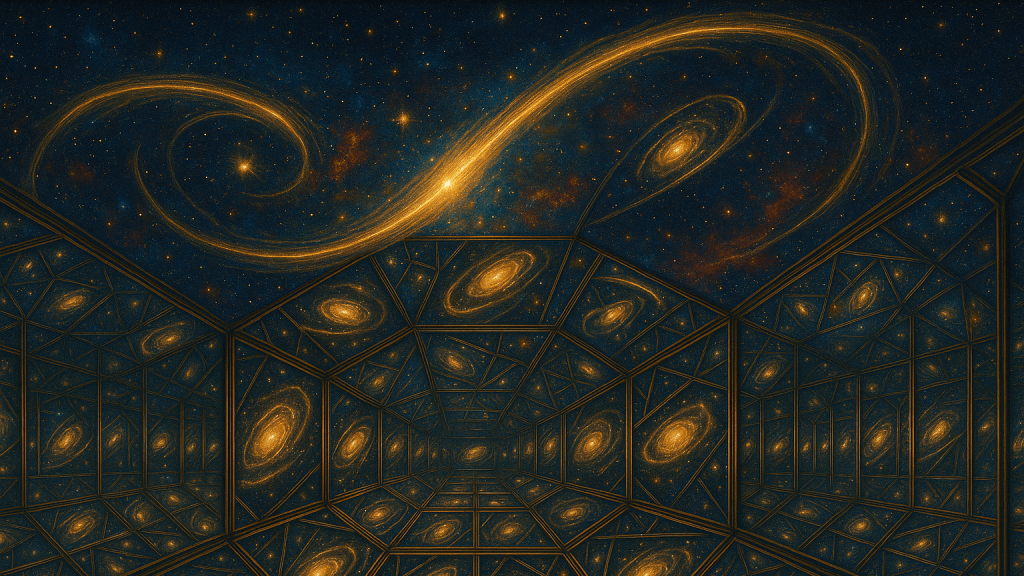
Then, we step into a stranger realm: The House of a Thousand Mirrors.
In this eerie cosmic funhouse, light bends, time folds, and a single distant galaxy can appear dozens of times across the sky. We explore the phenomenon of gravitational lensing — from the elegant Einstein Cross to the ghostly arcs of Abell clusters, and even a supernova that appeared twice in two different years. It’s astronomy that feels like science fiction, except it’s real.
Transcript
[MUSIC]
Howdy stargazers, and welcome to Star Trails. I’m Drew, and I’ll be your guide to the night sky for the week of October 12th to 18th.
This week we’re moving deeper into autumn, and the sky is shifting gears. Longer nights, crisp air, and the fading Moon are about to make for some excellent observing conditions. Also, we continue our march toward Halloween with another eerie observation. This week we journey into the House of 1,000 Mirrors to examine one of my favorite topics – the weird world of gravitational lensing.
Whether you’re tuning in from the backyard, the balcony, or just your imagination, I’m glad you’re here. So, find a cozy spot, let your eyes adjust, and let’s see what the sky holds for us this week.
[MUSIC FADES]
The week begins with a waning gibbous Moon, just past full.
On Monday the Moon reaches Last Quarter and thins into a waning crescent, rising later each night. That means the second half of the week will bring darker skies in the late evening, perfect for galaxies, nebulae, and faint star clusters.
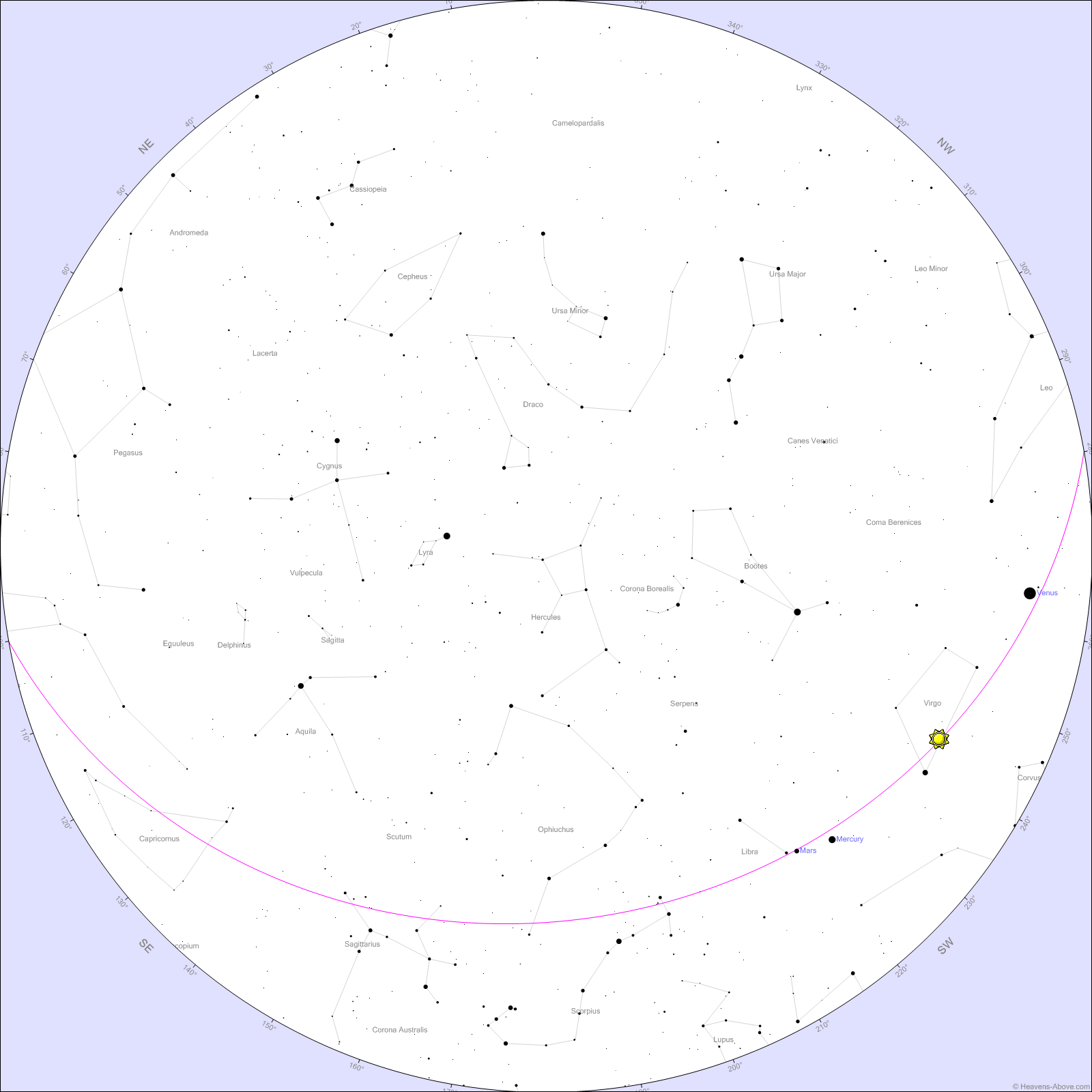
The planetary lineup is solid this week.
Saturn takes the spotlight right after dusk. It’s hanging in Aquarius, high enough for steady views by mid-evening. It passed opposition back in September, so it’s still bright and its moon, Titan, is easy to spot in a modest telescope.
Neptune is over in Pisces, best seen around midnight. Look for it as a tiny bluish dot in binoculars.
Uranus rises later in the evening in Aries, steadily climbing toward its November opposition. Under suburban skies, it’s easy to catch with binoculars and shows a small greenish disk in a telescope.
Jupiter doesn’t make its entrance until the early morning hours, but when it does, it dominates the sky. It’s rising earlier each night and will reach opposition in January, so this is the beginning of its best observing season.
And don’t miss Venus, now reemerging as a brilliant morning star in the pre-dawn sky. By week’s end you’ll see it low in the east with a delicate crescent Moon nearby — an excellent photo opportunity if you have a clear horizon.
Mars and Mercury are low and tricky this week. Mars is fading into the twilight, and Mercury will become more visible later in the month.
The Orionid meteor shower — made of dust from Halley’s Comet — is ramping up. The official peak is on October 21st, but during our week, early Orionids are already visible.
For your best chance, head out after midnight, face east, and watch as Orion climbs higher in the sky. Late in the week, the dimming Moon will make it easier to spot them.
Constellations of autumn are rising. We mentioned the Great Square of Pegasus last week, and how to locate the Andromeda Galaxy. If you revisit that same area, look for M33, the Triangulum Galaxy – a faint but rewarding catch.
And while you’re in Pegasus, don’t miss M15, a bright, compact globular cluster that looks great even under moderate light pollution.
Overhead at dusk, Cygnus is still well placed, its Milky Way lanes glowing faintly in darker skies. A telescope with a nebula filter can reveal the Veil Nebula or the North America Nebula, especially during the Moon-free later part of the week.
Down south, near Saturn, swing your scope to M2 in Aquarius — a fine globular cluster — and the Helix Nebula, a ghostly planetary nebula that really pops with an O-III or UHC filter.
And if you’re up late — or early — you’ll see Taurus rising in the east. The Hyades and Pleiades star clusters sparkle in the pre-dawn sky, signaling that winter constellations are on their way.
And don’t forget to check NASA’s Spot the Station app for ISS flyovers — a bright pass can add a little unexpected excitement to your observing session.
In a moment, we’ll step into a place where light bends, time folds, and a single galaxy can appear a dozen times over. We’ll explore The House of a Thousand Mirrors, where gravity itself builds a cosmic funhouse. Stay tuned.
That’s coming up after the break. Stay with us.
[MUSIC]
Welcome back!
Imagine drifting alone through intergalactic space. No stars. No planets. No sound. Just the faint, cold light of distant galaxies.
Then, there it is. A single quasar, bright and sharp… and another. And another. And another. The same object… repeated again and again, hanging in the void like reflections in a hallway of mirrors.
What you’re seeing isn’t a trick of your eyes. It isn’t a glitch in your telescope. It’s the universe itself bending light into impossible shapes. Welcome… to the cosmic version of the House of a Thousand Mirrors.
This strange funhouse is built by gravity. More specifically: gravitational lensing, one of the most breathtaking predictions of Einstein’s General Theory of Relativity.
Einstein showed that massive objects, stars, galaxies, even entire clusters, don’t just sit in space; they curve space-time itself. Light, always following the straightest possible path, bends along those curves like a car following a winding mountain road.
Picture a glass marble placed on a stretched rubber sheet. Roll a bead of light nearby, and it veers off course. Now scale that up to a galaxy weighing trillions of suns. The result is a natural lens, and an effect that can resemble a funhouse mirror.
There are different kinds of gravitational lensing:
Strong lensing is the funhouse variety — the one that splits a single object into multiple distinct images. These are the “mirrors” you can actually see.
Weak lensing is subtle, like a warped reflection in an old window. Astronomers use it statistically, to map the invisible skeleton of the universe.
And microlensing happens when stars briefly magnify distant objects like flickering lanterns in the dark.
But for our purposes tonight, it’s strong lensing that turns the universe into something eerie — a place where a single object can appear dozens of times, scattered across the sky like a shattered reflection.
One of the most famous examples is the Einstein Cross, a quasar billions of light-years away, whose light is split into four identical points arranged neatly around a foreground galaxy. It looks like a cosmic emblem.
Then there’s Abell 1689, a massive galaxy cluster that bends light so dramatically it produces arcs, rings, and multiple mirror images of galaxies hiding far behind it. If you’ve ever seen those long, ghostly arcs in Hubble images, that’s Abell 1689 at work.
Maybe the most astonishing example is MACS J1149.5+2223. In 2014, astronomers witnessed the explosion of a distant supernova nicknamed “Refsdal.” Then, a year later, they saw it again. The light had traveled through different routes in the warped space-time of a galaxy cluster. One path was shorter, one longer. It was the same explosion, appearing twice.
This is time itself, folded by gravity.
In a hall of mirrors, light bounces from surface to surface, arriving at your eyes at different moments. Gravitational lensing works in a similar way, but the mirrors aren’t made of glass. They’re made of space-time.
Light from a distant quasar might arrive at Earth by multiple routes, some taking longer than others. Kind of like watching the same film twice, from different theater seats.
This cosmic rerun isn’t just eerie. It’s incredibly useful. By carefully measuring the time delays between these mirror images, astronomers can calculate the expansion rate of the universe — the Hubble constant. And interestingly, these lensing-based measurements don’t quite match other methods, hinting at something strange about our cosmos.
Gravitational lensing is one of the most powerful tools in modern cosmology. It reveals the distribution of dark matter, the invisible mass that shapes the universe.
It helps us discover galaxies too distant and faint to detect otherwise. The lens acts like a magnifying glass, boosting their light. The James Webb Space Telescope is already peering through these natural telescopes to find some of the earliest galaxies after the Big Bang.
For backyard astronomers, strong lensing is challenging to spot directly, but not impossible. With a large enough telescope under dark skies, the arcs of Abell clusters can be teased out. More accessible, though, are the iconic images captured by Hubble and James Webb. The Einstein Cross, the Frontier Fields, the incredible deep field mosaics are all freely available online.
The next time you look at one, take a moment to ponder: Every arc, every ghostly streak, is the distorted light of a galaxy billions of years old, seen through another galaxy’s gravity. You’re looking into a cosmic mirror maze built by mass itself.
Light ricochets off invisible curves. Events repeat themselves. Objects appear in multiple places at once. These lenses in space replay the past, and reveal secrets hidden at the edge of time.
[MUSIC]
If the stars spoke to you this week, or if a question’s been on your mind, I’d love to hear it. Visit our website, startrails.show, where you can contact me and explore past episodes. Be sure to follow us on Bluesky, and YouTube — links are in the show notes. Until we meet again beneath the stars… Clear skies everyone!
[MUSIC FADES OUT]
Support the Show
Connect with us on Bluesky @startrails.bsky.social
If you’re enjoying the show, consider sharing it with a friend! Want to help? Buy us a coffee!
Podcasting is better with RSS.com! If you’re planning to start your own podcast, use our RSS.com affiliate link for a discount, and to help support Star Trails.
 Star Trails: A Weekly Astronomy Podcast
Leave a comment