
Echoes from the Cosmic Graveyard – Star Trails: A Weekly Astronomy Podcast
Episode 84
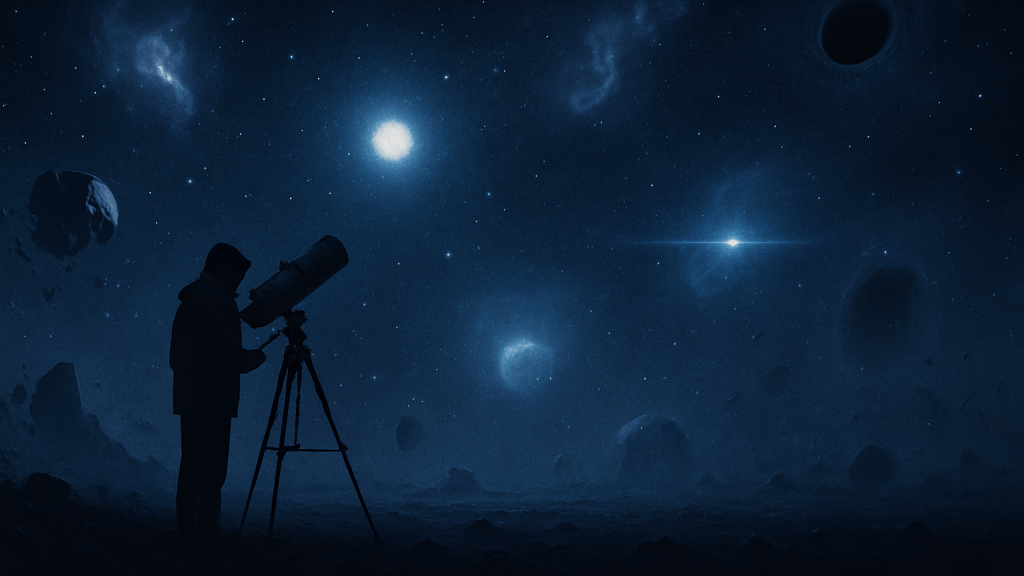
The veil between life and death is thin in late October, and not just on Earth. This week on Star Trails, we take a haunting journey through The Cosmic Graveyard, a place where dead suns still glow, galaxies devour one another, and the faint aftershocks of ancient explosions echo across time. From the slow cooling of white dwarfs to the bottomless depths of black holes, we explore the universe’s quietest afterlife.
But before venturing into that darkness, the night sky itself offers reason to stay up late. The Orionid meteor shower peaks under a new moon, delivering pristine, moonless skies for deep-sky observing. Saturn still commands the early evening, Jupiter gleams after midnight, and the autumn constellations fill the heavens with galaxies, clusters, and nebulae ripe for exploration.
Plus, a listener’s question sparks a timely detour into the strange beauty of black holes and the now-iconic image of a glowing ring surrounding a dark center. Is it art, or reality? We explain the physics behind those haunting visuals and how Einstein’s relativity sculpts light itself into the illusion we see.
So settle in beneath the cooling autumn sky, and listen as we wander the universe’s silent necropolis, where every dying star leaves behind a spark, and even the ashes of creation still shimmer with light.
Transcript
[MUSIC]
Howdy stargazers, and welcome to Star Trails. I’m Drew, and I’ll be your guide to the night sky for the week of October 19th through 25th.
The calendar says late October, and the heavens agree. Crisp air, long nights, and a new moon make this one of the best observing weeks of the year. And since Halloween creeps ever closer, we’re continuing our eerie tour of the cosmos with a visit to a place both beautiful and haunting — The Cosmic Graveyard, where dead stars still whisper across time.
Whether you’re tuning in from the backyard, the balcony, or just your imagination, I’m glad you’re here. So find a cozy spot, let your eyes adjust, and let’s see what the sky holds for us this week.
[MUSIC FADES]
The Moon disappears this week, reaching its new phase on Tuesday, October 21st. That means a stretch of wonderfully dark skies from Sunday through Friday — perfect for galaxies, nebulae, and meteor watching.
And speaking of meteors, the Orionids peak Monday night into Tuesday morning. These swift streaks are the dust of Halley’s Comet, burning up as Earth plows through the debris field.
With no moonlight to wash them out, you could catch 10 to 20 per hour under good conditions. Face southeast after midnight, lie back, and enjoy one of autumn’s finest shows.
Now for the planets.
Saturn glows in the southeast after dusk, nestled in Aquarius. It’s still bright and steady, and its moon Titan is visible in modest telescopes. Jupiter rises around midnight in Gemini, climbing higher each morning. Watch for its shifting cloud belts and dancing moons.
Mars and Mercury linger low in the western twilight — challenging but not impossible with binoculars and a flat horizon.
The others are taking a back seat for now.
As the constellations wheel overhead, Pegasus and the Great Square mark the heart of the autumn sky. Follow the chain of stars east to Andromeda and you’ll find the glowing oval of M31, our neighboring galaxy, easily seen in binoculars.
Below that, seek out M33, the Triangulum Galaxy, a faint but graceful swirl of starlight. Farther west, Perseus rises with the glittering Double Cluster, while Cassiopeia’s W-shape rides high, tracing the Milky Way’s rich star fields.
Down south, near Saturn, swing your scope toward M2 in Aquarius — a fine globular cluster — and, if you have a nebula filter, the Helix Nebula, a ghostly ring of gas that lives up to its nickname, the Eye of God.
Stay up past midnight and you’ll see Taurus climb the eastern sky, bringing the Hyades and the Pleiades — the first messengers of winter.
[TRANSITION FX]
Before we get into the second half of the show, I wanted to respond to an excellent listener question, and it’s one that’s been on my mind also. The listener writes: “I’m seeing the same artists’ depiction of a black hole everywhere lately, notably as the logo for the AI service, Grok, which appears all over Twitter/X, but also in movies like Interstellar. Is this really what a black hole looks like?”
Thanks for that question, and if you follow any space news, you probably know exactly what the listener is referring to. That striking, impossible-looking figure that sort of resembles a ringed planet – maybe if designed by M.C. Escher.
It’s sort of a glowing, lopsided ring with a dark center, and it’s been plastered across science videos, documentaries, space agency posters, and yes, the logo for the X-owned AI service, Grok. It looks almost too perfect. Like some digital artist cooked it up after a late-night sci-fi binge.
In case you’ve never seen one of these depictions I’ll include a link to such an image in the show notes.
Well, here’s the twist: that image is rooted in the actual physics of how black holes warp light. What looks like a sleek bit of graphic design is, possibly, a very accurate visualization.
Let’s unpack it.
At the center of that image is a dark patch. It isn’t the black hole itself, because you can’t actually see a black hole. Think of it as the shadow of a black hole. When light from hot gas passes near the event horizon, the black hole’s gravity bends those paths. Photons that get too close are trapped forever, creating a dark silhouette slightly larger than the event horizon. That’s what we’re looking at when we see that central void.
Surrounding it is the bright, thin ring. That’s made of photons that have orbited the black hole before escaping toward us. Think of light caught in a cosmic racetrack, looping around at breakneck speed, then slingshotting off to hit our telescopes. This is called the photon ring, and its existence is a direct consequence of Einstein’s general relativity.
But the part that really gives the image its distinctive shape is the crescent — the brighter arc on one side of the ring. That asymmetry is due to a relativistic effect called Doppler boosting.
Contrary to what we might think, black holes don’t just suck in matter from every direction. In almost all cosmic environments, the gas around them has some spin. Thanks to the conservation of angular momentum, that gas can’t just fall straight in, it forms a flat, spinning accretion disk. Over time, turbulence and magnetic forces shuffle angular momentum outward, letting material slowly spiral inward and heat up. This disk is what lights up so brightly that we can actually see the black hole’s surroundings, even though the hole itself remains invisible.
The gas in the accretion disk is whipping around the black hole at a significant fraction of the speed of light. On the side rotating toward us, the light is intensified; on the opposite side, it’s dimmed. The result is that glowing curve you see.
In 2019, the Event Horizon Telescope gave us the first real image of a black hole’s shadow in the galaxy M87. And it looked a lot like those simulation images: a glowing, asymmetric ring around a dark center.
So far, it’s our best glimpse at gravity in its purest, most extreme form.
In a moment, we’ll leave the living sky behind and step into a darker realm — a place where suns have burned out, galaxies devour one another, and time itself decays to silence. We’re headed into The Cosmic Graveyard. That’s coming up after the break, stay with us.
[MUSIC UP AND OUT FOR BREAK]
[MUSIC RETURNS]
Welcome back.
Tonight, we walk among the tombstones of the universe. Our destination is not a place but a condition — the cold and quiet aftermath of creation itself. This is The Cosmic Graveyard.
When you look up, the stars seem eternal. But many of those pinpoints are already dead, their light still traveling toward us, tricking our eyes with the glow of long-expired suns.
The universe is a cemetery of extinguished stars and broken galaxies — a realm where everything bright must one day fade.
First, let’s take a look at White Dwarfs, the embers of suns.
Stars like our Sun end their lives gently. They swell into red giants, shed their outer layers, and leave behind a dense core about the size of Earth.
That remaining ember is a white dwarf — a glowing cinder cooling slowly for billions of years. Someday, each will fade to invisibility, becoming a black dwarf, though the universe isn’t old enough for any to exist yet. They are the quiet ashes of creation.
Next up, Neutron Stars, the undead pulsars.
Massive stars die violently. Their cores collapse in a flash, crushing protons and electrons into neutrons. The resulting neutron star packs the Sun’s mass into a sphere just a dozen miles wide. A teaspoon of that matter outweighs a mountain.
Some spin rapidly, beaming radio pulses into space. We call them pulsars — rotating corpses that tick like cosmic clocks. When first discovered, they were nicknamed “LGM 1” for Little Green Men.
But these aren’t signals from aliens — they’re the heartbeats of dead stars that refuse to stop.
Then there are black holes, graves with no bottom. For the heaviest stars, gravity wins completely. Their cores collapse beyond recovery, forming black holes — regions where not even light can escape. They devour nearby stars, twist time, and shape entire galaxies. They’re tombs without headstones — yet they also sculpt the cosmos.
But even they will not endure forever. Physicist Stephen Hawking showed that black holes leak energy — tiny sparks of radiation. And that means given enough time, even these ultimate graves will evaporate into nothing.
Even galaxies can die. And they cannibalize each other.
Galaxies themselves expire through consumption. Big ones devour small ones, scattering stellar remains across the cosmos.
Our own Milky Way is guilty. Right now, it’s consuming the Sagittarius Dwarf Galaxy, its stars smeared across the sky like ashes scattered by a cosmic wind.
And in about four billion years, Andromeda will collide with us. Two spirals, locked together, merging into a single, bloated relic. Even in death, gravity hungers.
The far future bring the Great Dimming. Eventually, star-birth ceases. The last red dwarfs fade, the galaxies darken, and black holes evaporate. The cosmos cools toward absolute zero — the heat death of everything. It’s a state of perfect equilibrium, where no energy remains to power change, light, or life.
Just the last photons drifting through infinite darkness.
[MUSIC SWELLS AND LINGERS]
If the stars spoke to you this week, or if a question’s been on your mind, I’d love to hear it. Visit startrails.show, where you can contact me and explore past episodes. Be sure to follow Star Trails on Bluesky and YouTube — links are in the show notes.
Until we meet again beneath the stars … clear skies, everyone.
[MUSIC FADES OUT]
Support the Show
Connect with us on Bluesky @startrails.bsky.social
If you’re enjoying the show, consider sharing it with a friend! Want to help? Buy us a coffee!
Podcasting is better with RSS.com! If you’re planning to start your own podcast, use our RSS.com affiliate link for a discount, and to help support Star Trails.
 Star Trails: A Weekly Astronomy Podcast

Leave a comment