The Silence Between the Stars – Star Trails: A Weekly Astronomy Podcast
Episode 85
As Halloween approaches, we drift into one of astronomy’s most haunting questions: if life in the universe is so likely, where is everybody? This week, we explore the famous Fermi Paradox, from Enrico Fermi’s lunchroom question to Frank Drake’s mathematical quest for cosmic company.
Along the way, we revisit humanity’s attempts to speak into the void — the Arecibo Message, the golden records aboard Voyager, and the global volunteer army of SETI@Home. We also consider the possibilities: is the eerie silence a warning, a mystery, or simply a distance too vast for even radio waves to cross?
Plus, your night sky report for October 26 through November 1, features a first-quarter Moon, Saturn and Jupiter shining bright, Mercury at greatest elongation, and a visit from Comet Lemmon.
Transcript
[MUSIC]
Howdy, stargazers, and welcome to Star Trails. I’m Drew, and I’ll be your guide to the night sky for the week of October 26 through November 1, 2025.
The calendar is turning toward November now, and the stars have that unmistakable autumn clarity. The air’s a little sharper, the nights come earlier, and the sky feels deeper, like it’s holding its breath before winter sets in.
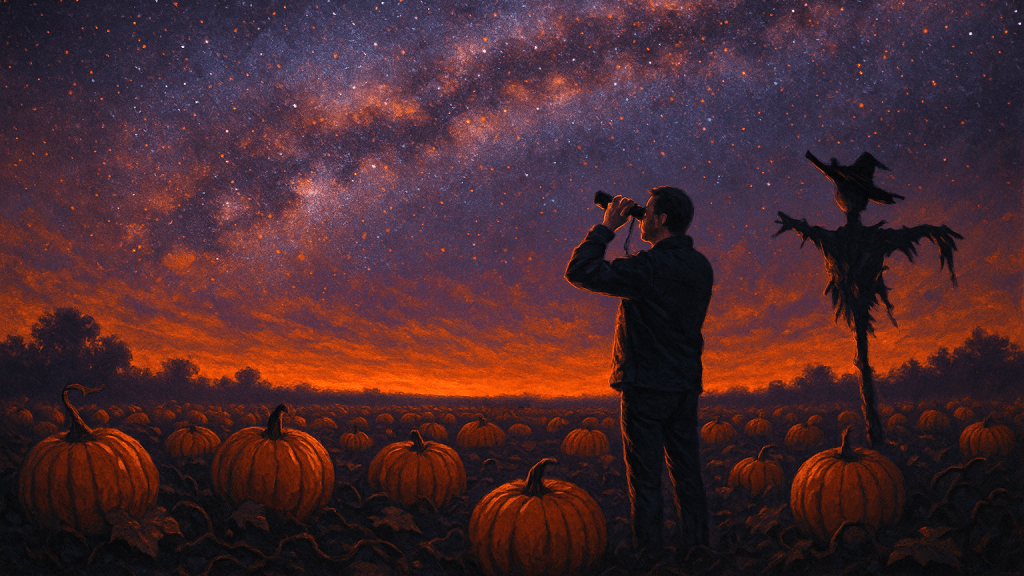
Also, Halloween is later this week, and for our final episode of October, we’re going to examine another eerie topic: In a universe as vast as ours, we ask the question, “where is everybody?”
We’re not looking for little green men or flying saucers necessarily, but with all the potential worlds that surround us, why haven’t we received any indication that someone or something is out there. Could it be that we truly are alone? It’s called the Fermi Paradox, and we’ll take a detour into that and more in the second half of the show.
[MUSIC FADES]
Before I get into the night sky report for this week, I just have a quick update on the show website. If you’re a new listener to the show, you might be wondering which other episodes would be good to go back and listen to.
So, I’ve created a section on the website, startrails.show, with resources for beginning astronomers and new listeners. On the site you’ll see a new option in the top menu called “Start Here.” On this page you’ll find a collection of my favorite episodes from the more than 80 we’ve published since last year. Some of these are very much aimed at the new astronomer, while others cover topics that might be a bit off-the-wall, but still thought-provoking.
I’ve also compiled a collection of links that new astronomers might find helpful, from some of the stargazing apps I use, to websites that are helpful for astronomers at any skill level.
And as always, if you have a question or comment about the show, you can use the contact form on the site to send me feedback. I really enjoy those listener questions.
So with that announcement out of the way, let’s see what’s up in the sky.
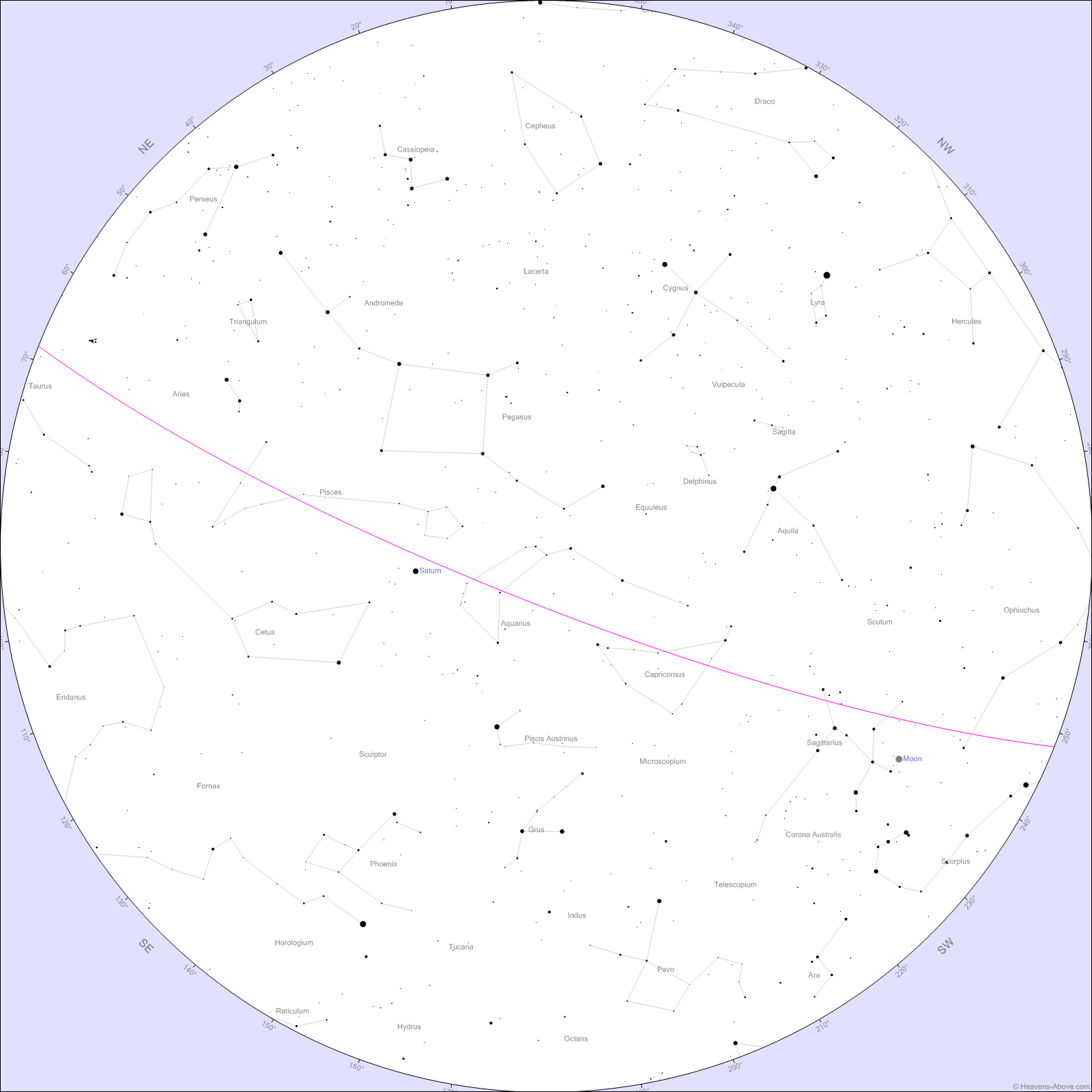
This week, the Moon begins as a slender waxing crescent and grows brighter each night, reaching its First Quarter phase on Wednesday. Early in the week you’ll still have dark evening skies, making it a prime time for faint objects and binocular or small-scope observing. By mid-week, the Moon will shine high at sunset and show off sharp craters and mountain ranges along the terminator, the line between lunar day and night.
After that, the Moon transitions into a waxing gibbous, staying up later into each night. That brighter Moon may wash out faint deep-sky targets, but it opens great opportunities for lunar-surface photography or simply enjoying the moonlit landscape.
Farther out, Saturn is still ruling the evening sky. You’ll find it glowing a soft yellow-white in the southeast after sunset, climbing higher through the night. Even a modest telescope will reveal its rings and a few of its moons.
Jupiter rises later, around mid-evening, and dominates the eastern sky. If you’re up late or awake before dawn, it’s one of the show-stoppers.
Mercury makes a fleeting appearance this week. On the 29th it will reach its greatest eastern elongation. That’s its furthest angular separation from the Sun in the evening sky. Keep a clear view toward the western horizon just after sunset, about thirty minutes or so after sundown. If the sky’s clear and the horizon free of trees or buildings, you might spot the elusive twilight planet.
Mars is fading—low in the west after sunset and chasing into the twilight. And Venus is now a morning star, rising just before dawn in the east. It’s worth a glance if you’re an early riser.
[TRANSITION FX]
Our solar system is still hosting two special guests, and if you’ve been active on any astrophotography forums lately, you’ve probably seen some beautiful images of at least one of them.
Our photogenic visitor is Comet C/2025 A6 (Lemmon). Discovered earlier this year by the Mount Lemmon Survey, it’s on a long-period orbit of roughly 1,150 years. It’s currently brightening and may be visible even with the naked eye under dark skies, though binoculars will make it much easier. For observers in North America, it’s best after sunset in the northwest-to-west sky. It’s low right now, but becoming more accessible. If you have a clear horizon, try locating it with binoculars in the constellation Bootes, a little more than five degrees northeast of Arcturus.
If you can’t find it, just keep enjoying those stunning images other astronomers are capturing. It has a well-defined coma and a long tail that looks like it’s shimmering in a cosmic breeze.
The second visitor that has many people intrigued is Interstellar object 3I/ATLAS. This object arrived from outside our Solar System and it just cruised past Mars a couple weeks ago. It’s classified as interstellar because its trajectory is hyperbolic, meaning it’s not bound to our Sun. And it’s only the third such object we’ve ever recorded.
Scientists are studying it carefully, though for backyard observers it’s faint and difficult to spot. The buzz about it is largely thanks to its interstellar origins.
You may have seen some of the speculation and conspiracies claiming it might be artificial or alien in origin, but mainstream science strongly supports the view that it’s a natural body. So while it’s a fascinating object to follow, keep expectations grounded, because it’s not much to look at.
[TRANSITION FX]
Now for the constellations and the quieter stars of fall. We’ve mentioned them in the past few episodes, but high overhead you’ll find the Great Square of Pegasus, that large, distinctive square shape marking the winged horse of myth. From its top corner, you can trace a line northeast to the Andromeda Galaxy, our galactic neighbor. A pair of binoculars will help you find it. North of that you’ll find Cassiopeia, the queen of the northern sky, hanging high for mid-northern latitudes.
Just below Cassiopeia lies one of my favorite binocular targets: the Double Cluster in Perseus, a pair of star clusters bright and compact, easily enjoyed even in modest skies.
The Milky Way isn’t as obvious as in summer, but if you’re under dark skies early in the week while the Moon is still thin, you can trace its faint river starting south and moving through Cygnus, Cassiopeia, and into Perseus before it drifts into the northeast. It’s a subtle beauty, less dramatic than the summer belt, but rewarding all the same.
Meteor activity from the Orionids is tapering off, but don’t rule out a stray meteor before dawn. If you’re out late, keep a casual eye toward Orion rising in the east and you may catch a bright one.
As always, to truly appreciate the fall sky: take a moment between targets, let your eyes adapt to darkness for about 10-15 minutes. With the heat of summer gone, the air is clearer, and your view reaches farther.
Next up, we’ll step into that stillness more deeply, exploring the vast silence between the stars, and why, in a universe so old and full of worlds, no one seems to be there to answer us.
That’s coming up after the break, stay with us.
[MUSIC UP AND OUT FOR BREAK]
[MUSIC RETURNS]
Welcome back.
There’s a kind of silence in the cosmos that feels different from any other kind. It isn’t peaceful or serene, it’s unsettling. It’s the silence of absence, the long echo of a question that’s never been answered.
We call it the Fermi Paradox: the contradiction between how likely life seems to be, and how alone we appear to be.
In 1950, physicist Enrico Fermi was having lunch with colleagues at Los Alamos. The conversation turned to UFO sightings, and Fermi simply asked: “Where is everybody?”
It was both a joke and a revelation. Because by that time, astronomers already knew the galaxy was ancient, ten billion years older than the Earth, and vast beyond comprehension. Even if just a tiny fraction of those stars had planets, and an even tinier fraction had life, shouldn’t we see some sign of it?
And keep in mind, at this point in astronomy, we hadn’t discovered a single exoplanet. That breakthrough was still more than 40 years away.
A decade later after Fermi’s question, astronomer Frank Drake tried to make sense of it mathematically. In 1961, he hosted a small meeting at the Green Bank Observatory in West Virginia, the first gathering devoted to the search for extraterrestrial intelligence. He scribbled a simple formula on a blackboard to structure their discussion, never imagining it would become iconic.
That formula became the Drake Equation.
It looks intimidating at first glance, full of variables and symbols, but the idea is straightforward, and it’s solvable using basic algebra, provided you can fill in the variables. Drake broke the problem into seven factors:
How many stars form each year.
What fraction have planets.
How many of those worlds could support life.
How many of those worlds produce life.
How often life develops intelligence.
How often intelligent life develops technology.
And finally, how long such civilizations can send detectable signals into space.
Multiply those together, and you get an estimate of how many civilizations might be communicating right now in the Milky Way.
But the genius of the equation wasn’t its precision, it was its humility. It showed us exactly where our ignorance lay. Every variable is a mystery to be solved, and each new discovery — exoplanets, biosignatures, radio surveys — tightened the numbers a little more.
Right now, if you plug some “hopeful” numbers into the equation, you might get a few dozen civilizations in our galaxy right now. If you use more careful, skeptical numbers, you might end up with less than one — meaning we could be the only ones at the moment.
The problem is, most of the numbers in the equation are giant question marks. We don’t know how often life begins, how often it becomes intelligent, or how long a civilization like ours stays detectable before it disappears. The math is strangely easy — it’s the facts we don’t have.
Drake didn’t stop there. He also co-founded Project Ozma, the first modern SETI experiment, using the Green Bank Telescope to listen for radio signals from two nearby stars. The effort was modest, just a few months of listening, but it sparked something profound.
Soon after came the idea that we shouldn’t just listen, but speak. In 1974, the Arecibo Message was transmitted toward the globular cluster M13, a tightly packed group of stars 25,000 light years away.
The signal, composed of 1,679 binary digits, encoded the numbers one through ten, the elements essential to life, DNA’s double helix, a stick figure of a human, the solar system, and the Arecibo telescope itself. It was symbolic more than practical. By the time the signal arrives, M13 will have drifted away, but it was a statement: We are here.
A few years before Arecibo, in 1972 and 1973, NASA’s Pioneer 10 and Pioneer 11 spacecraft became the first human-made objects to leave the solar system. Each carried a small aluminum plaque etched with a map of our location in the galaxy and the image of a man and woman greeting whoever might find it.
The Voyager 1 and 2 spacecraft went further. Each carried a gold-plated record, sealed against time, containing music from Bach to Chuck Berry, greetings in dozens of languages, and sounds of our planet, such as wind, rain, laughter, thunder, birdsong, even the heartbeat of a mother and child.
Together, these were our cosmic time capsules, drifting ever outward at 17 kilometers per second, bearing a message for listeners we may never meet. The most human of gestures: a greeting in the dark. We covered the Golden Record in episode 52 and included many sounds from it in the episode, so go back and check it out if you missed it.
By the 1990s, the search took a new form: Digital crowdsourcing. The SETI@Home project turned ordinary computers into a distributed radio telescope. Millions of volunteers – and I was one of them and maybe you were too – downloaded screensavers that processed chunks of data collected by the Arecibo Observatory, searching for narrow-band signals that might indicate alien transmissions.
For two decades, it quietly scanned billions of frequencies, running in the background on computers around the world. Humans, united by curiosity, gave their idle CPU cycles to the search for cosmic company. It was science as global collaboration and the largest volunteer computing project in history.
Sadly, SETI@Home never discovered any alien signals. The program went into hibernation in 2020, but its legacy continues in new AI-driven searches like Breakthrough Listen, which now monitors billions of stars with unprecedented sensitivity.
And yet… the silence persists.
Which brings us back to Fermi’s haunting question. Some have speculated a “Great Filter” — a stage in evolution so perilous that few make it past. Perhaps intelligence carries the seeds of its own destruction, ecological collapse, nuclear war, or even artificial intelligence run amok.
If the filter lies behind us, we’re lucky. If it lies ahead, the silence may be a warning.
Others suggest more poetic explanations. Maybe civilizations retreat inward, turning to virtual worlds richer than reality itself. Maybe they transcend physical space altogether, existing as patterns of energy or information.
Or maybe the galaxy is a Dark Forest, where every civilization hides in terror, knowing that to announce their presence might invite annihilation. In that sense, silence isn’t failure, it’s strategy.
And then there’s the humbling possibility that we simply don’t know how to listen. Alien intelligence might communicate in ways beyond our comprehension, through neutrinos, gravitational waves, or quantum entanglement. Their language could be encoded in magnetic fields or stellar oscillations. To them, our radio beacons might be as primitive as cave paintings.
Personally, I believe in the simplest explanation: Space is simply unimaginably vast.
The nearest star, Proxima Centauri, is more than four light-years away. That’s about 25 trillion miles. Even if we sent a message traveling at light speed, it would take more than eight years for a round-trip conversation. And that’s with our closest neighbor. The rest of the galaxy stretches across a hundred thousand light-years.
Also, radio waves, like light, weaken as they travel. What begins as a clear signal near its source dissolves into noise over cosmic distances. Heck, if you’re involved in ham radio, you’ve likely seen signals fade dramatically over just hundreds of miles.
The signals that escape Earth fade into the background hum of the universe long before they reach most of the stars we dream about. It’s not like the beginning of the movie CONTACT, where we zoom into the Solar System from light years away hearing our earliest broadcasts echo through the void as clear as they were the day they were made.
It’s entirely possible that the cosmos is teeming with voices, each calling out into the dark, but none strong enough to bridge the gulf between them. A million lonely transmitters, all speaking, all unheard.
Maybe the idea of that loneliness creates a feeling of existential dread. And here’s another eerie Halloween thought: When you look up, much of the starlight falling on your eyes began its journey long before humans existed. It crossed unimaginable distances, unbothered by our loneliness, carrying no reply, just photons from ancient suns.
And the silence isn’t nothing. The quiet between the stars may be the most profound message of all: a reminder that the universe is vast enough to contain both our fears and our hopes, our solitude and our longing.
[MUSIC]
If the stars spoke to you this week, or if a question’s been on your mind, I’d love to hear it. Visit startrails.show, where you can contact me and explore past episodes. Be sure to follow Star Trails on Bluesky and YouTube — links are in the show notes.
Until we meet again beneath the stars … clear skies, everyone.
[MUSIC FADES OUT]
Support the Show
Connect with us on Bluesky @startrails.bsky.social
If you’re enjoying the show, consider sharing it with a friend! Want to help? Buy us a coffee!
Podcasting is better with RSS.com! If you’re planning to start your own podcast, use our RSS.com affiliate link for a discount, and to help support Star Trails.
 Star Trails: A Weekly Astronomy Podcast
Leave a comment