A Postcard to the Cosmos: Recreating the Arecibo Signal – Star Trails: A Weekly Astronomy Podcast
Episode 86
This week on Star Trails, we explore the messages written across the cosmos, from faint comets in our own skies to the coded signals we’ve sent into the void. Drew shares a quick report from his local astronomy club’s fall star party, where hopes of photographing Comet A6 Lemmon met the familiar mix of excitement, haze, and grilled hamburgers under imperfect skies.
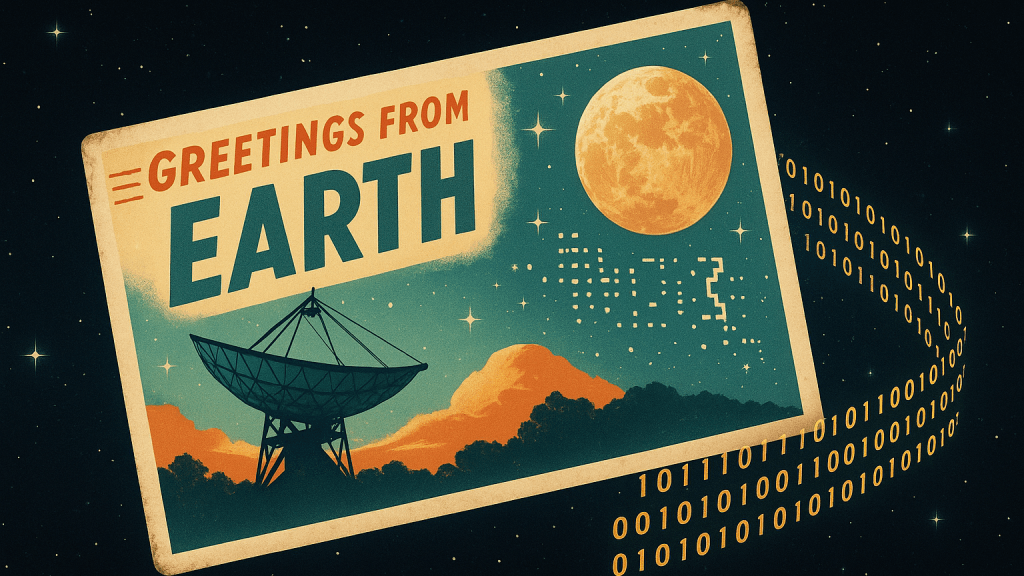
Then we turn from backyard observing to deep-space communication with a hands-on look at the Arecibo Message — the radio transmission beamed from Earth in 1974 as humanity’s mathematical greeting to the stars. We’ll break down what that signal said, how it was constructed, and whether an alien civilization could ever decode its meaning. Along the way, Drew uses Python to transform the original binary message into sound and decode it again to reveal the famous stick figure, DNA helix, and planetary map.
It’s a story about logic, language, and what it means to say hello to the universe, and a reminder that every beam of light and burst of radio energy carries a trace of who we are.
Links
Transcript
[MUSIC]
Howdy, stargazers, and welcome to Star Trails. I’m Drew, and I’ll be your guide to the night sky for the week of November 2 through the 8th.
This week we’re talking about messages — the kind we send across the cosmos, and the ones written in starlight. I’ll share a quick report from my local club’s fall star party, before we dive into what’s happening overhead this week. Then, in the second half of the show, we’ll turn our gaze from the backyard to deep space to revisit the Arecibo Message — the radio signal humanity beamed toward the stars more than fifty years ago. We’ll break down what it said, how it worked, and whether anyone — human or otherwise — could ever decode it.
[MUSIC FADES]
Before we get into this week’s night sky, I’d like to take a moment to report on the star party I attended last week. My local club was holding their fall cookout at their dark sky site about an hour north from where I live.
This year I had high hopes to get in some serious stargazing. In particular, I wanted to get eyes on Comet A6 Lemmon, and maybe even photograph it. We’d had cooler weather and clear blue skies all week, but as I made my way to the site Saturday afternoon, I noticed some haze on the horizon and high-altitude clouds moving in.
Just before 6 p.m. I was welcomed by club president and friend of the podcast, Mike Roberts, occupying his important position at the grill. If nothing else, we’d have a good meal. Turns out, that may have been the highlight of the night.
Just before 7 p.m., in the fading twilight, I scanned the sky for Lemmon with my 11×70 binoculars. Some low-lying clouds finally drifted away, and the comet emerged in my field of view, resembling a small, very dim, hazy snowball. In the binoculars, I could detect a hint of a tail. If I hadn’t been looking for it, I could have easily swept right past it. The only thing that gave it away was that it looked soft and fuzzy against the neighboring in-focus stars. All the credit goes to the Stellarium app for helping me locate it.
Having spotted Lemmon, I decided to try for a photo. Since I only had my camera and some lenses, it would have to be a wide field shot. At 70mm on a full frame camera, it was woefully small, but the coma and tails were visible enough. I stepped up to 200mm, and results weren’t much better on single-exposure shots. I won’t be showing these off anywhere.
By then, the clouds were rolling back in around that portion of the sky, so I aimed higher, and towards the opposite side of the sky, catching the Andromeda Galaxy in binoculars – another fuzzy blob at this magnification. The Milky Way’s dim river of light was crossing directly overhead with Cygnus the Swan gliding along its path. We spotted numerous satellites drifting by.
After about an hour, the atmospheric haze seemed to multiply and the sky was looking grey rather than black. The seeing tanked, so I packed up and headed home.
Sometimes it seems like these star parties are cursed, and then there are nights when the sky is so clear the stars seem to hover just feet above us. If nothing else, there’s food, camaraderie, and an array of scopes to check out. If you’ve ever wondered what a star party is like, go back and listen to episode 41, where I combined the sights and sounds of a party into an immersive first-person report.
[TRANSITION FX]
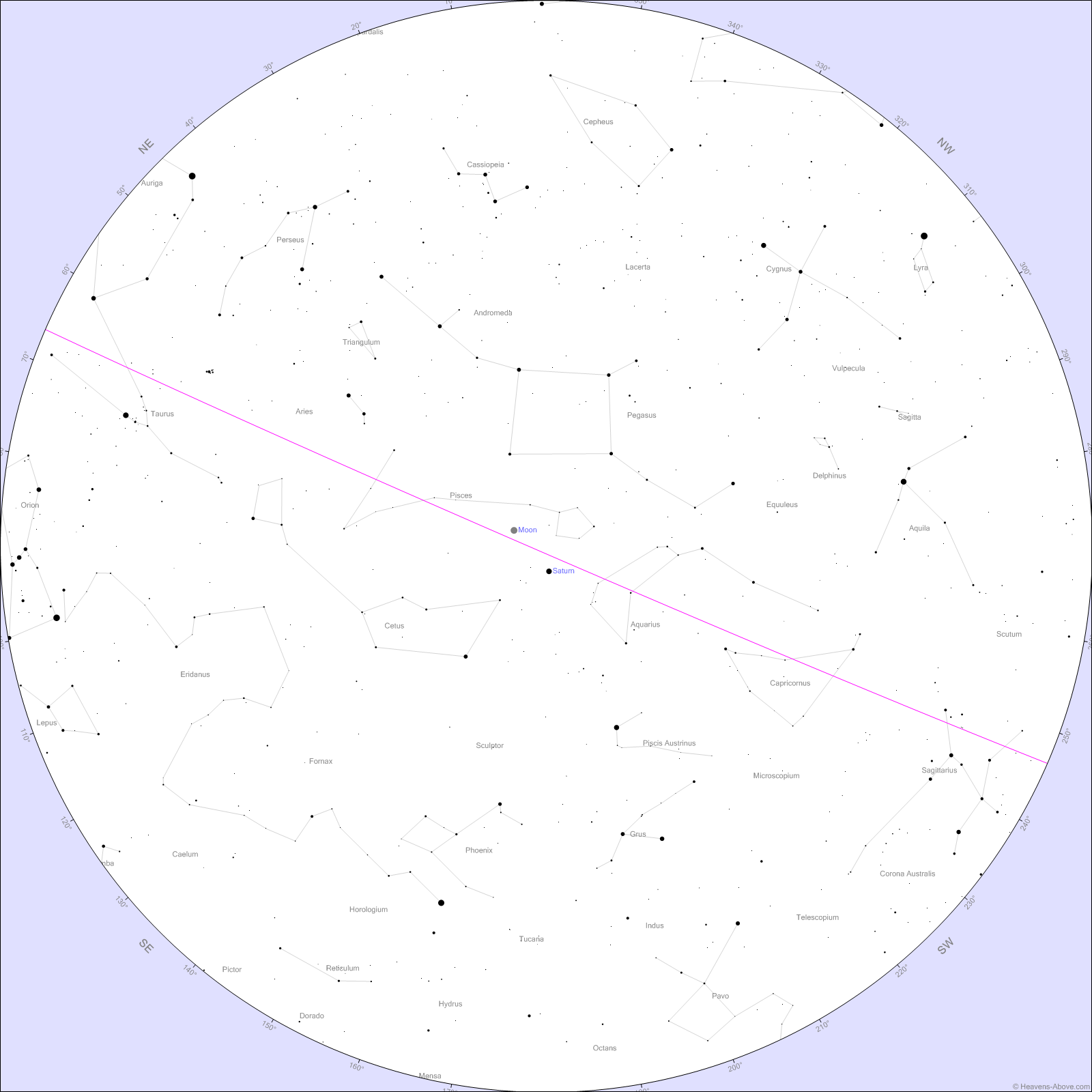
This week the Moon takes center stage. It begins the week as a waxing gibbous, bright and nearly full, and reaches its full phase on Wednesday — also known as the Beaver Moon.
This one’s also a supermoon, appearing a touch larger and brighter than usual as it makes one of its closest approaches to Earth this year. After that, the Moon begins to wane, spending the weekend as a waning gibbous rising later each night.
The Moon will light up the sky all week, so it’s not the best time for chasing faint nebulae or galaxies. But if you’re into lunar photography or moonlit landscapes, these bright nights are perfect.
That high-contrast autumn air makes craters, mountains, and maria pop beautifully through binoculars or a small telescope.
As for the planets, Saturn hangs low in the southeastern sky just after sunset, shining with a steady golden light. It drifts southward through the evening, setting before midnight.
Jupiter rises later in the night and commands the morning sky.
You’ll find it high in the east-southeast before dawn, bright and unmistakable. Through a telescope, its cloud bands and the four Galilean moons are always worth a look.
Venus joins the morning show as well. The bright “morning star” gleaming low in the east before sunrise. It’s slowly sinking toward the Sun as November goes on, so catch it early while it’s still prominent.
Mercury is hiding too close to the Sun this week, and Mars remains faint and distant, but both will become more interesting later this year.
For constellations, the autumn zodiac still dominates the evening — Pisces, Aries, and Taurus spread across the southern sky — while the great winter constellations are just starting to rise. If you stay up late, look toward the east, and you’ll see Orion beginning to climb above the horizon, a reassuring sign that the bright winter sky is around the corner.
[MUSIC]
Coming up, we revisit the Arecibo Signal, the message fired into space more than 50 years ago as a greeting to intelligent life. We’ll take a look at the format of the message and investigate if an alien species could even figure out how to decode the message if they received it.
To find out, we’re going to build our own decoder and generate our own version of the message.
That’s after the break, stay with us.
[MUSIC UP AND OUT FOR AD BREAK]
[MUSIC RETURNS]
Welcome back.
In our last show, we examined the idea of the Fermi Paradox, the idea that in a universe so vast, how is it possible we haven’t communicated with any other species. And if you heard the episode, you might recall that we spent some time describing one of humankind’s attempts to reach out to extraterrestrial life.
Of course, I’m talking about the Arecibo Message — a burst of binary code sent from Earth in 1974. It lasted just under three minutes. And though it was meant for ETs, I’ve often wondered if anyone could actually decode it if they received it. That’s the subject of this half of the show.
We’re going to take the original binary message intended for the stars and turn it into audio, then we’re going to decode that audio in a modern way and see if we can reproduce the Arecibo Signal the way in which it was intended to be seen.
Let’s set the scene: The story begins at the Arecibo Observatory in Puerto Rico. It’s November 16, 1974, and the telescope has just undergone a major upgrade. To celebrate, scientists Frank Drake and Carl Sagan wanted to do something audacious. So they decided to send a message to the stars.
Arecibo was the most powerful radio telescope on Earth at the time — a 305-meter dish carved into a limestone valley. It could transmit a million watts at 2,380 megahertz — a frequency in the S-band, far above radio frequencies we generally listen to.
To send a message into space, the team at Arecibo used a technique called phase modulation – essentially flipping the phase of a radio wave back and forth to represent the ones and zeros of a binary message. We didn’t transmit audio or spoken words into space – just pure data, and at that time, it was the most powerful signal to leave Earth.
The signal’s final destination is the globular cluster M13 in the constellation Hercules, 25,000 light-years away. M13 was selected because it was in the sky when the signal was scheduled to be sent. Crafted by Drake and Sagan, the message was a postcard to the cosmos that said, “we’re here.”
When decoded, the signal reveals quite a bit of information about the human experience – our science, our genetic makeup, where we are in the universe and more. But could anyone figure out how to convert the signal to meaningful data?
To try and answer that question, let’s look at what it takes to create such a signal, and how we can use some relatively simple tools to crack the code.
We’ll start the investigation by learning a little more about the signal and its structure, because the key to unraveling it lies in simple math.
The message itself was exactly 1,679 bits long. When we refer to a bit, we’re talking about a single on-off state, or in this case, a 1 or a 0 – binary.
The number of bits in the message, 1,679, was not chosen at random. It’s the result of multiplying two prime numbers: 23 and 73. And that’s the first key to unlocking the puzzle.
If you arrange the sequence of ones and zeros into a tall rectangle, 23 columns across, and 73 rows down, a picture emerges. The zeros represent a space, the ones represent a graphical block. You could even use a spreadsheet, or graph paper, and plot the ones and zeroes into a 23×73 grid and see the familiar pattern of the signal emerge. Any other combination results in a muddled message.
Let’s break down the resulting image from top to bottom. You’ve probably seen it in science books since the 1970s.
The sequence starts with a representation of numbers one through ten, written in binary.
Below that, the atomic numbers of hydrogen, carbon, nitrogen, oxygen, and phosphorus — the elements that form DNA.
Then, a diagram of DNA’s double helix, with a number showing how many base pairs it contains.
In the center, a little stick figure of a human, next to a bar showing our height and a number indicating Earth’s population in 1974 — about four billion people.
Beneath that: a row of nine dots representing the planets of our Solar System, with the third one offset — that’s Earth. And yep, Pluto was still a planet back then.
Finally, at the bottom, there’s a representation of the Arecibo telescope itself, with a coded version of its diameter.
The signal was designed to be so universal that it didn’t require spoken language to read it — just logic and math. If you’ve ever read or seen the movie, CONTACT, written by Sagan, you might recall prime numbers were also used there to decode a message from the stars. Primes are useful in this field because they are mathematically special, not likely to occur naturally as arranged signals or patterns in nature. Sagan used them as the logical bearer of meaning before words or images. Fortunately, we know this going into our experiment.
To see how readable the signal really is, I decided to recreate it using modern tools. My weapon of choice is the general-purpose programming language of Python. It’s a language I have some experience with, and the high-level nature of Python means coders have access to some really advanced functions, such as modules that do the heavy lifting of signal generation and analysis.
Basically, I set out to create a “software modem” to modulate and demodulate the Arecibo Signal.
With some lines of Python, I took the original binary sequence from Wikipedia — all 1,679 bits — and mapped it to sound. I decided to use a protocol inspired by my ham radio experience – frequency-shifted keying, or FSK. With this technique, I assigned specific audio frequencies to the ones and zeroes – in this case, 1,200 and 1,800 hertz.
It’s essentially the same basic principle ham operators use in digital modes like radio teletype.
To match the data rate of Arecibo, we’re encoding 10 bits per second, which results in a transmission just under three minutes in length. Finally, the script outputs the binary stream as a wave audio file that can be played on any device.
At this point, our result is virtually the same as the signal sent from Arecibo, with one big difference – since we’re shifting between two audible frequencies, we’ve essentially “sonified” the raw data so we can now hear it. Remember, the Arecibo Message simply shifted the phase of a carrier wave to represent the data, so there wasn’t much to actually listen to in the original transmission.
Our version sounds like a stream of robotic chirps and pulses. I could send it out into the ether with my ham radio transceiver if I wanted, and someone could, in theory, decode it. They would need to understand the protocol – in other words, my data rate and how the data is structured once received – essentially that 23×73 grid we mentioned.
So, to complete the circle, let’s now decode the message, using another brief python script.
We need to first load up the audio file for analysis, and fortunately, python contains libraries that do just that. Knowing the data rate of 10 bits per second, we segment the audio into windows of one-tenth of a second.
For each window, we measured the energy of those two tones. Whichever frequency was stronger became that bit’s value — a one or a zero.
Presumably, an alien species could analyze the message and see there is patterned information that appears in regular intervals. If you load up our wave file into an audio editor like Audacity, you can zoom into the waveforms and actually see the alternating tones.
When you string these bits back together, you get the same binary sequence that left Earth in 1974. Using a graphic library in python, we can plot the binary values into that 23-by-73 grid, and pop out the resulting image as a PNG file.
And there it is. The Arecibo message with its familiar DNA helix, stick figure and radio dish.
If you’d like to try this for yourself, I’ll make my code, wave file and resulting graphic available in the show notes. You’ll need Python installed on whatever computer you’re using, and you may need to install the special libraries that we import at the top of the scripts. I’m using Linux, but Python runs on everything from Windows to macOS to systems-on-chip, like the Rapsberry Pi.
So, encoding and decoding the Arecibo Signal is actually somewhat straightforward. But only because we already knew how it was constructed. Assuming an intelligent civilization made it this far, would they even understand what they are looking at? Can we as humans even understand it?
A viewer would see the geometric shapes: Stripes, dots, the stick figure of a human.
Would you recognize that the bar next to the human represents height in binary? Would you realize that those five lines of dots are atomic numbers? Would you know that the twin spirals are DNA?
Even for us, with all our context, the meaning only emerges because we already basically know the story. We know what DNA looks like. We know what a solar system looks like. We know what a human is. Although I’m willing to bet most of us don’t know how to convert binary to the familiar numbers of a base-10 system.
An alien species wouldn’t share those references. They might not even perceive visual patterns the way we do. Maybe they’d interpret the entire thing as a mathematical proof, or a piece of music, or a coordinate map. Or maybe they wouldn’t recognize it as a message at all.
The Arecibo pictograph looks self-explanatory to us because it IS us.
And that’s the trap: it’s anthropocentric. It’s written in the language of human experience, dressed in the symbols of universal truth – yes or no, on or off.
So imagine you’re the one receiving it — an alien scientist, staring at a stream of data from the sky. How do you even begin?
Maybe you notice a repeating pattern of phase shifts — okay, maybe it’s digital. You count 1,679 bits. You somehow realize that’s 23 times 73 — both prime. You try arranging the bits. Maybe you find the right orientation, maybe not. And if you do, you’re still faced with a puzzle made by a species you’ve never met, living on a world you’ve never seen. No shared biology. No shared reference frame.
It’s like solving a crossword puzzle in a language that doesn’t exist.
Maybe this works both ways. Maybe we’ve already received messages like this and never recognized them. We’ve detected fleeting, unexplained radio bursts — the famous “Wow!” signal, Fast Radio Bursts that repeat and vanish. Maybe they’re natural. Or maybe they’re messages encoded in forms we can’t yet decipher.
SETI scientist Paul Davies once said that an alien transmission might be “hidden in plain sight — a pattern so subtle we mistake it for noise.” And Jill Tarter reminded us: “If the universe is speaking to us, we might not recognize the language.”
The Arecibo Message was meant to say something — about who we were and what we could do. It was an act of optimism — a beacon of math and meaning, beamed into the dark.
Even now, more than fifty years later, that signal is still traveling outward at the speed of light, racing across the space between stars.
Long after our voices fade, that signal will keep going, like a perfectly preserved artifact of curiosity and intelligence.
Maybe, someday, someone will catch it. Maybe they’ll rearrange the bits and see the shape of a human. And maybe they’ll wonder who we were. Or maybe they’ll see nothing at all.
The Arecibo message was just the beginning. Since 1974, we’ve sent a handful of others, each one a new experiment in interstellar communication.
In 1983, Japan’s Message to Altair carried digital greetings toward a nearby bright star. In 1999 and 2003, the Cosmic Call 1 and 2 projects transmitted more elaborate, self-describing data sets toward multiple sun-like stars.
Later came the Teen Age Message in 2001, a musical broadcast created by Russian students, and NASA’s 2008 Across the Universe signal, which beamed a Beatles song toward Polaris.
That same year and into 2009, messages such as A Message From Earth and Hello From Earth targeted the potentially habitable world Gliese 581 c, carrying thousands of short notes from people around the globe.
Each attempt has been part scientific demonstration, part act of faith. Whether these signals ever reach another mind is unknown, but together they form a faint chorus of intent: evidence that at least once, and then again and again, a small species on a small planet looked up and tried to say hello to the universe.
[MUSIC]
If the stars spoke to you this week, or if a question’s been on your mind, I’d love to hear it. Visit startrails.show, where you can contact me and explore past episodes. Be sure to follow Star Trails on Bluesky and YouTube — links are in the show notes.
Until we meet again beneath the stars … clear skies, everyone.
[MUSIC FADES OUT]
Support the Show
Connect with us on Bluesky @startrails.bsky.social
If you’re enjoying the show, consider sharing it with a friend! Want to help? Buy us a coffee!
Podcasting is better with RSS.com! If you’re planning to start your own podcast, use our RSS.com affiliate link for a discount, and to help support Star Trails.

 Star Trails: A Weekly Astronomy Podcast
Leave a comment