Sad Astronomy: Reflections on Distance, Death, and Meaning – Star Trails: A Weekly Astronomy Podcast
Episode 88
This episode begins with auroras and interstellar objects and ends somewhere much closer to the heart. After catching up on the week’s sky – dark moonless nights, Mercury in the dawn, meteor activity, and the quiet unraveling of comet 3I/Atlas – we shift into something different.
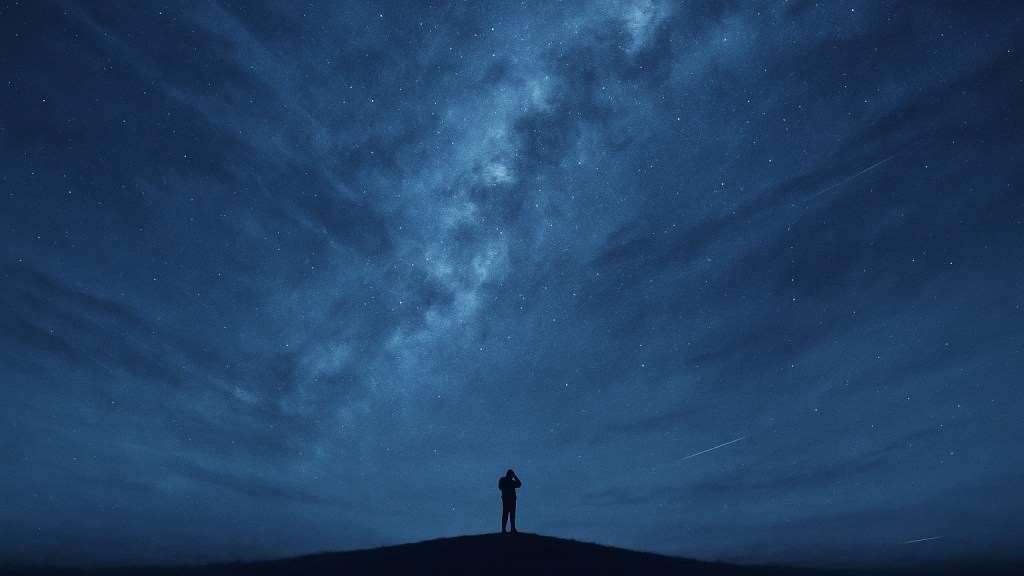
We’ll explore the idea of “sad astronomy”: the loneliness of deep space, the slow death of stars, the fragility of spacecraft, the silence of the cosmic void, and why so many stargazers feel a mix of awe and melancholy when they look up.
Along the way we wander through pop culture – the films Contact, and Interstellar, the Challenger and Columbia tragedies, the ghost glow of old light, the Arecibo message, Voyager’s endless journey, and the overview effect, the transformative shift astronauts feel when they see Earth from above.
It’s a meditation on distance, death, meaning, and the strange comfort found in the cold geometry of the cosmos.
Transcript
[MUSIC]
Howdy stargazers and welcome to this episode of Star Trails. My name is Drew, and I’ll be your guide to the night sky for the week of November 16th through the 22nd.
This week the moon leaves us for a few nights, revealing deep sky objects and clearing the way for dual meteor showers. We’ll check in on interstellar object 3I, and hopefully, you caught the Northern Lights last week.
Later in the show, we’ll take a detour into something a little different, something that’s been on my mind lately – the feeling that creeps in when you look at the night sky and wrestle with its scale.
Some people call it sad astronomy. It’s about the loneliness of deep space, the weight of old light, and the knowledge that everything must one day come to an end.
Whether you’re joining us from the backyard, the balcony, or just your imagination, I’m glad you’re here. So grab a comfortable spot and lets get started!
[INTRO MUSIC FADES OUT]
Before we get into the episode, we need to talk about the Northern Lights, because last week, the sun was once again putting on a show. If you were like me, you were glued to social media feeds watching folks post images of last Tuesday’s low-lattitude aurora.
It wasn’t quite as dramatic as the outburst last spring, at least not in my neck of the woods. All the images I saw locally were mostly just a red sky glow – those higher altitude aurora that I find particularly vexing to see, owing to both my own red-green colorblindness, and the way our eyes work – color is hard to see in dim conditions. That’s why your camera can often “see” aurora better than our eyes can.
I didn’t try to photograph it myself, but I enjoyed seeing everyone else’s efforts. Another coronal mass ejection blasted Earth the following day, Wednesday, and initial reports said we’d get aurora even farther south. By the time nightfall arrived, the prediction had shifted, and as far as I know, there were no Northern Lights down south on that day – too bad, because I had my camera and tripod loaded up and a road trip to a dark site planned.
If some of you caught photos of the light show, visit startrails.show and use the contact form there to let me know what you saw. I’d love to see what it looked like in your backyards.
[TRANSITION FX]
If you’ve been following any space news lately, you may have already heard that the excitement over interstellar object 3I/Atlas may be coming to an end, as it looks like the object has broken up during its close approach to the sun.
3I/Atlas is only the third confirmed interstellar object to drift through our solar system, following ʻOumuamua (1I) and Comet Borisov (2I). What makes Atlas intriguing is that, unlike ʻOumuamua’s enigmatic “pancake” or cigar-like geometry, Atlas presented as a more conventional comet — a nucleus with a modest coma. Over the last several weeks, astronomers have reported asymmetric brightening, a diffuse tail inconsistent with a single intact nucleus, and a slight shift in the object’s photometric center, all of which hint that Atlas might be breaking up, shedding fragments as it approaches perihelion.
Interstellar comets have hard lives. They spend millions of years adrift in space where the volatile ices that hold them together become fragile, desiccated, and riddled with micro-fractures. When such an object suddenly gets slammed with the full solar onslaught — heating, tidal forces, and radiation, those ancient weaknesses can give way. If Atlas is fragmenting, it’s probably because sunlight is turning its interior gases back into pressure, popping it apart like a cosmic blister.
Observatories tracking it have suggested either multiple small fragments or a single nucleus that’s beginning to shed material in uneven spurts, which creates that ghostly, broadened tail.
Break-up or not, Atlas is writing its autobiography in real time, and we get to read it. Fragmenting comets reveal their internal structure — the density, the layering, the mix of ices and dust — better than any intact pass ever could. And in Atlas’s case, everything we learn is a direct sample of another star system. Even if Atlas dies on approach, the disintegration itself becomes the science.
[TRANSITION FX]
The sky is a polite guest this week — no lunar glare, no drama, just clean darkness for deep sky enthusiasts and astrophotographers.
We’re sitting in a sweet spot on the lunar calendar. The Moon is fading into a waning crescent tonight, shrinking each morning, and it’s a New Moon by the 20th. That means we get a mid-week window of truly dark skies — the kind of darkness that makes the dim stuff pop. By the 22nd there’s the barest sliver of a waxing crescent after sunset, but it’s too low and too subtle to wash anything out.
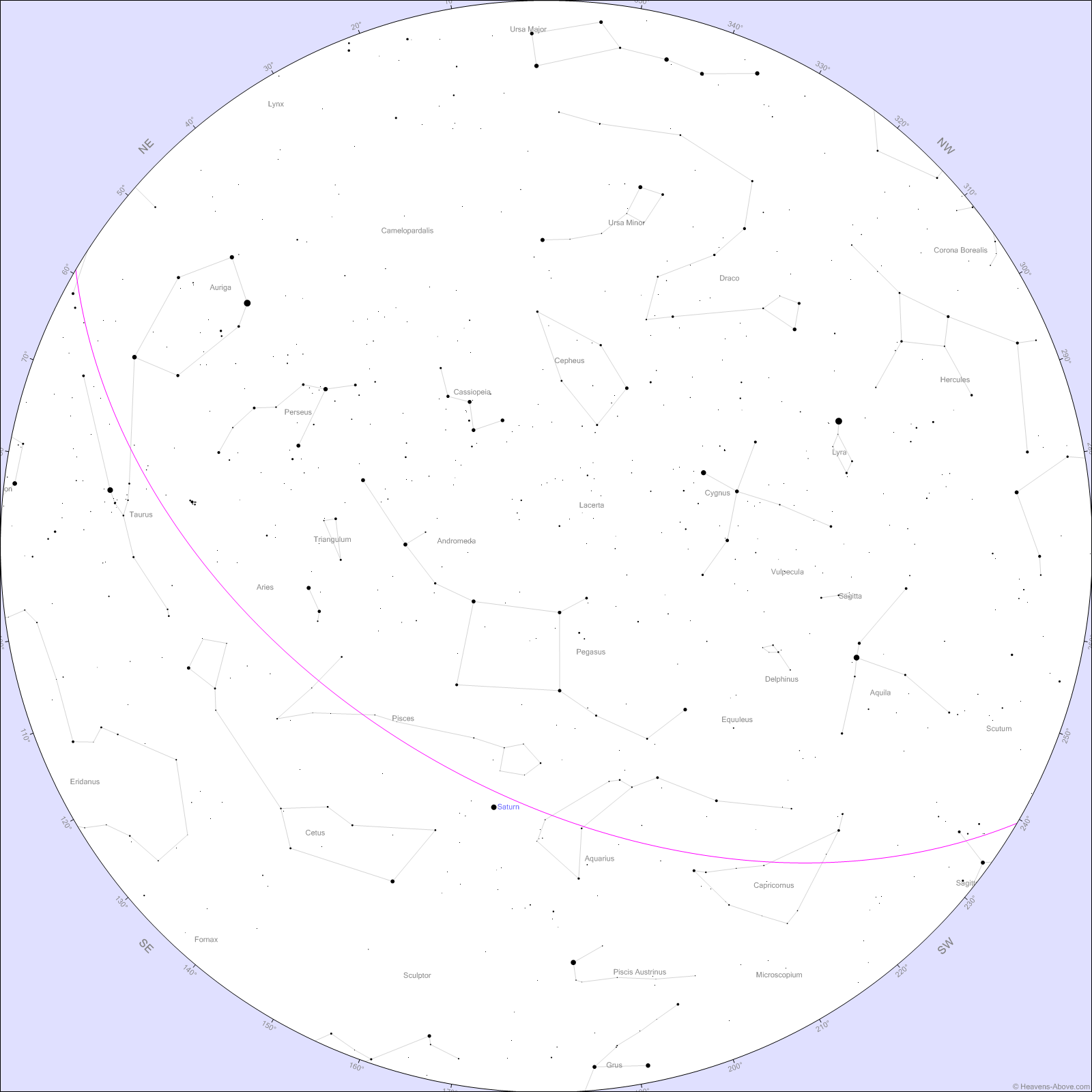
The planets are arranged in a neat little lineup this week. Saturn hangs in the southwest after sunset — mellow, steady, and easy to pick out. Jupiter rises earlier each night and dominates the late-evening sky, bright enough to stop you in your tracks.
And very early in the morning — especially by the 21st and 22nd — Mercury begins its climb into the predawn sky. It’s low, it’s fleeting, and the horizon needs to be clear, but it’s there. Venus is technically in the dawn too, but so low and faint this month that it’s not worth chasing.
With the Moon out of the way, the constellations take center stage. Cassiopeia is high in the northeast, and right below it sits Perseus, carrying the gorgeous Double Cluster — a binocular objects that is always a crowd-pleaser.
And in the east, the winter stars — Capella, Aldebaran, the first hints of Orion’s belt — are beginning to claim the late-night sky. Every night of November is an inch closer to full wintertime brilliance.
Now for the really fun stuff: meteor activity. We’re nearing the peaks of two November showers, and both benefit from the New-Moon darkness. First are the Leonids, famous for their historic storms, though this year they’re modest — maybe a handful per hour. They leave fast, bright streaks, and with the Moon gone they stand out beautifully.
The Leonids peak around the 17th and 18th, so the early part of the week is the best time to catch them. Then later in the week, the Alpha Monocerotids get a brief mention. They’re normally minor, but they’re unpredictable, and every so often they produce a sudden spike of activity.
With the dark skies, it should be easy to catch a meteor or two leaving a quick autograph across the sky.
[MUSIC]
Coming up – does the night sky make you sad? Do you find yourself questioning your own existence as you ponder the scale of the universe? Does the eventual heat death of the cosmos make you uneasy? If so, you’re not alone. This is the realm of “sad astronomy” and it’s a real phenomenon.
After the break, we’re going to have a cosmic meditation of sorts, on distance, on loss, on why we look up even when the universe doesn’t look back.
Think of it as a melancholy stretch of road between curiosity and hard science. It sounds cold, but I promise we’ll end in a warm place.
I’ll take you there after the break. Stay with us.
[MUSIC UP AND OUT]
[AD BREAK]
[MUSIC RETURNS]
Welcome back.
Astronomy is often described as a science of wonder: stars, nebulae, the promise of distant worlds. But behind that wonder, there’s another feeling, harder to name. It’s the silence after the signal fades.
It’s the awareness that most of what we see is already gone.
That’s sad astronomy. It’s the emotional gravity that comes from realizing how brief we are, and how magnificent the universe remains without us.
Sad astronomy isn’t hopeless, it’s honest. And honesty, like starlight, travels a long way.
Astronomy may very well be the study of everything that’s already gone. Every photon we catch in our telescopes left its home before any of us were born. Some of those stars don’t even exist anymore.
Space isn’t so much a place, as it’s a memory stretched across time.
For the past few episodes we’ve been knee-deep in data, models, probabilities, and even quantum computing. Tonight, I just want to step back and look at what all of it means, even if the beauty hurts a little.
Some of you may recall we didn’t have any episodes back in September. Part of that was simply the slings and arrows of life – but it was mostly because I had to take some weeks to reflect on my own tiny place in the universe, having just reached that gloomy age of 50. I’m sure you’ve noticed our topics lately have been a little meta, these large-scale ideas about our own existence. You could argue this podcast has been in “sad astronomy” mode for the past few weeks.
I’d never even heard the term “sad astronomy” until recently – but it’s real. It’s generally the study of how things end – the deaths of stars, galaxies, and the universe itself. But it also deals with how we feel when we look up at night. The vastness that makes us feel alone and tiny. The isolation we experience as specialists in a hobby where we often find ourselves physically alone, under a dark sky in the cold, chasing meaning and truth through the chromatic aberrations of eyepieces, fogging lenses and slightly misaligned mirrors.
Many, many people experience sadness in astronomy. Just searching for the term “sad astronomy” reveals endless forums and websites where observers wonder why space makes them feel dread and despair.
So in this episode, I want to share a kind of essay, told in five parts. Five brief reflections about distance, death, and endurance. And each one is a different way of hearing the universe’s song.
PART I – Silence and Distance
A telescope is essentially a time machine. When we look outward, we look backward. The light from Andromeda began its journey two and a half million years ago, long before the first humans carved symbols in stone.
Even the light from our own Sun is eight minutes old, a gentle delay between cause and effect, presence and memory.
Astronomy is the only science where the past never stops arriving. And the deeper we peer, the lonelier it becomes. The cosmos is expanding; galaxies are slipping away beyond reach.
Someday, the universe will outgrow our ability to see it. What will we do when the sky goes dark, not from clouds, but from time itself?
Light has a speed limit, and beyond that line there’s only silence.
Science fiction has tried to translate that silence for us.
In the film Contact, Jodie Foster listens for a signal, not just from aliens, but from meaning itself.
In Interstellar, Matthew McConaughey crosses the galaxy chasing love and time, and Anne Hathaway’s character, in a monologue I once found very cringy, insists that love is the one thing that transcends dimensions.
Carl Sagan said it better: “For small creatures such as we, the vastness is bearable only through love.” Not as a force of nature, but as a human survival instinct. We invent connections to make the infinite feel habitable.
These films are meditations on cosmic loneliness wrapped in the search for meaning. And those aren’t the only ones: there’s Solaris – the prototype for cosmic loneliness, of course, 2001: A Space Odyssey – existential, indifferent, and yet simultaneously glorifying the evolution of Man as he takes his first baby steps into deep space. And, Ad Astra, which tells us, the further out we journey, the more alone we are.
PART II – Ghosts of Light
A nebula is a graveyard that glows. It’s the ashes of a star, still burning with borrowed light. Every atom of carbon in our bodies was made in one of those funerals. We are, literally, the residue of dying suns.
When I look through my telescope, or photograph something like the Crab Nebula, I’m watching the aftermath of a death that happened before there were pyramids.
The light just took this long to reach us. Sad astronomy means standing in that afterglow, seeing beauty born from catastrophe,
and realizing that’s also what it means to be alive.
Eventually no new stars will form, the universe will suffer heat death and all warmth and structure will fade. Right now, 99.9% of the universe is actually empty. And light’s speed limit means if even we could travel that fast, that 1% will be largely unreachable.
PART III – Messages in a Bottle
We’ve always answered the universe’s silence with noise. In 1974, we sent the Arecibo message toward a distant star cluster, a digital portrait of who we are, transmitted once, never to be repeated.
Two spacecraft, Voyager 1 and 2, carry golden records with the sounds of Earth: thunder, birds, Beethoven, and a human heartbeat.
They’ve now left the solar system, still whispering faint radio signals back home. Chances are they’ll outlive every city we’ve built. Someday, some distant traveler, or perhaps no one, may find them.
We send these messages not because we expect an answer, but because silence is unbearable.
Even Opportunity, the Mars rover, left us a kind of message: “My battery is low, and it’s getting dark.”
That line wasn’t in its code, it was in ours. We made it poetic because we couldn’t stand the idea of something we built dying alone on a faraway planet.
PART IV – Entropy and Memory
Entropy is the universe’s tendency toward disorder, but that phrase doesn’t quite capture the scale of it. Entropy is the quiet drift of every system, from stars to spacecraft, toward breakdown. Heat spreads out. Metal fatigues. Orbits decay. Temperature differences flatten out until everything reaches the same cold, final equilibrium.
It’s inevitability. A star cools. A planet, like Mars for instance, loses its atmosphere.
Entropy is the cost of structure in a universe that prefers smoothness over complexity. It’s the universe’s quiet metronome. It ticks in the cooling of stars, the fading of orbits, and the corrosion of the mirrors in old observatories.
Even Arecibo’s great dish, once the ear of our planet, lies broken in the jungle now, listening to nothing.
Space exploration, while not astronomy per se, must conform to entropy. Where were you when Challenger exploded after lift-off in 1986. I was in the 5th grade and that tragedy was a touchstone for my generation.
I remember seeing the shuttle Columbia on its first launch in 1981 when I was in pre-school. 20 years later, as a journalist, I wrote about its destruction over Texas. And I hesitate to even mention Laika, the dog sent into space by the Soviets in 1957. Her one-way trip into orbit is just too sad for a retelling, yet, it’s entropy at work.
Without decay, there would be no change, no color, no sound. Every photograph I take is a small rebellion against it, a way of saying, this existed once. But without darkness there’s no light.
We can’t stop the universe from unraveling. But we can mark the pattern in its threads.
PART V – The Warm Horizon
Not every ending is tragic. Light still travels. The photons that left a star a billion years ago have finally arrived, to meet your eye, your camera, and your curiosity.
Astronauts talk about something called the overview effect, that moment when you see Earth floating in the black. Not on a screen, not through a photograph, but with your own eyes.
From orbit, borders disappear. Conflicts shrink. The noise of daily life drops away, and all that’s left is a thin, trembling line of atmosphere keeping every one of us alive.
Many astronauts describe an unexpected wave of emotion: grief, awe, protectiveness, a kind of fierce tenderness for a world they never realized was so fragile. Some say it rewired them forever. Seeing Earth from that distance didn’t make them feel small. It made them feel connected.
The overview effect is the counterpoint to sad astronomy. While most of us won’t be venturing into space anytime soon, we can gaze at the Pale Blue Dot photo – Voyager’s last look back at Earth, smaller than a pixel, suspended in a sunbeam. All of human experience, compressed into an inconsequential dot floating in a void.
Maybe sad astronomy isn’t really sad. Maybe it’s gratitude stretched across the dark. Because every time we look up, we become part of the same equation that made the stars. We’re not outside the story, we are the story.
And perhaps that’s what movies like Contact and Interstellar were trying to tell us: that even when the cosmos is indifferent, connection gives it meaning.
Love, curiosity, memory, these aren’t cosmic forces. They’re human ones. In a universe that forgets, we remember. That’s our small rebellion.
[MUSIC]
If you found this episode interesting, please share it with a friend who might enjoy it. The easiest way to do that is by sending folks to our website, startrails.show. And if you want to support the show, use the link on the site to buy me a coffee. It really helps!
Be sure to follow Star Trails on Bluesky and YouTube — links are in the show notes. Until we meet again beneath the stars … clear skies, everyone.
[MUSIC FADES OUT]
Support the Show
Connect with us on Bluesky @startrails.bsky.social
If you’re enjoying the show, consider sharing it with a friend! Want to help? Buy us a coffee!
Podcasting is better with RSS.com! If you’re planning to start your own podcast, use our RSS.com affiliate link for a discount, and to help support Star Trails.
 Star Trails: A Weekly Astronomy Podcast
Leave a comment