Eras of the Universe (Taylor’s Version) – Star Trails: A Weekly Astronomy Podcast
Episode 89
This week, we’re doing something chaotic: we’re mapping the entire history of the universe onto the musical eras of Taylor Swift. And yes, the science is absolutely real.
From the Big Bang to the heat death of everything, each of Taylor’s albums becomes a chapter in the cosmic timeline. We’ll travel through the Primordial Universe, the formation of the first stars, galaxy evolution, black hole fireworks, the rise of dark energy, and the long, cold future of the cosmos — all through a Swiftian lens.
Later in the episode, we return to our usual sky tour. We’ll explore the waxing crescent Moon, bright views of Jupiter and Saturn, and the early arrival of the winter constellations. And we’ll take a moment to marvel at Hubble’s breathtaking new mosaic of the Andromeda Galaxy, detailed enough that you can zoom in and see individual stars in another galaxy.
Think of this episode as a cosmic mix tape!
Links
Transcript
[MUSIC]
Howdy stargazers and welcome to Star Trails. My name is Drew, and I’ll be your guide to the night sky for the week of November 23rd to the 29th.
This week we’re doing something a little different — we’re mapping the entire history of the universe onto Taylor Swift’s musical eras. It’s part pop-culture crossover, part cosmology masterclass, and all grounded in real physics.
Later in the show our night sky report includes a delicate waxing crescent Moon, Jupiter and Saturn shining bright in the evening sky, and a return of the winter constellations. I’ll also share a quick segment about the newest Hubble mosaic of the Andromeda Galaxy — an image so detailed you can zoom in and see individual stars in another galaxy.
Whether you’re tuning in from the backyard or the balcony, I’m glad you’re here, so grab a comfortable spot under the night sky, and let’s get started.
[MUSIC FADES]
Listeners, I have a confession to make: I’m a Swifty. And tonight we’re making the most scientifically accurate Taylor Swift tribute in podcast history. This isn’t a joke. It’s actually happening.
Because when you really look at it, the universe evolves through eras, each with their own mood, color palette, and emotional signature. And it turns out, that maps “all too well” onto Taylor Swift’s discography.
So in honor of one of the real stars of our time, and in mild violation of the Geneva Convention on Cheesy Astronomy Metaphors, I proudly present: “Eras of the Universe (Taylor’s Version).”
I know Taylor Swift may not be your cup of tea, and if pop culture isn’t your thing, that’s fine. Scientists use metaphors constantly — it’s how we talk about things too large or too small to see directly. So if Taylor’s eras help a few more people understand dark energy or recombination, that’s a win for science.
Also, I’m not just making up this stuff. When we look deep into space, we’re looking back in time. The light from distant galaxies has taken billions of years to reach us — so the universe has already done us the favor of preserving its childhood photos, specifically in the form of the cosmic microwave background.
From a strictly scientific point of view, cosmologists actually divide the universe into four grand eras — the Primordial Era, the Stelliferous Era, the Degenerate Era, and the Dark Era — basically a cosmic trilogy plus one really bleak epilogue. Our Swiftie version highlights these, and adds some important “sub eras” within these larger swaths of time.
That being said, this episode is self-aware. It’s kind of ridiculous. Maybe excessive, but it’s also real science. There’s even a bit of a precedent for Taylor and the cosmos, at least here in my hometown. Our state museum’s planetarium routinely runs a Taylor Swift laser show, projecting images of guitars, hearts and more, across an accurate starfield, while Taylor songs form the soundtrack. It always sells out, and it’s a sing-along.
So let’s begin before Scooter Braun tries to buy the rights to this concept.
Era I – The Big Bang and the Primordial Universe
Every icon has an origin story. In her self-titled debut. Taylor started with a guitar and pure emotion; the universe began with a big bang and a lot of plasma. Space literally came into existence and outward expansion began.
This was the raw, acoustic stage — just hydrogen and helium trying to find their rhythm. The cosmic microwave background is the “Teardrops on My Guitar” of astrophysics: pure, unfiltered, but honest.
This era represents the first 300,000 years post-Big Bang — all energy and expansion. We call this process “recombination.” It was the moment when the universe settled down: a sudden calm after the chaos of the Big Bang. This is when free electrons finally latched onto nuclei and made the first atoms. When that happened, light broke free and filled the cosmos, creating the cosmic microwave background — the oldest light we can see.
Era II – A Star is Born
A few hundred million years later, the universe gets brave, and has its first glow-up – literally. The first stars ignite, flooding the dark with light. It’s the “Love Story” phase — an age of illumination and hope when hydrogen atoms and electrons “just said yes” to one another, combining under gravity.
These first stars, called Population III stars, were enormous — hundreds of times the mass of the Sun — burning hot and fast.
Technically, the very first light was the cosmic microwave background, but the universe’s first spotlight moment came when stars switched on for the first time
The cosmic dark ages end; fusion begins. It’s bold, it’s radiant — it’s like Taylor’s Fearless album.
If you listen closely, you can almost hear the universe strumming its first confident chord, saying, “You belong with me — in a galaxy someday.”
Era III – The Age of Expression
Taylor wrote Speak Now entirely by herself — a declaration of artistic independence. The universe, around this time, starts creating structure on its own terms: galaxies, clusters, superclusters. This corresponds to the universe’s first billion years, when large-scale structure emerged.
Matter gathers, forms stars and planets, and begins to sculpt the first grand designs. It’s creation by self-expression — the universe claiming authorship of its own story.
Consider this the ‘Enchanted’ era: everywhere you looked, the universe whispered, ‘Please don’t be in love with someone else… please just collapse into a galaxy.’
Era IV – Red: The Age of Fire and Fury
This is where things get messy. Taylor’s Red album was all about passion, heartbreak, and transformation — and so was the cosmos.
Stars die in violent supernovae, flinging their guts across space and forging heavier elements like carbon and iron — the building blocks of life and, incidentally, red lipstick. The light from these stellar deaths glows literally red, from heated gas and dust.
It’s cosmic chaos with emotional depth — the “I Knew You Were Trouble” phase of physics. Painful, but essential. Because from that heartbreak came everything we know.
Supernovae mark this age. Every fiery end seeds the possibility of new worlds. Just as “All Too Well” became a ten-minute catharsis, these explosions turned pain into a “state of grace.”
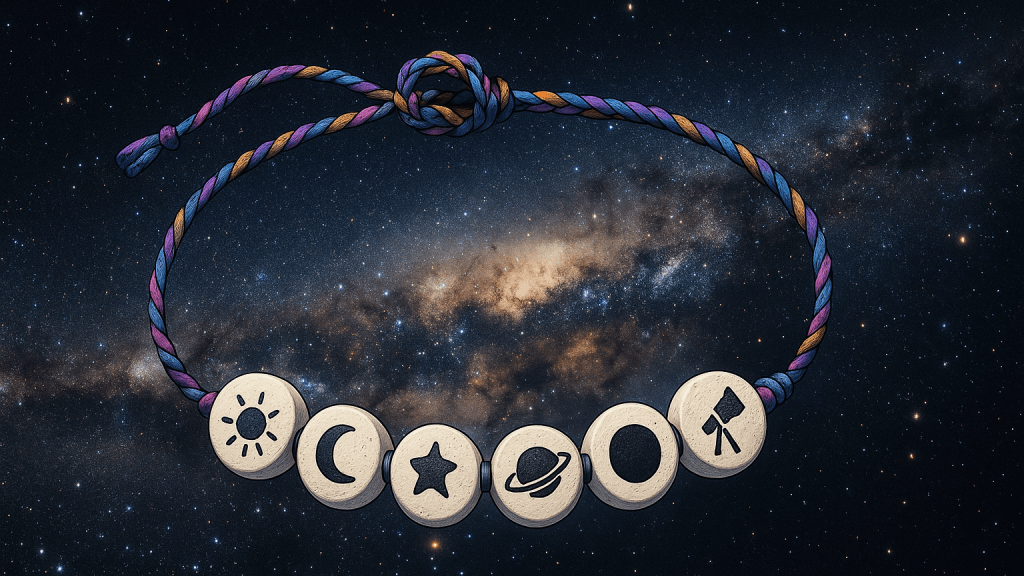
Incidentally, these explosions forged all the gold in the cosmos. So every Swiftie friendship bracelet with a gold charm? That’s brought to you by Red-era explosive drama.
Era V – The Structured, Shimmering Chaos
Welcome to the pop era. Taylor’s 1989 was polished, confident, crystalline — and so was the universe.
Galaxies shook themselves off into grand spirals. Planetary systems formed with elegant geometry. The messy adolescence of cosmic creation gave way to sleek order — the “Style” of the stars.
Welcome to the Virgo Supercluster.
By now, the universe is several billion years old, and the Milky Way is a pop hit spinning reliably in 4/4 time.
Era VI – Black Holes Emerge
Then came darkness — literally. In the Reputation album, Taylor embraced her shadows, and so did the cosmos. Supermassive black holes dominated galaxy centers, shaping everything around them. Accretion disks hotter than Taylor’s tabloid drama.
“Look What You Made Me Do” could easily be the motto of any galaxy orbiting a black hole. Every time-space distortion is an act of control disguised as destruction.
This is when feedback from active galactic nuclei defined star formation. Chaos with boundaries. Destruction as design. Quasars shooting jets light years long, wreaking havoc. This is why we can’t have nice things.
Era VII – The Calm After the Chaos
After the darkness comes the pastel. Taylor’s Lover album is the phase of cosmic domesticity — stars in stable orbits, planets cozying up around them, life beginning to bloom. Soft nebula pinks. Warm spiral arms. Star formation leaning into slow-burn romance.
The chemistry of love becomes literal: carbon chains, amino acids, and complex molecules start forming in interstellar clouds. The universe writes its first real love songs, in molecular spectra lines instead of chords. Even dark matter was like “can I go where you go?” This was cosmology’s homecoming dance.
Era VIII – The Reflective Universe
Every artist eventually turns inward. The universe, now middle-aged, slows down. Star formation declines. Things get quieter, moodier, more acoustic. Dwarf galaxies fade. Stars age into red giants and white dwarfs.
Folklore and Evermore are Taylor’s indie albums — less spectacle, more memory. Nebulae drift like melancholic chords; ancient stars fade into embers. Gravity hums like Bon Iver in a flannel shirt.
It’s the cardigan-wearing phase of cosmic existence — reflective, nostalgic, a little haunted by what’s gone but grateful for what remains.
This is the modern era of our universe, galaxies drifting apart, expansion accelerating, but new beauty still emerging from decay. Light from distant galaxies now takes billions of years to reach us.
This represents the latter moments of the Stelliferous Age, the long, glorious middle chapter of the universe’s life, the epoch when stars dominated everything. It’s the era where we, as humans, arrive in the universe. This era will last for trillions of years – far longer than the universe has existed up to now – which is around 13.8 billion years.
To recap, up to this point in the evolution of the cosmos galaxies have formed and evolved. Stars are born, burn and even fade out. Planets form, heavy elements accumulate, and life, at least once, emerges.
Stars, or stella, are still the main actors. Their fusion furnaces shaped the chemistry of the universe. They lit up galaxies. They made the heavy elements that become planets, oceans, DNA, and microphones used to record podcasts.
Era IX – The Dark Energy Era
Then comes introspection — the late-night confessional. The Midnights album represents cosmic self-awareness: the universe realizing it’s expanding faster than it ever planned to.
Dark energy drives galaxies apart, while astrophysicists stare into the void and hear a whisper saying, “It’s me, hi, I’m the problem, it’s entropy.”
The song “You’re On Your Own, Kid” fits perfectly here — galaxies receding, each glowing alone in the vast dark, still bejeweled but increasingly isolated.
The expansion is accelerating, and the ultimate fate of everything is uncertainty. Some galaxies are receding from us even faster than the speed of light, not because they’re moving fast, but because space itself is expanding. This acceleration is already happening, and it will shape the universe’s long-term fate.
Dark energy is the universe’s deeply unhinged era — the one where it makes reckless choices and refuses to explain itself. It’s basically the “Anti-Hero” in force-of-nature form.
Era X – The Quantum Age and the Uncertain Future
This is where it gets weird — both lyrically and physically. In The Tortured Poets Department, Taylor turned existential, layering self-reference and metaphor. The universe, meanwhile, retreats into quantum subtlety.
Particles exist in superposition — both here and not here, like Schrödinger’s breakup text. The quantum world is messy, poetic, and brutally honest. The song “Fortnight” fits: two moments overlapping in time, both true, neither comfortable.
Quantum fields rule the microcosm, dictating how the macrocosm behaves. It’s the tortured poetry of physics itself.
And finally… the curtain call.
Taylor’s latest era celebrates performance, spectacle, and survival — the endless concert. This is the Life of a Showgirl era. The universe, too, will have its final bow trillions of years from now.
As the last stars fade, white dwarfs glow briefly, black holes evaporate, and the cosmos performs one last, glittering encore. It’s elegant, tragic, and strangely glamorous — “The Alchemy” of energy turning into emptiness.
This is the far-future heat death, when entropy finally wins and the lights go out. The last black hole evaporates in a spark of Hawking radiation, a final glittering bow. The universe does, indeed, do it with a broken heart.
[MUSIC]
Thanks for joining me for the most chaotic astronomy crossover episode imaginable. If we zoom out far enough, Taylor Swift and the cosmos tell the same story: creation, chaos, reinvention, reflection. Both live through eras. Both leave Easter eggs for future observers. And both prove that change — no matter how dramatic — is how art and energy survive.
While the metaphors might be silly, keep in mind, every atom in you once glowed in a Red-era supernova. Every breath you take is borrowed from Lover-era chemistry. We’re all tracks on the universe’s album.
As you look up at the night sky this week, remember: you’re seeing the ultimate Greatest Hits album, the universe, spanning billions of years, still glowing from its earlier tracks.
After a quick break, we’ll listen, or rather, look at the night sky and see what it holds for us in the coming week. Stay with us.
[MUSIC]
Welcome back.
Before we get into this week’s night sky, I wanted to mention something intriguing I stumbled upon the other day – the Hubble composite of the Andromeda Galaxy, which was released earlier this year.
Normally when we talk about deep sky objects, we often think of “faint fuzzy galaxies” where the stars blur into a mist of light. Hubble’s new M31 mosaic consists of 600 individual frames, stitched together to create an image containing billions of pixels. But it’s not the size and beauty of the image that makes it remarkable. It’s what you see when you zoom in.
For the first time, in a galaxy outside our own, you can see individual stars. Not clusters. Not smears of blended starlight. Actual, solitary stars — hundreds of millions of them — each a tiny point of light shining across 2.5 million light-years of space.
And here’s what always blows my mind. Each one of those points could be a sun. Each one might have its own solar system, its own planets, its own little worlds orbiting in silence. We’re looking at a neighboring galaxy and seeing the stellar equivalent of faraway city lights.
Andromeda, this fuzzy smudge we see with the naked eye — is suddenly revealed to be a sprawling metropolis of stars. Billions of them. Each one potentially with its own story, its own family of worlds, its own physics, chemistry, atmospheres — its own eras.
And here’s where the scale really hits: Andromeda is just one galaxy. The observable universe might contain two trillion galaxies, maybe more — each one with hundreds of billions of stars.
Hubble’s zoom into Andromeda gives us a way to emotionally grasp that scale.
Check it out for yourself. I’ll leave a link to the zoomable mosaic in the show notes.
[TRANSITION FX]
We’re coming off a New Moon back on November 20th, which means the first half of this week features a thin, delicate waxing crescent, the kind of Moon that looks like it’s been painted on with a single brush stroke.
From Sunday through Thursday, that crescent will hang low in the southwestern sky after sunset, slowly growing each night. This is a good time to spot Earthshine, that soft glow lighting up the dark side of the Moon’s disk.
By Friday, we reach First Quarter. That classic half-moon will be high in the south during the evening. telescope.
On Saturday, the Moon tips just past half into a waxing gibbous, bright enough to start washing out fainter galaxies, but still excellent for lunar detail.
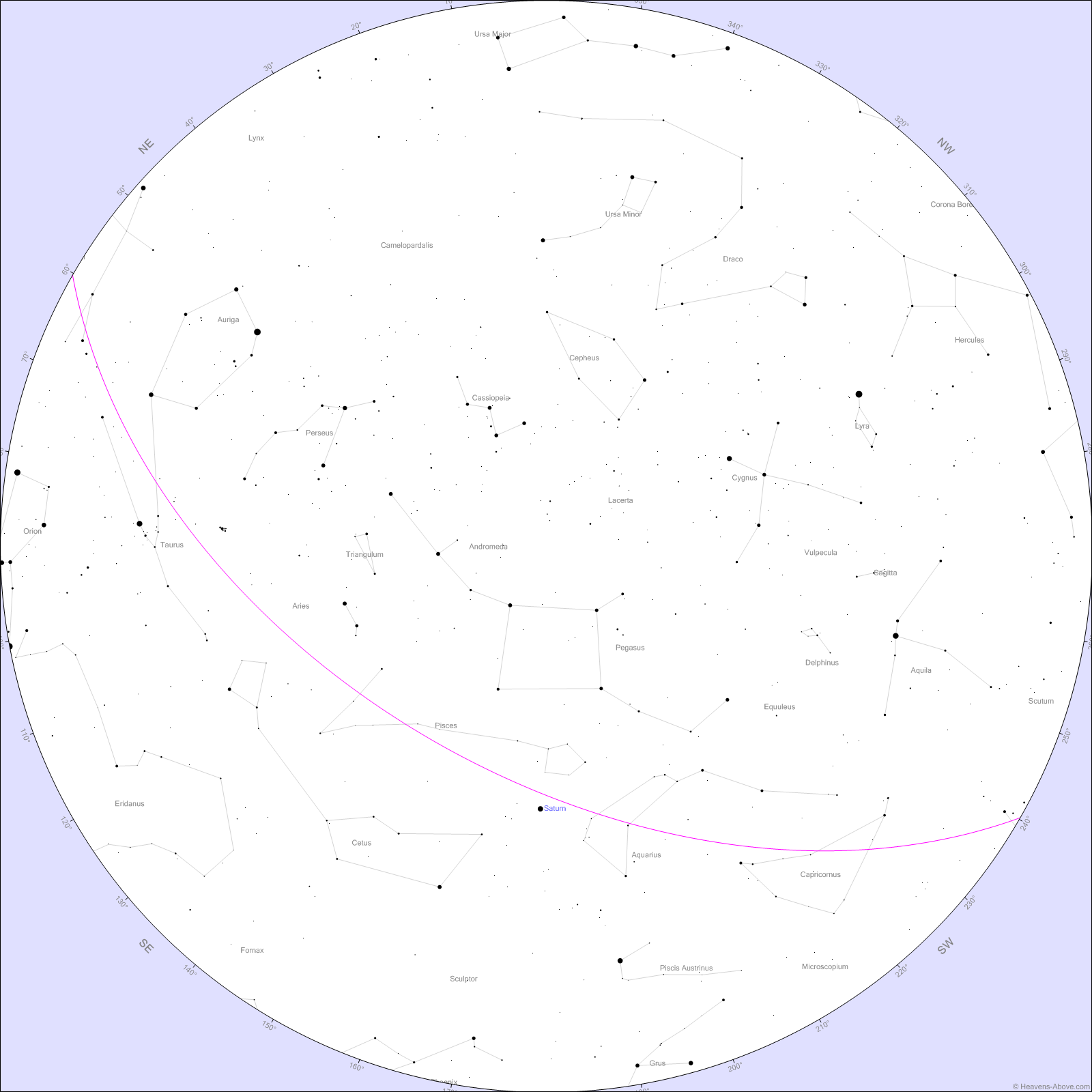
Let’s take a tour of the planetary lineup. Right after dusk, look toward the southeast for a soft golden “star.” That’s Saturn, still lingering in our evening skies. It’s higher by mid-evening and sits beautifully in small telescopes, though the rings are tilted so narrowly this year they look like a razor-thin line slicing across the planet.
A little later, bright Jupiter climbs up in the east-northeast, shining near the twin stars Castor and Pollux in Gemini. Through binoculars, check out its four Galilean moons. They shift positions from night to night, a dance we get to watch in real time.
For telescope owners, Uranus is the subtle show-stealer of the week. It just passed opposition a few days ago, which means it’s visible all night and as bright as it gets, which is to say, not very bright – around magnitude 5.5. You’ll find it in Taurus, not far from the Pleiades and the V-shaped Hyades star cluster. Through binoculars, it shows up as a tiny, cold blue dot.
Fainter still is Neptune, which you’ll need binoculars or a telescope to see. It’s higher up later in the evening, near the border of Aquarius and Pisces, appearing as a tiny bluish star.
In the pre-dawn hours, Venus is fading very low toward the southeast—much harder to spot now. Mercury and Mars are technically in the morning sky too, but buried in dawn twilight. We’ll catch them in better visibility another week.
The Leonid meteor shower peaked last week, but it remains active into early December.
You may catch a few stray Leonids in the pre-dawn hours. These are fast, bright streaks radiating from the constellation Leo.
This week is that transition when the autumn constellations are still high overhead, while the winter giants are just beginning to rise.
To the north and overhead you’ll see the great Square of Pegasus and the chain of Andromeda. This is a perfect time to hunt down the Andromeda Galaxy, M31. It’s a faint, elongated glow in binoculars.
Nearby, the “W” of Cassiopeia is high and bright. From there, you can hop down to the Double Cluster in Perseus, a fan favorite for binocular stargazers.
In the east, the constellation Taurus is rising, with the bright orange star Aldebaran, the Hyades, and the glittering Pleiades. And late in the evening, the unmistakable shape of Orion crawls over the horizon, announcing the return of winter. Take a moment to explore the Orion Nebula, M42, a glowing cradle of star formation hanging below Orion’s Belt.
If you only get one clear night this week, here’s a simple observation plan: In the early evening catch the thin crescent Moon in the southwest. Then swing over to Saturn as twilight deepens.
By mid-evening watch Jupiter rise in the east. Then tour Taurus—visit the Pleiades, trace the Hyades, and see if you can spot Uranus with binoculars. As we enter the late evening look for Orion and wrap up your night with a look at the Orion Nebula.
[MUSIC]
That’s going to do it for this week. I’ll return with some hardcore science in the next episode, which will close our season.. I’m going to take December off like I did last year – although if any good space news comes up, I’ll let you know with a special episode.
As always, if you’re a fan of Star Trails, please share it with a friend who might enjoy it. The easiest way to do that is by sending folks to our website, startrails.show. And if you want to support the show, use the link on the site to buy me a coffee. It really helps!
Be sure to follow Star Trails on Bluesky and YouTube — links are in the show notes. Until we meet again beneath the stars… clear skies, everyone.
Support the Show
Connect with us on Bluesky @startrails.bsky.social
If you’re enjoying the show, consider sharing it with a friend! Want to help? Buy us a coffee!
Podcasting is better with RSS.com! If you’re planning to start your own podcast, use our RSS.com affiliate link for a discount, and to help support Star Trails.
 Star Trails: A Weekly Astronomy Podcast
Leave a comment