
How to Build a Time Machine – Star Trails: A Weekly Astronomy Podcast
Episode 90
For the season finale of Star Trails, we’re building a “time machine” the only way we know how: with physics, not plot holes. Drew takes a tour through the time-travel stories that shaped his 80s childhood—Back to the Future, Star Trek IV, The Time Machine, Bill & Ted, and even Disney’s wonderfully unhinged The Black Hole—and then sets them beside the actual rules of our universe. We’ll look at the real ways you can travel into the future using speed and gravity.
Along the way we’ll ride with nuclear-pulse starships, bust the myth of the Bussard ramjet, and imagine skimming just outside the maw of Sagittarius A*, the supermassive black hole at the center of the Milky Way. We’ll talk about why time only runs forward, what it really means to “move through spacetime,” why black holes make clocks crawl, and how modern quantum ideas try, and mostly fail, to sneak backward time travel in through the side door without breaking causality.
In the second half of the episode, we park the starship and focus on the actual sky. December is one of the richest observing months of the year, so while the podcast takes a short holiday break, you’ll have a clear roadmap: the final Cold Supermoon of the year, the Geminid and Ursid meteor showers, Mercury’s dawn cameo, Jupiter and Saturn in the evening, and the full cast of winter constellations. We’ll lay out a simple three-session observing plan to carry you through the month: supermoon and giants, Geminid weekend, and a quiet solstice night under the Ursids.
It’s an episode about time travel that ends with the most accessible time machine we have: walking outside, looking up, and catching ancient photons from the deep past on a cold December night.
Transcript
[MUSIC]
Howdy stargazers and welcome to the season finale of Star Trails. My name is Drew, and I’ll be your guide to the night sky for the week of November 30th to December 6.
This week we’re building a time machine – or at least looking at the science that it might take to create one. Along the way, we’ll look at some famous time machines in pop culture, plow through Einstein’s two theories of Relativity – which provide us with the equations to calculate our time travel efforts, and we’ll verge into some wild theoretical territory that reads more like science fiction than fact.
The winter’s night sky is nearly upon us, and in the second half of the show, I’ll preview what you can expect to see in the night sky for the next month or so while we’re on a holiday break.
Whether you’re tuning in from the backyard, the balcony, I’m glad you’re here, so grab a comfortable spot, and let’s see what the universe holds for us this week
[INTRO MUSIC FADES OUT]
As a kid growing up in the 80s, it’s safe to say time travel movies were some of my favorites. There was Back to the Future, which taught us about the dangers of creating a paradox by going back in time. There was Star Trek IV: The Voyage Home, which taught us we could go back in time by slingshotting around the Sun in a Klingon battle cruiser, oh, and that humpback whales are apparently an intelligent alien species – who knew!
In middle school we read the original: The Time Machine, by H.G. Wells, and I became a fan of the 1960 film of the same name, where Rod Taylor manages to go forward in time some 800,000 years in a brassed-out steampunk sled, fall in love with an Eloi girl and presumably bring her back home to civilized Victorian Era London. Talk about a goal to aspire to.
And later, as a teen, Bill and Ted’s Excellent Adventure, a gonzo trip through time with two California goofs who gain access to a time machine to help them write a history term paper of all things.
I’ll also mention Disney’s Star Wars knock-off The Black Hole – not because there was time travel, but because of its wilful ignorance of General Relativity. More on that in a moment.
The 1980s, especially as a child, felt like an era where anything was possible if you threw enough science at it, especially with the rise of computers, and advancements in space travel, like the Space Shuttle. Magazines of that era were wild. As a kid I read OMNI, Discover, Astronomy, Popular Science and more.
And one day, after reading an article about the possibility of time travel, I decided to grab a pack of graph paper and start designing my own interstellar ship – one that used theoretical propulsion, that could either take us to speeds nearing that of light itself, or at least provide us with the means to reach the event horizon of a black hole.
I was so naive. But I had the science to back it up. Reading those articles in OMNI and Discover taught me a few important things: One, you can’t go back in time, only forward. Two, if you could travel near the speed of light, you can travel forward in time. Three, if you could orbit a black hole, you could go even further forward in time. Sounds easy right?
These time travel parameters were already old news even in the 1980s. See, Albert Einstein figured this stuff out back in the 1930s. He was Doc Brown, way before Michael J. Fox jumped into a DeLorean and fired up the flux capacitor.
So in this episode, we’ll examine the two sure-fire ways to dilate time, based on Einstein’s Special Theory of Relativity, and his General Theory of Relativity. The former deals with high speeds; the latter deals with regions of massive gravity. We know these principles are accurate, because we use technology linked to it every day.
Those GPS satellites that float overhead that we use for navigation? They are time travelers in a sense. They orbit fast, and high above our planet, so much that if we don’t factor in their time offsets using super-accurate atomic clocks, we’d be sent off-course down here on Earth.
So if the science actually works, what would it realistically take to make a time machine? One we can ride around in and fly forward ages into the future? Let’s find out.
Before we get any ideas of going back in time to play with dinosaurs, assassinate Hitler, or play Johnny B. Goode at a prom to make our parents fall in love, we need to know that time is a one-way street. We’re not going back in time, sadly.
Time only moves forward. This isn’t philosophy, it’s just physics.
The arrow of time points toward increasing entropy, toward disorder, toward future moments that haven’t happened yet.
You age forward. Your memories accumulate forward. The universe expands forward.
Einstein’s equations might be symmetrical, but everything we observe in nature has a preferred direction. Backwards simply doesn’t work. Yes, there are some theories where time may go backwards, but as you’ll find out later, all these theories generally have a giant loophole that breaks them.
The big takeaway is simply this: The rate at which time flows is flexible. You can stretch it. You can compress it. And if you’re clever, you can make your journey into the future faster.
That’s where relativity comes in.
Special relativity tells us that the faster you move, the slower your clock ticks relative to someone staying still. Go fast enough, really fast, and your timeline becomes syrupy.
A five-year journey for you might be decades for the people left on Earth. The problem is, the speeds required are insane.
The Parker Solar Probe, the fastest object humans have ever built, falls toward the Sun at about 0.058% the speed of light. That’s blistering for us… and virtually meaningless for spacetime.
After years of flying, the Parker probe has accumulated about as much time dilation as you’d get from a long nap.
To get dramatic effects, the kind movies show, you need to be going a significant fraction of light speed: 50 to 99% of the speed of light.
Right now, we don’t have any technology that could even begin to approach those numbers.
Traditional rockets? Forget it. One proposed method that’s been theorized since the 1960s involves detonating a series of nuclear bombs off behind your ship, and riding the shockwave. That was Project Orion, and I mention it because it could get us in the theoretical range of 5% the speed of light.
This project was a real, government-funded proposal decades ago, with the idea being we could travel to Mars in weeks, and stars in decades.
This was published everywhere in science magazines during the early space age, and it echoed through sci-fi art and articles for years after. OMNI especially adored Project Orion because it embodied that mid-century utopian futurism: “What if we used nuclear bombs to explore the stars?”
Even physicists like Freeman Dyson worked on it seriously.
Strangely, this is the propulsion method used by my middle-school graph-paper time machine. Evidently, I read about Project Orion somewhere.
I also augmented my design with something called a “Bussard Ramjet.” This was another theoretical propulsion scheme that involved a giant “scoop” at the front of a starship to collect wandering hydrogen, convert it to energy via fusion, and propel the ship forward using the nuclear exhaust to shove forward.
Sound great right? Infinite fuel for a long journey. Heck, even Star Trek borrowed this idea once.
The problem is, interstellar space contains hydrogen, but barely. The typical density is ~0.1 atoms per cubic centimeter. So if we do some math, we learn that the Bussard scoop would need to be tens of thousands of kilometers wide, maybe millions, for the concept to work. It’s not practical at any scale.
And another problem arises. Eventually this massive scoop would encounter a certain amount of drag as it rams into these hydrogen atoms, becoming more like a parachute than a stellar supercharger.
So assuming we managed to get our Project Orion engine fired up and we could achieve 5% of the speed of light, what does that get us? Let’s set our sails for Proxima Centauri, the closest star to us outside of our own solar system. Because if we’re pushing towards the speed of light, we might as well go somewhere interesting.
Proxima Centauri is 4.24 light years away. Cruising at 5% the speed of light it would take nearly 85 years to get there. One way.
Now, using the Lorentz Factor, we can calculate the time dilation. The equation tells us if it takes us 84.8 years to get there, and we’d only experience about 39 less days than clocks back on Earth.
So at 5% of light speed, you’re doing something insanely fast by human standards, and relativity basically says, “Cool story, here’s a one-month bonus.” Time is stubborn until you get really close to the speed of light.
That’s some sad astrophysics.
To make this fun, let’s assume we can move at 99% the speed of light (because we can never achieve the speed of light itself). The journey to Proxima would still take 4.28 years, but things get more intriguing when we plug that into the Lorentz equation: At this rate we’re about 4.5 years younger than people back home, and because our local time is slowing down, our one-way journey feels more like 7 months
If you could achieve 99.999% the effect would be even wilder. At that speed Earth would see the trip take just over four years. From our perspective on the ship, it would take about a week. So a week for us, four years for everyone back home. Do a round trip, and Earth ages eight and a half years while we age about two weeks.
At that point you’re not just traveling through space, you’re surfing along the edge of time itself.
So speed is one way to bend time, but it’s not the easiest way.
Gravity does something extraordinary: it slows time. The deeper you fall into a gravitational well, the slower your clock runs compared to someone far away.
This means that technically your head ages faster than your feet. Really. Sadly, nothing in our solar system is massive enough to give you sci-fi levels of time dilation.
Orbit the Sun closely for a year? You might gain a couple seconds compared to interstellar space. And you’d probably fry.
Orbit Jupiter? You might gain a few microseconds.
Real gravitational time machines need something stronger – preferably a black hole or neutron star, where we can achieve substantial dilation – minutes or hours in a day.
But let’s get crazy. Let’s journey to the center of the Milky Way to the supermassive black hole at the center of our galaxy: Sagittarius A. Here, we can seriously mess with time.
Sagittarius A is four million times the mass of the Sun. It curves spacetime so violently that time practically sticks to it like glue.
If we park our spacecraft in a safe orbit just outside the innermost stable circular orbit—a place where the tidal forces won’t tear us apart—our personal clocks would slow dramatically compared to clocks back on Earth. We calculate it using the Schwarzschild time dilation equation.
Depending on the specific orbit, one hour for me might equal days, weeks, even years back home.
If you’ve seen the movie Interstellar, you’ve seen this type of dilation accurately depicted, when the crew momentarily landed on Miller’s Planet, then returned to their ship to find years had elapsed for the scientist who remained behind.
Of course, there’s one tiny detail. Sagittarius A is twenty-six thousand light-years away. Getting to the thing that lets you time-travel efficiently requires a level of time travel we don’t have.
Remember when I mentioned Disney’s Black Hole movie earlier? Well, what bugs me about that film is that they are orbiting right at the edge of a black hole, seemingly ignorant to its effects on time. Remember, Einstein worked this out nearly 50 years earlier.
Not sure it matters because they all fall into the black hole at the end of the film and the bad guys emerge in some existential version of hell and the protagonists pop out near a nice-looking planet, presumably to repopulate Eden or… something.
So, why does this happen? Why does moving fast or floating in a gravity well affect time?
To the universe, time isn’t an independent thing. Time is woven into space. It’s literally part of the geometry. When you move, or when gravity bends spacetime, you’re changing that geometry. Your path through spacetime gets stretched or squeezed, and your clock ticks along that path.
When you approach the speed of light, you’re using more of your motion budget to move through space and less to move through time. Relativity says there’s a fixed “speed” you move through spacetime — always the speed of light, but divided between space and time.
If you move faster through space, you must move slower through time.
So your personal time, that is the time your body experiences, slows down. But you don’t feel it. To you, everything feels normal. Your heart beats normally. Your brain fires normally. It’s only when you compare with someone who stayed behind that you see the difference.
Gravity slows time because it bends space-time. Remember General Relativity redefined how science sees gravity. It isn’t just a force pulling downward. It’s a curvature of space-time itself.
The closer you are to a massive object: the more spacetime is bent, and the “deeper” you sit in that curvature the slower time passes for you.
That’s why clocks tick slower at sea level than on mountaintops.
It’s why GPS satellites tick faster than your phone. And near a black hole space-time is curved so violently that time practically congeals. Even light struggles to escape.
Again, to you, everything feels normal. All the slowing happens relative to someone outside the gravitational well.
We understand the “how.” The equations match experiments perfectly, GPS, particle accelerators, atomic clocks flown on planes, nuclear clocks on mountaintops and so on.
But the deeper why is more philosophical. The best answer physics gives us is: Because space-time has geometry, and time is one of its dimensions.
Einstein didn’t “explain” time dilation as much as he showed that it is a natural consequence of living in a four-dimensional universe where the speed of light is constant, and mass bends spacetime.
Once you accept those two facts, everything else follows: time slows near gravity, time slows at high speeds. It’s all geometry.
We don’t know why the universe has this geometry instead of some other one. But we know that once you plug the geometry in, everything behaves exactly as expected.
So what use is a time machine, if we can’t go back in time? There are theories that enable this, but so far quantum physics has sort of put its foot down.
In the last 15–20 years, physicists and quantum information theorists have been exploring what happens if you allow quantum bits to interact with versions of themselves from the future along a “closed timelike curve.”
This isn’t a proposed machine, more of a thought experiment to test the boundaries of causality. The punchline is always the same:
The quantum math protects itself from paradox. If you try to send contradictory information into your own past, the equations “smooth it out” so no paradox forms. It’s like the universe is auto-correcting itself.
Even at the smallest scales, the quantum world, the universe seems allergic to backward time travel.
One modern idea, the Novikov Self-Consistency Principle, says that even if you could go backward in time, the universe wouldn’t let you create a paradox. Every choice you try to make in the past loops around to become exactly the thing that made time travel possible in the first place.
It’s cosmic predestination: the past is locked, the future is open, and time refuses to contradict itself.
Another modern quantum theory leaves a tiny conceptual crack open: you might not be able to visit your own past, but you could, in theory, visit the past of a different branch of the universe, one where your arrival doesn’t break causality. It’s not time travel in the traditional sense; it’s more like switching tracks on a cosmic railroad made of probability.
So far, this idea has been untestable – I can’t imagine why!
For those of us stuck down here on Earth, the best time travel we can do is simply observe the universe. I feel like I’ve been saying this a lot lately, but every time we look up, we’re looking back into the past, sometimes the recent past, like the light leaving Jupiter is forty minutes old. Light from our Sun is 8 minutes old. Sometimes we look at the deep past, like the ancient glow of galaxies whose first stars fired long before Earth even formed. The night sky is a map of moments that have already happened, still streaming toward us across the vastness.
We may never build a starship that reaches ninety-nine point nine nine nine percent of the speed of light. We may never orbit a supermassive black hole and return home decades “ahead” of the people we left behind.
And we certainly won’t be sitting on Victorian chairs with bejeweled levers, racing off to fight the Morlocks, ducking into a police callbox, or driving a DeLorean like we stole it to re-write history.
It’s not about a machine, so much as a perspective. Relativity teaches us that time isn’t a singular river, but more like thousands of branching streams, and when speed or gravity gets involved, those streams can meander. Ultimately they still all run forward.
So if you really want to experience time travel, go outside tonight.
Look up. Find a star. The moment you’re seeing left that star years ago, sometimes centuries, sometimes millions or billions of years ago. You’re reaching backward with nothing but your eyes and the physics of the cosmos. Those are ancient photons from the past hitting our retinas in the present.
[MUSIC]
In the second part of this episode, we’ll explore what’s going on overhead for the month of December. That’s coming up after the break. Stay with us.
[MUSIC UP AND OUT]
[AD BREAK]
[MUSIC RETURNS]
Welcome back!
Star Trails is taking a breather in December, but that doesn’t mean the sky is taking a month off. Far from it. December is one of the richest observing months of the entire year.
So here’s your December sky strategy. Think of it as a guidebook for the whole month—three simple beats to follow: bright-moon season, meteor season, and deep-winter season.
December starts with a burst of brightness.
We get a full supermoon on December 4th—the final supermoon of the year—traditionally called the Cold Moon. It’ll look big and bold, climbing the eastern sky just after sunset.
A week later, on December 11th, the Moon hits third quarter, and lights up the sky.
Stick with it, because the sky gets wonderfully dark by December 19th, when we hit the new Moon. That new-Moon window will be your best opportunity for deep-sky observing.
And then, the month closes out with a first-quarter Moon on December 27th—a bright half-moon riding high in the afternoon and evening sky.
In the middle of all this:
The winter solstice occurs on December 21st, bringing the longest night of the year. Those nights around the solstice are as long and as dark as it gets.
December also gives you two meteor showers. One is spectacular. The other is subtle but atmospheric.
First: The Geminids. They’re active from December fourth through the twentieth, and they peak on the night of December 13th into the early morning of the fourteenth. The Moon will be just a thin waning crescent, rising late, so the sky will be beautifully dark. Under good conditions, the Geminids can deliver more than a hundred meteors per hour.
If you’re going to commit to one night this month, make it Geminid night.
Face east, get comfortable, and start watching around ten p.m.
Second: The Ursids. These are active from December 13th through the 26th and peak on December 21st and 22nd, right on the solstice.
The Ursids are gentle, maybe five to ten meteors an hour. Look north, toward the Little Dipper. Let the longest night of the year do the rest.
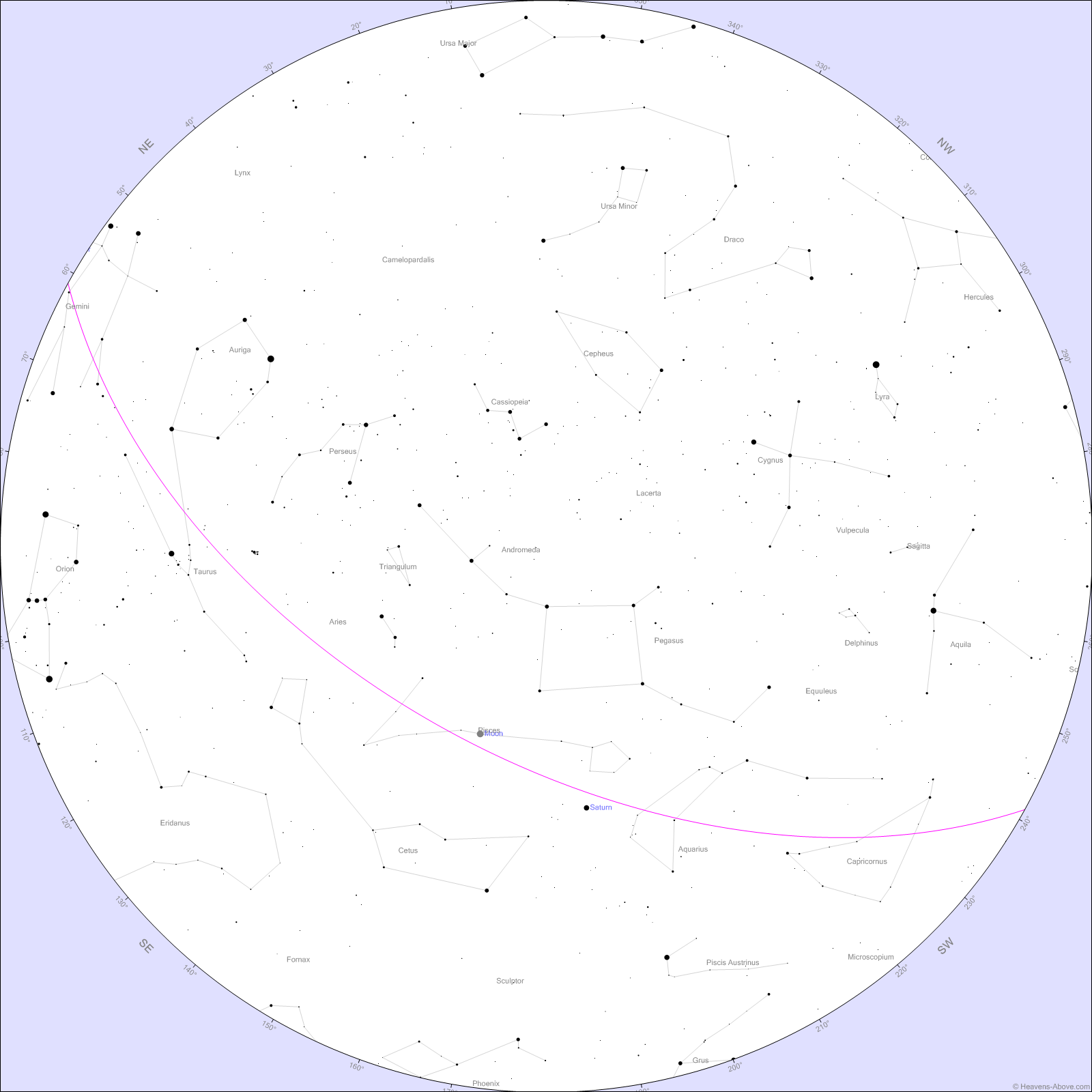
December’s planetary lineup is straightforward.
Mercury is the prize for early birds. It has one of its best morning showings of the entire year. Look low in the southeast about forty-five minutes before sunrise from December first through the twenty-third, with greatest visibility around December seventh.
Jupiter is the showstopper of the month. Bright, obvious, and unmistakable in Gemini in the early evening. If you have a telescope, Jupiter is your December anchor: belts, zones, storms, and the dance of its four big moons every single night.
Saturn hangs in the southwestern sky during the early evening hours.
It’s fading, sinking earlier each night, but still makes a wonderful warm-up target in Aquarius before you turn your attention to the winter constellations.
Venus and Mars are both tucked too close to the Sun this month.
If you’re hunting planets, your trio is Mercury at dawn, Saturn at dusk, and Jupiter all night.
Now for the real magic: the winter sky itself.
By nine or ten p.m., the whole eastern sky is glowing with the constellations that define the season. There’s Orion, rising with his belt leading downward toward Sirius in Canis Major—the brightest star in the night sky.
Above Orion is Auriga with brilliant Capella. To the left are Castor and Pollux in Gemini. And overhead, drifting westward, the Pleiades sparkle like a tiny jewel box.
If you want to keep things simple during December, here’s an easy plan.
Session One: Early December, around the full supermoon. Watch the Cold Moon rise. Use its glow to trace the winter constellations. Let Jupiter and Saturn orient you in the evening sky.
Session Two: The Geminid Weekend, December 13th and 14th.
Block out one night. Go somewhere dark if you can. Bundle up, lean back, and let the meteors pour out of Gemini.
Session Three: Solstice Night, December 21st and 22nd.
Take advantage of the new-Moon darkness. Check out the Orion Nebula, the Pleiades, the clusters in Auriga, and then, after midnight, turn north for the soft drizzle of the Ursids on the longest night of the year.
If you manage even one of these sessions, you’ll have a memorable December. We’ll see you again in January. I hope you all have a great holiday, and maybe some of you will unwrap a new pair of binoculars or smart scope. If you do, let me know!
[MUSIC]
If you found this episode interesting, please share it with a friend who might enjoy it. The easiest way to do that is by sending folks to our website, startrails.show. And if you want to support the show, use the link on the site to buy me a coffee. It really helps!
Be sure to follow Star Trails on Bluesky and YouTube — links are in the show notes. Until we meet again beneath the stars … be excellent to each other, and party on dudes!
[MUSIC FADES OUT]
Support the Show
Connect with us on Bluesky @startrails.bsky.social
If you’re enjoying the show, consider sharing it with a friend! Want to help? Buy us a coffee!
Podcasting is better with RSS.com! If you’re planning to start your own podcast, use our RSS.com affiliate link for a discount, and to help support Star Trails.
 Star Trails: A Weekly Astronomy Podcast
Leave a comment